University of Western Ontario
April 8th
, 2013 Lindsay Hillier
Manager, Training and
Quality Assurance, BLVEIP
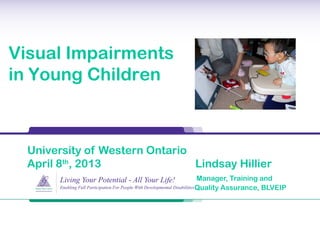
Visual Impairments
in Young Children
Agenda
• Overview of the Ontario Blind – Low Vision Early
Intervention Program
• Overview of common childhood visual impairments
• Impact of visual impairments on
service providers’ programming/goals
• Suggestions for modifying
audiologists’ test procedures for
children with visual issues
Ontario Blind – Low Vision
Early Intervention Program
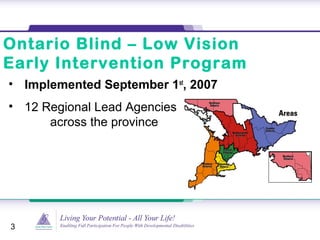
• Implemented September 1st
, 2007
• 12 Regional Lead Agencies
across the province
3
4
Program Goal
To promote an integrated system
of services and supports across
the province for families with
children who are blind or have low
vision, promoting:
early identification
intervention
support
Ontario BLVEIP Population
5
*Family Centered Service
Components of the Ontario BLVEIP
6
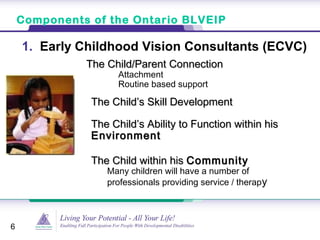
1. Early Childhood Vision Consultants (ECVC)
The Child/Parent ConnectionThe Child/Parent Connection
Attachment
Routine based support
The Child’s Skill DevelopmentThe Child’s Skill Development
The Child’s Ability to Function within hisThe Child’s Ability to Function within his
EnvironmentEnvironment
The Child within hisThe Child within his CommunityCommunity
Many children will have a number of
professionals providing service / therapy
Components of the Ontario BLVEIP
7
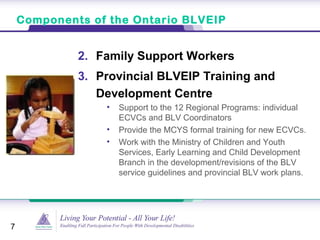
2. Family Support Workers
3. Provincial BLVEIP Training and
Development Centre
• Support to the 12 Regional Programs: individual
ECVCs and BLV Coordinators
• Provide the MCYS formal training for new ECVCs.
• Work with the Ministry of Children and Youth
Services, Early Learning and Child Development
Branch in the development/revisions of the BLV
service guidelines and provincial BLV work plans.
Areas Currently Served by Surrey Place Centre’s
Blind – Low Vision Early Intervention Program
Early Childhood
Vision Consultants:
•Toronto
•Durham
•York
•Peel
•Halton
8
Prevalence of Visual Impairments
• Approximately one child in a thousand
• Approximately 1% of all children with disabilities
• Approximately 50-70% of children with visual
impairments have additional disabilities
Defining Visual Impairment
Visual Impairment is defined as an impairment in
vision that, even with correction, adversely affects a
child’s interaction with his environment and may affect
the ability to access early learning opportunities and
educational material.
The term includes both low vision and blindness. Visual
impairment refers to the abnormality of the eyes, the
optic nerve or the visual center for the brain resulting in
decreased visual acuity and/or visual perceptual abilities.
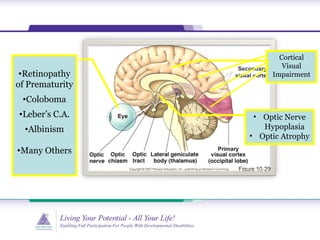
•Retinopathy
of Prematurity
•Coloboma
•Leber’s C.A.
•Albinism
•Many Others
Cortical
Visual
Impairment
• Optic Nerve
Hypoplasia
• Optic Atrophy
Visual Impairments Will Affect Vision
Differently
?????
‘Seeing’ Requires Visual Input and
Memory
VisualVisual
InputInput
MemoryMemory
“Seeing”
Sensory experience from the external world
can influence how the brain wires itself
up after birth.
Visual experience is crucial for a child's
vision to develop normally -- a "use it or
lose it" situation.
Society for Neuroscience, 2007
15
Babies Count
The National Registry for Children
With Visual Impairments,
Birth to 3 years
Deborah Hatton, Ph.D., & Sarah
Ivy, M.Ed.
Vanderbilt University
Burt Boyer, M.A.
American Printing House for the
Blind
September 2012
US National Data
Early Learning Environments,
Materials and Instruction
Cortical Visual Impairment
(CVI) istheleading causeof
bilateral visual impairment in
children in western countries.
Let’s Talk about Our Brain
and Vision!
Fast, Small,
Complexes.
Slow,
Large,
Simplicity
We should think about our vision and
those with CVI in the context of
VISUALVISUAL THRESHOLDSTHRESHOLDS.
Our Brain Operates like a Library
This analogy is more
accurate for children
with CVI as the image
arrives to the brain but
the brain has trouble
deciding what to do with
it
•Categorizing incoming
visual information
•Retrieving stored
visual information
Early Visual System
Object
Recognition
Face Recognition
The inability to visually
recognize familiar faces –
Prosopagnosia
We all went back to ourWe all went back to our
‘library’ to find a book‘library’ to find a book
that we stored. Thethat we stored. The
name we gave these inkname we gave these ink
blots are names ofblots are names of
previously stored visualpreviously stored visual
information.information.
What is the
Foreground and what
is the Background??
The Coffee Beans or
the Face?
Figure-Ground
The “Primitive and often
Unconscious” part of our brain
Registers and
causes a
quick
response to
MOVEMENT
This is often still intact for children with CVI.
Common Characteristics of Children with CVI
Program Implications• Face recognition difficulties
• Object generalization difficulties
• Object invariance difficulties
• Light gazing
• Visually attentive to colour
• Visually attentive to movement
• Latency
• Visual attention differences based on object placement
• –Complexity difficulties
– /Targets Objects
– Sensory Environment
– Array
• .Preference for familiar vs novel
• Visual motor behaviours
Easiest
Easiest
Harder
Harder
Once a child is
demonstrating
visual skills with
lower, easier
stimuli, movemove
down to thedown to the
next level.next level.
Implications for
Assessment
Ask for Help
All children with VI in
the province should
have an EarlyEarly
Childhood VisionChildhood Vision
ConsultantConsultant
Latency
Down &Slow Down Wait
There may be
a delay in
response to
.presented stimuli
No Turning to Auditory Stimuli
You may need
to look for
atypical
responses to
the auditory
stimuli
Example: Some children will consistently roles their eyes in an
upward position when listening
Using vision after hearing
something occurs because
vision is giving more
.information
Many children with visual impairment areMany children with visual impairment are
getting more information from theirgetting more information from their
hearing then their vision therefore will nothearing then their vision therefore will not
.turn to sound.turn to sound
Many of the children
have physical issues
limiting their ability to
.turn their head
The turning of the head is not establishedThe turning of the head is not established
for many of the children -----for many of the children -----
------ too much work for little payout!------ too much work for little payout!
Limit Other Distractions
Children with CVI have
difficulty using more
than one sense at a
.time
Keep Stimuli Close
.Visual items need to be close
Many children with CVI
have difficulty attending to
.objects in the distance
May Need to Repeat
After waiting for a
,response you may need to try
.again
Many children with CVI
have difficulty attending to
.objects in the distance
Ontario Blind – LowOntario Blind – Low
VisionVision
Early InterventionEarly Intervention
ProgramProgram
For specific recommendations and
suggestions, please contact your local
EARLY CHILDHOOD VISIONEARLY CHILDHOOD VISION
CONSULTANTCONSULTANT
Ontario Association of Optometrists’ Initiative
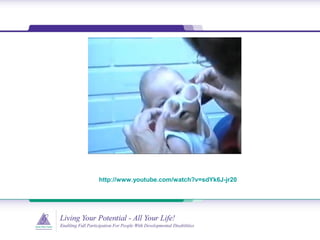
http://www.youtube.com/watch?v=sdYk6J-jr20
Augmentative
Communication
Considerations
Communication Systems
Can the child visually access
the communication system?
–Visual Motor
–Visual perception /
Functionally
–Cognitively
May need to use:
• CONCRETE ITEMS (easiest)
• PHOTOGRAPHS (more difficult)
• LINE DRAWINGS
(may or may not require both a
higher visual and cognitive ability)
Which Symbol is easier for a
child with CVI??
Need to be open to experimenting…..Need to be open to experimenting…..
–– There is no one answer!There is no one answer!
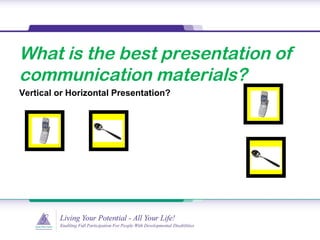
What is the best presentation of
communication materials?
Vertical or Horizontal Presentation?
Auditory Scanning
is often helpful …..
This can allow for single presentationof
communication symbols
Using
combinations of
different symbol
forms may be
.easier
• /Sufficient space between pictures symbols
• /Expect a consistent response with 2 choices
.presentations before increasing
• Using a consistent colour to
’anchor the child s visual focus
• Check for levels of glare
on materials
Other Considerations

Western april 2013

  • 1.
    University of WesternOntario April 8th , 2013 Lindsay Hillier Manager, Training and Quality Assurance, BLVEIP Visual Impairments in Young Children
  • 2.
    Agenda • Overview ofthe Ontario Blind – Low Vision Early Intervention Program • Overview of common childhood visual impairments • Impact of visual impairments on service providers’ programming/goals • Suggestions for modifying audiologists’ test procedures for children with visual issues
  • 3.
    Ontario Blind –Low Vision Early Intervention Program • Implemented September 1st , 2007 • 12 Regional Lead Agencies across the province 3
  • 4.
    4 Program Goal To promotean integrated system of services and supports across the province for families with children who are blind or have low vision, promoting: early identification intervention support
  • 5.
  • 6.
    Components of theOntario BLVEIP 6 1. Early Childhood Vision Consultants (ECVC) The Child/Parent ConnectionThe Child/Parent Connection Attachment Routine based support The Child’s Skill DevelopmentThe Child’s Skill Development The Child’s Ability to Function within hisThe Child’s Ability to Function within his EnvironmentEnvironment The Child within hisThe Child within his CommunityCommunity Many children will have a number of professionals providing service / therapy
  • 7.
    Components of theOntario BLVEIP 7 2. Family Support Workers 3. Provincial BLVEIP Training and Development Centre • Support to the 12 Regional Programs: individual ECVCs and BLV Coordinators • Provide the MCYS formal training for new ECVCs. • Work with the Ministry of Children and Youth Services, Early Learning and Child Development Branch in the development/revisions of the BLV service guidelines and provincial BLV work plans.
  • 8.
    Areas Currently Servedby Surrey Place Centre’s Blind – Low Vision Early Intervention Program Early Childhood Vision Consultants: •Toronto •Durham •York •Peel •Halton 8
  • 9.
    Prevalence of VisualImpairments • Approximately one child in a thousand • Approximately 1% of all children with disabilities • Approximately 50-70% of children with visual impairments have additional disabilities
  • 10.
    Defining Visual Impairment VisualImpairment is defined as an impairment in vision that, even with correction, adversely affects a child’s interaction with his environment and may affect the ability to access early learning opportunities and educational material. The term includes both low vision and blindness. Visual impairment refers to the abnormality of the eyes, the optic nerve or the visual center for the brain resulting in decreased visual acuity and/or visual perceptual abilities.
  • 11.
    •Retinopathy of Prematurity •Coloboma •Leber’s C.A. •Albinism •ManyOthers Cortical Visual Impairment • Optic Nerve Hypoplasia • Optic Atrophy
  • 12.
    Visual Impairments WillAffect Vision Differently ?????
  • 13.
    ‘Seeing’ Requires VisualInput and Memory VisualVisual InputInput MemoryMemory “Seeing”
  • 14.
    Sensory experience fromthe external world can influence how the brain wires itself up after birth. Visual experience is crucial for a child's vision to develop normally -- a "use it or lose it" situation. Society for Neuroscience, 2007
  • 15.
    15 Babies Count The NationalRegistry for Children With Visual Impairments, Birth to 3 years Deborah Hatton, Ph.D., & Sarah Ivy, M.Ed. Vanderbilt University Burt Boyer, M.A. American Printing House for the Blind September 2012 US National Data
  • 17.
  • 18.
    Cortical Visual Impairment (CVI)istheleading causeof bilateral visual impairment in children in western countries.
  • 20.
    Let’s Talk aboutOur Brain and Vision!
  • 21.
    Fast, Small, Complexes. Slow, Large, Simplicity We shouldthink about our vision and those with CVI in the context of VISUALVISUAL THRESHOLDSTHRESHOLDS.
  • 22.
    Our Brain Operateslike a Library This analogy is more accurate for children with CVI as the image arrives to the brain but the brain has trouble deciding what to do with it •Categorizing incoming visual information •Retrieving stored visual information
  • 23.
  • 25.
    Object Recognition Face Recognition The inabilityto visually recognize familiar faces – Prosopagnosia
  • 26.
    We all wentback to ourWe all went back to our ‘library’ to find a book‘library’ to find a book that we stored. Thethat we stored. The name we gave these inkname we gave these ink blots are names ofblots are names of previously stored visualpreviously stored visual information.information.
  • 30.
    What is the Foregroundand what is the Background?? The Coffee Beans or the Face? Figure-Ground
  • 31.
    The “Primitive andoften Unconscious” part of our brain Registers and causes a quick response to MOVEMENT This is often still intact for children with CVI.
  • 33.
    Common Characteristics ofChildren with CVI Program Implications• Face recognition difficulties • Object generalization difficulties • Object invariance difficulties • Light gazing • Visually attentive to colour • Visually attentive to movement • Latency • Visual attention differences based on object placement • –Complexity difficulties – /Targets Objects – Sensory Environment – Array • .Preference for familiar vs novel • Visual motor behaviours
  • 35.
    Easiest Easiest Harder Harder Once a childis demonstrating visual skills with lower, easier stimuli, movemove down to thedown to the next level.next level.
  • 36.
  • 37.
    Ask for Help Allchildren with VI in the province should have an EarlyEarly Childhood VisionChildhood Vision ConsultantConsultant
  • 38.
    Latency Down &Slow DownWait There may be a delay in response to .presented stimuli
  • 39.
    No Turning toAuditory Stimuli You may need to look for atypical responses to the auditory stimuli Example: Some children will consistently roles their eyes in an upward position when listening
  • 40.
    Using vision afterhearing something occurs because vision is giving more .information Many children with visual impairment areMany children with visual impairment are getting more information from theirgetting more information from their hearing then their vision therefore will nothearing then their vision therefore will not .turn to sound.turn to sound
  • 41.
    Many of thechildren have physical issues limiting their ability to .turn their head The turning of the head is not establishedThe turning of the head is not established for many of the children -----for many of the children ----- ------ too much work for little payout!------ too much work for little payout!
  • 42.
    Limit Other Distractions Childrenwith CVI have difficulty using more than one sense at a .time
  • 43.
    Keep Stimuli Close .Visualitems need to be close Many children with CVI have difficulty attending to .objects in the distance
  • 44.
    May Need toRepeat After waiting for a ,response you may need to try .again Many children with CVI have difficulty attending to .objects in the distance
  • 45.
    Ontario Blind –LowOntario Blind – Low VisionVision Early InterventionEarly Intervention ProgramProgram For specific recommendations and suggestions, please contact your local EARLY CHILDHOOD VISIONEARLY CHILDHOOD VISION CONSULTANTCONSULTANT
  • 46.
    Ontario Association ofOptometrists’ Initiative
  • 47.
  • 49.
  • 50.
    Communication Systems Can thechild visually access the communication system? –Visual Motor –Visual perception / Functionally –Cognitively
  • 51.
    May need touse: • CONCRETE ITEMS (easiest) • PHOTOGRAPHS (more difficult) • LINE DRAWINGS (may or may not require both a higher visual and cognitive ability)
  • 52.
    Which Symbol iseasier for a child with CVI?? Need to be open to experimenting…..Need to be open to experimenting….. –– There is no one answer!There is no one answer!
  • 53.
    What is thebest presentation of communication materials? Vertical or Horizontal Presentation?
  • 54.
    Auditory Scanning is oftenhelpful ….. This can allow for single presentationof communication symbols
  • 55.
  • 56.
    • /Sufficient spacebetween pictures symbols • /Expect a consistent response with 2 choices .presentations before increasing • Using a consistent colour to ’anchor the child s visual focus • Check for levels of glare on materials Other Considerations

Editor's Notes

  • #10 Seneca College - November 3rd, 2008 Lindsay Hillier, Program Director, Ontario Foundation for Visually Impaired Children
  • #36 CVI - A Functional Look Lindsay Hillier, Training and Development Centre, BLVEIP, OFVIC