COMMON RETINA
CONDITIONS
DR. AJAY DUDANI,
MUMBAI RETINA CENTRE,
SANTA CRUZ, MUMBAI.
RETINAL DETACHMENT
Separation of the neural retina from the underlying retinal
pigment epithelium.
• Types: Rhegmatogenous.
Tractional.
Exudative.
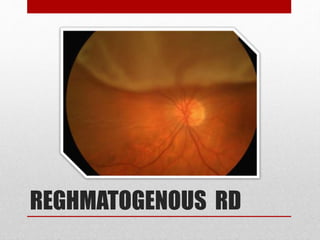
REGHMATOGENOUS RD
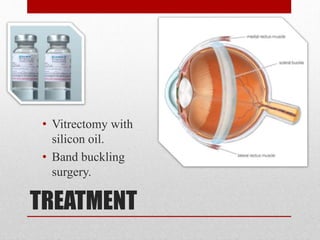
TREATMENT
• Vitrectomy with
silicon oil.
• Band buckling
surgery.
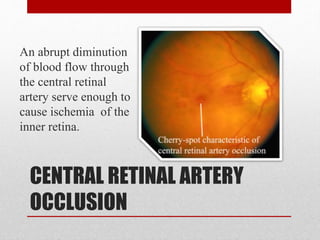
CENTRAL RETINAL ARTERY
OCCLUSION
An abrupt diminution
of blood flow through
the central retinal
artery serve enough to
cause ischemia of the
inner retina.
FFA
CLINICAL FEATURES
• Abrupt, painless, severe loss of vision.
• Cherry-red spot.
• Box-carring of blood flow in the retinal vessels.
• Ischemic retinal whitening of the posterior pole.
TREATMENT
• Carbogen Inhalation (95% Oxygen + 5% CO2)
• Ocular massage, paracentesis and administration of
ocular hypertensive medications
• Anti coagulants and fibrinolytic medications
BRANCH RETINAL ARTERY
OCCLUSION
An abrupt diminution of
blood flow through a
branch of central retinal
artery severe enough to
cause ischemia of inner
retina in the territory of
the affected vessel.
FFA
CLINICAL FEATURES
• Retinal whitening in the territory of the obstructed vessel.
• Embolus(66%)
• Visual field defect that correspond to the territory of the
obstructed vessels.
TREATMENT
• Ocular massage, paracentesis and administration of
ocular hypertensive medications
• Laser Photocoagulation to melt embolus
HYPERTENSIVE RETINOPATHY
Retinal vascular changes occurring from chronically
elevated systemic arterial hypertension.
HYPERTENSIVE
RETINOPATHY
CLINICAL FEATURES
• Narrowing and irregularity of retinal arteries.
• Arteriovenous nicking (narrowing of retinal veins at
arteriovenous crossing sites.)
• Blot retinal haemorrhages.
• Microaneurysms.
• Cotton-wool spots.
TREATMENT
• Treatment of Underlying Systemic condition can halt the
progress of retinal condition
CENTRAL RETINAL VEIN
OBSTRUCTION
Obstruction of the
central retinal vein at
the lamina cribrosa.
CLINICAL FEATURES
• Retinal haemorrhages in all four quadrants.
• Dilated, tortuous veins in all four quadrants.
• Optic disc oedema.
• Macular oedema.
• Cotton wool spots.
• Neovascularisation of the iris, retina or optic disc.
BRANCH RETINAL VEIN
OBSTRUCTION
Obstruction of branch
retinal vein.
FFA
CLINICAL FEATURES
• Retinal haemorrhages in the distribution of the obstructed
branch retinal vein.
TREATMENT
• Intravitreal Anti VEGF
• Intravitreal Steroid
• Grid Photocoagulation
DIABETIC RETINOPATHY
Progressive dysfunction of the retinal vasculature caused by
chronic hyperglycemia.
DIABETIC RETINOPATHY
NPDR PDR
CLINICAL FEATURES
• Microaneurysm.
• Retinal haemorrhages.
• Cotton wool spots.
• Macular oedema.
• Neovascularization.
TREATMENT
• Anti VEGF
• Panretinal Photocoagulation
• Peripheral retinal cryotherapy
• Vitrectomy in diabetic patients
TREATMENT
PRP VITRECTOMY
AGE RELATED MACULAR
DEGENERATION
• Age-related macular degeneration (AMD) is the leading
cause of irreversible severe visual loss in patients over 50
years of age.
• Types: Non exudative AMD
Exudative AMD
WET AMD DRY AMD
FFA
WET AMD DRY AMD
TREATMENT
• Intravitreal anti-VEGF
• Photodynamic Therapy
• Transpupillary thermotherapy
• Double frequency Nd YAG
• Surgery
RETINITIS PIGMENTOSA
• The term Retinitis pigmentosa encompasses a set of
diverse hereditary disorders that affect the photoreceptors
and retinal pigment epithelium.
RETINITIS PIGMENTOSA
CLINICAL FEATURES
• Progressive photoreceptor dysfunction and death.
• Intraneural retinal “bone spicule” pigment.
• Gliotic “waxy pallor” of optic nerve head.
• Visual field constriction.
• Night blindness.
• Loss of rod and cone electroretinography responses.
• Frequently, but not always, a family history.
PAPILLOEDEMA
Optic disc oedema
usually bilateral that
results from increased
intracranial pressure
CLINICAL FEATURES
• Blurring of optic disc margins
• Hyperaemia of optic nerve head
• Venous Congestion of arcuate and peri-papillary vessels.
• Engorged and dusty veins
• Peri-papillary splinter haemorrhages
TREATMENT
• Repeated lumbar puncture
• Diuretics
• Carbonic anhydrase inhibitors
• Optic nerve Sheath decompression
• Lumbar peritoneal Shunt
OPTIC NEURITIS
• It refers to inflammation of the optic nerve.
• Such inflammation my spare the optic disc (Retrobulbar
Optic neuritis) or may cause optic disc swelling(papillitis)
CLINICAL FEATURES
• Abrupt Vision loss.
• Dyschromatopsia.
• Afferent pupillary defect.
TREATMENT
• IV Methylprednisolone for 3 days.
• Followed by oral prednisolone tapered over 11 days.
OPTIC ATROPHY
Refers to optic nerve
shrinkage from any
cause which produces
degeneration of axons
in the anterior visual
system
INTRAVITREAL INJECTIONS
• AMD
• CSME/PDR
• Retinal Vein Occlusions
• Endophthalmitis
• Uveitis
• CME
• CNVM secondary to multiple retinal diseases
COMMON INDICATIONS
INTRAVITREAL MEDICATIONS
In Retinal vein occlusion/ AMD:
• Bevacizumab (Avastin)
• Ranibizumab (Lucentis)
• Triamcinolone acetonide (Kenalog)
In CMV Retinitis:
• Ganciclovir Intravitreal
In Endophthalmitis:
• Vancomycin 1mg/0.1ml
• Ceftazidime 2.25mg/0.1ml
• Amikacin 0.4mg/0.1ml
• Amphotericin B 0.1ml of 5-10mcg/ml
• Dexamethasone 0.4mg/0.1ml
INJECTION SITE
• Usually inferotemporal for ease of access
• Some Retina Specialists give the injection in the
superotemporal quadrant, as they feel that should a
complication such as a retinal detachment form, it can be
easier treated with a pneumatic retinopexy.
Common retinal disease

Common retinal disease