What is the Macula?
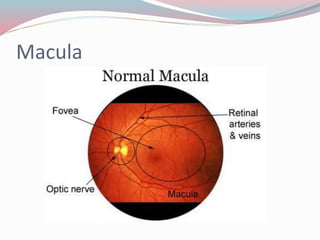
 The macula is the part of the retina responsible for
straight-ahead central vision
 It is responsible for focusing central vision in the eye,
and it controls our ability to read, drive a car, recognize
faces or colors, and see objects in fine detail.
 Any disease that affects the macula will cause a change and
impairment in the central vision.
Macula
Age-Related Macular Degeneration
 Macular degeneration is an age-associated
degenerative disorder of the macula, the part of the
retina responsible for straight-ahead, central vision.
Age-Related Macular Degeneration
 Age-related macular degeneration (AMD) is the
leading cause of central vision loss in the Western
world in people over the age of 55.
 As some people age, the macula weakens and its cells
begin to break down. This may result in the loss of
central vision.
Age Related Macular Degeneration
Dry AMD
 Dry AMD is the most common form of macular
degeneration, affecting 90 percent of people with the
disease.
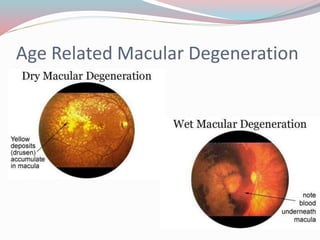
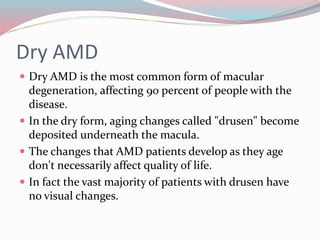
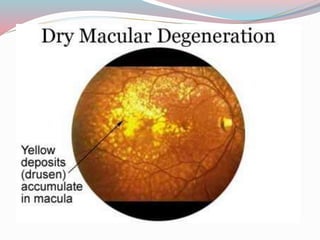
 In the dry form, aging changes called "drusen" become
deposited underneath the macula.
 The changes that AMD patients develop as they age
don't necessarily affect quality of life.
 In fact the vast majority of patients with drusen have
no visual changes.
Dry AMD
 However in some AMD patients, drusen can cause the
macula to thin, resulting in a gradual decrease in
central vision.
 This late stage of the dry type is called geographic
atrophy.
 If the drusen cause substantial weakening of
important layers of the macula, they can set the stage
for the "wet" form of AMD.
Wet AMD
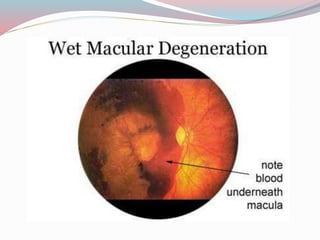
 Wet AMD develops when abnormal blood vessels start
to grow through important layers of the macula that
have been weakened by the dry form of AMD.
 This abnormal growth of blood vessels, called
choroidal neovascularization (CNV), can cause
bleeding, leakage of fluid, and scar tissue formation in
highly sensitive parts of the macula.
Wet AMD
 When this happens, loss of central vision can be rapid
and severe.
 Although only one in 10 patients with AMD will
convert from the dry to the wet form, the wet form
accounts for 90 percent of the vision loss associated
with AMD.
Symptoms of AMD
 The vast majority of patients with dry AMD will not
notice any change in their central vision.
 However, patients with advanced dry AMD may notice
a gradual decrease in their central vision over many
months or years.
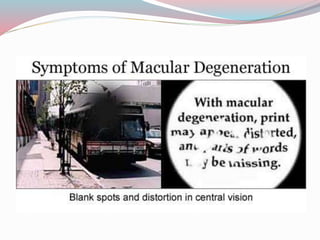
 This decline in vision is often accompanied by blank
spots that slowly develop in and around the central
vision.
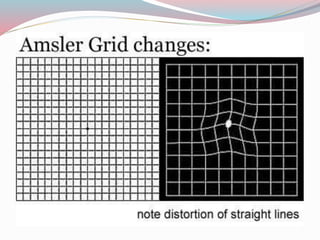
 The most common symptom of wet AMD is the
sudden onset of blurred or distorted central vision that
may occur over several days or weeks
AMD Treatment
 The various treatment options for AMD depend on the
type and stage of AMD that is present.
 At this time, the only treatment for dry AMD is high-
dose antioxidant vitamin therapy.
AMD Treatment
 Treatment options for the wet form of AMD include:
 Observation
 Hot laser therapy
 Cold laser therapy -- also knows as photodynamic
therapy or Visudyne™ therapy
 Macular translocation surgery
 Macugen
 Lucentis
 Avastin
Juvenile Macular Degeneration
 Juvenile macular degeneration is the term for several
inherited eye diseases -- including Stargardt's disease,
Best disease, and juvenile retinoschisis -- that affect
children and young adults.
 These rare diseases cause central vision loss that may
begin in childhood or young adulthood.
Stargardt’s Disease
 Stargardt disease is the most common form of juvenile
macular degeneration. It's named after German
ophthalmologist Karl Stargardt, who discovered it in
1901. Stargardt disease affects about one in 10,000
children in the U.S. Although the disease starts before
age 20, a person may not notice vision loss until age 30
to 40.
Signs of Stargardt’s Disease
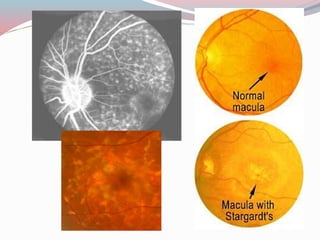
 The condition can be diagnosed by yellow-white spots
that appear in and around the macula.
 If the spots appear throughout the back of the eye,
then it is called fundus flavimaulatus.
 These deposits are an abnormal buildup of a fatty
substance produced during normal cell activity.
Symptoms of Stargardt’s Disease
 Symptoms include difficulty reading and gray or black
spots in the central vision. Loss of vision occurs gradually
at first and affects both eyes. Once vision reaches 20/40,
the disease progresses more rapidly, eventually reaching
20/200, which is legal blindness. Some people lose vision to
10/200 very quickly over a few months. Most people will
have vision loss ranging from 20/100 to 20/400 by age 30 to
40.
 Stargardt disease does not cause a loss of peripheral, or
side, vision. Most people don't lose night vision, but may
have trouble adjusting between dark and light
environments. Color vision is also affected in later stages of
the disease.
Genetics of Stargardt’s Disease
 Researchers have identified a specific gene that they
believe causes Stargardt disease. If both parents carry
one mutated gene and one normal gene, their children
have a 25% chance of developing the disease. People
who inherit only one mutated gene don't develop the
disease. However, they can pass on the disease without
knowing it.

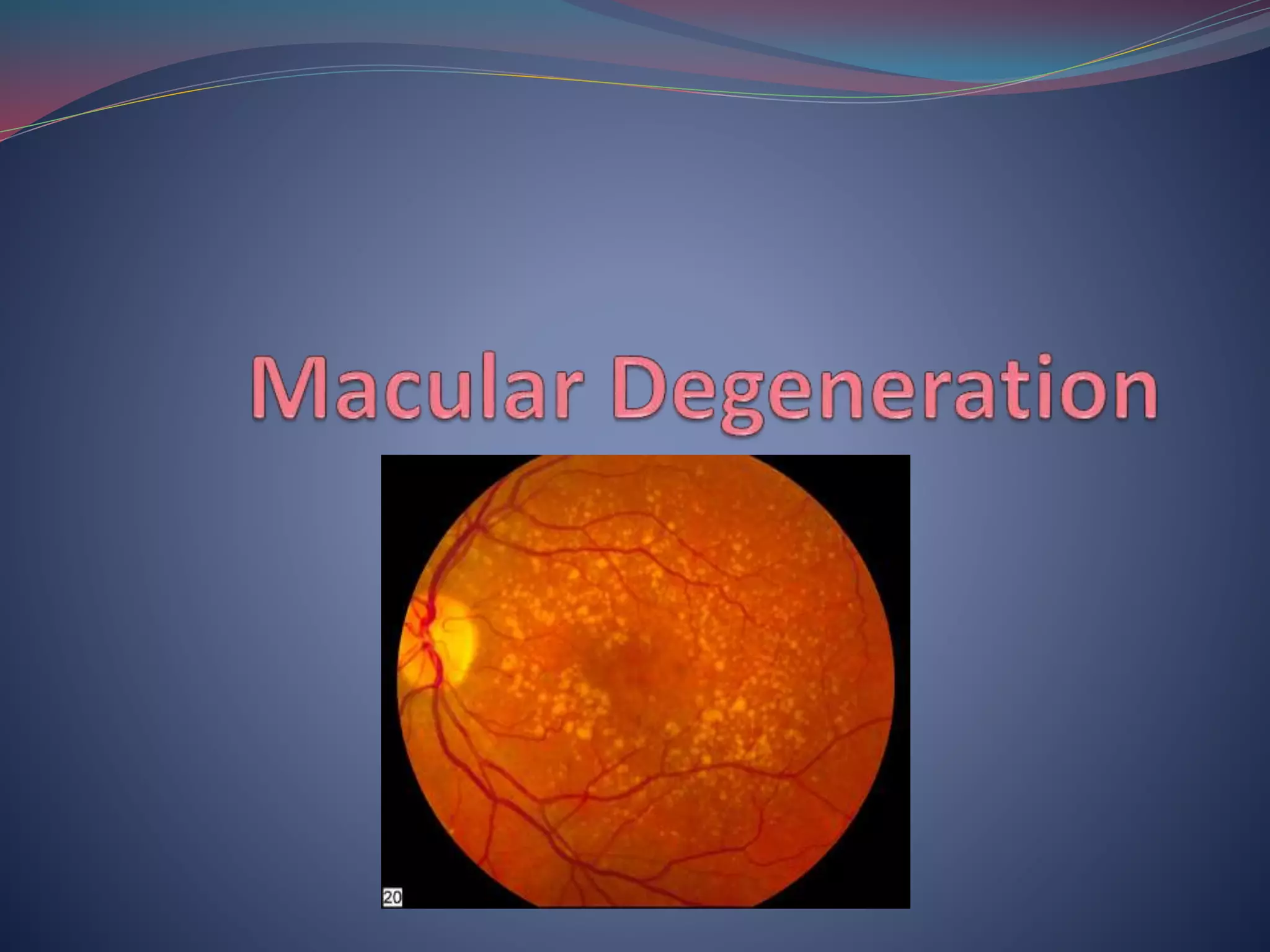
Macular degeneration

  • 2.
    What is theMacula?  The macula is the part of the retina responsible for straight-ahead central vision  It is responsible for focusing central vision in the eye, and it controls our ability to read, drive a car, recognize faces or colors, and see objects in fine detail.  Any disease that affects the macula will cause a change and impairment in the central vision.
  • 3.
  • 4.
    Age-Related Macular Degeneration Macular degeneration is an age-associated degenerative disorder of the macula, the part of the retina responsible for straight-ahead, central vision.
  • 5.
    Age-Related Macular Degeneration Age-related macular degeneration (AMD) is the leading cause of central vision loss in the Western world in people over the age of 55.  As some people age, the macula weakens and its cells begin to break down. This may result in the loss of central vision.
  • 6.
    Age Related MacularDegeneration
  • 7.
    Dry AMD  DryAMD is the most common form of macular degeneration, affecting 90 percent of people with the disease.  In the dry form, aging changes called "drusen" become deposited underneath the macula.  The changes that AMD patients develop as they age don't necessarily affect quality of life.  In fact the vast majority of patients with drusen have no visual changes.
  • 8.
    Dry AMD  Howeverin some AMD patients, drusen can cause the macula to thin, resulting in a gradual decrease in central vision.  This late stage of the dry type is called geographic atrophy.  If the drusen cause substantial weakening of important layers of the macula, they can set the stage for the "wet" form of AMD.
  • 10.
    Wet AMD  WetAMD develops when abnormal blood vessels start to grow through important layers of the macula that have been weakened by the dry form of AMD.  This abnormal growth of blood vessels, called choroidal neovascularization (CNV), can cause bleeding, leakage of fluid, and scar tissue formation in highly sensitive parts of the macula.
  • 11.
    Wet AMD  Whenthis happens, loss of central vision can be rapid and severe.  Although only one in 10 patients with AMD will convert from the dry to the wet form, the wet form accounts for 90 percent of the vision loss associated with AMD.
  • 13.
    Symptoms of AMD The vast majority of patients with dry AMD will not notice any change in their central vision.  However, patients with advanced dry AMD may notice a gradual decrease in their central vision over many months or years.  This decline in vision is often accompanied by blank spots that slowly develop in and around the central vision.  The most common symptom of wet AMD is the sudden onset of blurred or distorted central vision that may occur over several days or weeks
  • 16.
    AMD Treatment  Thevarious treatment options for AMD depend on the type and stage of AMD that is present.  At this time, the only treatment for dry AMD is high- dose antioxidant vitamin therapy.
  • 17.
    AMD Treatment  Treatmentoptions for the wet form of AMD include:  Observation  Hot laser therapy  Cold laser therapy -- also knows as photodynamic therapy or Visudyne™ therapy  Macular translocation surgery  Macugen  Lucentis  Avastin
  • 18.
    Juvenile Macular Degeneration Juvenile macular degeneration is the term for several inherited eye diseases -- including Stargardt's disease, Best disease, and juvenile retinoschisis -- that affect children and young adults.  These rare diseases cause central vision loss that may begin in childhood or young adulthood.
  • 19.
    Stargardt’s Disease  Stargardtdisease is the most common form of juvenile macular degeneration. It's named after German ophthalmologist Karl Stargardt, who discovered it in 1901. Stargardt disease affects about one in 10,000 children in the U.S. Although the disease starts before age 20, a person may not notice vision loss until age 30 to 40.
  • 20.
    Signs of Stargardt’sDisease  The condition can be diagnosed by yellow-white spots that appear in and around the macula.  If the spots appear throughout the back of the eye, then it is called fundus flavimaulatus.  These deposits are an abnormal buildup of a fatty substance produced during normal cell activity.
  • 22.
    Symptoms of Stargardt’sDisease  Symptoms include difficulty reading and gray or black spots in the central vision. Loss of vision occurs gradually at first and affects both eyes. Once vision reaches 20/40, the disease progresses more rapidly, eventually reaching 20/200, which is legal blindness. Some people lose vision to 10/200 very quickly over a few months. Most people will have vision loss ranging from 20/100 to 20/400 by age 30 to 40.  Stargardt disease does not cause a loss of peripheral, or side, vision. Most people don't lose night vision, but may have trouble adjusting between dark and light environments. Color vision is also affected in later stages of the disease.
  • 23.
    Genetics of Stargardt’sDisease  Researchers have identified a specific gene that they believe causes Stargardt disease. If both parents carry one mutated gene and one normal gene, their children have a 25% chance of developing the disease. People who inherit only one mutated gene don't develop the disease. However, they can pass on the disease without knowing it.