Co-enzyme
The non-protein, organic, Iow molecular weight and dialysable substance associated
with enzyme function is known as coenzyme.
Coenzymes are second substrates :
Coenzymes are often regarded as the second substrates or co-substrates, since they have
affinity with the enzyme comparable with that of the substrates.
Coenzymes undergo alterations during the enzymatic reactions, which are later
regenerated. This is in contrast to the substrate which is converted to the product.
Coenzymes participate in various reactions involving transfer of atoms or groups like
hydrogen, aldehyde, keto, amino, acyl, methyl, carbon dioxide etc. Coenzymes play a
decisive role in enzyme function.
Department of Life Sciences, Mandsaur University,
Mandsaur, Madhya Pradesh,
India. Pin: 458 001
Mob: +91- 8956649071, 9359101533
Email: ashish.warghane@meu.edu.in
Prepaid By
Dr Ashish Warghane PhD
Co-enzyme
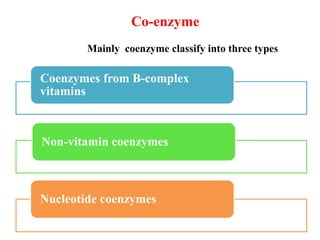
Coenzymes from B-complex
vitamins
Non-vitamin coenzymes
Nucleotide coenzymes
Mainly coenzyme classify into three types
1. Coenzymes from B-complex vitamins :
Most of the coenzymes are the derivatives of water soluble B-
complex vitamins. In fact, the biochemical functions of B-complex
vitamins are exerted through their respective coenzymes.
Example:
Thiamin pyrophosphate
Flavin Mononucleotide
2. Not all coenzymes are vitamin derivatives.
There are some other organic substances which have no relation with
vitamins but function as coenzymes. They may be considered as
non-vitamin coenzymes e.g.
ATP, CDP, UDP etc.
3. Nucleotide coenzymes :
Some of the coenzymes possess nitrogenous base, sugar and phosphate. Such
coenzymes are, therefore, regarded as nucleotides e.g. NAD+, NADP+, FMN,
FAD, Coenzyme A, UDPC etc.
COENZYMES DO NOT DECIDE ENZYME SPECIFICITY
A particular Coenzyme may participate in catalytic reactions along with different
enzymes. For instance, NAD+ acts as a coenzyme for lactate dehydrogenase and
alcohol dehydrogenase.
In both the enzymatic reactions, NAD+ is involved in hydrogen transfer. The
specificity of the enzyme is mostly dependent on the apoenzyme and not on the
coenzvme.
References: 1. Biochemistry. U. Satatynarayan
2. Enzyme. Palmer

Co-enzyme

  • 1.
    Co-enzyme The non-protein, organic,Iow molecular weight and dialysable substance associated with enzyme function is known as coenzyme. Coenzymes are second substrates : Coenzymes are often regarded as the second substrates or co-substrates, since they have affinity with the enzyme comparable with that of the substrates. Coenzymes undergo alterations during the enzymatic reactions, which are later regenerated. This is in contrast to the substrate which is converted to the product. Coenzymes participate in various reactions involving transfer of atoms or groups like hydrogen, aldehyde, keto, amino, acyl, methyl, carbon dioxide etc. Coenzymes play a decisive role in enzyme function. Department of Life Sciences, Mandsaur University, Mandsaur, Madhya Pradesh, India. Pin: 458 001 Mob: +91- 8956649071, 9359101533 Email: ashish.warghane@meu.edu.in Prepaid By Dr Ashish Warghane PhD
  • 2.
    Co-enzyme Coenzymes from B-complex vitamins Non-vitamincoenzymes Nucleotide coenzymes Mainly coenzyme classify into three types
  • 3.
    1. Coenzymes fromB-complex vitamins : Most of the coenzymes are the derivatives of water soluble B- complex vitamins. In fact, the biochemical functions of B-complex vitamins are exerted through their respective coenzymes. Example: Thiamin pyrophosphate Flavin Mononucleotide 2. Not all coenzymes are vitamin derivatives. There are some other organic substances which have no relation with vitamins but function as coenzymes. They may be considered as non-vitamin coenzymes e.g. ATP, CDP, UDP etc.
  • 4.
    3. Nucleotide coenzymes: Some of the coenzymes possess nitrogenous base, sugar and phosphate. Such coenzymes are, therefore, regarded as nucleotides e.g. NAD+, NADP+, FMN, FAD, Coenzyme A, UDPC etc. COENZYMES DO NOT DECIDE ENZYME SPECIFICITY A particular Coenzyme may participate in catalytic reactions along with different enzymes. For instance, NAD+ acts as a coenzyme for lactate dehydrogenase and alcohol dehydrogenase. In both the enzymatic reactions, NAD+ is involved in hydrogen transfer. The specificity of the enzyme is mostly dependent on the apoenzyme and not on the coenzvme. References: 1. Biochemistry. U. Satatynarayan 2. Enzyme. Palmer