Presented by- Priya ,saloni sharma
cs-b
roll no-75,88
overview
1. Introduction
2. Basic idea in cryptography
3. Key and key distribution
4. Need of quantum cryptography
5. Perfect secrecy and OTP
6. Quantum key distribution
7. QKD protocols
8. BB84 without eavesdropping
9. BB84 with eavesdropping
10. Working prototypes
11. conclusions
Introduction
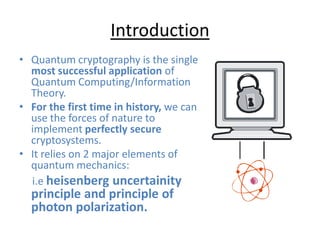
• Quantum cryptography is the single
most successful application of
Quantum Computing/Information
Theory.
• For the first time in history, we can
use the forces of nature to
implement perfectly secure
cryptosystems.
• It relies on 2 major elements of
quantum mechanics:
i.e heisenberg uncertainity
principle and principle of
photon polarization.
• Heisenberg uncertainty principle : states that certain pairs of
physical properties are related in such a way that measuring
one property prevents the observer from simultaneously
knowing the value for other.
• Principle of photon polarization: tells that an eavesdropper
cannot copy unknown Qubits due to non-cloning algorithm.
• Unique property of quantum cryptography is the
ability of two communicating users to detect the
presence of third party trying to gain knowledge of the
key.
• By using quantum superposition/entanglement and
transmitting information in quantum states , a
communication system can be implemented which can
detect eavesdropping.
• If the level of eavesdropping is below threshold , a
key is produced guarantying the secure
communication otherwise no secure key is possible
and communication is aborted.
Basic idea in cryptography
• Cryptography: “the coding
and decoding of secret
messages.”
• The basic idea is to modify
a message so as to make it
unintelligible to anyone but
the intended recipient.
• For message (plaintext) M,
e(M, K)
encryption - ciphertext
d[e(M, K), K] = M
decryption
• Cryptosystem (Cipher
System) – method of
disguising messages so that
only certain people can
read them
• Cryptography – Art of
creating and using
Cryptosystems
• Cryptanalysis – Art of
breaking Cryptosystems
• Cryptography – study of
Cryptography and
Cryptosystems
Key and key distribution
• K is called the key.
• The key is known only to sender and
receiver: it is secret.
• Anyone who knows the key can
decrypt the message.
• Key distribution is the problem of
exchanging the key between sender
and receiver.
Need of quantum cryptography
• Classical Cryptography relies heavily on the
complexity of factoring integers.
• Quantum Computers can use Shor’s Algorithm to
efficiently break today’s cryptosystems.
• We need a new kind of cryptography!
Perfect Secrecy and the OTP
• There exist perfect cryptosystems.
• Example: One-Time Pad (OTP)
• The problem of distributing the
keys in the first place remains.
• QKD: Quantum Key Distribution
• Using quantum effects, we can
distribute keys in perfect secrecy!
• The Result: The Perfect
Cryptosystem,
QC = QKD + OTP
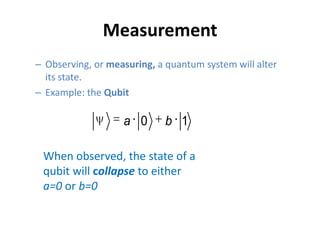
Measurement
– Observing, or measuring, a quantum system will alter
its state.
– Example: the Qubit
0 1a b
When observed, the state of a
qubit will collapse to either
a=0 or b=0
• Physical Qubits
– Any subatomic particle can be
used to represent a Qubit, e.g. an
electron.
– A photon is a convenient choice.
– A photon is a massless particle, the
quantum of e.m waves carrying
energy, momentum and angular
momentum.
• A photon has a property called
polarization, which is the plane
in which the electric field
oscillates.
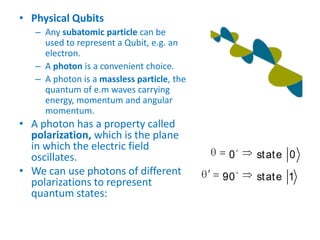
• We can use photons of different
polarizations to represent
quantum states:


0 state 0
90 state 1
• A device called a polarizer
allows us to place a
photon in a particular
polarization. A Pockels
Cell can be used too.
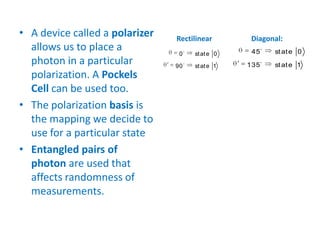
• The polarization basis is
the mapping we decide to
use for a particular state
• Entangled pairs of
photon are used that
affects randomness of
measurements.


0 state 0
90 state 1
Rectilinear Diagonal:


45 state 0
135 state 1
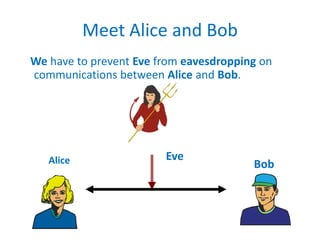
Meet Alice and Bob
We have to prevent Eve from eavesdropping on
communications between Alice and Bob.
Alice Bob
Eve
Quantum Key Distribution
• Quantum Key Distribution exploits the effects
discussed in order to thwart eavesdropping.
• It enables two parties to produce a shared
random bit string known only to them, which can
be used as a key for encryption and decryption.
• If an eavesdropper uses the wrong polarization
basis to measure the channel, the result of the
measurement will be random.
QKD Protocols
• A protocol is a set of rules governing the exchange
of messages over a channel.
• A security protocol is a special protocol designed to
ensure security properties are met during
communications.
• There are three main security protocols for QKD:
BB84, B92, and Entanglement-Based QKD.
• We will only discuss BB84 here.
BB84
• BB84 was the first security protocol implementing
Quantum Key Distribution.
• It uses the idea of photon polarization.
• The key consists of bits that will be transmitted as
photons.
• Each bit is encoded with a random polarization
basis!
Alice and Bob talk on the telephone:
– Alice chooses a subset of the bits (the test bits) and
reveals which basis she used to encode them to Bob.
– Bob tells Alice which basis he used to decode the same
bits.
– Where the same basis was used, Alice tells Bob what bits
he ought to have got.
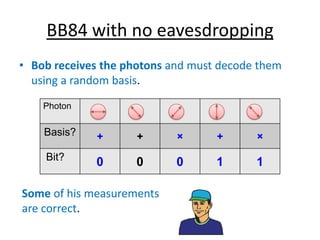
BB84 with no eavesdropping
• Bob receives the photons and must decode them
using a random basis.
Photon
Basis? + + × + ×
Bit?
0 0 0 1 1
Some of his measurements
are correct.
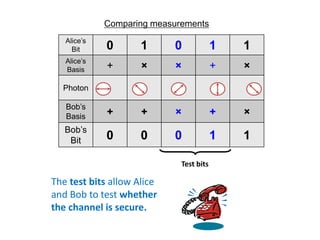
Comparing measurements
Alice’s
Bit 0 1 0 1 1
Alice’s
Basis + × × + ×
Photon
Bob’s
Basis + + × + ×
Bob’s
Bit 0 0 0 1 1
Test bits
The test bits allow Alice
and Bob to test whether
the channel is secure.
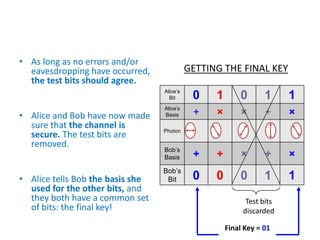
GETTING THE FINAL KEY
• As long as no errors and/or
eavesdropping have occurred,
the test bits should agree.
• Alice and Bob have now made
sure that the channel is
secure. The test bits are
removed.
• Alice tells Bob the basis she
used for the other bits, and
they both have a common set
of bits: the final key!
Alice’s
Bit 0 1 0 1 1
Alice’s
Basis + × × + ×
Photon
Bob’s
Basis + + × + ×
Bob’s
Bit 0 0 0 1 1
Test bits
discarded
Final Key = 01
BB84 with eavesdropping
• If an eavesdropper Eve tries to tap the channel, this will automatically
show up in Bob’s measurements.
• In those cases where Alice and Bob have used the same basis, Bob is likely
to obtain an incorrect measurement: Eve’s measurements are bound to
affect the states of the photons.
• As Eve intercepts Alice’s photons, she has to measure them with a
random basis and send new photons to Bob.`
• The photon states cannot be cloned (non-cloneability).
• Eve’s presence is always detected: measuring a quantum system
irreparably alters its state.
Working Prototypes
• Quantum cryptography has been tried
experimentally over fibre-optic cables and, more
recently, open air (23km).
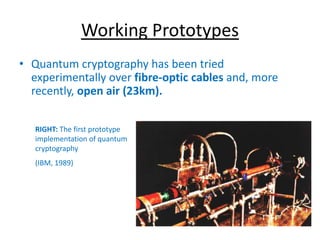
RIGHT: The first prototype
implementation of quantum
cryptography
(IBM, 1989)
Conclusion
• Quantum cryptography is a major achievement in
security engineering.
• As it gets implemented, it will allow perfectly secure
bank transactions, secret discussions for
government officials, and well-guarded trade
secrets for industry!

Quantum cryptography

  • 1.
    Presented by- Priya,saloni sharma cs-b roll no-75,88
  • 2.
    overview 1. Introduction 2. Basicidea in cryptography 3. Key and key distribution 4. Need of quantum cryptography 5. Perfect secrecy and OTP 6. Quantum key distribution 7. QKD protocols 8. BB84 without eavesdropping 9. BB84 with eavesdropping 10. Working prototypes 11. conclusions
  • 3.
    Introduction • Quantum cryptographyis the single most successful application of Quantum Computing/Information Theory. • For the first time in history, we can use the forces of nature to implement perfectly secure cryptosystems. • It relies on 2 major elements of quantum mechanics: i.e heisenberg uncertainity principle and principle of photon polarization.
  • 4.
    • Heisenberg uncertaintyprinciple : states that certain pairs of physical properties are related in such a way that measuring one property prevents the observer from simultaneously knowing the value for other. • Principle of photon polarization: tells that an eavesdropper cannot copy unknown Qubits due to non-cloning algorithm.
  • 5.
    • Unique propertyof quantum cryptography is the ability of two communicating users to detect the presence of third party trying to gain knowledge of the key. • By using quantum superposition/entanglement and transmitting information in quantum states , a communication system can be implemented which can detect eavesdropping. • If the level of eavesdropping is below threshold , a key is produced guarantying the secure communication otherwise no secure key is possible and communication is aborted.
  • 6.
    Basic idea incryptography • Cryptography: “the coding and decoding of secret messages.” • The basic idea is to modify a message so as to make it unintelligible to anyone but the intended recipient. • For message (plaintext) M, e(M, K) encryption - ciphertext d[e(M, K), K] = M decryption • Cryptosystem (Cipher System) – method of disguising messages so that only certain people can read them • Cryptography – Art of creating and using Cryptosystems • Cryptanalysis – Art of breaking Cryptosystems • Cryptography – study of Cryptography and Cryptosystems
  • 7.
    Key and keydistribution • K is called the key. • The key is known only to sender and receiver: it is secret. • Anyone who knows the key can decrypt the message. • Key distribution is the problem of exchanging the key between sender and receiver.
  • 8.
    Need of quantumcryptography • Classical Cryptography relies heavily on the complexity of factoring integers. • Quantum Computers can use Shor’s Algorithm to efficiently break today’s cryptosystems. • We need a new kind of cryptography!
  • 9.
    Perfect Secrecy andthe OTP • There exist perfect cryptosystems. • Example: One-Time Pad (OTP) • The problem of distributing the keys in the first place remains. • QKD: Quantum Key Distribution • Using quantum effects, we can distribute keys in perfect secrecy! • The Result: The Perfect Cryptosystem, QC = QKD + OTP
  • 10.
    Measurement – Observing, ormeasuring, a quantum system will alter its state. – Example: the Qubit 0 1a b When observed, the state of a qubit will collapse to either a=0 or b=0
  • 11.
    • Physical Qubits –Any subatomic particle can be used to represent a Qubit, e.g. an electron. – A photon is a convenient choice. – A photon is a massless particle, the quantum of e.m waves carrying energy, momentum and angular momentum. • A photon has a property called polarization, which is the plane in which the electric field oscillates. • We can use photons of different polarizations to represent quantum states:   0 state 0 90 state 1
  • 12.
    • A devicecalled a polarizer allows us to place a photon in a particular polarization. A Pockels Cell can be used too. • The polarization basis is the mapping we decide to use for a particular state • Entangled pairs of photon are used that affects randomness of measurements.   0 state 0 90 state 1 Rectilinear Diagonal:   45 state 0 135 state 1
  • 13.
    Meet Alice andBob We have to prevent Eve from eavesdropping on communications between Alice and Bob. Alice Bob Eve
  • 14.
    Quantum Key Distribution •Quantum Key Distribution exploits the effects discussed in order to thwart eavesdropping. • It enables two parties to produce a shared random bit string known only to them, which can be used as a key for encryption and decryption. • If an eavesdropper uses the wrong polarization basis to measure the channel, the result of the measurement will be random.
  • 15.
    QKD Protocols • Aprotocol is a set of rules governing the exchange of messages over a channel. • A security protocol is a special protocol designed to ensure security properties are met during communications. • There are three main security protocols for QKD: BB84, B92, and Entanglement-Based QKD. • We will only discuss BB84 here.
  • 16.
    BB84 • BB84 wasthe first security protocol implementing Quantum Key Distribution. • It uses the idea of photon polarization. • The key consists of bits that will be transmitted as photons. • Each bit is encoded with a random polarization basis!
  • 17.
    Alice and Bobtalk on the telephone: – Alice chooses a subset of the bits (the test bits) and reveals which basis she used to encode them to Bob. – Bob tells Alice which basis he used to decode the same bits. – Where the same basis was used, Alice tells Bob what bits he ought to have got.
  • 18.
    BB84 with noeavesdropping • Bob receives the photons and must decode them using a random basis. Photon Basis? + + × + × Bit? 0 0 0 1 1 Some of his measurements are correct.
  • 19.
    Comparing measurements Alice’s Bit 01 0 1 1 Alice’s Basis + × × + × Photon Bob’s Basis + + × + × Bob’s Bit 0 0 0 1 1 Test bits The test bits allow Alice and Bob to test whether the channel is secure.
  • 20.
    GETTING THE FINALKEY • As long as no errors and/or eavesdropping have occurred, the test bits should agree. • Alice and Bob have now made sure that the channel is secure. The test bits are removed. • Alice tells Bob the basis she used for the other bits, and they both have a common set of bits: the final key! Alice’s Bit 0 1 0 1 1 Alice’s Basis + × × + × Photon Bob’s Basis + + × + × Bob’s Bit 0 0 0 1 1 Test bits discarded Final Key = 01
  • 21.
    BB84 with eavesdropping •If an eavesdropper Eve tries to tap the channel, this will automatically show up in Bob’s measurements. • In those cases where Alice and Bob have used the same basis, Bob is likely to obtain an incorrect measurement: Eve’s measurements are bound to affect the states of the photons. • As Eve intercepts Alice’s photons, she has to measure them with a random basis and send new photons to Bob.` • The photon states cannot be cloned (non-cloneability). • Eve’s presence is always detected: measuring a quantum system irreparably alters its state.
  • 22.
    Working Prototypes • Quantumcryptography has been tried experimentally over fibre-optic cables and, more recently, open air (23km). RIGHT: The first prototype implementation of quantum cryptography (IBM, 1989)
  • 23.
    Conclusion • Quantum cryptographyis a major achievement in security engineering. • As it gets implemented, it will allow perfectly secure bank transactions, secret discussions for government officials, and well-guarded trade secrets for industry!