BLOCK CIPHER MODES OF OPERATION
BY,
AKASH RANJAN DAS
5TH SEMESTER
B-TECH COMPUTER SCIENCE AND ENGINEERING
SIDDAGANGA INSTITUTE OF TECHNOLOGY, TUMKUR
AGENDA
➢ Block Ciphers
▪ What is Block Cipher?
▪ Block Cipher Modes of Operation
▪ When we use Block Cipher Modes of
Operation?
➢ Electronic Code Book
▪ Introduction
▪ Electronic Code Book Encryption and
Decryption Process
▪ Electronic Code Book Encryption and
Decryption Algorithm
▪ Example
▪ Security Issues
➢ Cipher Block Chaining Mode
▪ Introduction
▪ Encryption and decryption in CBC mode
▪ Cipher block chaining mode algorithm
▪ Security Issues
BLOCK CIPHERS
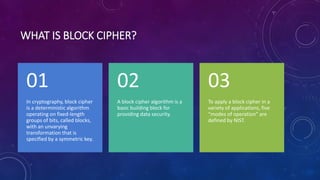
WHAT IS BLOCK CIPHER?
In cryptography, block cipher
is a deterministic algorithm
operating on fixed-length
groups of bits, called blocks,
with an unvarying
transformation that is
specified by a symmetric key.
01
A block cipher algorithm is a
basic building block for
providing data security.
02
To apply a block cipher in a
variety of applications, five
“modes of operation” are
defined by NIST.
03
BLOCK CIPHER
MODES OF
OPERATION
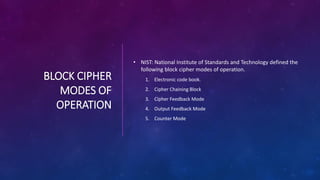
• NIST: National Institute of Standards and Technology defined the
following block cipher modes of operation.
1. Electronic code book.
2. Cipher Chaining Block
3. Cipher Feedback Mode
4. Output Feedback Mode
5. Counter Mode
WHEN WE
USE BLOCK
CIPHER
MODES OF
OPERATION?
Block Cipher only allow to encrypt
entire blocks.
What if our message is longer/ shorter
than the block size?
Algorithms that exploit a block cipher to
provide a service (e.g. confidentiality)
ELECTRONIC CODE BOOK
ELECTRONIC
CODE BOOK
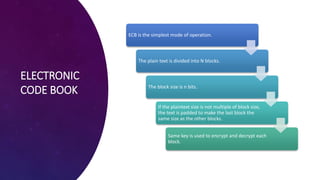
ECB is the simplest mode of operation.
The plain text is divided into N blocks.
The block size is n bits.
If the plaintext size is not multiple of block size,
the text is padded to make the last block the
same size as the other blocks.
Same key is used to encrypt and decrypt each
block.
ELECTRONIC CODE
BOOK ENCRYPTION
AND DECRYPTION
PROCESS
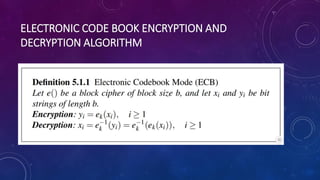
ELECTRONIC CODE BOOK ENCRYPTION AND
DECRYPTION ALGORITHM
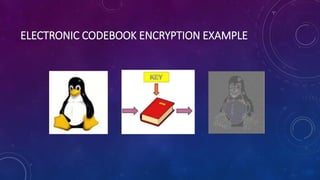
ELECTRONIC CODEBOOK ENCRYPTION EXAMPLE
ELECTRONIC
CODEBOOK
SECURITY
ISSUES
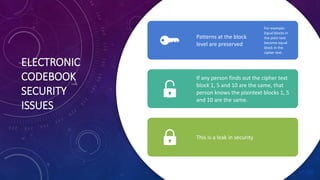
Patterns at the block
level are preserved
For example:
Equal blocks in
the plain text
become equal
block in the
cipher text.
If any person finds out the cipher text
block 1, 5 and 10 are the same, that
person knows the plaintext blocks 1, 5
and 10 are the same.
This is a leak in security
CIPHER BLOCK CHAINING MODE
CIPHER BLOCK
CHAINING
MODE
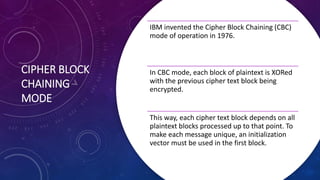
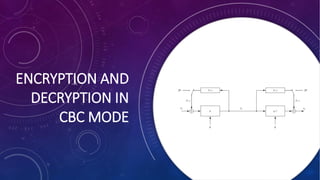
IBM invented the Cipher Block Chaining (CBC)
mode of operation in 1976.
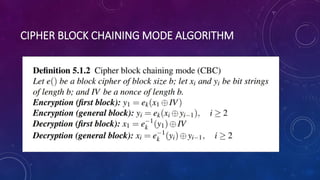
In CBC mode, each block of plaintext is XORed
with the previous cipher text block being
encrypted.
This way, each cipher text block depends on all
plaintext blocks processed up to that point. To
make each message unique, an initialization
vector must be used in the first block.
WHAT IS AN
INITIALIZATION
VECTOR?
An initialization vector (IV) or starting variable is a block of
bits that is used by several modes to randomize the
encryption and hence to produce distinct cipher texts
even if the same plain text is encrypted multiple times,
without the need for a slower re-keying process.
An initialization vector has different security requirements
than a key, so the IV usually does not need to be secret.
However, in most cases, it is important that an
initialization vector is never reused under the same key.
ENCRYPTION AND
DECRYPTION IN
CBC MODE
CIPHER BLOCK CHAINING MODE ALGORITHM
CIPHER BLOCK
CHAINING MODE
SECURITY ISSUES
The patterns at the block level are not preserved.
In CBC mode, equal plain text block belonging to the same message are
enciphered into different cipher text block.
However, if two message are equal, their encipherment is the same if
they use the same IV.
As a matter of fact, if the first M blocks in two different message are
equal, they are enciphered into equal blocks unless different IVs are used.
For this reason, some people recommended the use of time-stamp as an
IV.
Any person can add some cipher text blocks to the end of the cipher text
stream.
THANK YOU

Block cipher modes of operations

  • 1.
    BLOCK CIPHER MODESOF OPERATION BY, AKASH RANJAN DAS 5TH SEMESTER B-TECH COMPUTER SCIENCE AND ENGINEERING SIDDAGANGA INSTITUTE OF TECHNOLOGY, TUMKUR
  • 2.
    AGENDA ➢ Block Ciphers ▪What is Block Cipher? ▪ Block Cipher Modes of Operation ▪ When we use Block Cipher Modes of Operation? ➢ Electronic Code Book ▪ Introduction ▪ Electronic Code Book Encryption and Decryption Process ▪ Electronic Code Book Encryption and Decryption Algorithm ▪ Example ▪ Security Issues ➢ Cipher Block Chaining Mode ▪ Introduction ▪ Encryption and decryption in CBC mode ▪ Cipher block chaining mode algorithm ▪ Security Issues
  • 3.
  • 4.
    WHAT IS BLOCKCIPHER? In cryptography, block cipher is a deterministic algorithm operating on fixed-length groups of bits, called blocks, with an unvarying transformation that is specified by a symmetric key. 01 A block cipher algorithm is a basic building block for providing data security. 02 To apply a block cipher in a variety of applications, five “modes of operation” are defined by NIST. 03
  • 5.
    BLOCK CIPHER MODES OF OPERATION •NIST: National Institute of Standards and Technology defined the following block cipher modes of operation. 1. Electronic code book. 2. Cipher Chaining Block 3. Cipher Feedback Mode 4. Output Feedback Mode 5. Counter Mode
  • 6.
    WHEN WE USE BLOCK CIPHER MODESOF OPERATION? Block Cipher only allow to encrypt entire blocks. What if our message is longer/ shorter than the block size? Algorithms that exploit a block cipher to provide a service (e.g. confidentiality)
  • 7.
  • 8.
    ELECTRONIC CODE BOOK ECB isthe simplest mode of operation. The plain text is divided into N blocks. The block size is n bits. If the plaintext size is not multiple of block size, the text is padded to make the last block the same size as the other blocks. Same key is used to encrypt and decrypt each block.
  • 9.
  • 10.
    ELECTRONIC CODE BOOKENCRYPTION AND DECRYPTION ALGORITHM
  • 11.
  • 12.
    ELECTRONIC CODEBOOK SECURITY ISSUES Patterns at theblock level are preserved For example: Equal blocks in the plain text become equal block in the cipher text. If any person finds out the cipher text block 1, 5 and 10 are the same, that person knows the plaintext blocks 1, 5 and 10 are the same. This is a leak in security
  • 13.
  • 14.
    CIPHER BLOCK CHAINING MODE IBM inventedthe Cipher Block Chaining (CBC) mode of operation in 1976. In CBC mode, each block of plaintext is XORed with the previous cipher text block being encrypted. This way, each cipher text block depends on all plaintext blocks processed up to that point. To make each message unique, an initialization vector must be used in the first block.
  • 15.
    WHAT IS AN INITIALIZATION VECTOR? Aninitialization vector (IV) or starting variable is a block of bits that is used by several modes to randomize the encryption and hence to produce distinct cipher texts even if the same plain text is encrypted multiple times, without the need for a slower re-keying process. An initialization vector has different security requirements than a key, so the IV usually does not need to be secret. However, in most cases, it is important that an initialization vector is never reused under the same key.
  • 16.
  • 17.
    CIPHER BLOCK CHAININGMODE ALGORITHM
  • 18.
    CIPHER BLOCK CHAINING MODE SECURITYISSUES The patterns at the block level are not preserved. In CBC mode, equal plain text block belonging to the same message are enciphered into different cipher text block. However, if two message are equal, their encipherment is the same if they use the same IV. As a matter of fact, if the first M blocks in two different message are equal, they are enciphered into equal blocks unless different IVs are used. For this reason, some people recommended the use of time-stamp as an IV. Any person can add some cipher text blocks to the end of the cipher text stream.
  • 19.