29-01-2015 by Bart Van Bos - AllBits29-01-2015 by Bart Van Bos - AllBits
Security in TheorySecurity in Theory
Cryptography and Entity Authentication
Presentation Overview
● Introduction
● Cryptographic Algorithms
● Entity Authentication
● Network Security
● Conclusion
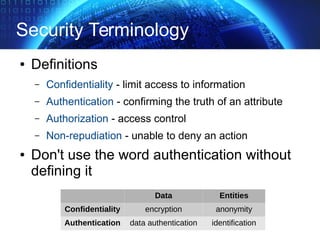
Security Terminology
● Definitions
– Confidentiality - limit access to information
– Authentication - confirming the truth of an attribute
– Authorization - access control
– Non-repudiation - unable to deny an action
● Don't use the word authentication without
defining it
Data Entities
Confidentiality encryption anonymity
Authentication data authentication identification
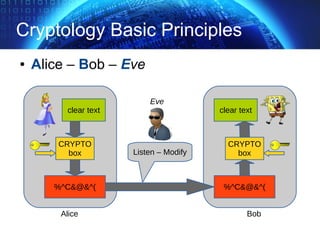
Cryptology Basic Principles
● Alice – Bob – Eve
clear text
%^C&@&^(
CRYPTO
box
clear text
%^C&@&^(
CRYPTO
boxListen – Modify
Alice Bob
Eve
Presentation Overview
● Introduction
● Cryptographic Algorithms
– Symmetric algorithms
– Public-key Cryptology
● Entity Authentication
● Network Security
● Conclusion
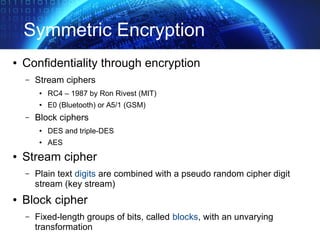
Symmetric Encryption
● Confidentiality through encryption
– Stream ciphers
● RC4 – 1987 by Ron Rivest (MIT)
● E0 (Bluetooth) or A5/1 (GSM)
– Block ciphers
● DES and triple-DES
● AES
● Stream cipher
– Plain text digits are combined with a pseudo random cipher digit
stream (key stream)
● Block cipher
– Fixed-length groups of bits, called blocks, with an unvarying
transformation
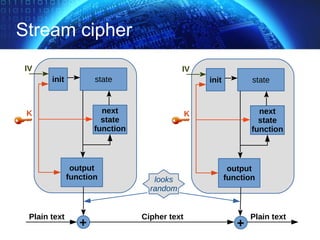
Stream cipher
init state
next
state
function
output
function
IV
K
+
init state
next
state
function
output
function
IV
K
+
Plain textPlain text Cipher text
looks
random
Stream cipher key stream
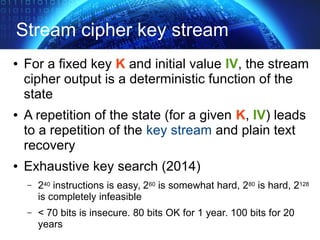
● For a fixed key K and initial value IV, the stream
cipher output is a deterministic function of the
state
● A repetition of the state (for a given K, IV) leads
to a repetition of the key stream and plain text
recovery
● Exhaustive key search (2014)
– 240 instructions is easy, 260 is somewhat hard, 280 is hard, 2128
is completely infeasible
– < 70 bits is insecure. 80 bits OK for 1 year. 100 bits for 20
years
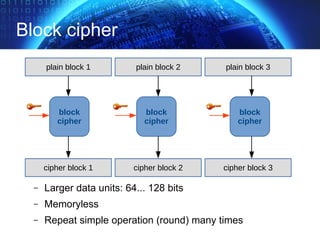
Block cipher
plain block 1 plain block 2 plain block 3
cipher block 1 cipher block 2 cipher block 3
block
cipher
block
cipher
block
cipher
– Larger data units: 64... 128 bits
– Memoryless
– Repeat simple operation (round) many times
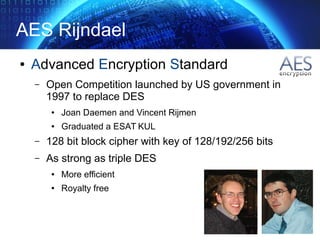
AES Rijndael
● Advanced Encryption Standard
– Open Competition launched by US government in
1997 to replace DES
● Joan Daemen and Vincent Rijmen
● Graduated a ESAT KUL
– 128 bit block cipher with key of 128/192/256 bits
– As strong as triple DES
● More efficient
● Royalty free
Symmetric Data Hashing
● Data authentication through Hashing
– A hash function is a one way function
– Hash functions without a key
● MDC (Manipulation Detection Code)
– MD5: collisions 230 steps
– SHA-1: collisions 269 steps
– SHA-3 (Keccak – BE 2013): collisions 2256 steps
– Hash functions with a secret key
● MAC (Message Authentication Code)
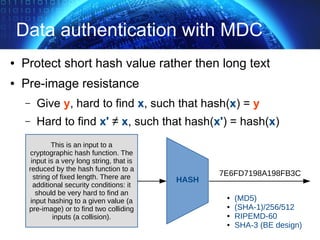
Data authentication with MDC
● Protect short hash value rather then long text
● Pre-image resistance
– Give y, hard to find x, such that hash(x) = y
– Hard to find x' ≠ x, such that hash(x') = hash(x)
This is an input to a
cryptographic hash function. The
input is a very long string, that is
reduced by the hash function to a
string of fixed length. There are
additional security conditions: it
should be very hard to find an
input hashing to a given value (a
pre-image) or to find two colliding
inputs (a collision).
7E6FD7198A198FB3C
HASH
● (MD5)
● (SHA-1)/256/512
● RIPEMD-60
● SHA-3 (BE design)
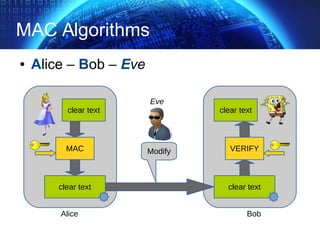
MAC Algorithms
● Alice – Bob – Eve
clear text
clear text
MAC
clear text
clear text
VERIFYModify
Alice Bob
Eve
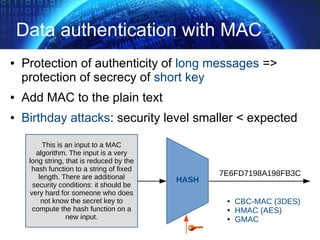
Data authentication with MAC
● Protection of authenticity of long messages =>
protection of secrecy of short key
● Add MAC to the plain text
● Birthday attacks: security level smaller < expected
This is an input to a MAC
algorithm. The input is a very
long string, that is reduced by the
hash function to a string of fixed
length. There are additional
security conditions: it should be
very hard for someone who does
not know the secret key to
compute the hash function on a
new input.
7E6FD7198A198FB3C
HASH
● CBC-MAC (3DES)
● HMAC (AES)
● GMAC
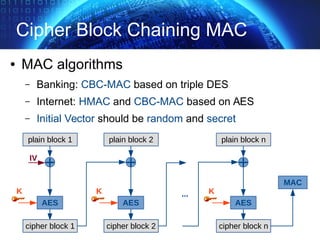
Cipher Block Chaining MAC
● MAC algorithms
– Banking: CBC-MAC based on triple DES
– Internet: HMAC and CBC-MAC based on AES
– Initial Vector should be random and secret
AES
+
K
plain block 1
cipher block 1
AES
+
K
plain block 1
cipher block 1
AES
+
K
plain block 2
cipher block 2
AES
+
K
plain block n
cipher block n
...
IV
MAC
Presentation Overview
● Introduction
● Cryptographic Algorithms
– Symmetric algorithms
– Public-key cryptology
● Entity Authentication
● Network Security
● Conclusion
Why Public-key Cryptology?
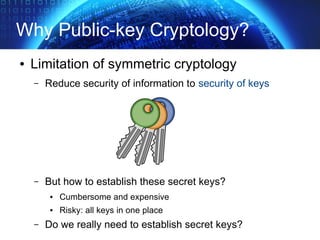
● Limitation of symmetric cryptology
– Reduce security of information to security of keys
– But how to establish these secret keys?
● Cumbersome and expensive
● Risky: all keys in one place
– Do we really need to establish secret keys?
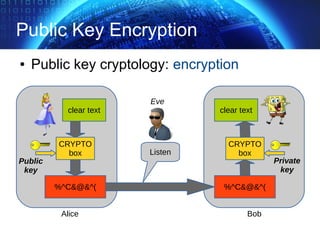
Public Key Encryption
clear text
%^C&@&^(
CRYPTO
box
clear text
%^C&@&^(
CRYPTO
boxListen
Alice Bob
Eve
Public
key
Private
key
● Public key cryptology: encryption
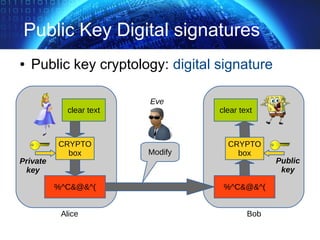
Public Key Digital signatures
● Public key cryptology: digital signature
clear text
%^C&@&^(
CRYPTO
box
clear text
%^C&@&^(
CRYPTO
boxModify
Alice Bob
Eve
Private
key
Public
key
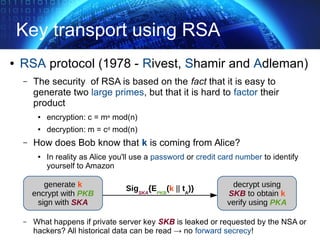
Key transport using RSA
● RSA protocol (1978 - Rivest, Shamir and Adleman)
– The security of RSA is based on the fact that it is easy to
generate two large primes, but that it is hard to factor their
product
● encryption: c = me mod(n)
● decryption: m = cd mod(n)
– How does Bob know that k is coming from Alice?
● In reality as Alice you'll use a password or credit card number to identify
yourself to Amazon
– What happens if private server key SKB is leaked or requested by the NSA or
hackers? All historical data can be read → no forward secrecy!
generate k
encrypt with PKB
sign with SKA
decrypt using
SKB to obtain k
verify using PKA
SigSKA
{EPKB
(k || tA
)}
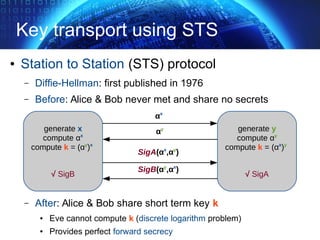
Key transport using STS
● Station to Station (STS) protocol
– Diffie-Hellman: first published in 1976
– Before: Alice & Bob never met and share no secrets
– After: Alice & Bob share short term key k
● Eve cannot compute k (discrete logarithm problem)
● Provides perfect forward secrecy
generate x
compute αx
compute k = (αy
)x
√ SigB
generate y
compute αy
compute k = (αx
)y
√ SigA
αx
αy
SigA(αx
,αy
)
SigB(αy
,αx
)
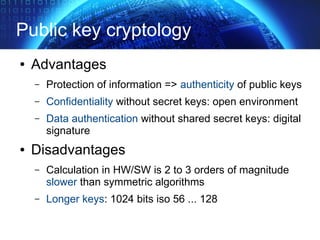
Public key cryptology
● Advantages
– Protection of information => authenticity of public keys
– Confidentiality without secret keys: open environment
– Data authentication without shared secret keys: digital
signature
● Disadvantages
– Calculation in HW/SW is 2 to 3 orders of magnitude
slower than symmetric algorithms
– Longer keys: 1024 bits iso 56 ... 128
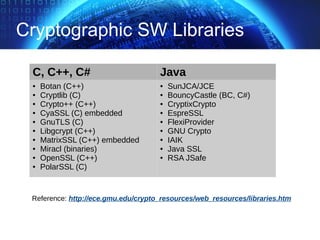
Cryptographic SW Libraries
C, C++, C# Java
● Botan (C++)
● Cryptlib (C)
● Crypto++ (C++)
● CyaSSL (C) embedded
● GnuTLS (C)
● Libgcrypt (C++)
● MatrixSSL (C++) embedded
● Miracl (binaries)
● OpenSSL (C++)
● PolarSSL (C)
● SunJCA/JCE
● BouncyCastle (BC, C#)
● CryptixCrypto
● EspreSSL
● FlexiProvider
● GNU Crypto
● IAIK
● Java SSL
● RSA JSafe
Reference: http://ece.gmu.edu/crypto_resources/web_resources/libraries.htm
Presentation Overview
● Introduction
● Cryptographic Algorithms
● Entity Authentication
– Passwords
– Symmetric Keys
– Public Keys
● Network Security
● Conclusion
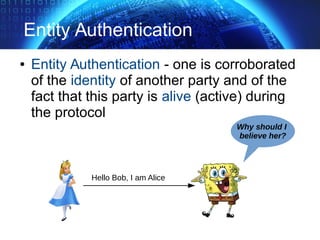
Entity Authentication
● Entity Authentication - one is corroborated
of the identity of another party and of the
fact that this party is alive (active) during
the protocol
Why should I
believe her?
Hello Bob, I am Alice
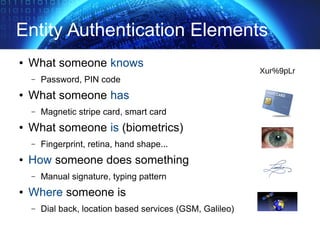
Entity Authentication Elements
● What someone knows
– Password, PIN code
● What someone has
– Magnetic stripe card, smart card
● What someone is (biometrics)
– Fingerprint, retina, hand shape...
● How someone does something
– Manual signature, typing pattern
● Where someone is
– Dial back, location based services (GSM, Galileo)
Xur%9pLr
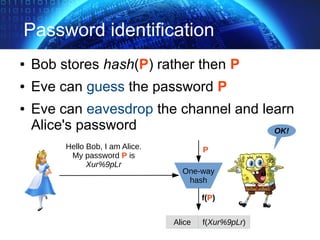
Password identification
● Bob stores hash(P) rather then P
● Eve can guess the password P
● Eve can eavesdrop the channel and learn
Alice's password OK!
Hello Bob, I am Alice.
My password P is
Xur%9pLr
One-way
hash
P
f(P)
Alice f(Xur%9pLr)
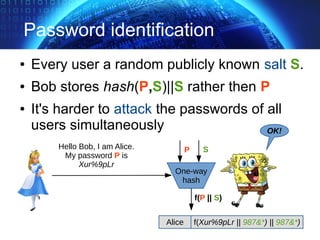
Password identification
● Every user a random publicly known salt S.
● Bob stores hash(P,S)||S rather then P
● It's harder to attack the passwords of all
users simultaneously OK!
Hello Bob, I am Alice.
My password P is
Xur%9pLr
One-way
hash
P
f(P || S)
Alice f(Xur%9pLr || 987&*) || 987&*)
S
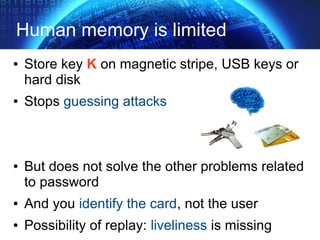
Human memory is limited
● Store key K on magnetic stripe, USB keys or
hard disk
● Stops guessing attacks
● But does not solve the other problems related
to password
● And you identify the card, not the user
● Possibility of replay: liveliness is missing
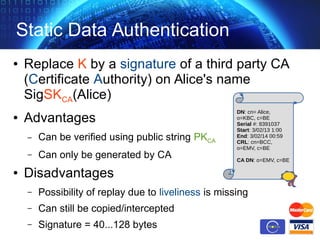
Static Data Authentication
● Replace K by a signature of a third party CA
(Certificate Authority) on Alice's name
SigSKCA(Alice)
● Advantages
– Can be verified using public string PKCA
– Can only be generated by CA
● Disadvantages
– Possibility of replay due to liveliness is missing
– Can still be copied/intercepted
– Signature = 40...128 bytes
DN: cn= Alice,
o=KBC, c=BE
Serial #: 8391037
Start: 3/02/13 1:00
End: 3/02/14 00:59
CRL: cn=BCC,
o=EMV, c=BE
CA DN: o=EMV, c=BE
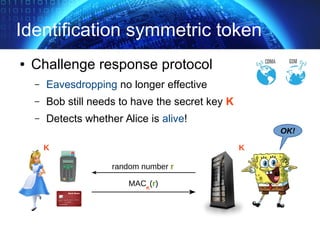
Identification symmetric token
● Challenge response protocol
– Eavesdropping no longer effective
– Bob still needs to have the secret key K
– Detects whether Alice is alive!
OK!
MACK
(r)
random number r
K K
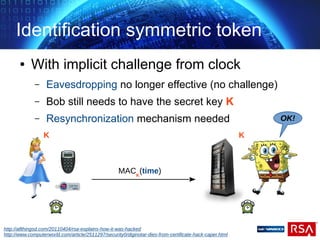
Identification symmetric token
● With implicit challenge from clock
– Eavesdropping no longer effective (no challenge)
– Bob still needs to have the secret key K
– Resynchronization mechanism needed OK!
MACK
(time)
K K
http://allthingsd.com/20110404/rsa-explains-how-it-was-hacked
http://www.computerworld.com/article/2511297/security0/diginotar-dies-from-certificate-hack-caper.html
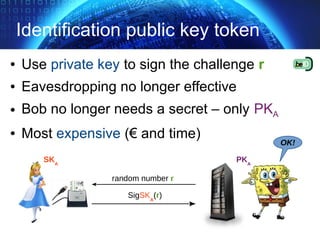
Identification public key token
● Use private key to sign the challenge r
● Eavesdropping no longer effective
● Bob no longer needs a secret – only PKA
● Most expensive (€ and time)
OK!
SigSKA
(r)
random number r
SKA
PKA
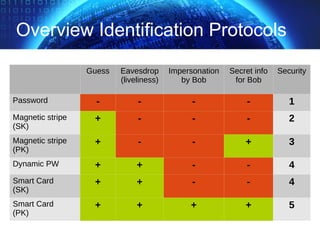
Overview Identification Protocols
Guess Eavesdrop
(liveliness)
Impersonation
by Bob
Secret info
for Bob
Security
Password - - - - 1
Magnetic stripe
(SK)
+ - - - 2
Magnetic stripe
(PK)
+ - - + 3
Dynamic PW + + - - 4
Smart Card
(SK)
+ + - - 4
Smart Card
(PK)
+ + + + 5
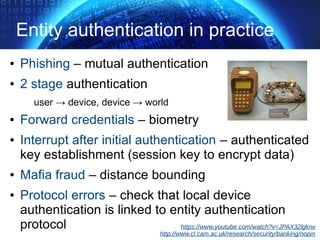
Entity authentication in practice
● Phishing – mutual authentication
● 2 stage authentication
user → device, device → world
● Forward credentials – biometry
● Interrupt after initial authentication – authenticated
key establishment (session key to encrypt data)
● Mafia fraud – distance bounding
● Protocol errors – check that local device
authentication is linked to entity authentication
protocol https://www.youtube.com/watch?v=JPAX32lgkrw
http://www.cl.cam.ac.uk/research/security/banking/nopin
Presentation Overview
● Introduction
● Cryptographic Algorithms
● Entity Authentication
● Network Security
– Transport Layer Security (SSL/TLS)
● Conclusion
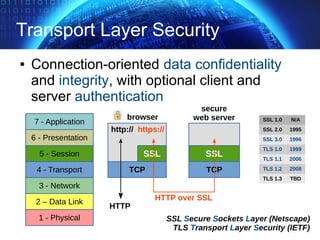
Transport Layer Security
● Connection-oriented data confidentiality
and integrity, with optional client and
server authentication
TCP
SSL
TCP
SSL
https://http://
HTTP
HTTP over SSL
browser
4 - Transport
3 - Network
2 – Data Link
1 - Physical
5 - Session
6 - Presentation
7 - Application
SSL Secure Sockets Layer (Netscape)
TLS Transport Layer Security (IETF)
secure
web server SSL 1.0 N/A
SSL 2.0 1995
SSL 3.0 1996
TLS 1.0 1999
TLS 1.1 2006
TLS 1.2 2008
TLS 1.3 TBD
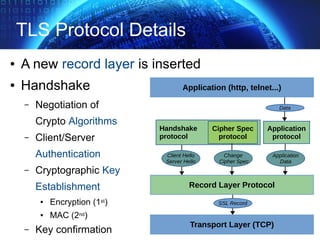
TLS Protocol Details
● A new record layer is inserted
● Handshake
– Negotiation of
Crypto Algorithms
– Client/Server
Authentication
– Cryptographic Key
Establishment
● Encryption (1st)
● MAC (2nd)
– Key confirmation
Application (http, telnet...)
Transport Layer (TCP)
Record Layer Protocol
Handshake
protocol
Cipher Spec
protocol
Application
protocol
Client Hello
Server Hello
Application
Data
Data
SSL Record
Change
Cipher Spec
TLS Handshake Overview
✔ start handshake, protocol version, algorithms
✔ authentication server + exchange (pre)master secret
✔ client authentication
✔ end handshake, integrity verification (*)
Hello Request
Server Hello
Certificate
Server Key Exchange
Certificate Request
Server Hello Done
[change cipher spec]
Finished
Client Hello
Certificate
Client Key Exchange
Certificate Verify
[change cipher spec]
Finished
CLIENT SERVER
MAC*
MAC*
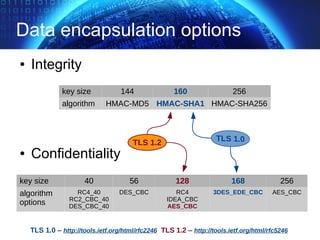
Data encapsulation options
● Integrity
● Confidentiality
key size 144 160 256
algorithm HMAC-MD5 HMAC-SHA1 HMAC-SHA256
key size 40 56 128 168 256
algorithm
options
RC4_40
RC2_CBC_40
DES_CBC_40
DES_CBC RC4
IDEA_CBC
AES_CBC
3DES_EDE_CBC AES_CBC
TLS 1.2
TLS 1.0 – http://tools.ietf.org/html/rfc2246 TLS 1.2 – http://tools.ietf.org/html/rfc5246
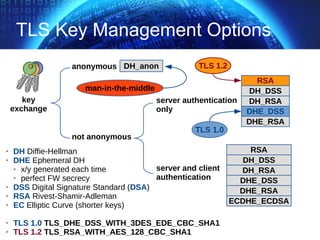
TLS Key Management Options
➢ DH Diffie-Hellman
➢ DHE Ephemeral DH
➢ x/y generated each time
➢ perfect FW secrecy
➢ DSS Digital Signature Standard (DSA)
➢ RSA Rivest-Shamir-Adleman
➢ EC Elliptic Curve (shorter keys)
➢ TLS 1.0 TLS_DHE_DSS_WITH_3DES_EDE_CBC_SHA1
➢ TLS 1.2 TLS_RSA_WITH_AES_128_CBC_SHA1
key
exchange
anonymousanonymous
not anonymous
server authentication
only
server and client
authentication
DH_anon
RSA
DH_DSS
DH_RSA
DHE_DSS
DHE_RSA
RSA
DH_DSS
DH_RSA
DHE_DSS
DHE_RSA
TLS 1.0
man-in-the-middle
ECDHE_ECDSA
TLS 1.2
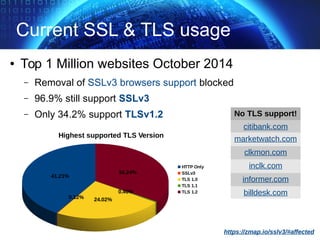
Current SSL & TLS usage
● Top 1 Million websites October 2014
– Removal of SSLv3 browsers support blocked
– 96.9% still support SSLv3
– Only 34.2% support TLSv1.2
https://zmap.io/sslv3/#affected
41.21%
0.12% 24.02%
0.40%
34.24%
Highest supported TLS Version
HTTP Only
SSLv3
TLS 1.0
TLS 1.1
TLS 1.2
No TLS support!
citibank.com
marketwatch.com
clkmon.com
inclk.com
informer.com
billdesk.com
Presentation Overview
● Introduction
● Cryptographic Algorithms
● Entity Authentication
● Network Security
● Conclusion
Conclusions
● Properties of protocols are subtle
● Many standardized protocols exist
– ISO/IEC, IETF
● Difficulty: which properties are needed for
a specific application
● Rule #1 of protocol design – DON'T
– Not even by simplifying existing protocols
References
● A.J. Menezes, P.C. van Oorschot, S.A. Vanstone,
Handbook of Applied Cryptography, CRC Press, 1997.
– http://www.cacr.math.uwaterloo.ca/hac
● N. Smart, Cryptography, An Introduction: 3rd Ed, 2008.
Solid and up to date but on the mathematical side.
– http://www.cs.bris.ac.uk/~nigel/Crypto_Book
● Joseph Bonneau, Cormac Herley, Paul C. van Oorschot,
Frank Stajano: The Quest to Replace Passwords: A
Framework for Comparative Evaluation of Web
Authentication Schemes.
– IEEE Symposium on Security
and Privacy 2012: 553-567
Q&A
● Thanks for your attention
Email: bartvanbos@allbits.eu
LinkedIn: http://lnkd.in/Kre-kR

AllBits presentation - Security in Theory

  • 1.
    29-01-2015 by BartVan Bos - AllBits29-01-2015 by Bart Van Bos - AllBits Security in TheorySecurity in Theory Cryptography and Entity Authentication
  • 2.
    Presentation Overview ● Introduction ●Cryptographic Algorithms ● Entity Authentication ● Network Security ● Conclusion
  • 3.
    Security Terminology ● Definitions –Confidentiality - limit access to information – Authentication - confirming the truth of an attribute – Authorization - access control – Non-repudiation - unable to deny an action ● Don't use the word authentication without defining it Data Entities Confidentiality encryption anonymity Authentication data authentication identification
  • 4.
    Cryptology Basic Principles ●Alice – Bob – Eve clear text %^C&@&^( CRYPTO box clear text %^C&@&^( CRYPTO boxListen – Modify Alice Bob Eve
  • 5.
    Presentation Overview ● Introduction ●Cryptographic Algorithms – Symmetric algorithms – Public-key Cryptology ● Entity Authentication ● Network Security ● Conclusion
  • 6.
    Symmetric Encryption ● Confidentialitythrough encryption – Stream ciphers ● RC4 – 1987 by Ron Rivest (MIT) ● E0 (Bluetooth) or A5/1 (GSM) – Block ciphers ● DES and triple-DES ● AES ● Stream cipher – Plain text digits are combined with a pseudo random cipher digit stream (key stream) ● Block cipher – Fixed-length groups of bits, called blocks, with an unvarying transformation
  • 7.
    Stream cipher init state next state function output function IV K + initstate next state function output function IV K + Plain textPlain text Cipher text looks random
  • 8.
    Stream cipher keystream ● For a fixed key K and initial value IV, the stream cipher output is a deterministic function of the state ● A repetition of the state (for a given K, IV) leads to a repetition of the key stream and plain text recovery ● Exhaustive key search (2014) – 240 instructions is easy, 260 is somewhat hard, 280 is hard, 2128 is completely infeasible – < 70 bits is insecure. 80 bits OK for 1 year. 100 bits for 20 years
  • 9.
    Block cipher plain block1 plain block 2 plain block 3 cipher block 1 cipher block 2 cipher block 3 block cipher block cipher block cipher – Larger data units: 64... 128 bits – Memoryless – Repeat simple operation (round) many times
  • 10.
    AES Rijndael ● AdvancedEncryption Standard – Open Competition launched by US government in 1997 to replace DES ● Joan Daemen and Vincent Rijmen ● Graduated a ESAT KUL – 128 bit block cipher with key of 128/192/256 bits – As strong as triple DES ● More efficient ● Royalty free
  • 11.
    Symmetric Data Hashing ●Data authentication through Hashing – A hash function is a one way function – Hash functions without a key ● MDC (Manipulation Detection Code) – MD5: collisions 230 steps – SHA-1: collisions 269 steps – SHA-3 (Keccak – BE 2013): collisions 2256 steps – Hash functions with a secret key ● MAC (Message Authentication Code)
  • 12.
    Data authentication withMDC ● Protect short hash value rather then long text ● Pre-image resistance – Give y, hard to find x, such that hash(x) = y – Hard to find x' ≠ x, such that hash(x') = hash(x) This is an input to a cryptographic hash function. The input is a very long string, that is reduced by the hash function to a string of fixed length. There are additional security conditions: it should be very hard to find an input hashing to a given value (a pre-image) or to find two colliding inputs (a collision). 7E6FD7198A198FB3C HASH ● (MD5) ● (SHA-1)/256/512 ● RIPEMD-60 ● SHA-3 (BE design)
  • 13.
    MAC Algorithms ● Alice– Bob – Eve clear text clear text MAC clear text clear text VERIFYModify Alice Bob Eve
  • 14.
    Data authentication withMAC ● Protection of authenticity of long messages => protection of secrecy of short key ● Add MAC to the plain text ● Birthday attacks: security level smaller < expected This is an input to a MAC algorithm. The input is a very long string, that is reduced by the hash function to a string of fixed length. There are additional security conditions: it should be very hard for someone who does not know the secret key to compute the hash function on a new input. 7E6FD7198A198FB3C HASH ● CBC-MAC (3DES) ● HMAC (AES) ● GMAC
  • 15.
    Cipher Block ChainingMAC ● MAC algorithms – Banking: CBC-MAC based on triple DES – Internet: HMAC and CBC-MAC based on AES – Initial Vector should be random and secret AES + K plain block 1 cipher block 1 AES + K plain block 1 cipher block 1 AES + K plain block 2 cipher block 2 AES + K plain block n cipher block n ... IV MAC
  • 16.
    Presentation Overview ● Introduction ●Cryptographic Algorithms – Symmetric algorithms – Public-key cryptology ● Entity Authentication ● Network Security ● Conclusion
  • 17.
    Why Public-key Cryptology? ●Limitation of symmetric cryptology – Reduce security of information to security of keys – But how to establish these secret keys? ● Cumbersome and expensive ● Risky: all keys in one place – Do we really need to establish secret keys?
  • 18.
    Public Key Encryption cleartext %^C&@&^( CRYPTO box clear text %^C&@&^( CRYPTO boxListen Alice Bob Eve Public key Private key ● Public key cryptology: encryption
  • 19.
    Public Key Digitalsignatures ● Public key cryptology: digital signature clear text %^C&@&^( CRYPTO box clear text %^C&@&^( CRYPTO boxModify Alice Bob Eve Private key Public key
  • 20.
    Key transport usingRSA ● RSA protocol (1978 - Rivest, Shamir and Adleman) – The security of RSA is based on the fact that it is easy to generate two large primes, but that it is hard to factor their product ● encryption: c = me mod(n) ● decryption: m = cd mod(n) – How does Bob know that k is coming from Alice? ● In reality as Alice you'll use a password or credit card number to identify yourself to Amazon – What happens if private server key SKB is leaked or requested by the NSA or hackers? All historical data can be read → no forward secrecy! generate k encrypt with PKB sign with SKA decrypt using SKB to obtain k verify using PKA SigSKA {EPKB (k || tA )}
  • 21.
    Key transport usingSTS ● Station to Station (STS) protocol – Diffie-Hellman: first published in 1976 – Before: Alice & Bob never met and share no secrets – After: Alice & Bob share short term key k ● Eve cannot compute k (discrete logarithm problem) ● Provides perfect forward secrecy generate x compute αx compute k = (αy )x √ SigB generate y compute αy compute k = (αx )y √ SigA αx αy SigA(αx ,αy ) SigB(αy ,αx )
  • 22.
    Public key cryptology ●Advantages – Protection of information => authenticity of public keys – Confidentiality without secret keys: open environment – Data authentication without shared secret keys: digital signature ● Disadvantages – Calculation in HW/SW is 2 to 3 orders of magnitude slower than symmetric algorithms – Longer keys: 1024 bits iso 56 ... 128
  • 23.
    Cryptographic SW Libraries C,C++, C# Java ● Botan (C++) ● Cryptlib (C) ● Crypto++ (C++) ● CyaSSL (C) embedded ● GnuTLS (C) ● Libgcrypt (C++) ● MatrixSSL (C++) embedded ● Miracl (binaries) ● OpenSSL (C++) ● PolarSSL (C) ● SunJCA/JCE ● BouncyCastle (BC, C#) ● CryptixCrypto ● EspreSSL ● FlexiProvider ● GNU Crypto ● IAIK ● Java SSL ● RSA JSafe Reference: http://ece.gmu.edu/crypto_resources/web_resources/libraries.htm
  • 24.
    Presentation Overview ● Introduction ●Cryptographic Algorithms ● Entity Authentication – Passwords – Symmetric Keys – Public Keys ● Network Security ● Conclusion
  • 25.
    Entity Authentication ● EntityAuthentication - one is corroborated of the identity of another party and of the fact that this party is alive (active) during the protocol Why should I believe her? Hello Bob, I am Alice
  • 26.
    Entity Authentication Elements ●What someone knows – Password, PIN code ● What someone has – Magnetic stripe card, smart card ● What someone is (biometrics) – Fingerprint, retina, hand shape... ● How someone does something – Manual signature, typing pattern ● Where someone is – Dial back, location based services (GSM, Galileo) Xur%9pLr
  • 27.
    Password identification ● Bobstores hash(P) rather then P ● Eve can guess the password P ● Eve can eavesdrop the channel and learn Alice's password OK! Hello Bob, I am Alice. My password P is Xur%9pLr One-way hash P f(P) Alice f(Xur%9pLr)
  • 28.
    Password identification ● Everyuser a random publicly known salt S. ● Bob stores hash(P,S)||S rather then P ● It's harder to attack the passwords of all users simultaneously OK! Hello Bob, I am Alice. My password P is Xur%9pLr One-way hash P f(P || S) Alice f(Xur%9pLr || 987&*) || 987&*) S
  • 29.
    Human memory islimited ● Store key K on magnetic stripe, USB keys or hard disk ● Stops guessing attacks ● But does not solve the other problems related to password ● And you identify the card, not the user ● Possibility of replay: liveliness is missing
  • 30.
    Static Data Authentication ●Replace K by a signature of a third party CA (Certificate Authority) on Alice's name SigSKCA(Alice) ● Advantages – Can be verified using public string PKCA – Can only be generated by CA ● Disadvantages – Possibility of replay due to liveliness is missing – Can still be copied/intercepted – Signature = 40...128 bytes DN: cn= Alice, o=KBC, c=BE Serial #: 8391037 Start: 3/02/13 1:00 End: 3/02/14 00:59 CRL: cn=BCC, o=EMV, c=BE CA DN: o=EMV, c=BE
  • 31.
    Identification symmetric token ●Challenge response protocol – Eavesdropping no longer effective – Bob still needs to have the secret key K – Detects whether Alice is alive! OK! MACK (r) random number r K K
  • 32.
    Identification symmetric token ●With implicit challenge from clock – Eavesdropping no longer effective (no challenge) – Bob still needs to have the secret key K – Resynchronization mechanism needed OK! MACK (time) K K http://allthingsd.com/20110404/rsa-explains-how-it-was-hacked http://www.computerworld.com/article/2511297/security0/diginotar-dies-from-certificate-hack-caper.html
  • 33.
    Identification public keytoken ● Use private key to sign the challenge r ● Eavesdropping no longer effective ● Bob no longer needs a secret – only PKA ● Most expensive (€ and time) OK! SigSKA (r) random number r SKA PKA
  • 34.
    Overview Identification Protocols GuessEavesdrop (liveliness) Impersonation by Bob Secret info for Bob Security Password - - - - 1 Magnetic stripe (SK) + - - - 2 Magnetic stripe (PK) + - - + 3 Dynamic PW + + - - 4 Smart Card (SK) + + - - 4 Smart Card (PK) + + + + 5
  • 35.
    Entity authentication inpractice ● Phishing – mutual authentication ● 2 stage authentication user → device, device → world ● Forward credentials – biometry ● Interrupt after initial authentication – authenticated key establishment (session key to encrypt data) ● Mafia fraud – distance bounding ● Protocol errors – check that local device authentication is linked to entity authentication protocol https://www.youtube.com/watch?v=JPAX32lgkrw http://www.cl.cam.ac.uk/research/security/banking/nopin
  • 36.
    Presentation Overview ● Introduction ●Cryptographic Algorithms ● Entity Authentication ● Network Security – Transport Layer Security (SSL/TLS) ● Conclusion
  • 37.
    Transport Layer Security ●Connection-oriented data confidentiality and integrity, with optional client and server authentication TCP SSL TCP SSL https://http:// HTTP HTTP over SSL browser 4 - Transport 3 - Network 2 – Data Link 1 - Physical 5 - Session 6 - Presentation 7 - Application SSL Secure Sockets Layer (Netscape) TLS Transport Layer Security (IETF) secure web server SSL 1.0 N/A SSL 2.0 1995 SSL 3.0 1996 TLS 1.0 1999 TLS 1.1 2006 TLS 1.2 2008 TLS 1.3 TBD
  • 38.
    TLS Protocol Details ●A new record layer is inserted ● Handshake – Negotiation of Crypto Algorithms – Client/Server Authentication – Cryptographic Key Establishment ● Encryption (1st) ● MAC (2nd) – Key confirmation Application (http, telnet...) Transport Layer (TCP) Record Layer Protocol Handshake protocol Cipher Spec protocol Application protocol Client Hello Server Hello Application Data Data SSL Record Change Cipher Spec
  • 39.
    TLS Handshake Overview ✔start handshake, protocol version, algorithms ✔ authentication server + exchange (pre)master secret ✔ client authentication ✔ end handshake, integrity verification (*) Hello Request Server Hello Certificate Server Key Exchange Certificate Request Server Hello Done [change cipher spec] Finished Client Hello Certificate Client Key Exchange Certificate Verify [change cipher spec] Finished CLIENT SERVER MAC* MAC*
  • 40.
    Data encapsulation options ●Integrity ● Confidentiality key size 144 160 256 algorithm HMAC-MD5 HMAC-SHA1 HMAC-SHA256 key size 40 56 128 168 256 algorithm options RC4_40 RC2_CBC_40 DES_CBC_40 DES_CBC RC4 IDEA_CBC AES_CBC 3DES_EDE_CBC AES_CBC TLS 1.2 TLS 1.0 – http://tools.ietf.org/html/rfc2246 TLS 1.2 – http://tools.ietf.org/html/rfc5246
  • 41.
    TLS Key ManagementOptions ➢ DH Diffie-Hellman ➢ DHE Ephemeral DH ➢ x/y generated each time ➢ perfect FW secrecy ➢ DSS Digital Signature Standard (DSA) ➢ RSA Rivest-Shamir-Adleman ➢ EC Elliptic Curve (shorter keys) ➢ TLS 1.0 TLS_DHE_DSS_WITH_3DES_EDE_CBC_SHA1 ➢ TLS 1.2 TLS_RSA_WITH_AES_128_CBC_SHA1 key exchange anonymousanonymous not anonymous server authentication only server and client authentication DH_anon RSA DH_DSS DH_RSA DHE_DSS DHE_RSA RSA DH_DSS DH_RSA DHE_DSS DHE_RSA TLS 1.0 man-in-the-middle ECDHE_ECDSA TLS 1.2
  • 42.
    Current SSL &TLS usage ● Top 1 Million websites October 2014 – Removal of SSLv3 browsers support blocked – 96.9% still support SSLv3 – Only 34.2% support TLSv1.2 https://zmap.io/sslv3/#affected 41.21% 0.12% 24.02% 0.40% 34.24% Highest supported TLS Version HTTP Only SSLv3 TLS 1.0 TLS 1.1 TLS 1.2 No TLS support! citibank.com marketwatch.com clkmon.com inclk.com informer.com billdesk.com
  • 43.
    Presentation Overview ● Introduction ●Cryptographic Algorithms ● Entity Authentication ● Network Security ● Conclusion
  • 44.
    Conclusions ● Properties ofprotocols are subtle ● Many standardized protocols exist – ISO/IEC, IETF ● Difficulty: which properties are needed for a specific application ● Rule #1 of protocol design – DON'T – Not even by simplifying existing protocols
  • 45.
    References ● A.J. Menezes,P.C. van Oorschot, S.A. Vanstone, Handbook of Applied Cryptography, CRC Press, 1997. – http://www.cacr.math.uwaterloo.ca/hac ● N. Smart, Cryptography, An Introduction: 3rd Ed, 2008. Solid and up to date but on the mathematical side. – http://www.cs.bris.ac.uk/~nigel/Crypto_Book ● Joseph Bonneau, Cormac Herley, Paul C. van Oorschot, Frank Stajano: The Quest to Replace Passwords: A Framework for Comparative Evaluation of Web Authentication Schemes. – IEEE Symposium on Security and Privacy 2012: 553-567
  • 46.
    Q&A ● Thanks foryour attention Email: bartvanbos@allbits.eu LinkedIn: http://lnkd.in/Kre-kR