3-2-1 Entry Card
3 – Things I already know about
eclipses
2 – Superstitious beliefs I know
about eclipses
1 – Thing I want to know more
about eclipses
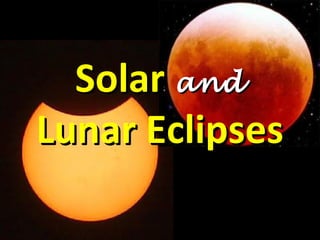
Solar and
Lunar Eclipses
ECLIPSE
• It occurs when the
source of light is
blocked
• when the sun, Earth and
moon are in one straight
line.
Lunar Eclipses

• It occurs when the moon passes
through Earth’s shadow. (Full Moon)
• Umbra – The dark inner portion of
the shadow cone.
• Penumbral – the lighter outer
portion of the shadow.
Types of Lunar Eclipses

1. Total Lunar Eclipse
2. Partial Lunar Eclipse
3. Penumbral Lunar
Eclipse
Total Lunar Eclipse – when the Moon passes
completely into the Umbra, or total shadow of the
Earth.
Partial Lunar Eclipse – Occur when the
Moon does not fully move into the Umbra
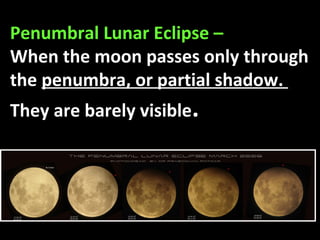
Penumbral Lunar Eclipse –
When the moon passes only through
the penumbra, or partial shadow.
They are barely visible.
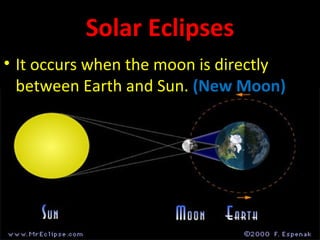
Solar Eclipses
• It occurs when the moon is directly
between Earth and Sun. (New Moon)
Types of Solar
Eclipses

1. Total Solar Eclipse
2. Partial Solar Eclipse
3. Annular Eclipse
Total Solar Eclipse – can only
occur if you are at the exact spot within
the moon’s umbra (which isn’t very big).
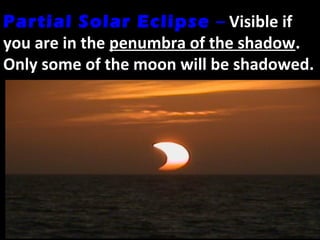
Partial Solar Eclipse – Visible if
you are in the penumbra of the shadow.
Only some of the moon will be shadowed.
Annular Eclipse – occurs
when the moon is farthest from
the Earth in its orbit.
This makes the
moon look smaller,
so during the
eclipse you see an
outer ring of light
from the Sun.
2 Kinds of Eclipse
Solar Eclipse
Daytime
When the Moon
casts a shadow on
the Earth, causing
the sun to go dark.

Lunar Eclipse
Nighttime
When the Earth
casts a shadow on
the moon, causing
the moon to go
dark.

SME
New Moon

SEM
Full Moon
How often do Eclipses Happen?

• That depends. Lunar Eclipses
happen more often than Solar
Eclipses.
• Everyone who is
experiencing nighttime
during a lunar eclipse can
see it.
How often do Eclipses Happen?

• But you have to be at the

exact spot on Earth to see a

Solar Eclipse.
• The spot on Earth is so small, that
the same place only sees a Solar
Eclipse every

350 years*.
Why Don’t We See Lunar
Eclipses More Often?
• Well, lunar eclipses don’t happen everyday
because the Moon’s orbit is tilted.
So, during most months, the Moon is above or
below the Earth.
Dates

Object

15 Apr 2014
8 Oct 2014

Lunar

29 Apr 2014

Solar

23 Oct 2014

Solar

20 Mar 2015

Solar

Type

Where is the eclipse visible
West in Asia, East in North
Total America, Parts of South
America
South in Asia, Australia,
Annular Pacific, Indian Ocean,
Antarctica
East in Asia, Much of North
Partial
America, Pacific, Atlantic
Europe, Parts of Asia, Parts
Total of Africa, West in North
America, Atlantic, Arctic
Eclipse
Venn
Diagram

Eclipses

  • 1.
    3-2-1 Entry Card 3– Things I already know about eclipses 2 – Superstitious beliefs I know about eclipses 1 – Thing I want to know more about eclipses
  • 2.
  • 3.
    ECLIPSE • It occurswhen the source of light is blocked • when the sun, Earth and moon are in one straight line.
  • 4.
    Lunar Eclipses • Itoccurs when the moon passes through Earth’s shadow. (Full Moon)
  • 5.
    • Umbra –The dark inner portion of the shadow cone. • Penumbral – the lighter outer portion of the shadow.
  • 6.
    Types of LunarEclipses 1. Total Lunar Eclipse 2. Partial Lunar Eclipse 3. Penumbral Lunar Eclipse
  • 7.
    Total Lunar Eclipse– when the Moon passes completely into the Umbra, or total shadow of the Earth.
  • 8.
    Partial Lunar Eclipse– Occur when the Moon does not fully move into the Umbra
  • 9.
    Penumbral Lunar Eclipse– When the moon passes only through the penumbra, or partial shadow. They are barely visible.
  • 10.
    Solar Eclipses • Itoccurs when the moon is directly between Earth and Sun. (New Moon)
  • 11.
    Types of Solar Eclipses 1.Total Solar Eclipse 2. Partial Solar Eclipse 3. Annular Eclipse
  • 12.
    Total Solar Eclipse– can only occur if you are at the exact spot within the moon’s umbra (which isn’t very big).
  • 13.
    Partial Solar Eclipse– Visible if you are in the penumbra of the shadow. Only some of the moon will be shadowed.
  • 14.
    Annular Eclipse –occurs when the moon is farthest from the Earth in its orbit. This makes the moon look smaller, so during the eclipse you see an outer ring of light from the Sun.
  • 15.
    2 Kinds ofEclipse Solar Eclipse Daytime When the Moon casts a shadow on the Earth, causing the sun to go dark. Lunar Eclipse Nighttime When the Earth casts a shadow on the moon, causing the moon to go dark. SME New Moon SEM Full Moon
  • 16.
    How often doEclipses Happen? • That depends. Lunar Eclipses happen more often than Solar Eclipses. • Everyone who is experiencing nighttime during a lunar eclipse can see it.
  • 17.
    How often doEclipses Happen? • But you have to be at the exact spot on Earth to see a Solar Eclipse. • The spot on Earth is so small, that the same place only sees a Solar Eclipse every 350 years*.
  • 18.
    Why Don’t WeSee Lunar Eclipses More Often? • Well, lunar eclipses don’t happen everyday because the Moon’s orbit is tilted. So, during most months, the Moon is above or below the Earth.
  • 21.
    Dates Object 15 Apr 2014 8Oct 2014 Lunar 29 Apr 2014 Solar 23 Oct 2014 Solar 20 Mar 2015 Solar Type Where is the eclipse visible West in Asia, East in North Total America, Parts of South America South in Asia, Australia, Annular Pacific, Indian Ocean, Antarctica East in Asia, Much of North Partial America, Pacific, Atlantic Europe, Parts of Asia, Parts Total of Africa, West in North America, Atlantic, Arctic
  • 22.