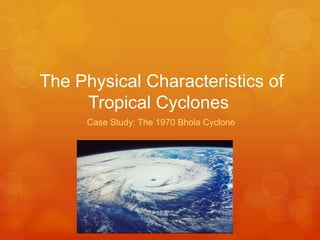
The Physical Characteristics of
Tropical Cyclones
Case Study: The 1970 Bhola Cyclone
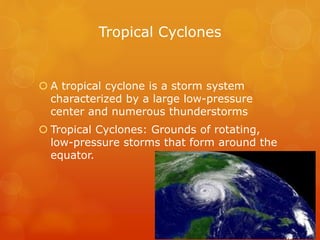
Tropical Cyclones

 A tropical cyclone is a storm system
characterized by a large low-pressure
center and numerous thunderstorms
 Tropical Cyclones: Grounds of rotating,
low-pressure storms that form around the
equator.
Cyclones, Hurricanes, Typhoons
 Named according to region
where they develops
 Cyclones – Develop over
the Indian Ocean on worm
waters

Eye

 Hurricanes - Develop over
Atlantic and eastern Pacific
Oceans

 Typhoons – Develop over
western Pacific Oceans
 All produce similar effects

Typhoon Odessa, Philippines
Fact.

The strongest of these cyclones storms are
known in the US and other parts of the
Atlantic ocean
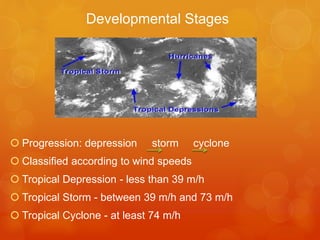
Developmental Stages

 Progression: depression

storm

cyclone

 Classified according to wind speeds
 Tropical Depression - less than 39 m/h

 Tropical Storm - between 39 m/h and 73 m/h
 Tropical Cyclone - at least 74 m/h
Tropical Cyclones Introduction

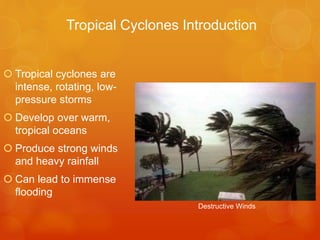
 Tropical cyclones are
intense, rotating, lowpressure storms

 Develop over warm,
tropical oceans
 Produce strong winds
and heavy rainfall

 Can lead to immense
flooding
Destructive Winds
Formation of tropical cyclones

 Tropical Cyclones require to basic
conditions to form: an abundant supply of
very warm ocean water and some sort of
disturbance to lift warm air and keep it
rising.
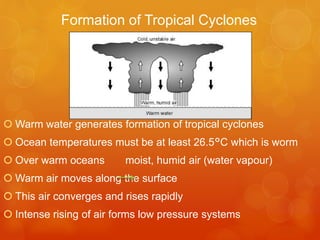
Formation of Tropical Cyclones

 Warm water generates formation of tropical cyclones
 Ocean temperatures must be at least 26.5°C which is worm
 Over warm oceans

moist, humid air (water vapour)

 Warm air moves along the surface
 This air converges and rises rapidly
 Intense rising of air forms low pressure systems
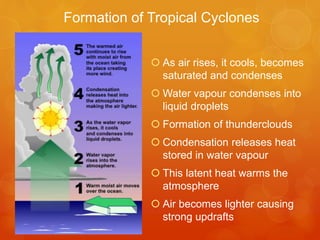
Formation of Tropical Cyclones
 As air rises, it cools, becomes
saturated and condenses
 Water vapour condenses into
liquid droplets

 Formation of thunderclouds
 Condensation releases heat
stored in water vapour
 This latent heat warms the
atmosphere
 Air becomes lighter causing
strong updrafts
Formation of Tropical Cyclones

 Air expands and diverges at higher levels
 Occurs only where wind speed/direction remain constant
(no wind shear)
 Air moves in at surface taking the place of rising air

 This intensifies convergence
 Creates wind and increases rising movement
 Builds and progresses into a mature cyclone
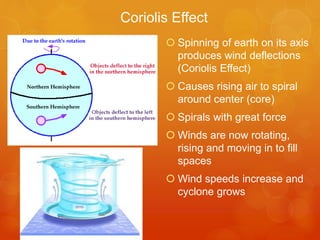
Coriolis Effect
 Spinning of earth on its axis
produces wind deflections
(Coriolis Effect)

 Causes rising air to spiral
around center (core)
 Spirals with great force

 Winds are now rotating,
rising and moving in to fill
spaces
 Wind speeds increase and
cyclone grows
Conditions

 These conditions exist in all tropical
oceans except the south Atlantic ocean
and the pacific, west of the South
American coast ocean waters in these
areas are somewhat cooler.
Coriolis Effect

 Northern hemisphere winds are blowing counterclockwise around center core

 Southern hemisphere winds are blowing clockwise
around center core
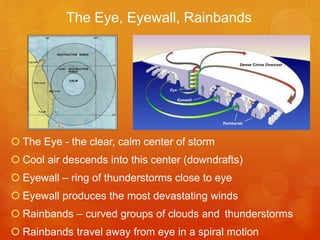
The Eye, Eyewall, Rainbands

 The Eye - the clear, calm center of storm
 Cool air descends into this center (downdrafts)
 Eyewall – ring of thunderstorms close to eye
 Eyewall produces the most devastating winds
 Rainbands – curved groups of clouds and thunderstorms
 Rainbands travel away from eye in a spiral motion
Storm Surges

 Occur when tropical cyclones reach land
 Storm surge – raised swell of water
 60 to 80 km across
 Around 2 to 5 meters higher than normal tides
 Created by heavy winds and cause flooding
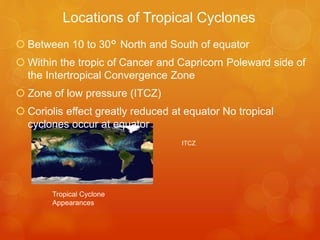
Locations of Tropical Cyclones
 Between 10 to 30° North and South of equator
 Within the tropic of Cancer and Capricorn Poleward side of
the Intertropical Convergence Zone

 Zone of low pressure (ITCZ)
 Coriolis effect greatly reduced at equator No tropical
cyclones occur at equator
ITCZ

Tropical Cyclone
Appearances
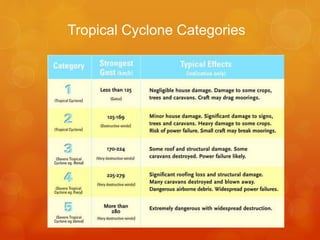
Tropical Cyclone Categories
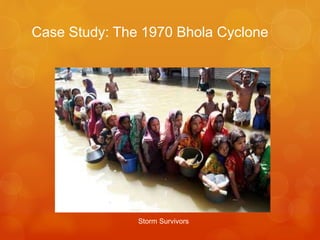
Case Study: The 1970 Bhola Cyclone

Storm Survivors
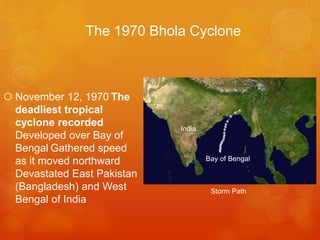
The 1970 Bhola Cyclone

 November 12, 1970 The
deadliest tropical
cyclone recorded
Developed over Bay of
Bengal Gathered speed
as it moved northward
Devastated East Pakistan
(Bangladesh) and West
Bengal of India

India

Bay of Bengal

Storm Path
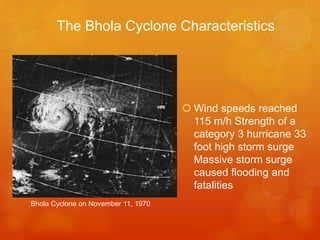
The Bhola Cyclone Characteristics

 Wind speeds reached
115 m/h Strength of a
category 3 hurricane 33
foot high storm surge
Massive storm surge
caused flooding and
fatalities
Bhola Cyclone on November 11, 1970
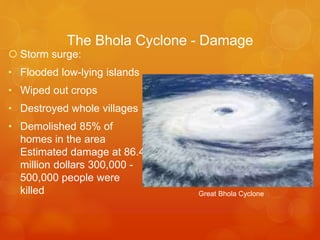
The Bhola Cyclone - Damage
 Storm surge:
• Flooded low-lying islands
• Wiped out crops
• Destroyed whole villages
• Demolished 85% of
homes in the area
Estimated damage at 86.4
million dollars 300,000 500,000 people were
killed

Great Bhola Cyclone
Mid-latitude Storms

 Unlike mid latitude storms that derive
their energy from the contrast between
warm and cold air masses. Tropical
Cyclones oceans as water evaporates from
the ocean surface.
Ocean Surface

 The ocean surface latent heat is later
released when the air begins to rise and
water vapor condenses into clouds and
rain


Ashley Proctor Samone Proctor Chelsea Addison



(3)



(8)



(1)



(6)



(4)



(5)



(2)



(7)

References

Australian Government Bureau of Meteorology. (2009). About Tropical Cyclones. Retrieved November 22, 2009, from
http://www.bom.gov.au/weather/cyclone/about/about-tropical-cyclones.shtml
1970 Bhola cyclone. (2009, November 22). In Wikipedia, The Free Encyclopedia. Retrieved November 23, 2009, from
http://en.wikipedia.org/wiki/1970_Bhola_cyclone
Catto, N., Hyndman, D., Hyndman, D. (2009). Natural Hazards and Disasters. Toronto, ON:

Nelson Education

Earth Science Australia. (2009). Tropical Cyclones. Retrieved November 22, 2009, from
http://earthsci.org/flood/J_Flood04/cyclone/cyclone.html

National Weather Service. (2008, October 8). Tropical Weather. Retrieved November 22, 2009, from
http://oceanservice.noaa.gov/education/yos/resource/JetStream/tropics/tc.htm

Nelson, S.A. (2009, October 30). Exceptional Weather – Tropical Cyclones. Retrieved November 22, 2009, from
http://www.tulane.edu/~sanelson/geol204/tropical_cyclones.htm

Tropical cyclone. (2009, November 22). In Wikipedia, The Free Encyclopedia. Retrieved November 20, 2009, from
http://en.wikipedia.org/wiki/Tropical_cyclone
WikiAnswers. (2009). How do cyclones form? Retrieved November 23, 2009, from
http://wiki.answers.com/Q/How_do_cyclones_form&alreadyAsked=1&rtitle=What_causes_cyclones

Tropical cyclone by Martin

  • 1.
    The Physical Characteristicsof Tropical Cyclones Case Study: The 1970 Bhola Cyclone
  • 2.
    Tropical Cyclones  Atropical cyclone is a storm system characterized by a large low-pressure center and numerous thunderstorms  Tropical Cyclones: Grounds of rotating, low-pressure storms that form around the equator.
  • 3.
    Cyclones, Hurricanes, Typhoons Named according to region where they develops  Cyclones – Develop over the Indian Ocean on worm waters Eye  Hurricanes - Develop over Atlantic and eastern Pacific Oceans  Typhoons – Develop over western Pacific Oceans  All produce similar effects Typhoon Odessa, Philippines
  • 4.
    Fact. The strongest ofthese cyclones storms are known in the US and other parts of the Atlantic ocean
  • 5.
    Developmental Stages  Progression:depression storm cyclone  Classified according to wind speeds  Tropical Depression - less than 39 m/h  Tropical Storm - between 39 m/h and 73 m/h  Tropical Cyclone - at least 74 m/h
  • 6.
    Tropical Cyclones Introduction Tropical cyclones are intense, rotating, lowpressure storms  Develop over warm, tropical oceans  Produce strong winds and heavy rainfall  Can lead to immense flooding Destructive Winds
  • 7.
    Formation of tropicalcyclones  Tropical Cyclones require to basic conditions to form: an abundant supply of very warm ocean water and some sort of disturbance to lift warm air and keep it rising.
  • 8.
    Formation of TropicalCyclones  Warm water generates formation of tropical cyclones  Ocean temperatures must be at least 26.5°C which is worm  Over warm oceans moist, humid air (water vapour)  Warm air moves along the surface  This air converges and rises rapidly  Intense rising of air forms low pressure systems
  • 9.
    Formation of TropicalCyclones  As air rises, it cools, becomes saturated and condenses  Water vapour condenses into liquid droplets  Formation of thunderclouds  Condensation releases heat stored in water vapour  This latent heat warms the atmosphere  Air becomes lighter causing strong updrafts
  • 10.
    Formation of TropicalCyclones  Air expands and diverges at higher levels  Occurs only where wind speed/direction remain constant (no wind shear)  Air moves in at surface taking the place of rising air  This intensifies convergence  Creates wind and increases rising movement  Builds and progresses into a mature cyclone
  • 11.
    Coriolis Effect  Spinningof earth on its axis produces wind deflections (Coriolis Effect)  Causes rising air to spiral around center (core)  Spirals with great force  Winds are now rotating, rising and moving in to fill spaces  Wind speeds increase and cyclone grows
  • 12.
    Conditions  These conditionsexist in all tropical oceans except the south Atlantic ocean and the pacific, west of the South American coast ocean waters in these areas are somewhat cooler.
  • 13.
    Coriolis Effect  Northernhemisphere winds are blowing counterclockwise around center core  Southern hemisphere winds are blowing clockwise around center core
  • 14.
    The Eye, Eyewall,Rainbands  The Eye - the clear, calm center of storm  Cool air descends into this center (downdrafts)  Eyewall – ring of thunderstorms close to eye  Eyewall produces the most devastating winds  Rainbands – curved groups of clouds and thunderstorms  Rainbands travel away from eye in a spiral motion
  • 15.
    Storm Surges  Occurwhen tropical cyclones reach land  Storm surge – raised swell of water  60 to 80 km across  Around 2 to 5 meters higher than normal tides  Created by heavy winds and cause flooding
  • 16.
    Locations of TropicalCyclones  Between 10 to 30° North and South of equator  Within the tropic of Cancer and Capricorn Poleward side of the Intertropical Convergence Zone  Zone of low pressure (ITCZ)  Coriolis effect greatly reduced at equator No tropical cyclones occur at equator ITCZ Tropical Cyclone Appearances
  • 17.
  • 18.
    Case Study: The1970 Bhola Cyclone Storm Survivors
  • 19.
    The 1970 BholaCyclone  November 12, 1970 The deadliest tropical cyclone recorded Developed over Bay of Bengal Gathered speed as it moved northward Devastated East Pakistan (Bangladesh) and West Bengal of India India Bay of Bengal Storm Path
  • 20.
    The Bhola CycloneCharacteristics  Wind speeds reached 115 m/h Strength of a category 3 hurricane 33 foot high storm surge Massive storm surge caused flooding and fatalities Bhola Cyclone on November 11, 1970
  • 21.
    The Bhola Cyclone- Damage  Storm surge: • Flooded low-lying islands • Wiped out crops • Destroyed whole villages • Demolished 85% of homes in the area Estimated damage at 86.4 million dollars 300,000 500,000 people were killed Great Bhola Cyclone
  • 22.
    Mid-latitude Storms  Unlikemid latitude storms that derive their energy from the contrast between warm and cold air masses. Tropical Cyclones oceans as water evaporates from the ocean surface.
  • 23.
    Ocean Surface  Theocean surface latent heat is later released when the air begins to rise and water vapor condenses into clouds and rain
  • 24.
     Ashley Proctor SamoneProctor Chelsea Addison  (3)  (8)  (1)  (6)  (4)  (5)  (2)  (7) References Australian Government Bureau of Meteorology. (2009). About Tropical Cyclones. Retrieved November 22, 2009, from http://www.bom.gov.au/weather/cyclone/about/about-tropical-cyclones.shtml 1970 Bhola cyclone. (2009, November 22). In Wikipedia, The Free Encyclopedia. Retrieved November 23, 2009, from http://en.wikipedia.org/wiki/1970_Bhola_cyclone Catto, N., Hyndman, D., Hyndman, D. (2009). Natural Hazards and Disasters. Toronto, ON: Nelson Education Earth Science Australia. (2009). Tropical Cyclones. Retrieved November 22, 2009, from http://earthsci.org/flood/J_Flood04/cyclone/cyclone.html National Weather Service. (2008, October 8). Tropical Weather. Retrieved November 22, 2009, from http://oceanservice.noaa.gov/education/yos/resource/JetStream/tropics/tc.htm Nelson, S.A. (2009, October 30). Exceptional Weather – Tropical Cyclones. Retrieved November 22, 2009, from http://www.tulane.edu/~sanelson/geol204/tropical_cyclones.htm Tropical cyclone. (2009, November 22). In Wikipedia, The Free Encyclopedia. Retrieved November 20, 2009, from http://en.wikipedia.org/wiki/Tropical_cyclone WikiAnswers. (2009). How do cyclones form? Retrieved November 23, 2009, from http://wiki.answers.com/Q/How_do_cyclones_form&alreadyAsked=1&rtitle=What_causes_cyclones