B’ PHARMACY
SUBJECT: Pharmaceutical Biotechnology
Subject Code: BP605T
MODULE- 2
GENE CLONING VECTORS
BALASUNDARESAN. M
Objective of course
Genetic Engineering applications relation to production of pharmaceutical
• Learning Outcome
• Students will learn about cloning vectors. They will also learn
about the application of genetic Enginnering and various steps
of Polymerase Chain Reaction.
INTRODUCTION
• A cloning vector is a DNA molecule in which
foreign DNA can be inserted or integrated and
which is further capable of replicating within
host cell to produce multiple clones of
recombinant DNA.
• Examples: Plasmids,phage or virus
Characteristics
It should be able to replicate autonomously.
Origin of replication.
Selectable markers.
Restriction sites.
Types
• Plasmid as vector .
• Bacteriophage as vector.
• Cosmid as vector
• Phagemid as vector.
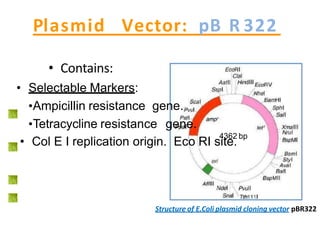
Plasmid Vector: pB R 322
• Contains:
• Selectable Markers:
•Ampicillin resistance gene.
•Tetracycline resistance gene.
• Col E I replication origin. Eco RI s
4
it
3
e
62
.
bp
Structure of E.Coli plasmid cloning vector pBR322
Screening procedure of cloning vector
Blue/White selection.
replica plating technique.
Blue/ White Selection
Only colonies
from bacteria that
have plasmid
IPTG + X-Gal
Overnight growth
Bacteria with
plasmid plus insert
Colonies with insert - white
Colonies w/o insert - blue
Replica Plating Technique
BACTERIOPHAGE VECTORS
• It infects bacteria.
• Follow either lytic or lysogenic cycle.
• Lambda phage vector
• high transformation efficiency, about 1000
times more efficient than the plasmid vector.
• Origin of replication.
• genes for head and tail protein.
• single- stranded protruding cohesive ends.
• Size is 48,502 bp.
Cosmid vector
• Combine parts of the lambda chromosome
with parts of plasmids.
• an origin of replication (ori).
• a cos site(a sequence yield cohesive end) .
• an ampicillin resistance gene (amp),
• restriction sites for cloning
• Cosmids can carry up to 50 kb of inserted
DNA.
APPLICATION
• A particular gene can be isolated andits
nucleotide sequence determined
• Control sequences of DNA can be identified&
analyzed
• Protein/enzyme/RNA function canbe
investigated
• Mutations can be identified, e.g. genedefects
related to specificdiseases
• Organisms can be ‘engineered’ for specific
purposes, e.g. insulin production.
PRODUCTION OF
HEPATITIS
PRODUCTION OF INSULIN
Polymerase Chain Reaction (PCR)
DNA
DNA is a nucleic acid that is composed of
two complementary nucleotide building
block chains.
The nucleotides are made up of a phosphate
group, a five carbon sugar, and a nitrogen
base.
DNA
 DNA Sugar
– Deoxyribonucleic acid
 RNA Sugar
– Ribonucleic acid
DNA
 Two are purines ( 2 ringed base )
– Adenine ( A ), Guanine ( G )
 Two are pyrimidines ( 1 ringed base )
– Cytosine ( C ), Thymine ( T )
DNA
These four bases are linked in a repeated
pattern by hydrogen bonding between the
nitrogen bases.
The linking of the two complementary
strands is called hybridization.
DNA
Example of bonding pattern.
Primary strand
CCGAATGGGATGC
GGCTTACCCTACG
Complementary strand
DNA
A purine always links with a pyrimidine base
to maintain the structure of DNA.
Adenine ( A ) binds to Thymine ( T ), with
two hydrogen bonds between them.
Guanine ( G ) binds to Cytosine ( C ), with
three hydrogen bonds between them.
WHY WE NEED PCR?
• Template (the DNAyou are exploring)
Sequence-specific primers flanking the target
sequence, Forward & Reverse.
• Polymerases
• Nucleotides (dATP, dCTP, dGTP, dTTP)
• Magnesium chloride (enzyme cofactor)
• Buffer
• Water, mineral oil
PCR REQUIREMENTS
 Magnesium chloride: .5-2.5mM
 Buffer: pH 8.3-8.8
 dNTPs: 20-200µM
 Primers: 0.1-0.5µM
 DNA Polymerase: 1-2.5 units
 Target DNA:  1 µg
• Denaturation 93 to 95°C 1min
• Annealing 50 to 55°C 45 sec.
• Elongation 70-75°C 1-2 min.
PCR CYCLE REVIEW
 Denaturation: 94°- 95°C
 Primer Annealing: 55°- 65°C
 Elongation of DNA: 72°
 Number of Cycles: 25-40
 No target products are made until the
third cycle.
 At 30 cycles there are 1,073,741,764
target copies (~1×10⁹).
ADVANTAGES OF PCR
 Speed
 Ease of use
 Sensitivity
 Robustness
APPLICATION OF PCR
 Screening human DNA samples for
mutations associated with genetic
diseases such as thalassemia and cystic
fibrosis.
 Can detect the presence of viral DNA before it
turns in to a killer.
 PCR enables rapid amplification of template DNA
for screening of uncharacterized mutations
 Can obtain sequences from hair, blood stain,
bones, other forensic specimens, other remains
preserved at archaeological sites.
CLONING VECTOR

CLONING VECTOR

  • 1.
    B’ PHARMACY SUBJECT: PharmaceuticalBiotechnology Subject Code: BP605T MODULE- 2 GENE CLONING VECTORS BALASUNDARESAN. M
  • 2.
    Objective of course GeneticEngineering applications relation to production of pharmaceutical • Learning Outcome • Students will learn about cloning vectors. They will also learn about the application of genetic Enginnering and various steps of Polymerase Chain Reaction.
  • 3.
    INTRODUCTION • A cloningvector is a DNA molecule in which foreign DNA can be inserted or integrated and which is further capable of replicating within host cell to produce multiple clones of recombinant DNA. • Examples: Plasmids,phage or virus
  • 4.
    Characteristics It should beable to replicate autonomously. Origin of replication. Selectable markers. Restriction sites.
  • 5.
    Types • Plasmid asvector . • Bacteriophage as vector. • Cosmid as vector • Phagemid as vector.
  • 6.
    Plasmid Vector: pBR 322 • Contains: • Selectable Markers: •Ampicillin resistance gene. •Tetracycline resistance gene. • Col E I replication origin. Eco RI s 4 it 3 e 62 . bp Structure of E.Coli plasmid cloning vector pBR322
  • 7.
    Screening procedure ofcloning vector Blue/White selection. replica plating technique.
  • 8.
    Blue/ White Selection Onlycolonies from bacteria that have plasmid IPTG + X-Gal Overnight growth Bacteria with plasmid plus insert Colonies with insert - white Colonies w/o insert - blue
  • 9.
  • 10.
    BACTERIOPHAGE VECTORS • Itinfects bacteria. • Follow either lytic or lysogenic cycle. • Lambda phage vector • high transformation efficiency, about 1000 times more efficient than the plasmid vector. • Origin of replication. • genes for head and tail protein. • single- stranded protruding cohesive ends. • Size is 48,502 bp.
  • 11.
    Cosmid vector • Combineparts of the lambda chromosome with parts of plasmids. • an origin of replication (ori). • a cos site(a sequence yield cohesive end) . • an ampicillin resistance gene (amp), • restriction sites for cloning • Cosmids can carry up to 50 kb of inserted DNA.
  • 12.
    APPLICATION • A particulargene can be isolated andits nucleotide sequence determined • Control sequences of DNA can be identified& analyzed • Protein/enzyme/RNA function canbe investigated • Mutations can be identified, e.g. genedefects related to specificdiseases • Organisms can be ‘engineered’ for specific purposes, e.g. insulin production.
  • 15.
  • 17.
  • 18.
  • 19.
    DNA DNA is anucleic acid that is composed of two complementary nucleotide building block chains. The nucleotides are made up of a phosphate group, a five carbon sugar, and a nitrogen base.
  • 20.
    DNA  DNA Sugar –Deoxyribonucleic acid  RNA Sugar – Ribonucleic acid
  • 21.
    DNA  Two arepurines ( 2 ringed base ) – Adenine ( A ), Guanine ( G )  Two are pyrimidines ( 1 ringed base ) – Cytosine ( C ), Thymine ( T )
  • 22.
    DNA These four basesare linked in a repeated pattern by hydrogen bonding between the nitrogen bases. The linking of the two complementary strands is called hybridization.
  • 23.
    DNA Example of bondingpattern. Primary strand CCGAATGGGATGC GGCTTACCCTACG Complementary strand
  • 24.
    DNA A purine alwayslinks with a pyrimidine base to maintain the structure of DNA. Adenine ( A ) binds to Thymine ( T ), with two hydrogen bonds between them. Guanine ( G ) binds to Cytosine ( C ), with three hydrogen bonds between them.
  • 25.
    WHY WE NEEDPCR? • Template (the DNAyou are exploring) Sequence-specific primers flanking the target sequence, Forward & Reverse. • Polymerases • Nucleotides (dATP, dCTP, dGTP, dTTP) • Magnesium chloride (enzyme cofactor) • Buffer • Water, mineral oil
  • 26.
    PCR REQUIREMENTS  Magnesiumchloride: .5-2.5mM  Buffer: pH 8.3-8.8  dNTPs: 20-200µM  Primers: 0.1-0.5µM  DNA Polymerase: 1-2.5 units  Target DNA:  1 µg
  • 27.
    • Denaturation 93to 95°C 1min • Annealing 50 to 55°C 45 sec. • Elongation 70-75°C 1-2 min.
  • 28.
    PCR CYCLE REVIEW Denaturation: 94°- 95°C  Primer Annealing: 55°- 65°C  Elongation of DNA: 72°  Number of Cycles: 25-40  No target products are made until the third cycle.  At 30 cycles there are 1,073,741,764 target copies (~1×10⁹).
  • 29.
    ADVANTAGES OF PCR Speed  Ease of use  Sensitivity  Robustness
  • 30.
    APPLICATION OF PCR Screening human DNA samples for mutations associated with genetic diseases such as thalassemia and cystic fibrosis.  Can detect the presence of viral DNA before it turns in to a killer.  PCR enables rapid amplification of template DNA for screening of uncharacterized mutations  Can obtain sequences from hair, blood stain, bones, other forensic specimens, other remains preserved at archaeological sites.