CAPSULE
• Capsules are the solid dosage form in which the drug or the mixture of drugs with or
without excipients that are enclosed in Hard Gelatin capsules shells, in soft soluble
shells of gelatin, or in hard or soft shells of any other suitable materials, of various
shape and capacities.
• They usually contain a single dose of active ingredients and are intended for oral
administration.
• They are basically of two types:
• A) Hard Gelatin Capsules.
• B) Soft Gelatin Capsules.
PROCESS VALIDATION OF CAPSULES
• It is a solid dosage form in which medications are
encapsulated in a two part empty hard gelatin capsule shell.
• The upper and small part is called ‘CAP’ and the remaining
large part is called ‘BODY’.
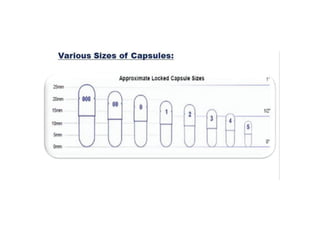
• There are 8 different fill volume.
• Normally 0 and 2 sized shells are widely used.
• The shell of hard gelatin capsules basically consists of
gelatin, plasticizers and water.
• Modern day shells may, in addition, consist of
preservatives, colours, pacifying agents, flavours, sugars,
acids, enteric materials etc.
HARD GELETIN CAPSULE
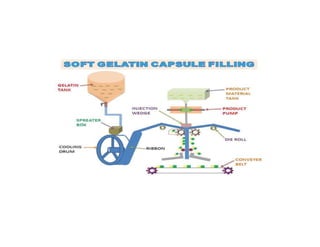
¾A soft gel (soft gelatin capsule) is a solid capsule (outer shell)
surrounding a liquid or semi-solid Centre (inner fill).
¾An active ingredient can be incorporated into the outer shell, the
inner fill, or both.
¾They process of manufacturing of hard gelatin capsules is same
as that of tablets, the only difference is that instead of
compressing the granules they are filled in the capsules shell.
¾So the validation process is also the same.
SOFT GELATIN CAPSULE
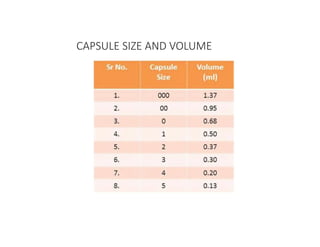
CAPSULE SIZE AND VOLUME
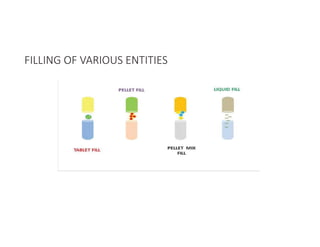
FILLING OF VARIOUS ENTITIES
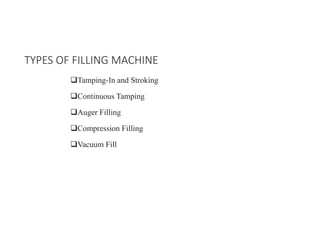
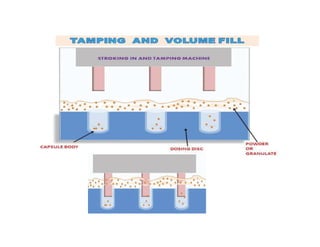
‰Tamping-In and Stroking
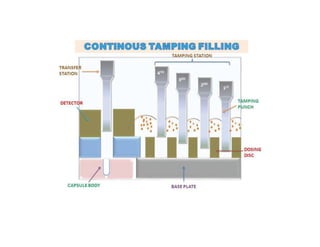
‰Continuous Tamping
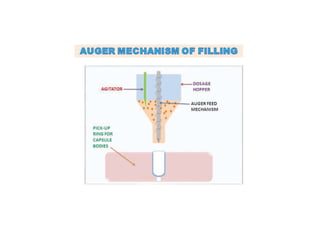
‰Auger Filling
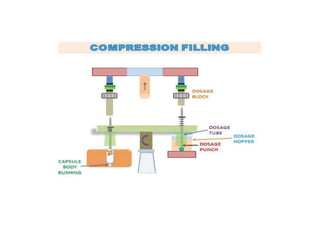
‰Compression Filling
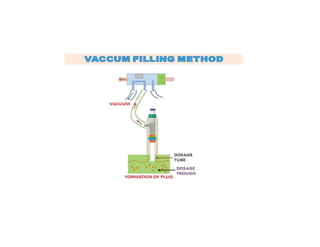
‰Vacuum Fill
TYPES OF FILLING MACHINE
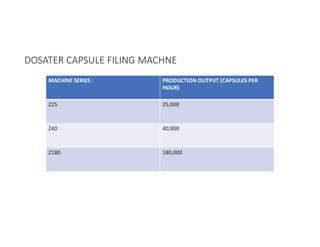
MACHINE SERIES : PRODUCTION OUTPUT (CAPSULES PER
HOUR)
Z25 25,000
Z40 40,000
Z180 180,000
DOSATER CAPSULE FILING MACHNE
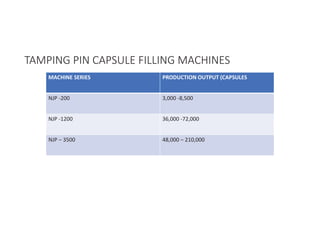
MACHINE SERIES PRODUCTION OUTPUT (CAPSULES
NJP -200 3,000 -8,500
NJP -1200 36,000 -72,000
NJP – 3500 48,000 – 210,000
TAMPING PIN CAPSULE FILLING MACHINES
‰CAPSULE SHELL PROVIDE:
ƒ The reason for the presence of each ingredient in the
capsule formulae .
ƒ Justify the level and grade of each ingredient .
ƒ Explain the selection of the capsule size and shape
ƒ Discuss the need for capsule identification (color)
CAPSULE SELECTION
ƒ Establish the compatibility of the capsule shell and the capsule
contents.
ƒ Determine the hygroscopic native of the capsule formulation.
ƒ For example : A hygroscopic formulation (API/excipients) can
pull from the capsule shell, which could effect the API stability.
CAPSULE SELECTION…
ƒ The process to manufacture the contents of a hard gelatin
capsule is the same as the tablet.
ƒ It may required only a blending step, such as a direct
compression table, or several unit operations, such as a wet
granulation tablet. (e.g. mixing, wet milling, drying, dry
milling and blending)
ƒ In either case, the materials are then encapsulated in a
capsule shell’
PROCESSS EVALUATON AND SELECTION
ƒ The formulation should be encapsulated at a wide range of speeds to
determine the operating range of the encapsulation.
ƒ Encapsulation is a critical step in the production of capsules, similar to the
compression for tablet dosage forms.
ƒ The materials to be encapsulated will need to have good flow properties and
a consistent density.
ENCAPSULATION
‰PHYSICAL TEST :
ƒ Disintegration test
ƒ Dissolution test
‰CHEMICAL TEST :
ƒ Assay
ƒ Content uniformity test
ƒ Weight variation test
ƒ Stability testing moisture permeation test
QUALITY CONTROL TEST
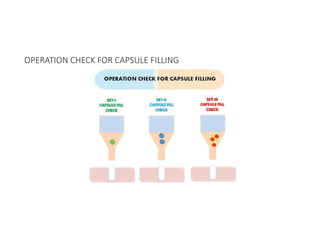
OPERATION CHECK FOR CAPSULE FILLING
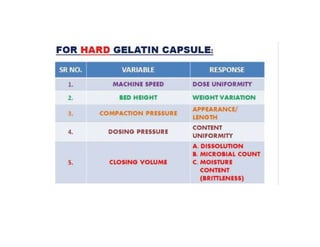
™VARIBLE :
• Machine speed, bed height compaction pressure, dosing volume,
closing pressure .
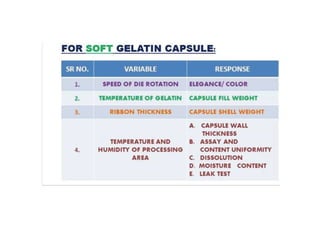
• Speed die rotation, temperature of gelatin, ribbon thickness,
temperature and humidity of processing area .
QC OF HGC FILLING MACHINE
• Dose uniformity, weight variation, appearance /length, content
uniformity, dissolution, microbial count, moisture content [brittleness]
• Elegance /color, capsule fill weight, capsule shell weight, capsule wall
thickness assay and content uniformity, dissolution {where
appropriate}, moisture content, leak test.
QC FOR HGC
• Basic document that is root for all validation and qualification.
• The goal of working out user requirement specifications is to
document the needs of the manufacturing department.
• A well planned URS is the key to project success.
USED REQUIREMENTS SPECIFICATION
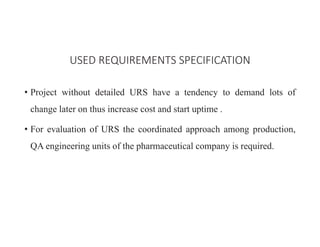
• Project without detailed URS have a tendency to demand lots of
change later on thus increase cost and start uptime .
• For evaluation of URS the coordinated approach among production,
QA engineering units of the pharmaceutical company is required.
USED REQUIREMENTS SPECIFICATION
• Nash RA and Wachter AH, Pharmaceutical process validation, 3rd edition,
Basel (NY) : Marcel Dekker Inc, 83- 110, 1993.
• Syed Imtiaz Haider, Pharmaceutical Master Validation Plan, St. Luice press,
114 , 119 , 120.
• Leon Lachman, The Theory and Practice of Industrial Pharmacy, Special
Indian Edition, 374 – 412, 2009.
• http//www.pharmainfo.net/reviews/guidelines-principles-validation–soild-
dosage.
• Mervyn J, Venketachallam VV, Hard gelation capsules - A formulation design
perspective and evolution, International Journal of Chemical and
Pharmaceutical Sciences, 5(3):129-135, 2014 .
REFERENCE

PROCESS VALIDATION FOR CAPSULES (SOLID DOSAGE FORM).pdf

  • 1.
  • 2.
    • Capsules arethe solid dosage form in which the drug or the mixture of drugs with or without excipients that are enclosed in Hard Gelatin capsules shells, in soft soluble shells of gelatin, or in hard or soft shells of any other suitable materials, of various shape and capacities. • They usually contain a single dose of active ingredients and are intended for oral administration. • They are basically of two types: • A) Hard Gelatin Capsules. • B) Soft Gelatin Capsules. PROCESS VALIDATION OF CAPSULES
  • 3.
    • It isa solid dosage form in which medications are encapsulated in a two part empty hard gelatin capsule shell. • The upper and small part is called ‘CAP’ and the remaining large part is called ‘BODY’. • There are 8 different fill volume. • Normally 0 and 2 sized shells are widely used. • The shell of hard gelatin capsules basically consists of gelatin, plasticizers and water. • Modern day shells may, in addition, consist of preservatives, colours, pacifying agents, flavours, sugars, acids, enteric materials etc. HARD GELETIN CAPSULE
  • 5.
    ¾A soft gel(soft gelatin capsule) is a solid capsule (outer shell) surrounding a liquid or semi-solid Centre (inner fill). ¾An active ingredient can be incorporated into the outer shell, the inner fill, or both. ¾They process of manufacturing of hard gelatin capsules is same as that of tablets, the only difference is that instead of compressing the granules they are filled in the capsules shell. ¾So the validation process is also the same. SOFT GELATIN CAPSULE
  • 8.
  • 10.
  • 11.
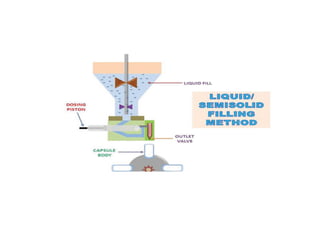
    ‰Tamping-In and Stroking ‰ContinuousTamping ‰Auger Filling ‰Compression Filling ‰Vacuum Fill TYPES OF FILLING MACHINE
  • 19.
    MACHINE SERIES :PRODUCTION OUTPUT (CAPSULES PER HOUR) Z25 25,000 Z40 40,000 Z180 180,000 DOSATER CAPSULE FILING MACHNE
  • 20.
    MACHINE SERIES PRODUCTIONOUTPUT (CAPSULES NJP -200 3,000 -8,500 NJP -1200 36,000 -72,000 NJP – 3500 48,000 – 210,000 TAMPING PIN CAPSULE FILLING MACHINES
  • 21.
    ‰CAPSULE SHELL PROVIDE: ƒThe reason for the presence of each ingredient in the capsule formulae . ƒ Justify the level and grade of each ingredient . ƒ Explain the selection of the capsule size and shape ƒ Discuss the need for capsule identification (color) CAPSULE SELECTION
  • 22.
    ƒ Establish thecompatibility of the capsule shell and the capsule contents. ƒ Determine the hygroscopic native of the capsule formulation. ƒ For example : A hygroscopic formulation (API/excipients) can pull from the capsule shell, which could effect the API stability. CAPSULE SELECTION…
  • 23.
    ƒ The processto manufacture the contents of a hard gelatin capsule is the same as the tablet. ƒ It may required only a blending step, such as a direct compression table, or several unit operations, such as a wet granulation tablet. (e.g. mixing, wet milling, drying, dry milling and blending) ƒ In either case, the materials are then encapsulated in a capsule shell’ PROCESSS EVALUATON AND SELECTION
  • 24.
    ƒ The formulationshould be encapsulated at a wide range of speeds to determine the operating range of the encapsulation. ƒ Encapsulation is a critical step in the production of capsules, similar to the compression for tablet dosage forms. ƒ The materials to be encapsulated will need to have good flow properties and a consistent density. ENCAPSULATION
  • 25.
    ‰PHYSICAL TEST : ƒDisintegration test ƒ Dissolution test ‰CHEMICAL TEST : ƒ Assay ƒ Content uniformity test ƒ Weight variation test ƒ Stability testing moisture permeation test QUALITY CONTROL TEST
  • 26.
    OPERATION CHECK FORCAPSULE FILLING
  • 27.
    ™VARIBLE : • Machinespeed, bed height compaction pressure, dosing volume, closing pressure . • Speed die rotation, temperature of gelatin, ribbon thickness, temperature and humidity of processing area . QC OF HGC FILLING MACHINE
  • 28.
    • Dose uniformity,weight variation, appearance /length, content uniformity, dissolution, microbial count, moisture content [brittleness] • Elegance /color, capsule fill weight, capsule shell weight, capsule wall thickness assay and content uniformity, dissolution {where appropriate}, moisture content, leak test. QC FOR HGC
  • 29.
    • Basic documentthat is root for all validation and qualification. • The goal of working out user requirement specifications is to document the needs of the manufacturing department. • A well planned URS is the key to project success. USED REQUIREMENTS SPECIFICATION
  • 30.
    • Project withoutdetailed URS have a tendency to demand lots of change later on thus increase cost and start uptime . • For evaluation of URS the coordinated approach among production, QA engineering units of the pharmaceutical company is required. USED REQUIREMENTS SPECIFICATION
  • 31.
    • Nash RAand Wachter AH, Pharmaceutical process validation, 3rd edition, Basel (NY) : Marcel Dekker Inc, 83- 110, 1993. • Syed Imtiaz Haider, Pharmaceutical Master Validation Plan, St. Luice press, 114 , 119 , 120. • Leon Lachman, The Theory and Practice of Industrial Pharmacy, Special Indian Edition, 374 – 412, 2009. • http//www.pharmainfo.net/reviews/guidelines-principles-validation–soild- dosage. • Mervyn J, Venketachallam VV, Hard gelation capsules - A formulation design perspective and evolution, International Journal of Chemical and Pharmaceutical Sciences, 5(3):129-135, 2014 . REFERENCE