CLINDAMYCIN
Introduction
Clindamycin is of the lincosamide class and works by blocking bacteria from making protein.
Clindamycin is an antibiotic used for the treatment of a number of bacterial infections,
including bone or joint infections, pelvic inflammatory disease, strep throat, pneumonia,
middle ear infections, and endocarditis. It can also be used to treat acne, and some cases of
methicillin-resistant Staphylococcus aureus (MRSA). In combination with quinine, it can be
used for malaria.
Clindamycin is a semi-synthetic derivative of lincomycin, a natural antibiotic produced by the
actinobacterium Streptomyces lincolnensis.
Clindamycin was first made in 1966 from lincomycin. It is obtained by 7-(S)-chloro
substitution of the 7-(R)-hydroxyl group of lincomycin. The synthesis was first announced by
BJ Magerlain, et al., in 1966. It has been on the market since 1968.
Lincomycin Clindamycin
It is on the World Health Organization's List of Essential Medicines. It is available as a
generic medication.
In 2018, it was the 130th most commonly prescribed medication in the United States, with
more than 5 million prescriptions.
Chemistry
Clindamycin is a semisynthetic derivative of lincomycin, a natural antibiotic produced by the
actinobacterium Streptomyces lincolnensis. It is obtained by 7(S)-chloro-substitution of the
7(R)-hydroxyl group of lincomycin.
Clindamycin is white or yellow. It is very soluble in water. The topically used clindamycin
phosphate is a phosphate-ester prodrug of clindamycin.
Clindamycin
Clindamycin phosphate
Mechanism of action
Clindamycin has a primarily bacteriostatic effect. At higher concentrations, it may be
bactericidal. Clindamycin is a bacterial protein synthesis inhibitor by inhibiting ribosomal
translocation. It does so by binding to the 50S rRNA of the large bacterial ribosome subunit,
overlapping with the binding sites of the oxazolidinone, pleuromutilin, and macrolide
antibiotics, among others.
Video:
https://www.youtube.com/watch?v=gclx3iF5KXc
https://www.youtube.com/watch?v=kE_LmH-1-6w
Therapeutic uses
Clindamycin is used primarily to treat anaerobic infections caused by susceptible anaerobic
bacteria, including dental infections, and infections of the respiratory tract, skin, and soft
tissue, and peritonitis.
In people with hypersensitivity to penicillins, clindamycin may be used to treat infections
caused by susceptible aerobic bacteria, as well.
It is also used to treat bone and joint infections, particularly those caused by Staphylococcus
aureus. Topical application of clindamycin phosphate can be used to treat mild to moderate
acne.
For treatment of acne, in the long term the combined use of topical clindamycin and benzoyl
peroxide was beneficial. Topical clindamycin plus topical benzoyl peroxide is more effective
than topical clindamycin alone.
SAR
O S
OH
OH
O
H
NH
Cl
CH3
CH3
N
C3H7
C
H3
O
Chloro (-Cl) at position-7 can be replaced successfully with bromo (-Br) and iodo (-I)
retaining antibacterial activity.
Clindamycin
Replacement of chlror (-Cl) at position-7 with hydroxyl (-OH) group resulted in reduced
antibacterial activity, e.g., lincomycin.
Lincomycin
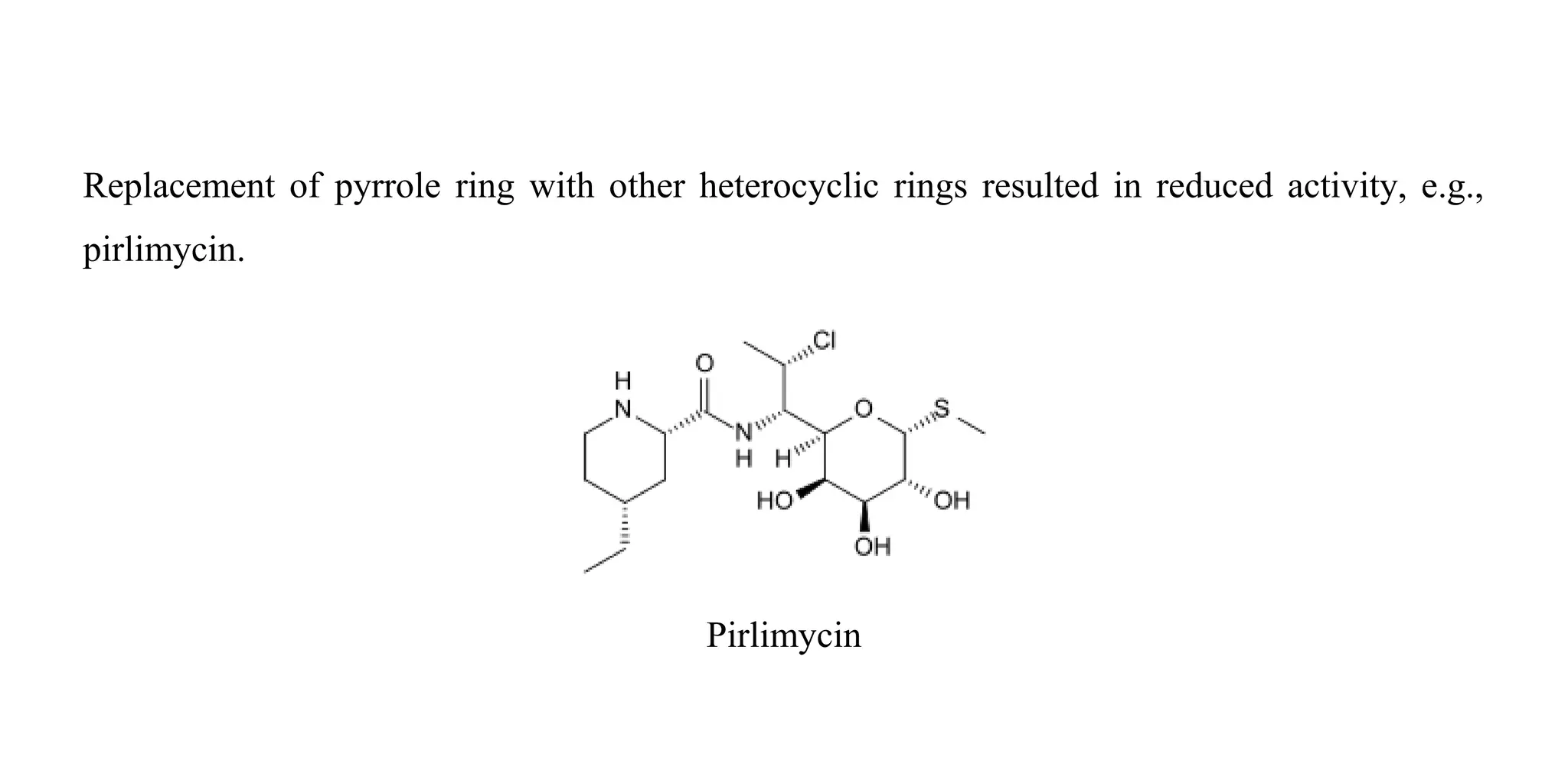
Replacement of pyrrole ring with other heterocyclic rings resulted in reduced activity, e.g.,
pirlimycin.
Pirlimycin
Replacement of propyl group (at heterocyclic ring) with ethyl group resulted in increased
activity, e.g., pirlimycin.
Pirlimycin
Chemical Degradation
pH range 0.4-4.0
In the pH range of 0.4 to 4.0, the major degradative pathway for clindamycin is hydrolysis of
the thioglycoside linkage to form 1-dethiomethyl-1-hydroxy clindamycin and methyl
mercaptan (CH3SH).
O S
OH
OH
O
H
NH
Cl
CH3
CH3
N
C3H7
C
H3
O
At
pH 0.4-4.0
O OH
OH
OH
O
H
NH
Cl
CH3
N
C3H7
C
H3
O
+ C
H3 SH
Clindamycin 1-Dethiomethyl-1-
hydroxy
clindamycin
Methyl
mercaptan
pH range 5.0-10.0
In the pH range 5.0-10.0, the major degradation pathway for clindamycin is scission of the 7-
(S)-Cl of clindamycin to 7-(R)-OH of lincomycin (proceed through formation of oxazolonium
intermediate).
O S
OH
OH
O
H
NH
Cl
CH3
CH3
N
C3H7
C
H3
O
Clindamycin Lincomycin
At
pH 5.0-10.0
O S
OH
OH
O
H
NH
O
H
CH3
CH3
N
C3H7
C
H3
O
Thank You

Clindamycin

  • 1.
  • 2.
    Introduction Clindamycin is ofthe lincosamide class and works by blocking bacteria from making protein. Clindamycin is an antibiotic used for the treatment of a number of bacterial infections, including bone or joint infections, pelvic inflammatory disease, strep throat, pneumonia, middle ear infections, and endocarditis. It can also be used to treat acne, and some cases of methicillin-resistant Staphylococcus aureus (MRSA). In combination with quinine, it can be used for malaria.
  • 3.
    Clindamycin is asemi-synthetic derivative of lincomycin, a natural antibiotic produced by the actinobacterium Streptomyces lincolnensis. Clindamycin was first made in 1966 from lincomycin. It is obtained by 7-(S)-chloro substitution of the 7-(R)-hydroxyl group of lincomycin. The synthesis was first announced by BJ Magerlain, et al., in 1966. It has been on the market since 1968.
  • 4.
  • 5.
    It is onthe World Health Organization's List of Essential Medicines. It is available as a generic medication. In 2018, it was the 130th most commonly prescribed medication in the United States, with more than 5 million prescriptions.
  • 6.
    Chemistry Clindamycin is asemisynthetic derivative of lincomycin, a natural antibiotic produced by the actinobacterium Streptomyces lincolnensis. It is obtained by 7(S)-chloro-substitution of the 7(R)-hydroxyl group of lincomycin. Clindamycin is white or yellow. It is very soluble in water. The topically used clindamycin phosphate is a phosphate-ester prodrug of clindamycin.
  • 7.
  • 8.
  • 9.
    Mechanism of action Clindamycinhas a primarily bacteriostatic effect. At higher concentrations, it may be bactericidal. Clindamycin is a bacterial protein synthesis inhibitor by inhibiting ribosomal translocation. It does so by binding to the 50S rRNA of the large bacterial ribosome subunit, overlapping with the binding sites of the oxazolidinone, pleuromutilin, and macrolide antibiotics, among others.
  • 11.
  • 12.
    Therapeutic uses Clindamycin isused primarily to treat anaerobic infections caused by susceptible anaerobic bacteria, including dental infections, and infections of the respiratory tract, skin, and soft tissue, and peritonitis. In people with hypersensitivity to penicillins, clindamycin may be used to treat infections caused by susceptible aerobic bacteria, as well.
  • 13.
    It is alsoused to treat bone and joint infections, particularly those caused by Staphylococcus aureus. Topical application of clindamycin phosphate can be used to treat mild to moderate acne. For treatment of acne, in the long term the combined use of topical clindamycin and benzoyl peroxide was beneficial. Topical clindamycin plus topical benzoyl peroxide is more effective than topical clindamycin alone.
  • 14.
  • 15.
    Chloro (-Cl) atposition-7 can be replaced successfully with bromo (-Br) and iodo (-I) retaining antibacterial activity. Clindamycin
  • 16.
    Replacement of chlror(-Cl) at position-7 with hydroxyl (-OH) group resulted in reduced antibacterial activity, e.g., lincomycin. Lincomycin
  • 17.
    Replacement of pyrrolering with other heterocyclic rings resulted in reduced activity, e.g., pirlimycin. Pirlimycin
  • 18.
    Replacement of propylgroup (at heterocyclic ring) with ethyl group resulted in increased activity, e.g., pirlimycin. Pirlimycin
  • 19.
    Chemical Degradation pH range0.4-4.0 In the pH range of 0.4 to 4.0, the major degradative pathway for clindamycin is hydrolysis of the thioglycoside linkage to form 1-dethiomethyl-1-hydroxy clindamycin and methyl mercaptan (CH3SH).
  • 20.
    O S OH OH O H NH Cl CH3 CH3 N C3H7 C H3 O At pH 0.4-4.0 OOH OH OH O H NH Cl CH3 N C3H7 C H3 O + C H3 SH Clindamycin 1-Dethiomethyl-1- hydroxy clindamycin Methyl mercaptan
  • 21.
    pH range 5.0-10.0 Inthe pH range 5.0-10.0, the major degradation pathway for clindamycin is scission of the 7- (S)-Cl of clindamycin to 7-(R)-OH of lincomycin (proceed through formation of oxazolonium intermediate).
  • 22.
    O S OH OH O H NH Cl CH3 CH3 N C3H7 C H3 O Clindamycin Lincomycin At pH5.0-10.0 O S OH OH O H NH O H CH3 CH3 N C3H7 C H3 O
  • 23.