MACROLIDE
ANTIBIOTICS
Introduction
Macrolide antibiotics are a class of antibiotics which contain a macrocyclic ring (lactone ring)
attached to deoxy sugars (usually cladinose and desosamine).
The lactone rings are usually 14-, 15-, or 16-membered. Macrolides belong to the polyketide
class of natural products.
These antibiotics are bacteriostatic in nature and act by inhibiting the protein synthesis of
bacteria.
Macrolide antibiotics are usually obtained from certain actinomycetes genes such as
Streptomyces.
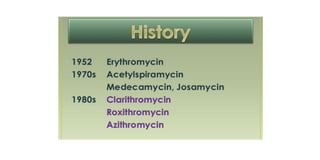
Erythromycin was the first macrolide antibiotic discovered (from the soil bacterium
Streptomyces erythraeus) and put in clinical use (1952).
Picromycin was discovered in 1950 (not clinically useful). In 1970s, various macrolide
antibiotics were discovered including those of acetylspiramycin, medecamycin, and
josamycin. In 1980s, clarithromycin, roxithromycin, and azithromycin (in 1988) were
discovered. Tylosin was introduced in 1961, which was extensively used in veterinary
medicine.
Classification
1. 12-Membered: Natural
Methymycin Neomethymycin
2. 13-Membered: Natural
Tulathromycin
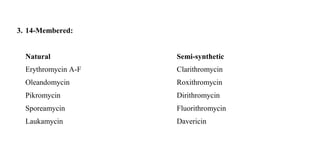
3. 14-Membered:
Natural
Erythromycin A-F
Oleandomycin
Pikromycin
Sporeamycin
Laukamycin
Semi-synthetic
Clarithromycin
Roxithromycin
Dirithromycin
Fluorithromycin
Davericin
Erythromycin A Erythromycin B Erythromycin C
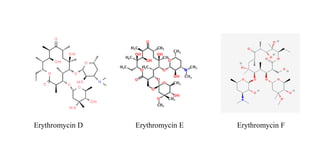
Erythromycin D Erythromycin E Erythromycin F
Oleandomycin Pikromycin
Clarithromycin Roxithromycin
Dirithromycin Fluorithromycin
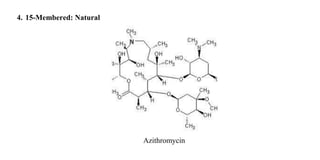
4. 15-Membered: Natural
Azithromycin
5. 16-Membered:
Natural
Josamycin
Kitasamycin
Spiramycin
Midecamycin
Niddamycin
Tylosin
Synthetic
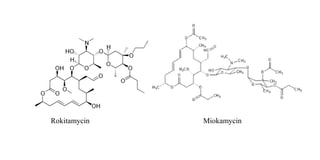
Rokitamycin
Miokamycin
Tilmicocin
Josamycin Kitasamycin
Spiramycin Midecamycin
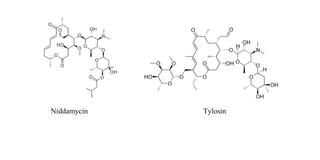
Niddamycin Tylosin
Rokitamycin Miokamycin
Tilmicosin
Mechanism of action
Macrolide antibiotics have excellent tissue penetration and antimicrobial activity, mainly
against Gram-positive cocci and atypical pathogen.
Macrolide antibiotics act as inhibitors of protein synthesis by attaching to the 50S ribosomal
subunit. They do so by binding reversibly to the P site on the 50S subunit of the bacterial
ribosome.
By so doing, they block the ability of the ribosome to synthesize the polypeptide chain. By
inhibiting protein synthesis, macrolides are considered bacteriostatic antibiotics. However, at
higher concentrations and with lower bacterial density or during rapid bacterial growth,
macrolides may be bactericidal.
Video:
https://www.youtube.com/watch?v=oC21vLFtsjo
Therapeutic uses
Macrolides are a class of antibiotic that includes erythromycin, roxithromycin, azithromycin
and clarithromycin.
First-line indications for macrolides include the treatment of atypical community acquired
pneumonia, H. Pylori (as part of triple therapy), chlamydia and acute non-specific urethritis.
Macrolides are also a useful alternative for the patients having penicillin and cephalosporin
allergy.
Upper respiratory tract infections- pharyngitis, tonsillitis, sore throat, whooping caugh etc
Lower respiratory tract infection- pneumonia, community derived pneumonia, anthrax etc
COPD
Sinusitis
 Peptic ulcer treatment foreradication of H. pylori in triple therapy
 Skin & soft tissue infection
 MAC(Mycobacterium avium complex) infection in AIDS
 Gonorrhea
 Conjunctivitis
Lyme disease
SAR
 As macrolide antibiotics (such as erythromycin) are unstable in acidic pH. The stability of
erythromycin can be imroved by a no. of strategies:
 Addition of methoxy group at C-6, e.g., Clarithromycin.
 Addition of an oxime group at C-9, e.g., Roxithromycin.
Clarithromycin Roxithromycin
 C-11 carbamate side chain increases affinity for the ribosomes, e.g., Lankamycin.
Lankamycin
 Replacement of C-6 hydroxyl group can be replaced (nucleophilic functionality which
initiates erythromycin degradation reaction), e.g., Clarithromycin, Oleandomycin.
Clarithromycin Oleandomycin
 Addition of N-atom to expand a 14-membered ring resulted in expanded spectrum of action
(broad spectrum), e.g., Azithromycin.
Azithromycin
 Addition of C-2 fluoro group (-F) enhanced activity against both susceptible and resistant
organisms and imroved pharmacokinetics.
Fluorithromycin
 L-Cladinose moiety at C-3 can be successfully replaced with a keto group resulting in
improved activity, e.g., ketolides (e.g., Telithromycin).
Telithromycin
Chemical Degradation
Macrolides are unstable under acidic conditions and undergo an intramolecular reaction to
form an inactive cyclic ketal.
The cyclic ketal is is the cause of intestinal cramp which is reported after the use of
erythromycin.
Water-insoluble salts and enteric coated dosage forms of macrolides have less such a side
effect. Water insoluble forms cannot take part in the reactions which occur in aqueous
solutions. Stearate salt is an example of insoluble salts of erythromycin.
Thank You

Macrolide antibiotics