DRUGS FOR
BRONCHIAL
ASTHMA
Dr.Vijay bhushanam MD
Bronchial asthma
• Derived from a Greek word meaning difficulty in
breathing.
• It is the most common chronic disabling disease of
childhood, but it affects all age groups
• CLINICAL FEATURES: Recurrent, episodic bouts of
coughing, shortness of breath, chest tightness, and
wheezing.
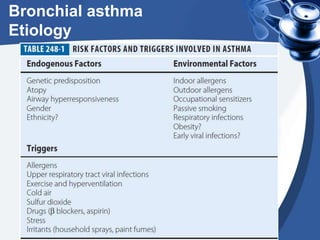
Bronchial asthma
Etiology
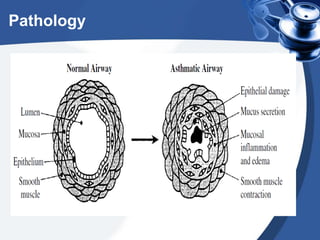
Pathology
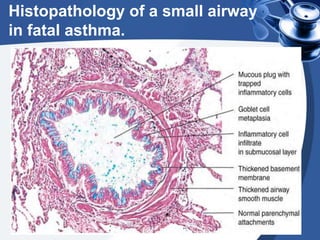
Histopathology of a small airway
in fatal asthma.
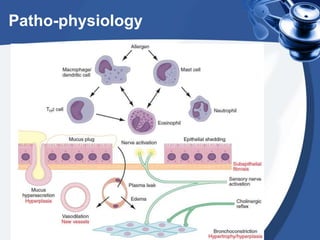
Patho-physiology
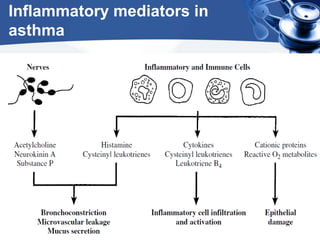
Inflammatory mediators in
asthma
Bronchial asthma
Types of asthma based on etiology:
• Extrinsic asthma:
– Allergy-induced
– Commonly suffer from other atopic diseases,
– Mostly episodic, Less prone to status asthmaticus
• Intrinsic asthma:
– No immunological basis for their condition
– Negative skin test to common inhalant allergens
– Normal serum concentrations of IgE,
– Perennial,
– More prone to status asthmaticus
Bronchial asthma
• Types of Asthma based on clinical condition:
• Mild episodic asthma:
• Seasonal asthma:
• Mild chronic asthma:
• Moderate asthma with frequent exacerbations:
• Severe asthma:
• Status asthmaticus/Refractory asthma
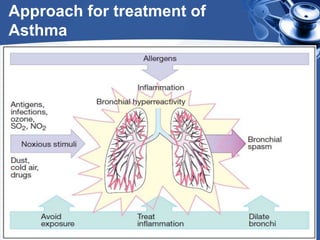
Approach for treatment of
Asthma
Classification of drugs for
asthma
• BRONCHODILATORS:
1. β-Sympathomimetics: Salbutamol, Terbutaline, Bambuterol,
Salmeterol, Formoterol, Ephedrine
2. Methyl Xanthines: Theophylline, Aminophylline, Choline
theophyllinate, Hydroxyethyl theophylline, Doxophylline.
3. Anticholinergics: Ipratropium bromide, Tiotropium bromide
• LEUKOTRIENE ANTAGONISTS: Montelukast, Zafirlukast
• MAST CELL STABILIZERS: Sodium chromoglycate, Ketotifen
• CORTICOSTEROIDS
1. Systemic: Hydrocortisone, Prednisolone
2. Inhalational: Beclomethasone, Budesonide, Fluticasone,
Flunisolide
• ANTI Ig-E ANTIBODY: Omalizumab
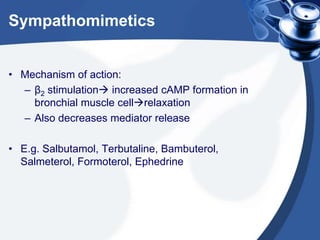
Sympathomimetics
• Mechanism of action:
– β2 stimulation increased cAMP formation in
bronchial muscle cellrelaxation
– Also decreases mediator release
• E.g. Salbutamol, Terbutaline, Bambuterol,
Salmeterol, Formoterol, Ephedrine
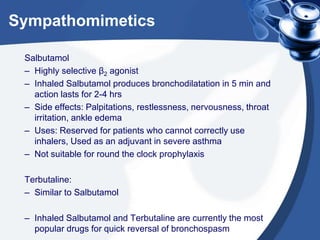
Sympathomimetics
Salbutamol
– Highly selective β2 agonist
– Inhaled Salbutamol produces bronchodilatation in 5 min and
action lasts for 2-4 hrs
– Side effects: Palpitations, restlessness, nervousness, throat
irritation, ankle edema
– Uses: Reserved for patients who cannot correctly use
inhalers, Used as an adjuvant in severe asthma
– Not suitable for round the clock prophylaxis
Terbutaline:
– Similar to Salbutamol
– Inhaled Salbutamol and Terbutaline are currently the most
popular drugs for quick reversal of bronchospasm
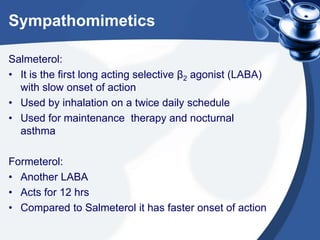
Sympathomimetics
Salmeterol:
• It is the first long acting selective β2 agonist (LABA)
with slow onset of action
• Used by inhalation on a twice daily schedule
• Used for maintenance therapy and nocturnal
asthma
Formeterol:
• Another LABA
• Acts for 12 hrs
• Compared to Salmeterol it has faster onset of action
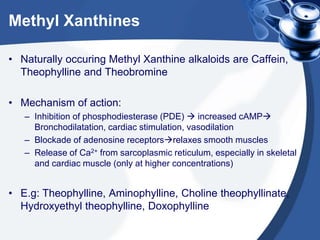
Methyl Xanthines
• Naturally occuring Methyl Xanthine alkaloids are Caffein,
Theophylline and Theobromine
• Mechanism of action:
– Inhibition of phosphodiesterase (PDE)  increased cAMP
Bronchodilatation, cardiac stimulation, vasodilation
– Blockade of adenosine receptorsrelaxes smooth muscles
– Release of Ca2+ from sarcoplasmic reticulum, especially in skeletal
and cardiac muscle (only at higher concentrations)
• E.g: Theophylline, Aminophylline, Choline theophyllinate,
Hydroxyethyl theophylline, Doxophylline
Methyl Xanthines
• Theophylline:
– Well absorbed orally
– T1/2 is 7-12 hrs
– Side effects: gastric pain (with oral), rectal inflammation (with rectal
suppositories), pain at site of injection (i.m), Rapid IV can cause
precordial pain, syncope and sudden death.
– Interactions:
– metabolism is induced by smoking, phenytoin, rifampicin,
phenobarbitone
– Metabolism is inhibited by erythromycin, ciprofloxacin, cimetedine,
OCPs, allopurinol
– Uses: Bronchial asthma and COPD, Apnoea in premature infant,
Anticholinergics
• Atropinic drugs cause bronchodilatation by blocking cholinergic
constrictor tone
• Act primarily in larger airways
• Produce slower response than inhaled sympathomimetics
• Better suited for regular prophylactic use
• Combination of inhaled Ipratropium with β2 agonists produce
more marked and longer lasting bronchodilatation.
• E.g: Ipratropium bromide, Tiotropium bromide
Leukotriene antagonists
• Competitively antagonize cysLT1 receptor mediated
bronchoconstriction, increased vasodilatation and
recruitment of eisonophils
• Indicated for prophylactic therapy of mild to moderate
asthma as alternative to inhaled glucocorticoids
• May obviate need for inhaled glucocorticoids
• Safe drugs
• Side effetcs: headache, rashes
• E.g: Montelukast, Zafirlukast
Mast cell stabilizers
• Inhibits degranulation of mast cells
• Release of mediators like Histamine, LTs, PAF, ILs,
etc is restricted
• Not absorbed orally, administered as an aerosol
through metered dose inhaler (MDI)
• Uses: Long term prophylaxis in mild to moderate
Bronchial asthma, Allergic rhinitis, Allergic
conjunctivitis
• Side effetcs: Bronchospasm, throat irritation, cough
• E.g: Sodium chromoglycate, Ketotifen
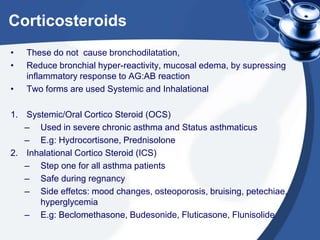
Corticosteroids
• These do not cause bronchodilatation,
• Reduce bronchial hyper-reactivity, mucosal edema, by supressing
inflammatory response to AG:AB reaction
• Two forms are used Systemic and Inhalational
1. Systemic/Oral Cortico Steroid (OCS)
– Used in severe chronic asthma and Status asthmaticus
– E.g: Hydrocortisone, Prednisolone
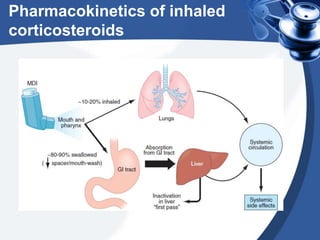
2. Inhalational Cortico Steroid (ICS)
– Step one for all asthma patients
– Safe during regnancy
– Side effetcs: mood changes, osteoporosis, bruising, petechiae,
hyperglycemia
– E.g: Beclomethasone, Budesonide, Fluticasone, Flunisolide
Pharmacokinetics of inhaled
corticosteroids
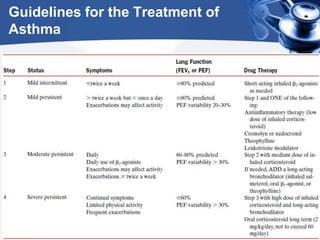
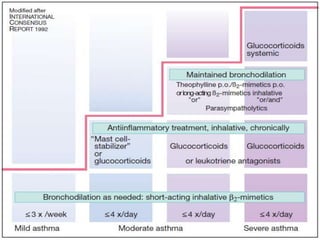
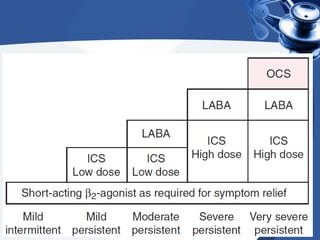
Guidelines for the Treatment of
Asthma
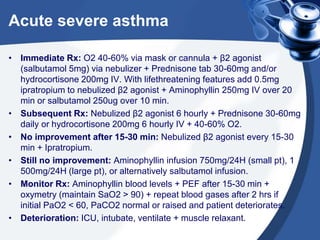
Acute severe asthma
• Immediate Rx: O2 40-60% via mask or cannula + β2 agonist
(salbutamol 5mg) via nebulizer + Prednisone tab 30-60mg and/or
hydrocortisone 200mg IV. With lifethreatening features add 0.5mg
ipratropium to nebulized β2 agonist + Aminophyllin 250mg IV over 20
min or salbutamol 250ug over 10 min.
• Subsequent Rx: Nebulized β2 agonist 6 hourly + Prednisone 30-60mg
daily or hydrocortisone 200mg 6 hourly IV + 40-60% O2.
• No improvement after 15-30 min: Nebulized β2 agonist every 15-30
min + Ipratropium.
• Still no improvement: Aminophyllin infusion 750mg/24H (small pt), 1
500mg/24H (large pt), or alternatively salbutamol infusion.
• Monitor Rx: Aminophyllin blood levels + PEF after 15-30 min +
oxymetry (maintain SaO2 > 90) + repeat blood gases after 2 hrs if
initial PaO2 < 60, PaCO2 normal or raised and patient deteriorates.
• Deterioration: ICU, intubate, ventilate + muscle relaxant.

Asthma and antiasthmatics

  • 1.
  • 2.
    Bronchial asthma • Derivedfrom a Greek word meaning difficulty in breathing. • It is the most common chronic disabling disease of childhood, but it affects all age groups • CLINICAL FEATURES: Recurrent, episodic bouts of coughing, shortness of breath, chest tightness, and wheezing.
  • 3.
  • 4.
  • 5.
    Histopathology of asmall airway in fatal asthma.
  • 6.
  • 7.
  • 8.
    Bronchial asthma Types ofasthma based on etiology: • Extrinsic asthma: – Allergy-induced – Commonly suffer from other atopic diseases, – Mostly episodic, Less prone to status asthmaticus • Intrinsic asthma: – No immunological basis for their condition – Negative skin test to common inhalant allergens – Normal serum concentrations of IgE, – Perennial, – More prone to status asthmaticus
  • 9.
    Bronchial asthma • Typesof Asthma based on clinical condition: • Mild episodic asthma: • Seasonal asthma: • Mild chronic asthma: • Moderate asthma with frequent exacerbations: • Severe asthma: • Status asthmaticus/Refractory asthma
  • 10.
  • 11.
    Classification of drugsfor asthma • BRONCHODILATORS: 1. β-Sympathomimetics: Salbutamol, Terbutaline, Bambuterol, Salmeterol, Formoterol, Ephedrine 2. Methyl Xanthines: Theophylline, Aminophylline, Choline theophyllinate, Hydroxyethyl theophylline, Doxophylline. 3. Anticholinergics: Ipratropium bromide, Tiotropium bromide • LEUKOTRIENE ANTAGONISTS: Montelukast, Zafirlukast • MAST CELL STABILIZERS: Sodium chromoglycate, Ketotifen • CORTICOSTEROIDS 1. Systemic: Hydrocortisone, Prednisolone 2. Inhalational: Beclomethasone, Budesonide, Fluticasone, Flunisolide • ANTI Ig-E ANTIBODY: Omalizumab
  • 12.
    Sympathomimetics • Mechanism ofaction: – β2 stimulation increased cAMP formation in bronchial muscle cellrelaxation – Also decreases mediator release • E.g. Salbutamol, Terbutaline, Bambuterol, Salmeterol, Formoterol, Ephedrine
  • 13.
    Sympathomimetics Salbutamol – Highly selectiveβ2 agonist – Inhaled Salbutamol produces bronchodilatation in 5 min and action lasts for 2-4 hrs – Side effects: Palpitations, restlessness, nervousness, throat irritation, ankle edema – Uses: Reserved for patients who cannot correctly use inhalers, Used as an adjuvant in severe asthma – Not suitable for round the clock prophylaxis Terbutaline: – Similar to Salbutamol – Inhaled Salbutamol and Terbutaline are currently the most popular drugs for quick reversal of bronchospasm
  • 14.
    Sympathomimetics Salmeterol: • It isthe first long acting selective β2 agonist (LABA) with slow onset of action • Used by inhalation on a twice daily schedule • Used for maintenance therapy and nocturnal asthma Formeterol: • Another LABA • Acts for 12 hrs • Compared to Salmeterol it has faster onset of action
  • 15.
    Methyl Xanthines • Naturallyoccuring Methyl Xanthine alkaloids are Caffein, Theophylline and Theobromine • Mechanism of action: – Inhibition of phosphodiesterase (PDE)  increased cAMP Bronchodilatation, cardiac stimulation, vasodilation – Blockade of adenosine receptorsrelaxes smooth muscles – Release of Ca2+ from sarcoplasmic reticulum, especially in skeletal and cardiac muscle (only at higher concentrations) • E.g: Theophylline, Aminophylline, Choline theophyllinate, Hydroxyethyl theophylline, Doxophylline
  • 16.
    Methyl Xanthines • Theophylline: –Well absorbed orally – T1/2 is 7-12 hrs – Side effects: gastric pain (with oral), rectal inflammation (with rectal suppositories), pain at site of injection (i.m), Rapid IV can cause precordial pain, syncope and sudden death. – Interactions: – metabolism is induced by smoking, phenytoin, rifampicin, phenobarbitone – Metabolism is inhibited by erythromycin, ciprofloxacin, cimetedine, OCPs, allopurinol – Uses: Bronchial asthma and COPD, Apnoea in premature infant,
  • 17.
    Anticholinergics • Atropinic drugscause bronchodilatation by blocking cholinergic constrictor tone • Act primarily in larger airways • Produce slower response than inhaled sympathomimetics • Better suited for regular prophylactic use • Combination of inhaled Ipratropium with β2 agonists produce more marked and longer lasting bronchodilatation. • E.g: Ipratropium bromide, Tiotropium bromide
  • 18.
    Leukotriene antagonists • Competitivelyantagonize cysLT1 receptor mediated bronchoconstriction, increased vasodilatation and recruitment of eisonophils • Indicated for prophylactic therapy of mild to moderate asthma as alternative to inhaled glucocorticoids • May obviate need for inhaled glucocorticoids • Safe drugs • Side effetcs: headache, rashes • E.g: Montelukast, Zafirlukast
  • 19.
    Mast cell stabilizers •Inhibits degranulation of mast cells • Release of mediators like Histamine, LTs, PAF, ILs, etc is restricted • Not absorbed orally, administered as an aerosol through metered dose inhaler (MDI) • Uses: Long term prophylaxis in mild to moderate Bronchial asthma, Allergic rhinitis, Allergic conjunctivitis • Side effetcs: Bronchospasm, throat irritation, cough • E.g: Sodium chromoglycate, Ketotifen
  • 20.
    Corticosteroids • These donot cause bronchodilatation, • Reduce bronchial hyper-reactivity, mucosal edema, by supressing inflammatory response to AG:AB reaction • Two forms are used Systemic and Inhalational 1. Systemic/Oral Cortico Steroid (OCS) – Used in severe chronic asthma and Status asthmaticus – E.g: Hydrocortisone, Prednisolone 2. Inhalational Cortico Steroid (ICS) – Step one for all asthma patients – Safe during regnancy – Side effetcs: mood changes, osteoporosis, bruising, petechiae, hyperglycemia – E.g: Beclomethasone, Budesonide, Fluticasone, Flunisolide
  • 21.
  • 22.
    Guidelines for theTreatment of Asthma
  • 25.
    Acute severe asthma •Immediate Rx: O2 40-60% via mask or cannula + β2 agonist (salbutamol 5mg) via nebulizer + Prednisone tab 30-60mg and/or hydrocortisone 200mg IV. With lifethreatening features add 0.5mg ipratropium to nebulized β2 agonist + Aminophyllin 250mg IV over 20 min or salbutamol 250ug over 10 min. • Subsequent Rx: Nebulized β2 agonist 6 hourly + Prednisone 30-60mg daily or hydrocortisone 200mg 6 hourly IV + 40-60% O2. • No improvement after 15-30 min: Nebulized β2 agonist every 15-30 min + Ipratropium. • Still no improvement: Aminophyllin infusion 750mg/24H (small pt), 1 500mg/24H (large pt), or alternatively salbutamol infusion. • Monitor Rx: Aminophyllin blood levels + PEF after 15-30 min + oxymetry (maintain SaO2 > 90) + repeat blood gases after 2 hrs if initial PaO2 < 60, PaCO2 normal or raised and patient deteriorates. • Deterioration: ICU, intubate, ventilate + muscle relaxant.