SulphonamideSSulphonamideS
Prepared by
Mr. Dharmendrasinh A Baria
Assistant professor
Department of Pharmaceutical Chemistry
Smt. S. M. Shah Pharmacy college, Amsaran
1
Description
• One of the oldest antibacterial agents used to
combat infection
• Used for coccal infection in 1935
• They are bacteriostatic because it inhibits
bacterial synthesis of folic acid
• Clinical usefulness has decreased because of the
effectiveness of other antibiotics and penicillin
2
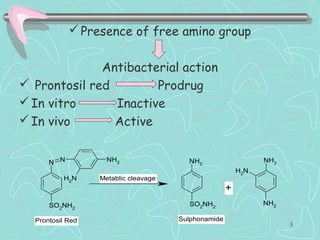
Presence of free amino group
Antibacterial action
 Prontosil red Prodrug
In vitro Inactive
In vivo Active
SO2NH2
N N NH2
NH2
SO2NH2
NH2
NH2
NH2
NH2
Metablic cleavage
+
Prontosil Red Sulphonamide
3
 Chemical modification of the sulphonamide structure
has given rise to several important group of drugs.
Gloucoma – Acetazolamide
Diuretic – Thiazides
Anti-mycobacterial – Sulphones
Oral hypoglycemic – Sulphonyl ureas
NH2SO2
NH2
Substitution gives
prodrug
1) Sodium salt-- water soluble
2)Substitution on these group gives
different molecules having different
pharmacokinetic properties
4
Mechanism of action
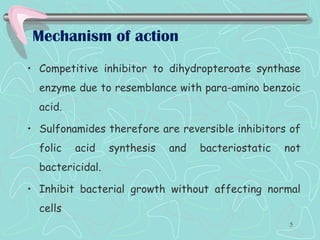
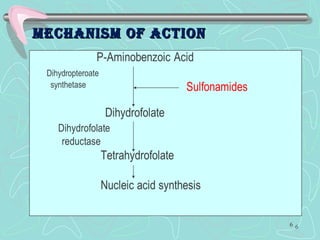
• Competitive inhibitor to dihydropteroate synthase
enzyme due to resemblance with para-amino benzoic
acid.
• Sulfonamides therefore are reversible inhibitors of
folic acid synthesis and bacteriostatic not
bactericidal.
• Inhibit bacterial growth without affecting normal
cells
5
MechanisM of actionMechanisM of action
6
Antibacterial activityAntibacterial activity
• Gram-positive and gram negative.
• Nocardia, chlamydia trachomatis, some protozoa.
ClassificationClassification
A. Sulphonamides employed for treatment of
systemic infection. Depending upon duration , they
can be further subdivided into
7
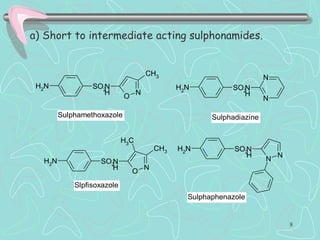
a) Short to intermediate acting sulphonamides.
NH2 SO2N
H
O
N
CH3
CH3
NH2 SO2N
H
N
N
NH2 SO2N
H
O
N
CH3
NH2 SO2N
H
N
N
Sulphamethoxazole Sulphadiazine
Slpfisoxazole
Sulphaphenazole
8
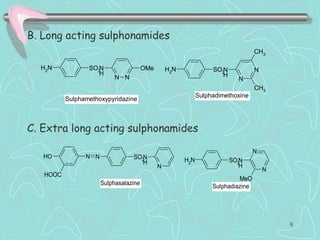
B. Long acting sulphonamides
C. Extra long acting sulphonamides
NH2 SO2N
H
N
N
CH3
CH3
NH2 SO2N
H
N N
OMe
Sulphamethoxypyridazine
Sulphadimethoxine
N SO2N
H
N
NOH
HOOC
NH2 SO2N
H
N
N
MeO
Sulphasalazine
Sulphadiazine
9
2. Poorly absorbed sulphonamides
3. Topically used sulphonamides
NH2 SO2N
H
NH2
NH
SO2N
H
N
H
O
CH2
C
H2
OH
O
N
S
SO2N
H
N
H
OO
OH
N
S
Sulphaguanidine
Succinyl Sulphathiazole
Phthalyl Sulphathiazole
NH2 SO2N
H
COCH3
NH2 SO2N
N
N
Ag
+
S
O O
N
H
O CH3
ONH2
Sulphacetamide
Silver Sulphadiazine
Mafenide acetate
10
Structure activityStructure activity
relationShiprelationShip
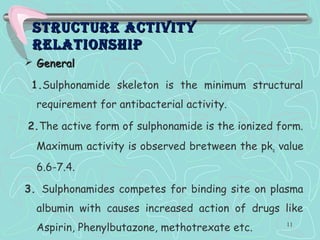
 GeneralGeneral
1.Sulphonamide skeleton is the minimum structural
requirement for antibacterial activity.
2.The active form of sulphonamide is the ionized form.
Maximum activity is observed bretween the pka value
6.6-7.4.
3. Sulphonamides competes for binding site on plasma
albumin with causes increased action of drugs like
Aspirin, Phenylbutazone, methotrexate etc. 11
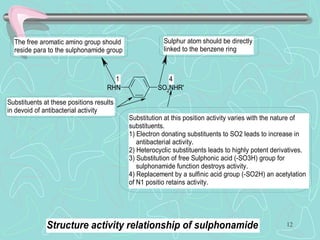
RHN SO2NHR'
1 4
Sulphur atom should be directly
linked to the benzene ring
The free aromatic amino group should
reside para to the sulphonamide group
Substituents at these positions results
in devoid of antibacterial activity
Substitution at this position activity varies with the nature of
substituents.
1) Electron donating substituents to SO2 leads to increase in
antibacterial activity.
2) Heterocyclic substituents leads to highly potent derivatives.
3) Substitution of free Sulphonic acid (-SO3H) group for
sulphonamide function destroys activity.
4) Replacement by a sulfinic acid group (-SO2H) an acetylation
of N1 positio retains activity.
Structure activity relationship of sulphonamide 12
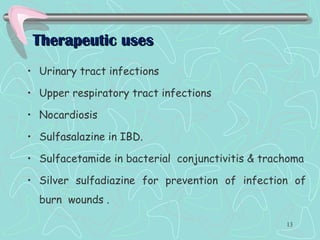
Therapeutic usesTherapeutic uses
• Urinary tract infections
• Upper respiratory tract infections
• Nocardiosis
• Sulfasalazine in IBD.
• Sulfacetamide in bacterial conjunctivitis & trachoma
• Silver sulfadiazine for prevention of infection of
burn wounds .
13
Adverse effectsAdverse effects
• Hypersensitivity reactions
• Crystalluria,hematuria,renal obstruction.
• Allergic nephritis
• Haemolytic anaemia, aplastic anaemia, thrombocytopenia.
• Kernicterus in new born
14
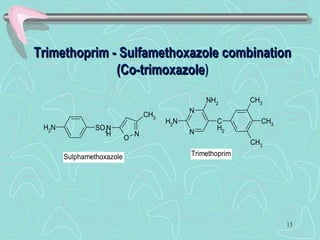
Trimethoprim - Sulfamethoxazole combinationTrimethoprim - Sulfamethoxazole combination
(Co-trimoxazole(Co-trimoxazole)
N
N
NH2
NH2
C
H2
CH3
CH3
CH3
NH2 SO2N
H
O
N
CH3
TrimethoprimSulphamethoxazole
15
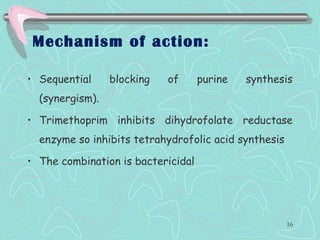
Mechanism of action:
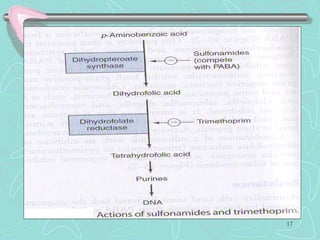
• Sequential blocking of purine synthesis
(synergism).
• Trimethoprim inhibits dihydrofolate reductase
enzyme so inhibits tetrahydrofolic acid synthesis
• The combination is bactericidal
16
17
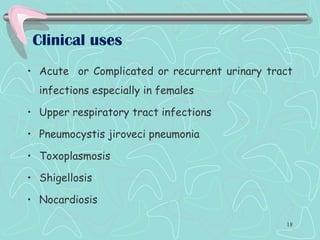
Clinical uses
• Acute or Complicated or recurrent urinary tract
infections especially in females
• Upper respiratory tract infections
• Pneumocystis jiroveci pneumonia
• Toxoplasmosis
• Shigellosis
• Nocardiosis
18
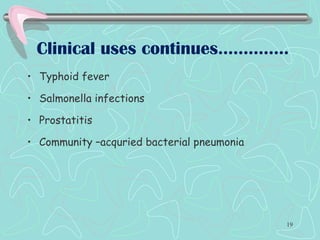
• Typhoid fever
• Salmonella infections
• Prostatitis
• Community –acquried bacterial pneumonia
Clinical uses continues…………..
19
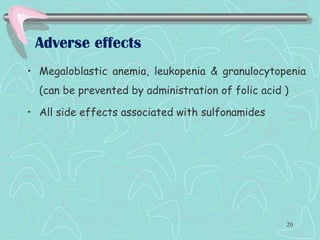
Adverse effects
• Megaloblastic anemia, leukopenia & granulocytopenia
(can be prevented by administration of folic acid )
• All side effects associated with sulfonamides
20

Med.chem sulfonamides

  • 1.
    SulphonamideSSulphonamideS Prepared by Mr. DharmendrasinhA Baria Assistant professor Department of Pharmaceutical Chemistry Smt. S. M. Shah Pharmacy college, Amsaran 1
  • 2.
    Description • One ofthe oldest antibacterial agents used to combat infection • Used for coccal infection in 1935 • They are bacteriostatic because it inhibits bacterial synthesis of folic acid • Clinical usefulness has decreased because of the effectiveness of other antibiotics and penicillin 2
  • 3.
    Presence of freeamino group Antibacterial action  Prontosil red Prodrug In vitro Inactive In vivo Active SO2NH2 N N NH2 NH2 SO2NH2 NH2 NH2 NH2 NH2 Metablic cleavage + Prontosil Red Sulphonamide 3
  • 4.
     Chemical modificationof the sulphonamide structure has given rise to several important group of drugs. Gloucoma – Acetazolamide Diuretic – Thiazides Anti-mycobacterial – Sulphones Oral hypoglycemic – Sulphonyl ureas NH2SO2 NH2 Substitution gives prodrug 1) Sodium salt-- water soluble 2)Substitution on these group gives different molecules having different pharmacokinetic properties 4
  • 5.
    Mechanism of action •Competitive inhibitor to dihydropteroate synthase enzyme due to resemblance with para-amino benzoic acid. • Sulfonamides therefore are reversible inhibitors of folic acid synthesis and bacteriostatic not bactericidal. • Inhibit bacterial growth without affecting normal cells 5
  • 6.
  • 7.
    Antibacterial activityAntibacterial activity •Gram-positive and gram negative. • Nocardia, chlamydia trachomatis, some protozoa. ClassificationClassification A. Sulphonamides employed for treatment of systemic infection. Depending upon duration , they can be further subdivided into 7
  • 8.
    a) Short tointermediate acting sulphonamides. NH2 SO2N H O N CH3 CH3 NH2 SO2N H N N NH2 SO2N H O N CH3 NH2 SO2N H N N Sulphamethoxazole Sulphadiazine Slpfisoxazole Sulphaphenazole 8
  • 9.
    B. Long actingsulphonamides C. Extra long acting sulphonamides NH2 SO2N H N N CH3 CH3 NH2 SO2N H N N OMe Sulphamethoxypyridazine Sulphadimethoxine N SO2N H N NOH HOOC NH2 SO2N H N N MeO Sulphasalazine Sulphadiazine 9
  • 10.
    2. Poorly absorbedsulphonamides 3. Topically used sulphonamides NH2 SO2N H NH2 NH SO2N H N H O CH2 C H2 OH O N S SO2N H N H OO OH N S Sulphaguanidine Succinyl Sulphathiazole Phthalyl Sulphathiazole NH2 SO2N H COCH3 NH2 SO2N N N Ag + S O O N H O CH3 ONH2 Sulphacetamide Silver Sulphadiazine Mafenide acetate 10
  • 11.
    Structure activityStructure activity relationShiprelationShip GeneralGeneral 1.Sulphonamide skeleton is the minimum structural requirement for antibacterial activity. 2.The active form of sulphonamide is the ionized form. Maximum activity is observed bretween the pka value 6.6-7.4. 3. Sulphonamides competes for binding site on plasma albumin with causes increased action of drugs like Aspirin, Phenylbutazone, methotrexate etc. 11
  • 12.
    RHN SO2NHR' 1 4 Sulphuratom should be directly linked to the benzene ring The free aromatic amino group should reside para to the sulphonamide group Substituents at these positions results in devoid of antibacterial activity Substitution at this position activity varies with the nature of substituents. 1) Electron donating substituents to SO2 leads to increase in antibacterial activity. 2) Heterocyclic substituents leads to highly potent derivatives. 3) Substitution of free Sulphonic acid (-SO3H) group for sulphonamide function destroys activity. 4) Replacement by a sulfinic acid group (-SO2H) an acetylation of N1 positio retains activity. Structure activity relationship of sulphonamide 12
  • 13.
    Therapeutic usesTherapeutic uses •Urinary tract infections • Upper respiratory tract infections • Nocardiosis • Sulfasalazine in IBD. • Sulfacetamide in bacterial conjunctivitis & trachoma • Silver sulfadiazine for prevention of infection of burn wounds . 13
  • 14.
    Adverse effectsAdverse effects •Hypersensitivity reactions • Crystalluria,hematuria,renal obstruction. • Allergic nephritis • Haemolytic anaemia, aplastic anaemia, thrombocytopenia. • Kernicterus in new born 14
  • 15.
    Trimethoprim - SulfamethoxazolecombinationTrimethoprim - Sulfamethoxazole combination (Co-trimoxazole(Co-trimoxazole) N N NH2 NH2 C H2 CH3 CH3 CH3 NH2 SO2N H O N CH3 TrimethoprimSulphamethoxazole 15
  • 16.
    Mechanism of action: •Sequential blocking of purine synthesis (synergism). • Trimethoprim inhibits dihydrofolate reductase enzyme so inhibits tetrahydrofolic acid synthesis • The combination is bactericidal 16
  • 17.
  • 18.
    Clinical uses • Acuteor Complicated or recurrent urinary tract infections especially in females • Upper respiratory tract infections • Pneumocystis jiroveci pneumonia • Toxoplasmosis • Shigellosis • Nocardiosis 18
  • 19.
    • Typhoid fever •Salmonella infections • Prostatitis • Community –acquried bacterial pneumonia Clinical uses continues………….. 19
  • 20.
    Adverse effects • Megaloblasticanemia, leukopenia & granulocytopenia (can be prevented by administration of folic acid ) • All side effects associated with sulfonamides 20