Prepared by Group 5:

                       Rudraksh Joshi
                       Khushbu Jethwa
                       Sonali Kadam
                       Shirish Kadam
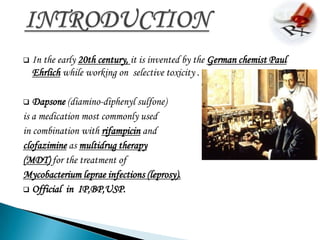
   In the early 20th century, it is invented by the German chemist Paul
    Ehrlich while working on selective toxicity .

  Dapsone (diamino-diphenyl sulfone)
is a medication most commonly used
in combination with rifampicin and
clofazimine as multidrug therapy
(MDT) for the treatment of
Mycobacterium leprae infections (leprosy).
 Official in IP,BP,USP.
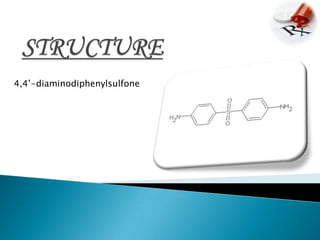
4,4’-diaminodiphenylsulfone
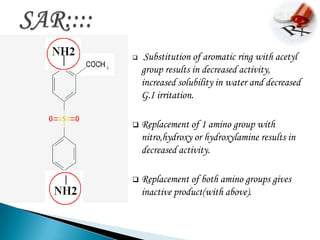
    Substitution of aromatic ring with acetyl
    group results in decreased activity,
    increased solubility in water and decreased
    G.I irritation.

   Replacement of 1 amino group with
    nitro,hydroxy or hydroxylamine results in
    decreased activity.

   Replacement of both amino groups gives
    inactive product(with above).
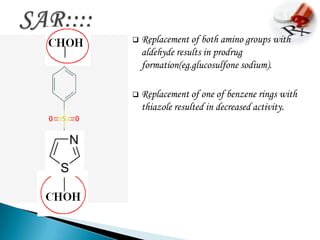
   Replacement of both amino groups with
    aldehyde results in prodrug
    formation(eg.glucosulfone sodium).

   Replacement of one of benzene rings with
    thiazole resulted in decreased activity.
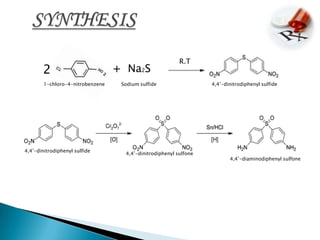
R.T
       2                          + Na2S
        1-chloro-4-nitrobenzene    Sodium sulfide                  4,4’-dinitrodiphenyl sulfide


4,4’-dinitrodiphenyl sulfide
                                    4,4’-dinitrodiphenyl sulfone
                                                                          4,4’-diaminodiphenyl sulfone
1. Absorption
 It is completely absorbed after oral administration


2. Distribution
 Approximately 70% bound to plasma protein. The main
  metabolite, monoacetyl dapsone, is nearly 100% protein
  bound.
3. Metabolism
Dapsone is acetylated in the liver, the degree of which is
genetically determined.

4 . Elimination
The plasma t1/2 is variable, though often>24hrs
Elimination takes 1-2 weeks or longer
Metabolites are excreted in bile & urine
 Mild  haemolytic anaemia
 Gastric intolerance-nausea & anorexia
 methaemoglobinaemia, headache, paresthesias, mental
  symptoms & drug fever
 allergic rashes, fixed drug eruption, hypermelanosis,
  phototoxicity& rarely exfoliative dermatitis
 Hepatitis & agranulocytosis
 Dapsone reaction/sulfone syndrome
 Hypersensitivity
 more frequent in patients receiving multiple-drug therapy.
 The reaction involves a rash and may also include fever,
  jaundice, and eosinophilia.
 In general, these symptoms will occur within the first six
  weeks of therapy or not at all, and may be treated by
  corticosteroid therapy.
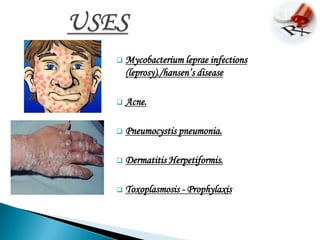
   Mycobacterium leprae infections
    (leprosy)./hansen’s disease

   Acne.

   Pneumocystis pneumonia.

   Dermatitis Herpetiformis.

   Toxoplasmosis - Prophylaxis
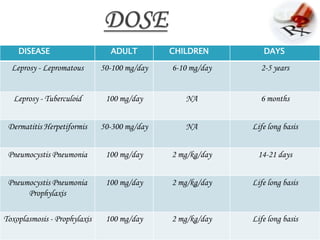
DISEASE                     ADULT         CHILDREN         DAYS

  Leprosy - Lepromatous       50-100 mg/day   6-10 mg/day     2-5 years


   Leprosy - Tuberculoid       100 mg/day        NA           6 months


 Dermatitis Herpetiformis     50-300 mg/day      NA         Life long basis


 Pneumocystis Pneumonia        100 mg/day     2 mg/kg/day    14-21 days


 Pneumocystis Pneumonia        100 mg/day     2 mg/kg/day   Life long basis
      Prophylaxis

Toxoplasmosis - Prophylaxis    100 mg/day     2 mg/kg/day   Life long basis
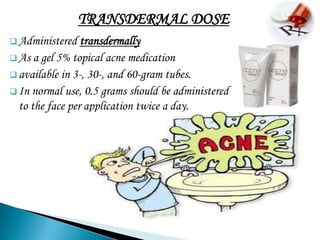
TRANSDERMAL DOSE
 Administered   transdermally
 As a gel 5% topical acne medication
 available in 3-, 30-, and 60-gram tubes.
 In normal use, 0.5 grams should be administered
  to the face per application twice a day.
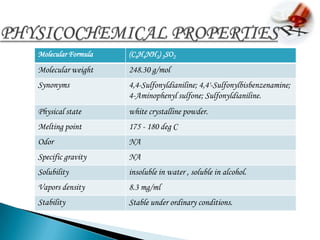
Molecular Formula   (C6H4NH2) 2SO2
Molecular weight    248.30 g/mol
Synonyms            4,4-Sulfonyldianiline; 4,4'-Sulfonylbisbenzenamine;
                    4-Aminophenyl sulfone; Sulfonyldianiline.
Physical state      white crystalline powder.
Melting point       175 - 180 deg C
Odor                NA
Specific gravity    NA
Solubility          insoluble in water , soluble in alcohol.
Vapors density      8.3 mg/ml
Stability           Stable under ordinary conditions.
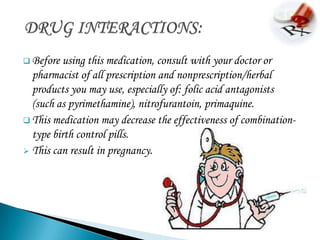
 Before using this medication, consult with your doctor or
  pharmacist of all prescription and nonprescription/herbal
  products you may use, especially of: folic acid antagonists
  (such as pyrimethamine), nitrofurantoin, primaquine.
 This medication may decrease the effectiveness of combination-
  type birth control pills.
 This can result in pregnancy.
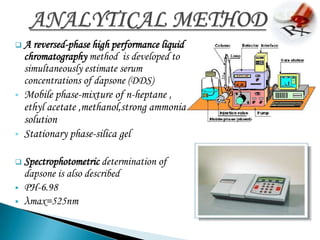
A    reversed-phase high performance liquid
    chromatography method is developed to
    simultaneously estimate serum
    concentrations of dapsone (DDS)
   Mobile phase-mixture of n-heptane ,
    ethyl acetate ,methanol,strong ammonia
    solution
   Stationary phase-silica gel

 Spectrophotometric    determination of
    dapsone is also described
   PH-6.98
   λmax=525nm
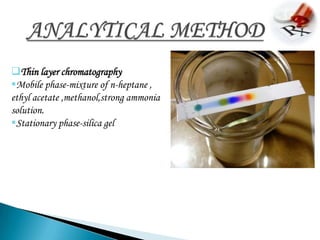
Thin layer chromatography
Mobile phase-mixture of n-heptane ,
ethyl acetate ,methanol,strong ammonia
solution.
Stationary phase-silica gel
 The  need for a more reliable route of administration led to
  investigation the possibility of an I.M. dapsone depot
  injection.
 To achieve effective blood levels for 3-4 weeks, suspensions
  of large dapsone particles in an aqueous vehicle were made.
 Studies in the rat revealed that dapsone-dependent
  methaemoglobinaemia could be greatly diminished by the co-
  administration of metabolic inhibitors(eg-cimetidine).
 The  need for a more reliable route of administration led to
  investigation the possibility of an I.M. dapsone depot
  injection.
 To achieve effective blood levels for 3-4 weeks, suspensions
  of large dapsone particles in an aqueous vehicle were made.
 Studies in the rat revealed that dapsone-dependent
  methaemoglobinaemia could be greatly diminished by the co-
  administration of metabolic inhibitors(eg-cimetidine).
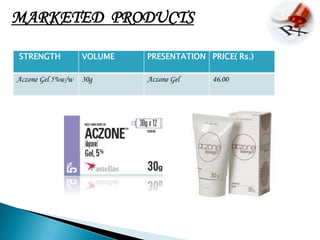
MARKETED PRODUCTS

STRENGTH           VOLUME   PRESENTATION PRICE( Rs.)

Aczone Gel 5%w/w   30g      Aczone Gel    46.00
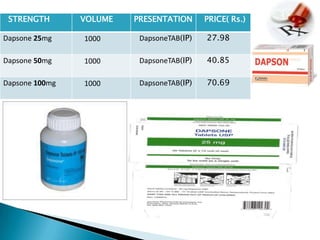
STRENGTH       VOLUME   PRESENTATION      PRICE( Rs.)

Dapsone 25mg    1000      DapsoneTAB(IP)   27.98

Dapsone 50mg    1000      DapsoneTAB(IP)   40.85

Dapsone 100mg   1000      DapsoneTAB(IP)   70.69
   Williams D.et al ,Foye's principles of medicinal chemistry, fifth edition,
    Lippincott's Williams & Wilkins
   John H.et al ,Wilson & Gisvolds textbook of organic medical &
    pharmaceutical chemistry , eleventh edition ,Lippincott's Williams & Wilkins
   Indian Pharmacopoeia, 2010,Volume I, 1162-1163
   United states Pharmacopoeia,2009,Volume II, 2059-2060
   Moncrief J. Journal of Chromatography B: Biomedical Sciences and
    Applications
    Volume 654, Issue 1, 18 March 1994, 103:110.
   http://www.rxlist.com
   http:// www.medicinenet.com
   http://www.leprosy-information.org
   http://onlinelibrary.wiley.com
Dapsone
Dapsone

Dapsone

  • 2.
    Prepared by Group5: Rudraksh Joshi Khushbu Jethwa Sonali Kadam Shirish Kadam
  • 3.
    In the early 20th century, it is invented by the German chemist Paul Ehrlich while working on selective toxicity .  Dapsone (diamino-diphenyl sulfone) is a medication most commonly used in combination with rifampicin and clofazimine as multidrug therapy (MDT) for the treatment of Mycobacterium leprae infections (leprosy).  Official in IP,BP,USP.
  • 4.
  • 5.
    Substitution of aromatic ring with acetyl group results in decreased activity, increased solubility in water and decreased G.I irritation.  Replacement of 1 amino group with nitro,hydroxy or hydroxylamine results in decreased activity.  Replacement of both amino groups gives inactive product(with above).
  • 6.
    Replacement of both amino groups with aldehyde results in prodrug formation(eg.glucosulfone sodium).  Replacement of one of benzene rings with thiazole resulted in decreased activity.
  • 7.
    R.T 2 + Na2S 1-chloro-4-nitrobenzene Sodium sulfide 4,4’-dinitrodiphenyl sulfide 4,4’-dinitrodiphenyl sulfide 4,4’-dinitrodiphenyl sulfone 4,4’-diaminodiphenyl sulfone
  • 9.
    1. Absorption  Itis completely absorbed after oral administration 2. Distribution  Approximately 70% bound to plasma protein. The main metabolite, monoacetyl dapsone, is nearly 100% protein bound.
  • 10.
    3. Metabolism Dapsone isacetylated in the liver, the degree of which is genetically determined. 4 . Elimination The plasma t1/2 is variable, though often>24hrs Elimination takes 1-2 weeks or longer Metabolites are excreted in bile & urine
  • 11.
     Mild haemolytic anaemia  Gastric intolerance-nausea & anorexia  methaemoglobinaemia, headache, paresthesias, mental symptoms & drug fever  allergic rashes, fixed drug eruption, hypermelanosis, phototoxicity& rarely exfoliative dermatitis  Hepatitis & agranulocytosis  Dapsone reaction/sulfone syndrome
  • 12.
     Hypersensitivity  morefrequent in patients receiving multiple-drug therapy.  The reaction involves a rash and may also include fever, jaundice, and eosinophilia.  In general, these symptoms will occur within the first six weeks of therapy or not at all, and may be treated by corticosteroid therapy.
  • 13.
    Mycobacterium leprae infections (leprosy)./hansen’s disease  Acne.  Pneumocystis pneumonia.  Dermatitis Herpetiformis.  Toxoplasmosis - Prophylaxis
  • 14.
    DISEASE ADULT CHILDREN DAYS Leprosy - Lepromatous 50-100 mg/day 6-10 mg/day 2-5 years Leprosy - Tuberculoid 100 mg/day NA 6 months Dermatitis Herpetiformis 50-300 mg/day NA Life long basis Pneumocystis Pneumonia 100 mg/day 2 mg/kg/day 14-21 days Pneumocystis Pneumonia 100 mg/day 2 mg/kg/day Life long basis Prophylaxis Toxoplasmosis - Prophylaxis 100 mg/day 2 mg/kg/day Life long basis
  • 15.
    TRANSDERMAL DOSE  Administered transdermally  As a gel 5% topical acne medication  available in 3-, 30-, and 60-gram tubes.  In normal use, 0.5 grams should be administered to the face per application twice a day.
  • 16.
    Molecular Formula (C6H4NH2) 2SO2 Molecular weight 248.30 g/mol Synonyms 4,4-Sulfonyldianiline; 4,4'-Sulfonylbisbenzenamine; 4-Aminophenyl sulfone; Sulfonyldianiline. Physical state white crystalline powder. Melting point 175 - 180 deg C Odor NA Specific gravity NA Solubility insoluble in water , soluble in alcohol. Vapors density 8.3 mg/ml Stability Stable under ordinary conditions.
  • 17.
     Before usingthis medication, consult with your doctor or pharmacist of all prescription and nonprescription/herbal products you may use, especially of: folic acid antagonists (such as pyrimethamine), nitrofurantoin, primaquine.  This medication may decrease the effectiveness of combination- type birth control pills.  This can result in pregnancy.
  • 18.
    A reversed-phase high performance liquid chromatography method is developed to simultaneously estimate serum concentrations of dapsone (DDS)  Mobile phase-mixture of n-heptane , ethyl acetate ,methanol,strong ammonia solution  Stationary phase-silica gel  Spectrophotometric determination of dapsone is also described  PH-6.98  λmax=525nm
  • 19.
    Thin layer chromatography Mobilephase-mixture of n-heptane , ethyl acetate ,methanol,strong ammonia solution. Stationary phase-silica gel
  • 20.
     The need for a more reliable route of administration led to investigation the possibility of an I.M. dapsone depot injection.  To achieve effective blood levels for 3-4 weeks, suspensions of large dapsone particles in an aqueous vehicle were made.  Studies in the rat revealed that dapsone-dependent methaemoglobinaemia could be greatly diminished by the co- administration of metabolic inhibitors(eg-cimetidine).
  • 21.
     The need for a more reliable route of administration led to investigation the possibility of an I.M. dapsone depot injection.  To achieve effective blood levels for 3-4 weeks, suspensions of large dapsone particles in an aqueous vehicle were made.  Studies in the rat revealed that dapsone-dependent methaemoglobinaemia could be greatly diminished by the co- administration of metabolic inhibitors(eg-cimetidine).
  • 22.
    MARKETED PRODUCTS STRENGTH VOLUME PRESENTATION PRICE( Rs.) Aczone Gel 5%w/w 30g Aczone Gel 46.00
  • 23.
    STRENGTH VOLUME PRESENTATION PRICE( Rs.) Dapsone 25mg 1000 DapsoneTAB(IP) 27.98 Dapsone 50mg 1000 DapsoneTAB(IP) 40.85 Dapsone 100mg 1000 DapsoneTAB(IP) 70.69
  • 24.
    Williams D.et al ,Foye's principles of medicinal chemistry, fifth edition, Lippincott's Williams & Wilkins  John H.et al ,Wilson & Gisvolds textbook of organic medical & pharmaceutical chemistry , eleventh edition ,Lippincott's Williams & Wilkins  Indian Pharmacopoeia, 2010,Volume I, 1162-1163  United states Pharmacopoeia,2009,Volume II, 2059-2060  Moncrief J. Journal of Chromatography B: Biomedical Sciences and Applications Volume 654, Issue 1, 18 March 1994, 103:110.  http://www.rxlist.com  http:// www.medicinenet.com  http://www.leprosy-information.org  http://onlinelibrary.wiley.com