Climate Change :
Impacts on Agriculture
 MUHAMMAD FAHAD ANSARI
       12IEEM 14
Climate Change
Noun
a long-term change in the earth's climate, especially a change
due to an increase in the average atmospheric temperature:
Melting glaciers imply that life in the Arctic is affected by
climate change.

Climate change is a significant and lasting change in the
statistical distribution of weather patterns over periods ranging
from decades to millions of years. It may be a change in
average weather conditions or the distribution of events
around that average (e.g., more or fewer extreme weather
events). Climate change may be limited to a specific region or
may occur across the whole Earth.
Current Issues in Agriculture
• Overproduction in short-term, yet food
  insecurity for a large population
• Stagnation/decline in yields
• Diversification
• Natural resource management- SOM
  decline, input use efficiencies, narrow
  genetic base
• Quality and quantity of water resources
• Profitability: Increasing cost and
  deceleration in TFP growth
E merging Scenario: Drivers of
       Agricultural Transformation
• Increasing population leading to higher (and
  quality) demand of food
• Increasing urbanization
• Increasing rural migration -tenant farming,
  contract and cooperative farming
• Increasing inter- and intra-sectoral competition for
  resources: land, water, energy, credit
• Increasing globalization: removal of trade barriers,
  information and communication
• New technologies: Biotechnology, space and
  information technology
 Increasing privatization of agricultural extension
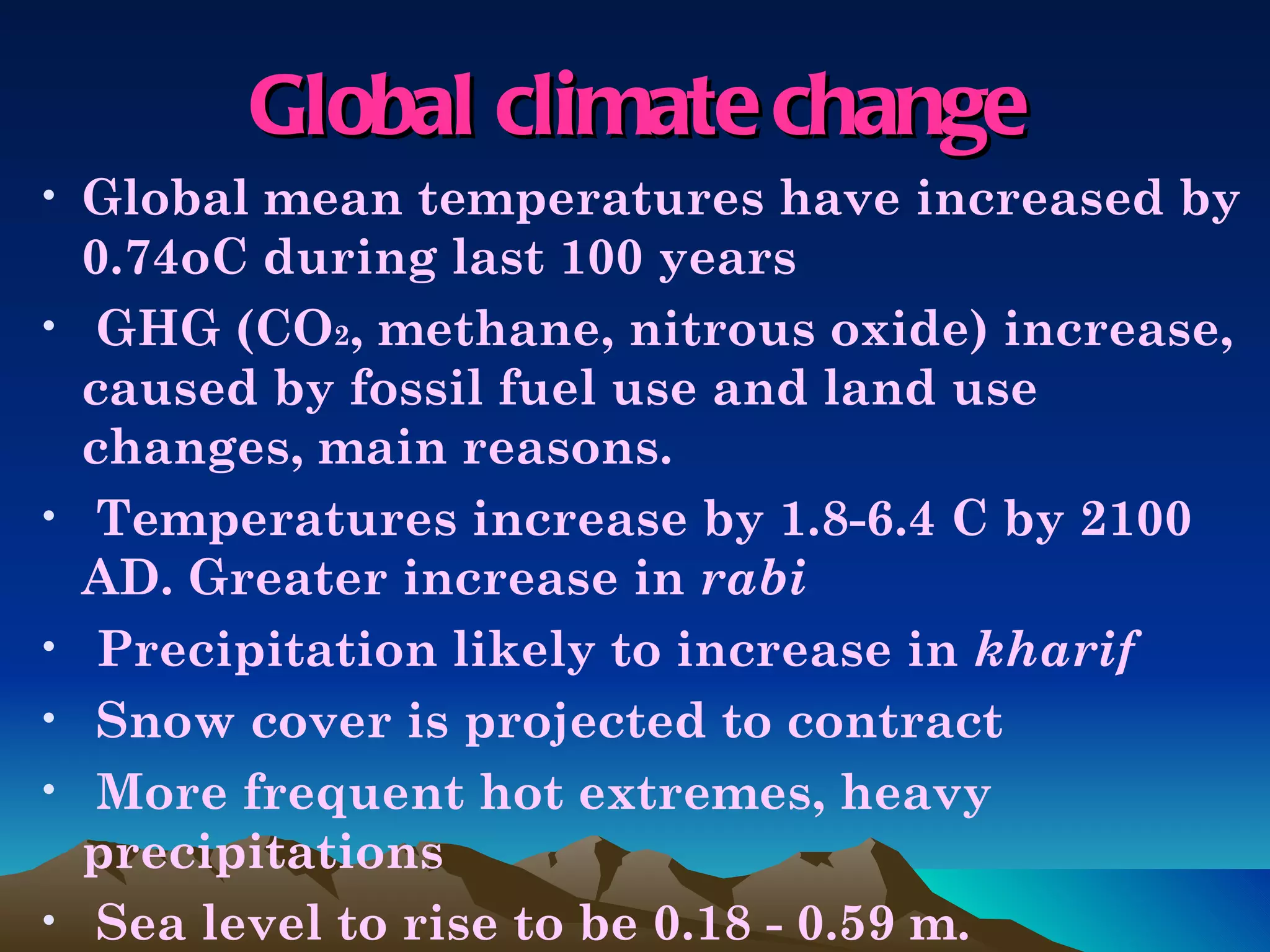
Global climate change
• Global mean temperatures have increased by
  0.74oC during last 100 years
• GHG (CO2, methane, nitrous oxide) increase,
  caused by fossil fuel use and land use
  changes, main reasons.
• Temperatures increase by 1.8-6.4 C by 2100
  AD. Greater increase in rabi
• Precipitation likely to increase in kharif
• Snow cover is projected to contract
• More frequent hot extremes, heavy
  precipitations
• Sea level to rise to be 0.18 - 0.59 m.
Contribution of different sectors in world to
              climate change.
   (Sources of Greenhouse Gas emissions)
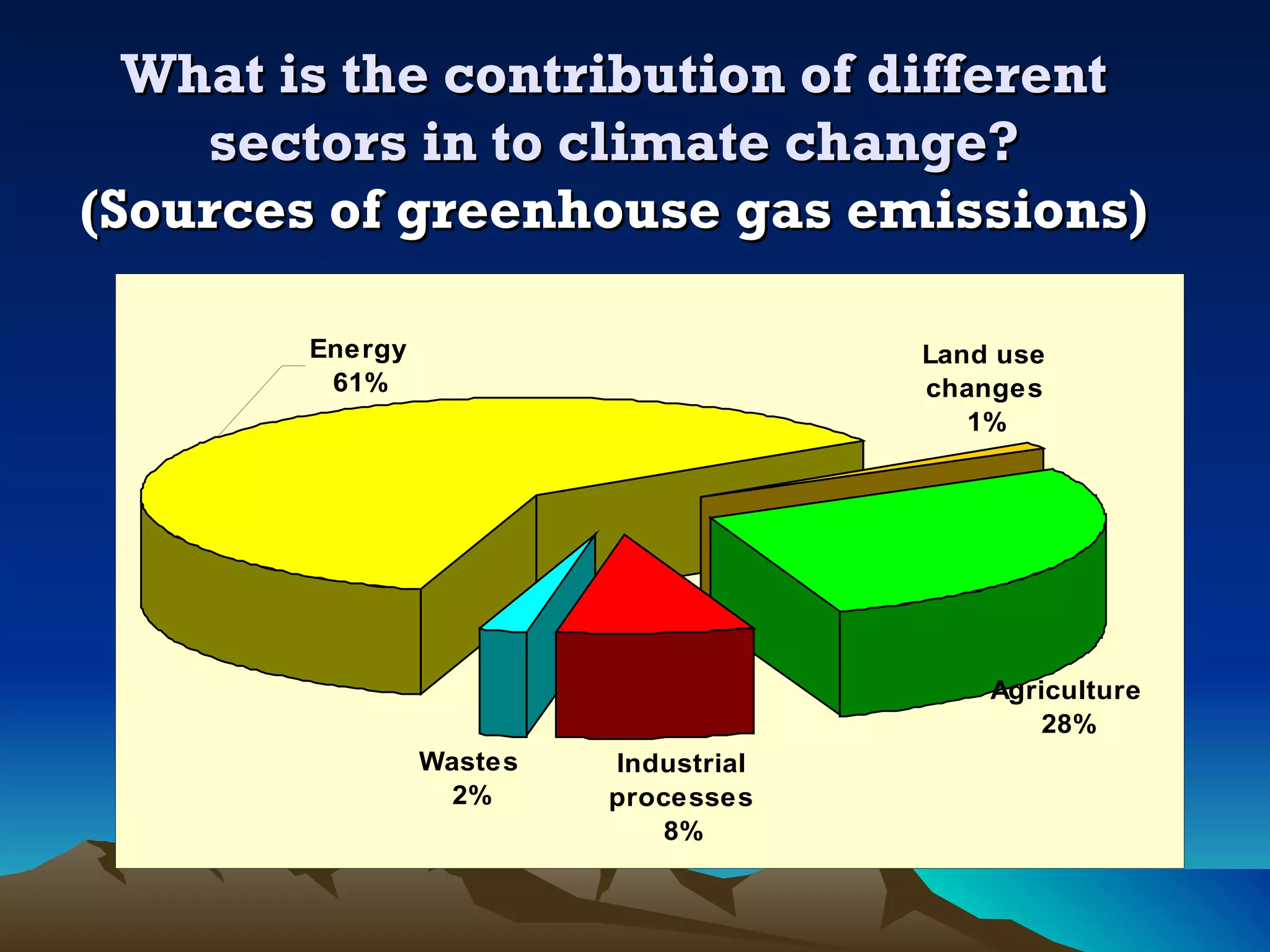
What is the contribution of different
    sectors in to climate change?
(Sources of greenhouse gas emissions)

        Energy                         Land use
         61%                           changes
                                          1%


                                           Agriculture
                                               28%
                 Wastes   Industrial
                   2%     processes
                              8%
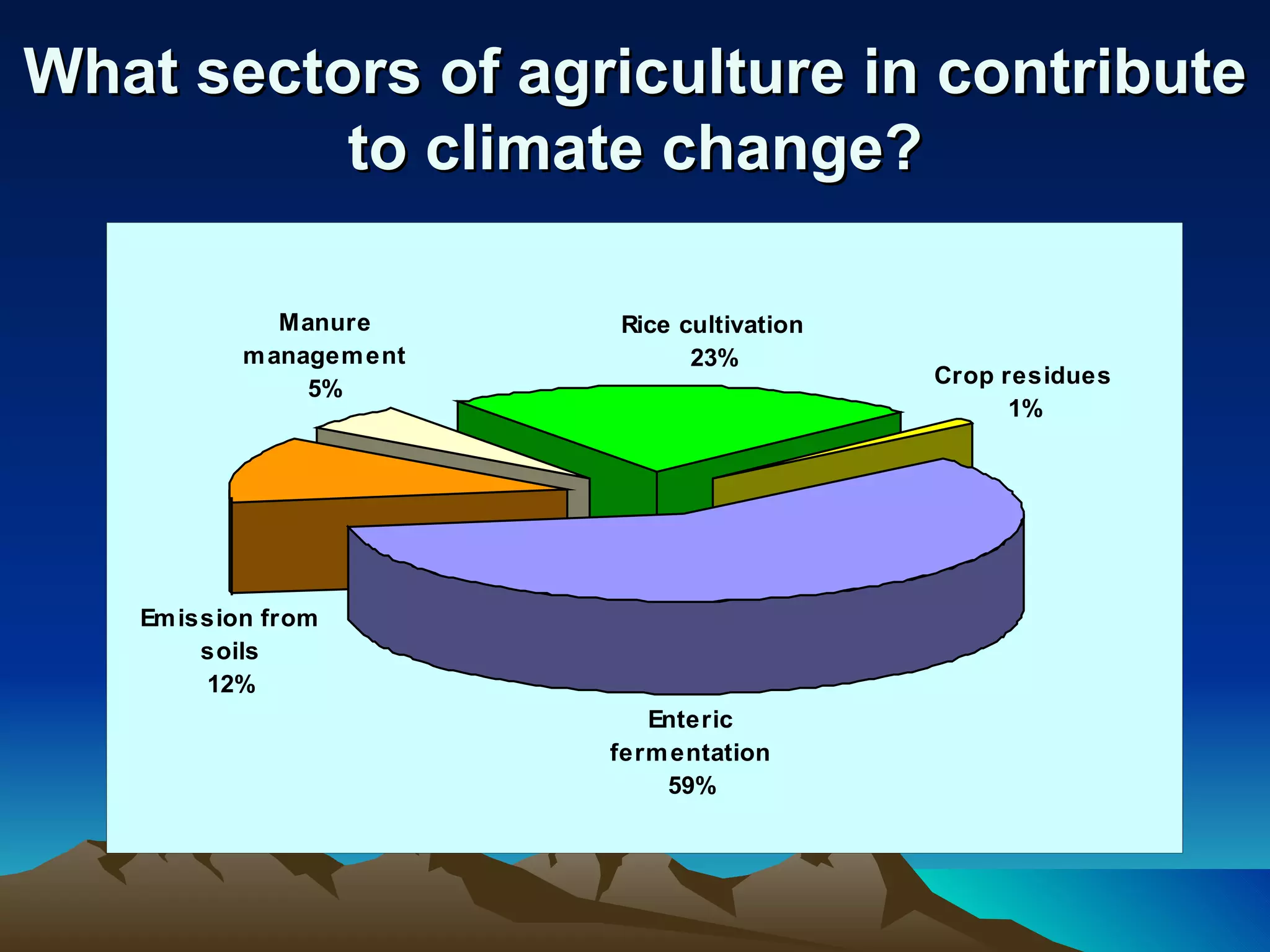
What sectors of agriculture in contribute
          to climate change?

              Manure      Rice cultivation
           m anagem ent         23%
                                             Crop residues
                5%
                                                   1%


   Em ission from
        soils
        12%
                             Enteric
                          ferm entation
                              59%
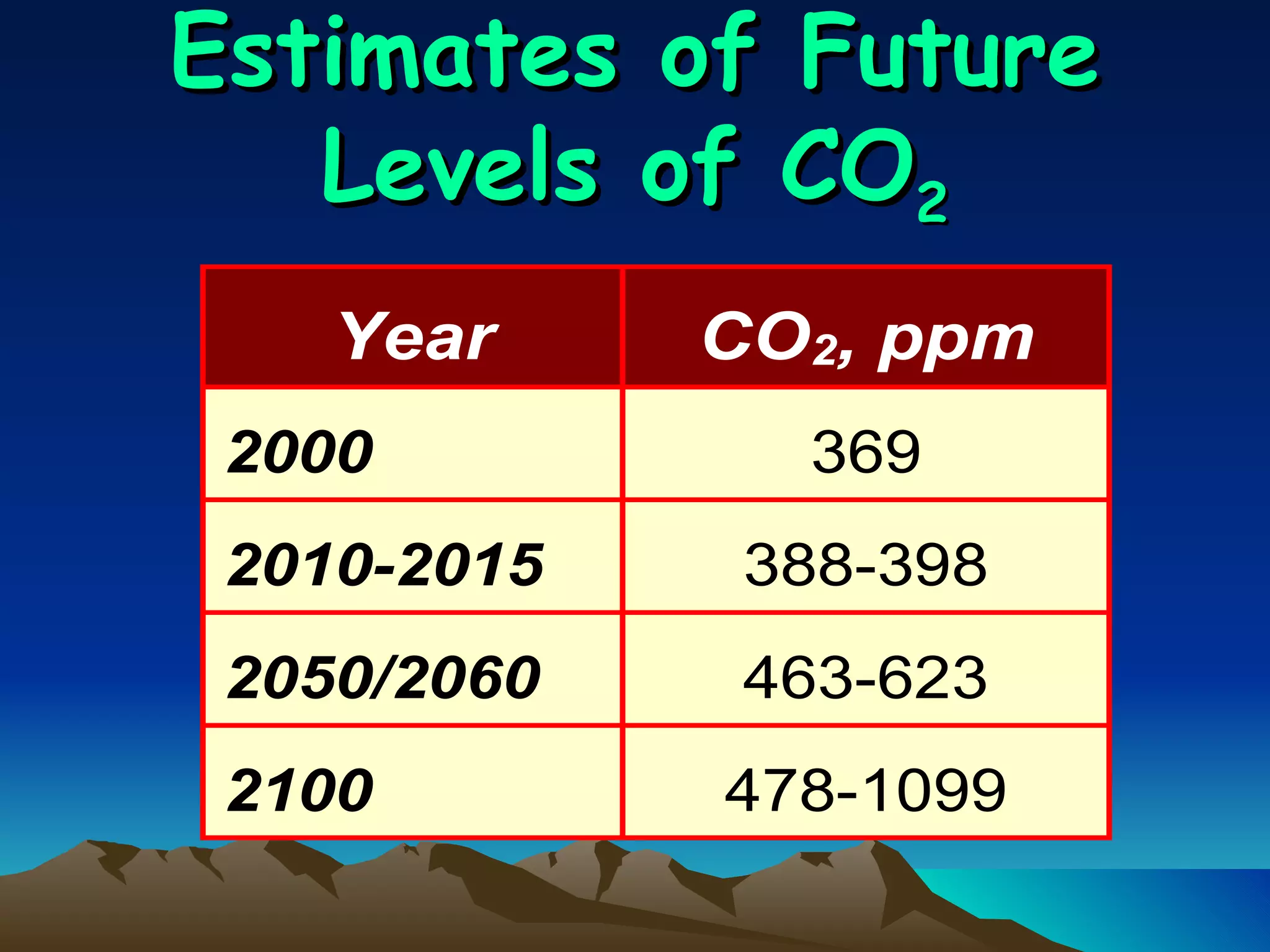
Estimates of Future
   Levels of CO2
    Year     CO2, ppm
 2000          369
 2010-2015    388-398
 2050/2060    463-623
 2100        478-1099
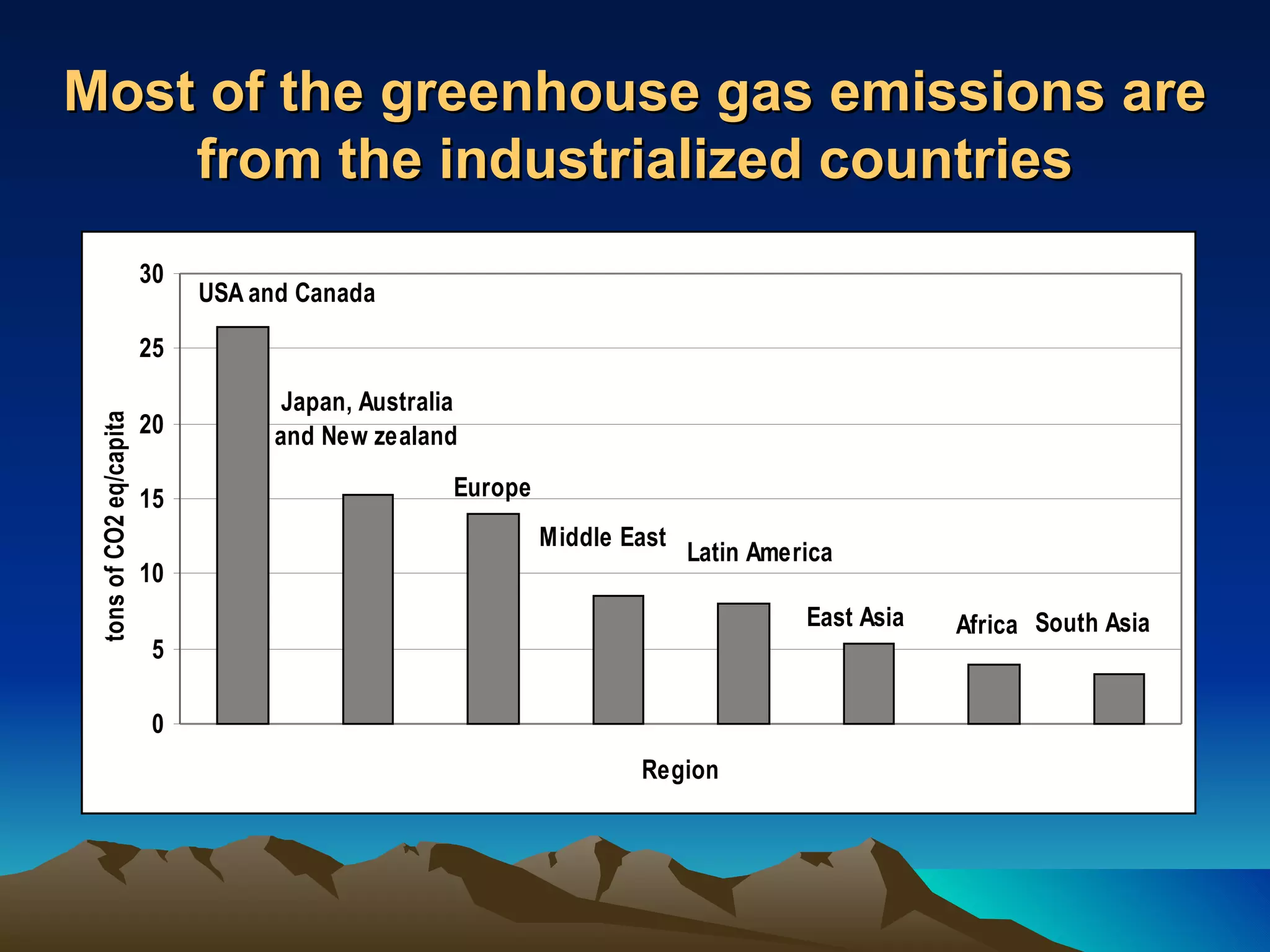
Most of the greenhouse gas emissions are
    from the industrialized countries
                         30
                              USA and Canada

                         25
                                     Japan, Australia
                         20
 tons of CO2 eq/capita


                                    and New zealand

                         15                         Europe
                                                             Middle East
                                                                           Latin America
                         10
                                                                                     East Asia   Africa South Asia
                          5

                          0
                                                                     Region
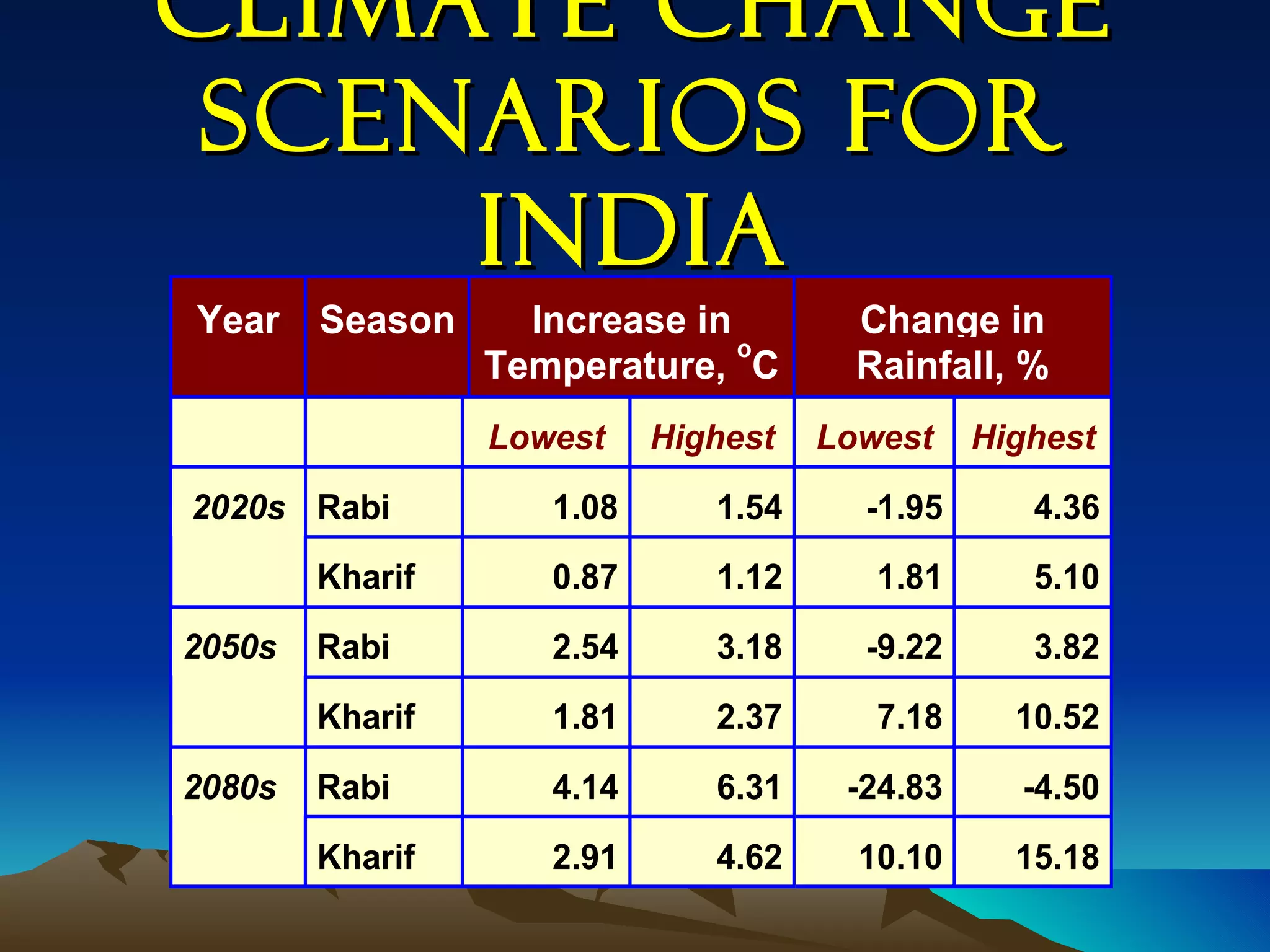
Climate Change
 Scenarios for
     India
Year    Season     Increase in         Change in
                               o
                 Temperature, C        Rainfall, %
                 Lowest    Highest   Lowest    Highest
2020s Rabi          1.08      1.54     -1.95      4.36
        Kharif      0.87      1.12      1.81      5.10
2050s   Rabi        2.54      3.18     -9.22      3.82
        Kharif      1.81      2.37      7.18     10.52

2080s   Rabi        4.14      6.31    -24.83     -4.50
        Kharif      2.91      4.62     10.10     15.18
Other observations of change in
        global climate
• Globally, hot days, hot nights, and heat
  waves have become more frequent.
• Frequency of heavy precipitation
  events has increased over most land
  areas.
• Global average sea level rose at an
  average rate of 1.8 mm per year over
  1961 to 2003.
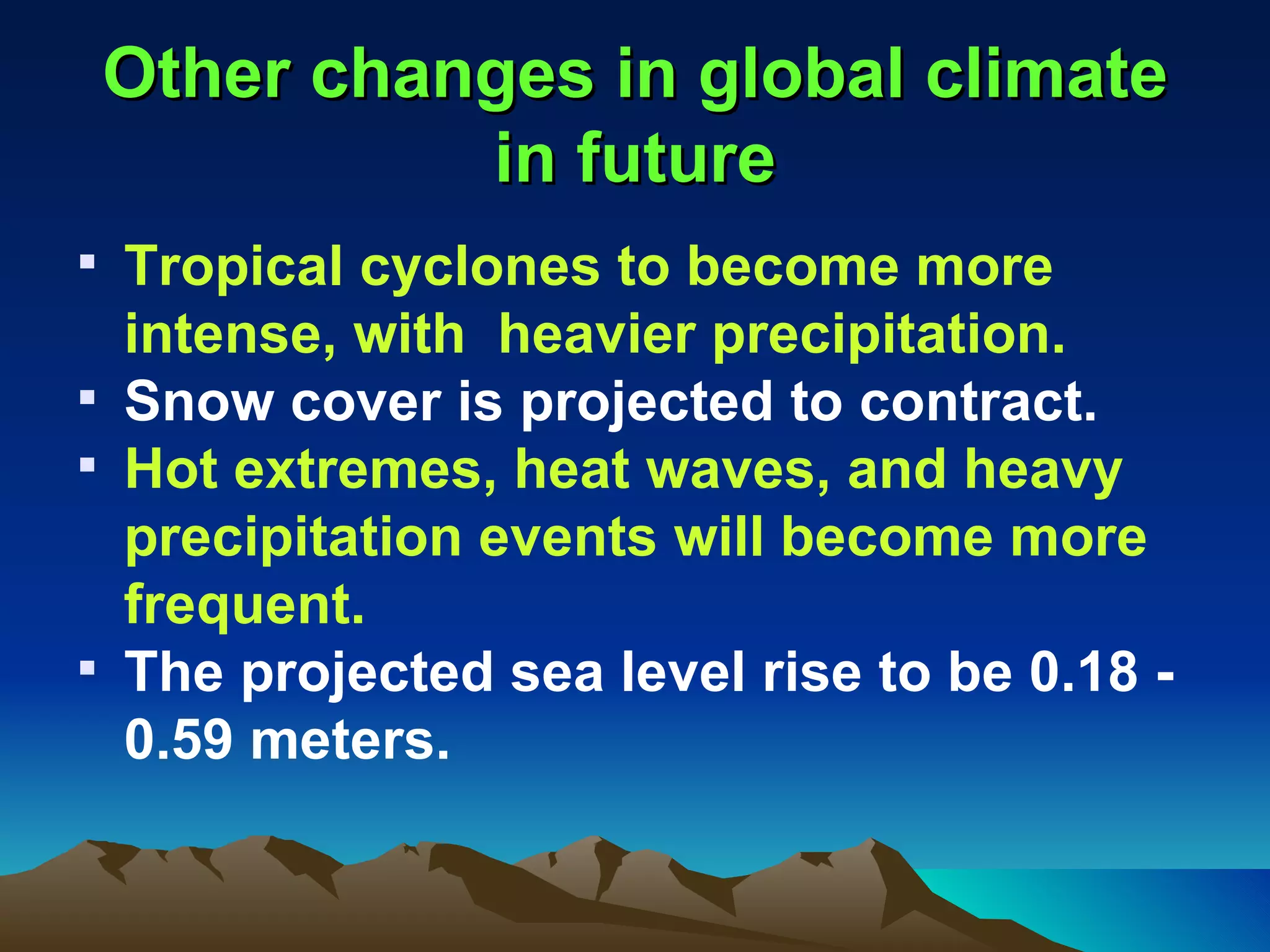
Other changes in global climate
           in future
 Tropical cyclones to become more
  intense, with heavier precipitation.
 Snow cover is projected to contract.
 Hot extremes, heat waves, and heavy
  precipitation events will become more
  frequent.
 The projected sea level rise to be 0.18 -
  0.59 meters.
Potential Impact of Climate Change on
Wheat Production in developing countries
                      80

                      75

                      70
 Production , Mtons


                      65

                      60

                      55

                      50

                      45

                      40
                           2000   2010   2020   2030          2040   2050      2060       2070
                                                       Year

                                                                     Source: Aggarwal et al. (2002)
Projected impacts of climate change
on developing countries agriculture
 Cereal productivity to decrease by 10-40% by
  2100.
 Greater loss expected in rabi. Every 1oC increase
  in temperature reduces wheat production by 4-5
  million tons. Loss only 1-2 million tons if farmers
  could plant in time.
 Reduced frequency of frost damage: less
  damage to potato, peas, mustard
 Increased droughts and floods are likely to
  increase production variability
Projected impacts of climate change
on developing countries agriculture
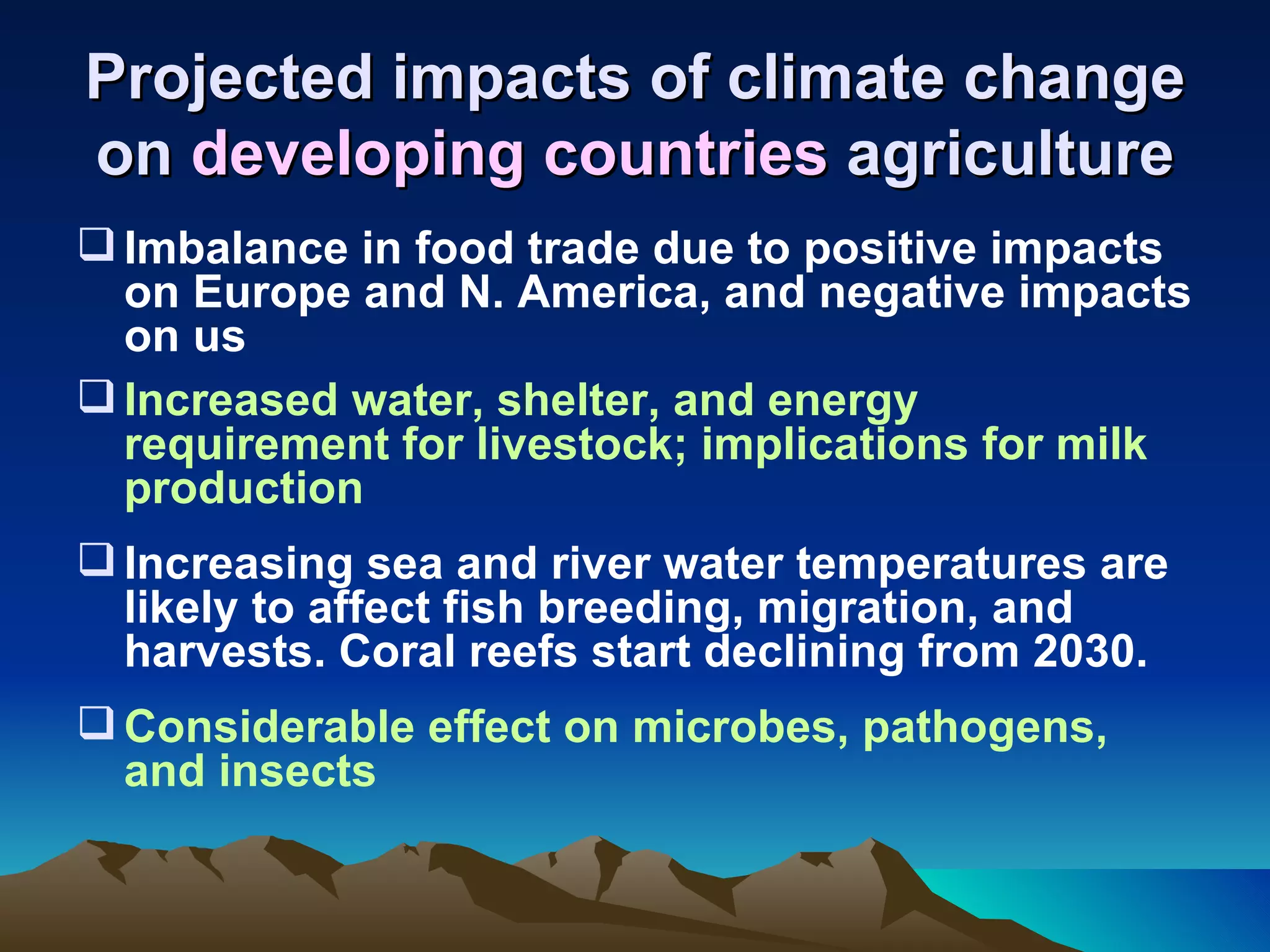
 Imbalance in food trade due to positive impacts
  on Europe and N. America, and negative impacts
  on us
 Increased water, shelter, and energy
  requirement for livestock; implications for milk
  production
 Increasing sea and river water temperatures are
  likely to affect fish breeding, migration, and
  harvests. Coral reefs start declining from 2030.
 Considerable effect on microbes, pathogens,
  and insects
Projected impacts of climate change
on developing countries agriculture
 Increasing temperature would increase
  fertilizer requirement for the same
  production targets; and result in higher
  emissions
 Increasing sea and river water temperatures
  are likely to affect fish breeding, migration,
  and harvests. Coral reefs start declining from
  2030.
 Increased water, shelter, and energy
  requirement for livestock; implications for
  milk production
Climate Variability and Climate Change-
     Another Driver in Agriculture
 • Increase in CO2
 •   Increase in temperature
 •   Change in precipitation
 •   Sea level rise
 •   Variability and extreme events
     such as floods and drought
Projected beneficial impacts of climate change on
        developing countries agriculture

 Reduced frequency of frost damage:
  less damage to potato, peas, mustard
 New ‘flooded’ areas may become
  available for fisheries in coastal
  regions
 Other potential benefits, if any, need to
  be characterized
Impacts on Agriculture
• May alter spatial and temporal
  demands and supply by impacting:
  – Food production
  – Stability and sustainability
  – Employment and Autonomy
  – Profitability
  – Trade & economy
  – Global financial Crisis
Adaptation and mitigation framework:
Need to consider emerging scenario
• Greater demand for (quality) food; yields
  need to increase by 30-50% by 2030
• Increasing urbanization and globalization
• Increasing competition from other sectors
  for land, energy, water and capital
• Climate change a continuous process;
  greater focus on short-term actions on
  adaptation and mitigation
Key adaptation strategies
¢ Assisting farmers in coping with
  current climatic risks
¢ Intensifying food production
  systems
¢ Improving land and water
  management
¢ Enabling policies
¢ Strengthening adaptation research
Information Needs- Scenarios

• Changes in CO2 with time
• Spatial and temporal changes in
  temperature and rainfall
• Impact on groundwater and surface
  water availability, floods and droughts,
  sea level rise
Impact assessment- Information
              Needs
Where, how and at what cost food (crops,
 livestock products and fish) can be
 produced to meet the increasing demand
 and/or what alternative technologies would
 be needed to meet the desired production
 targets?
Which region and the social group would be
 more affected as a consequence of global
 environmental change?
Impact assessment- Information
               Needs
Which pests will start migrating to currently
 uninfected areas?
How does climate change affect the quality
 of cereals, spices, medicinal plants, tea and
 coffee?
How inter-state and international trade of
 different commodities is likely to be affected
 by global warming considering differential
 impacts on competing states and
Adaptations to Climate
              Change
•   New varieties: drought/heat resistant
•   New farm management practices
•   Change in land use
•   Watershed management
•   Agri-insurance
India Adapting to Global Warming by
Changed Management of Wheat in North

                                                     Year
                                   2000 2010 2020 2030 2040 2050 2060 2070
  Change in grain yield, %


                              0
                              -5
                             -10
                             -15       Minimum
                                       New management
                             -20
                                       Maximum
                             -25
                             -30
                             -35
Mitigation of Climatic Change/
  Feedbacks on Environment

 Agro-forestry systems
 Resource conservation
 technologies
 Enriching soil organic matter
 Biofuels
Mitigation of Climatic Change/ Feedbacks
   on Environment : Information Needs
Can alternate land use systems such as
 plantation crops and agroforestry increase
 carbon sequestration and yet meet food
 demand?
How much area can be taken out from
 agriculture for forestry; where and what policy
 measures would be needed?
How much carbon is conserved by limited
 tillage options? For how long and in which
 regions?
What policies and technologies would
 encourage the farmers to enrich organic matter
 in the soil and thus improve soil health?
Conclusions
• Climate change is a reality
• Indian agriculture is likely to suffer losses
  due to heat, erratic weather, and decreased
  irrigation availability
• Adaptation strategies can help minimize
  negative impacts
• These need research, funding, and policy
  support
• Costs of adaptation and mitigation are
  unknown but likely to be high; costs of
  inaction could be even higher
• Start with ‘no-regrets’ adaptation options
Climate change…Is it the
 Beginning of the end..??

The earth is heating..So is the
        environment..


    Now..Its Upto Us..What We can
                           Do..??
Come Forward..

        Join hands..

Save Agriculture..to sustain
                 ourselves..
Thank You

Climate change and agriculture lecture by MUHAMMAD FAHAD ANSARI 12IEEM 14

  • 1.
    Climate Change : Impactson Agriculture MUHAMMAD FAHAD ANSARI 12IEEM 14
  • 2.
    Climate Change Noun a long-termchange in the earth's climate, especially a change due to an increase in the average atmospheric temperature: Melting glaciers imply that life in the Arctic is affected by climate change. Climate change is a significant and lasting change in the statistical distribution of weather patterns over periods ranging from decades to millions of years. It may be a change in average weather conditions or the distribution of events around that average (e.g., more or fewer extreme weather events). Climate change may be limited to a specific region or may occur across the whole Earth.
  • 3.
    Current Issues inAgriculture • Overproduction in short-term, yet food insecurity for a large population • Stagnation/decline in yields • Diversification • Natural resource management- SOM decline, input use efficiencies, narrow genetic base • Quality and quantity of water resources • Profitability: Increasing cost and deceleration in TFP growth
  • 4.
    E merging Scenario:Drivers of Agricultural Transformation • Increasing population leading to higher (and quality) demand of food • Increasing urbanization • Increasing rural migration -tenant farming, contract and cooperative farming • Increasing inter- and intra-sectoral competition for resources: land, water, energy, credit • Increasing globalization: removal of trade barriers, information and communication • New technologies: Biotechnology, space and information technology  Increasing privatization of agricultural extension
  • 5.
    Global climate change •Global mean temperatures have increased by 0.74oC during last 100 years • GHG (CO2, methane, nitrous oxide) increase, caused by fossil fuel use and land use changes, main reasons. • Temperatures increase by 1.8-6.4 C by 2100 AD. Greater increase in rabi • Precipitation likely to increase in kharif • Snow cover is projected to contract • More frequent hot extremes, heavy precipitations • Sea level to rise to be 0.18 - 0.59 m.
  • 6.
    Contribution of differentsectors in world to climate change. (Sources of Greenhouse Gas emissions)
  • 7.
    What is thecontribution of different sectors in to climate change? (Sources of greenhouse gas emissions) Energy Land use 61% changes 1% Agriculture 28% Wastes Industrial 2% processes 8%
  • 8.
    What sectors ofagriculture in contribute to climate change? Manure Rice cultivation m anagem ent 23% Crop residues 5% 1% Em ission from soils 12% Enteric ferm entation 59%
  • 9.
    Estimates of Future Levels of CO2 Year CO2, ppm 2000 369 2010-2015 388-398 2050/2060 463-623 2100 478-1099
  • 10.
    Most of thegreenhouse gas emissions are from the industrialized countries 30 USA and Canada 25 Japan, Australia 20 tons of CO2 eq/capita and New zealand 15 Europe Middle East Latin America 10 East Asia Africa South Asia 5 0 Region
  • 11.
    Climate Change Scenariosfor India Year Season Increase in Change in o Temperature, C Rainfall, % Lowest Highest Lowest Highest 2020s Rabi 1.08 1.54 -1.95 4.36 Kharif 0.87 1.12 1.81 5.10 2050s Rabi 2.54 3.18 -9.22 3.82 Kharif 1.81 2.37 7.18 10.52 2080s Rabi 4.14 6.31 -24.83 -4.50 Kharif 2.91 4.62 10.10 15.18
  • 12.
    Other observations ofchange in global climate • Globally, hot days, hot nights, and heat waves have become more frequent. • Frequency of heavy precipitation events has increased over most land areas. • Global average sea level rose at an average rate of 1.8 mm per year over 1961 to 2003.
  • 13.
    Other changes inglobal climate in future  Tropical cyclones to become more intense, with heavier precipitation.  Snow cover is projected to contract.  Hot extremes, heat waves, and heavy precipitation events will become more frequent.  The projected sea level rise to be 0.18 - 0.59 meters.
  • 14.
    Potential Impact ofClimate Change on Wheat Production in developing countries 80 75 70 Production , Mtons 65 60 55 50 45 40 2000 2010 2020 2030 2040 2050 2060 2070 Year Source: Aggarwal et al. (2002)
  • 15.
    Projected impacts ofclimate change on developing countries agriculture  Cereal productivity to decrease by 10-40% by 2100.  Greater loss expected in rabi. Every 1oC increase in temperature reduces wheat production by 4-5 million tons. Loss only 1-2 million tons if farmers could plant in time.  Reduced frequency of frost damage: less damage to potato, peas, mustard  Increased droughts and floods are likely to increase production variability
  • 16.
    Projected impacts ofclimate change on developing countries agriculture  Imbalance in food trade due to positive impacts on Europe and N. America, and negative impacts on us  Increased water, shelter, and energy requirement for livestock; implications for milk production  Increasing sea and river water temperatures are likely to affect fish breeding, migration, and harvests. Coral reefs start declining from 2030.  Considerable effect on microbes, pathogens, and insects
  • 17.
    Projected impacts ofclimate change on developing countries agriculture  Increasing temperature would increase fertilizer requirement for the same production targets; and result in higher emissions  Increasing sea and river water temperatures are likely to affect fish breeding, migration, and harvests. Coral reefs start declining from 2030.  Increased water, shelter, and energy requirement for livestock; implications for milk production
  • 18.
    Climate Variability andClimate Change- Another Driver in Agriculture • Increase in CO2 • Increase in temperature • Change in precipitation • Sea level rise • Variability and extreme events such as floods and drought
  • 19.
    Projected beneficial impactsof climate change on developing countries agriculture Reduced frequency of frost damage: less damage to potato, peas, mustard New ‘flooded’ areas may become available for fisheries in coastal regions Other potential benefits, if any, need to be characterized
  • 20.
    Impacts on Agriculture •May alter spatial and temporal demands and supply by impacting: – Food production – Stability and sustainability – Employment and Autonomy – Profitability – Trade & economy – Global financial Crisis
  • 21.
    Adaptation and mitigationframework: Need to consider emerging scenario • Greater demand for (quality) food; yields need to increase by 30-50% by 2030 • Increasing urbanization and globalization • Increasing competition from other sectors for land, energy, water and capital • Climate change a continuous process; greater focus on short-term actions on adaptation and mitigation
  • 22.
    Key adaptation strategies ¢Assisting farmers in coping with current climatic risks ¢ Intensifying food production systems ¢ Improving land and water management ¢ Enabling policies ¢ Strengthening adaptation research
  • 23.
    Information Needs- Scenarios •Changes in CO2 with time • Spatial and temporal changes in temperature and rainfall • Impact on groundwater and surface water availability, floods and droughts, sea level rise
  • 24.
    Impact assessment- Information Needs Where, how and at what cost food (crops, livestock products and fish) can be produced to meet the increasing demand and/or what alternative technologies would be needed to meet the desired production targets? Which region and the social group would be more affected as a consequence of global environmental change?
  • 25.
    Impact assessment- Information Needs Which pests will start migrating to currently uninfected areas? How does climate change affect the quality of cereals, spices, medicinal plants, tea and coffee? How inter-state and international trade of different commodities is likely to be affected by global warming considering differential impacts on competing states and
  • 26.
    Adaptations to Climate Change • New varieties: drought/heat resistant • New farm management practices • Change in land use • Watershed management • Agri-insurance
  • 27.
    India Adapting toGlobal Warming by Changed Management of Wheat in North Year 2000 2010 2020 2030 2040 2050 2060 2070 Change in grain yield, % 0 -5 -10 -15 Minimum New management -20 Maximum -25 -30 -35
  • 28.
    Mitigation of ClimaticChange/ Feedbacks on Environment  Agro-forestry systems  Resource conservation technologies  Enriching soil organic matter  Biofuels
  • 29.
    Mitigation of ClimaticChange/ Feedbacks on Environment : Information Needs Can alternate land use systems such as plantation crops and agroforestry increase carbon sequestration and yet meet food demand? How much area can be taken out from agriculture for forestry; where and what policy measures would be needed? How much carbon is conserved by limited tillage options? For how long and in which regions? What policies and technologies would encourage the farmers to enrich organic matter in the soil and thus improve soil health?
  • 30.
    Conclusions • Climate changeis a reality • Indian agriculture is likely to suffer losses due to heat, erratic weather, and decreased irrigation availability • Adaptation strategies can help minimize negative impacts • These need research, funding, and policy support • Costs of adaptation and mitigation are unknown but likely to be high; costs of inaction could be even higher • Start with ‘no-regrets’ adaptation options
  • 31.
    Climate change…Is itthe Beginning of the end..?? The earth is heating..So is the environment.. Now..Its Upto Us..What We can Do..??
  • 32.
    Come Forward.. Join hands.. Save Agriculture..to sustain ourselves..
  • 33.