1
Climate
change and
its
awareness.
 Climate is defined as an area's long-term weather
patterns. The simplest way to describe climate is
to look at average temperature and precipitation
over time. Other useful elements for describing
climate include the type and the timing of
precipitation, amount of sunshine, average wind
speeds and directions, number of days above
freezing, weather extremes, and local geography.
2
3
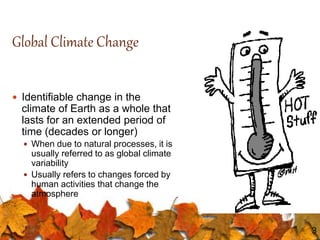
Global Climate Change
 Identifiable change in the
climate of Earth as a whole that
lasts for an extended period of
time (decades or longer)
 When due to natural processes, it is
usually referred to as global climate
variability
 Usually refers to changes forced by
human activities that change the
atmosphere
Some Effects of Climate Change
 An average increase in Earth’s temperature during the last
century
 Melting of polar ice—polar bears and other animals are drowning
 Migrating birds are forced to change their time and place of
migration
 Melting of glaciers will lead to higher sea level, which will cause
floods and put many low-elevation regions at risk of disappearing
under water
 Longer summers can disrupt animal habitation
 New and widespread diseases because of warm climate
 Damaged crops due to sudden climate change and floods
 Average precipitation increase around the world
 Droughts, heat waves, extreme winters and storms.
4
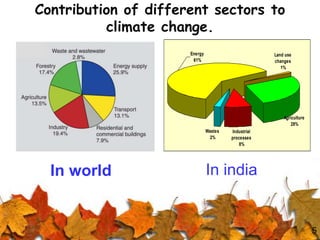
Contribution of different sectors to
climate change.
In world In india
5
Industrial
processes
8%
Wastes
2%
Land use
changes
1%
Agriculture
28%
Energy
61%
Climate change impact on
villages
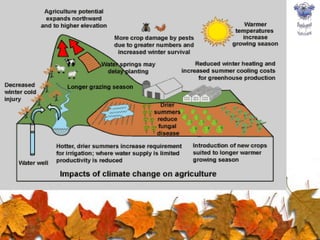
 Villages are adversely affected by climate change, it
not only affects the life of farmers but it also affects
the agriculture. Climate change affects agriculture in
a number of ways, including through changes in
average temperatures, rainfall, and climate extremes
changes in pests and diseases; changes in
atmospheric carbon dioxide and ground-level ozone
concentrations; changes in the nutritional quality of
some foods
6
7
EFFECT OF CLIMATE CHANGE ON
AGRICULTURE
•Climate change may have beneficial as well as detrimental
consequences for agriculture.
•A warming climate and decreasing soil moisture can also result in
increasing need for irrigation.
•Benefits to agriculture might be offset by an increased likelihood
of heat waves, drought, severe thunderstorms and tornadoes.
•With the virtually certain likelihood of warmer and more frequent
hot days and nights, there are projected to be increased insect
outbreaks impacting agriculture, forestry and ecosystems. (IPCC )
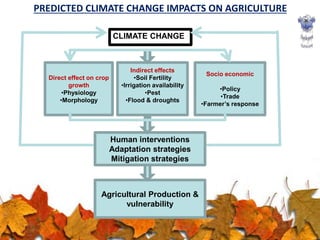
PREDICTED CLIMATE CHANGE IMPACTS ON AGRICULTURE
Direct effect on crop
growth
•Physiology
•Morphology
Indirect effects
•Soil Fertility
•Irrigation availability
•Pest
•Flood & droughts
Socio economic
•Policy
•Trade
•Farmer’s response
Human interventions
Adaptation strategies
Mitigation strategies
Agricultural Production &
vulnerability
CLIMATE CHANGE
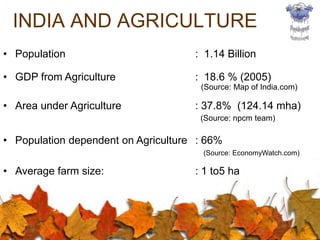
INDIA AND AGRICULTURE
• Population : 1.14 Billion
• GDP from Agriculture : 18.6 % (2005)
(Source: Map of India.com)
• Area under Agriculture : 37.8% (124.14 mha)
(Source: npcm team)
• Population dependent on Agriculture : 66%
(Source: EconomyWatch.com)
• Average farm size: : 1 to5 ha
11
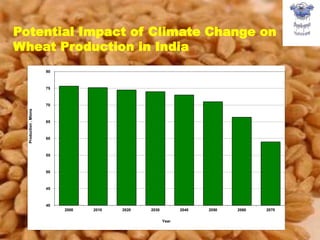
40
45
50
55
60
65
70
75
80
2000 2010 2020 2030 2040 2050 2060 2070
Production,Mtons
Year
Potential Impact of Climate Change on
Wheat Production in India
12
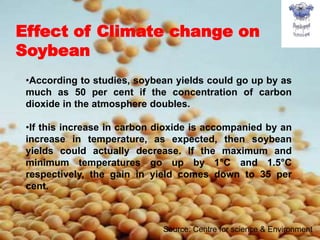
•According to studies, soybean yields could go up by as
much as 50 per cent if the concentration of carbon
dioxide in the atmosphere doubles.
•If this increase in carbon dioxide is accompanied by an
increase in temperature, as expected, then soybean
yields could actually decrease. If the maximum and
minimum temperatures go up by 1°C and 1.5°C
respectively, the gain in yield comes down to 35 per
cent.
Effect of Climate change on
Soybean
Source: Centre for science & Environment
13
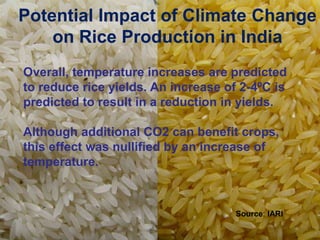
Potential Impact of Climate Change
on Rice Production in India
Overall, temperature increases are predicted
to reduce rice yields. An increase of 2-4ºC is
predicted to result in a reduction in yields.
Although additional CO2 can benefit crops,
this effect was nullified by an increase of
temperature.
Source: IARI
How does agriculture
influence climate change?
• The primary sources of greenhouse gases in agriculture are the
production of nitrogen based fertilizers; the combustion of fossil
fuels such as coal, gasoline, diesel fuel and natural gas; and
waste management. One of the biggest problems in industrialized
agriculture is the massive overuse of fertilizers. More than 50
percent of all fertilizer applied to the soil ends up in the
atmosphere or in local waterways.
• The second biggest direct emitter in agriculture is animals. When
digesting fodder, animals produce and emit large amounts of
methane; a potent greenhouse gas.
14
Agriculture’s role in
mitigating climate change
There are several adaptation measures that the agricultural sector
can undertake to cope with future climate change.
These include:
– Changing planting dates;
– Planting different varieties or crop species;
– Development and promotion of alternative crops;
– Developing new drought and heat-resistant varieties;
– Improved crop residue and weed management;
– More use of water harvesting techniques,
– Better pest and disease control for crops;
– Implementing new or improving existing irrigation systems
(Reducing water leakage, soil moisture conservation - mulching)
15
Reducing use of fertilisers: By applying only the amount of fertiliser
that the crop needs, precisely and at the right time, a tremendous
amount of greenhouse gas releases can be prevented.
Protecting the soil: By increasing the carbon content through a
variety of measures such as cover crops, agricultural soils can be
turned into carbon sinks and can greatly reduce agriculture’s
contribution to climate change.
16
Land restoration and land use changes: Modifications to grazing
practices, such as implementing rotational grazing and seasonal use of
rangelands. Converting marginal cropland to trees or grass maximizes
carbon storage.
• Changes in yield of certain crops can affect imports/exports,
depending on the crop (this is particularly relevant for cash crops).
• Because impacts vary significantly according to whether crops are
rain fed or irrigated, water policy will need to consider the implications
for water demand of agricultural change due to climate change.
• Policy-makers will also need to consider adaptive measures to cope
with changing agricultural patterns. Measures may include the
introduction of the use of alternative crops, changes to cropping
patterns, and promotion of water conservation and irrigation
techniques.
17
WHAT ARE THE IMPLICATIONS OF
THESE PREDICTIONS?
 Climate change is a reality
 Indian agriculture is likely to suffer losses due to heat, erratic weather,
and decreased irrigation availability
 Adaptation strategies can help minimize negative impacts
 These need research, funding, and policy support
 Costs of adaptation and mitigation are unknown but likely to be high;
costs of inaction could be even higher
18
Thank you
19

Climate change

  • 1.
  • 2.
     Climate isdefined as an area's long-term weather patterns. The simplest way to describe climate is to look at average temperature and precipitation over time. Other useful elements for describing climate include the type and the timing of precipitation, amount of sunshine, average wind speeds and directions, number of days above freezing, weather extremes, and local geography. 2
  • 3.
    3 Global Climate Change Identifiable change in the climate of Earth as a whole that lasts for an extended period of time (decades or longer)  When due to natural processes, it is usually referred to as global climate variability  Usually refers to changes forced by human activities that change the atmosphere
  • 4.
    Some Effects ofClimate Change  An average increase in Earth’s temperature during the last century  Melting of polar ice—polar bears and other animals are drowning  Migrating birds are forced to change their time and place of migration  Melting of glaciers will lead to higher sea level, which will cause floods and put many low-elevation regions at risk of disappearing under water  Longer summers can disrupt animal habitation  New and widespread diseases because of warm climate  Damaged crops due to sudden climate change and floods  Average precipitation increase around the world  Droughts, heat waves, extreme winters and storms. 4
  • 5.
    Contribution of differentsectors to climate change. In world In india 5 Industrial processes 8% Wastes 2% Land use changes 1% Agriculture 28% Energy 61%
  • 6.
    Climate change impacton villages  Villages are adversely affected by climate change, it not only affects the life of farmers but it also affects the agriculture. Climate change affects agriculture in a number of ways, including through changes in average temperatures, rainfall, and climate extremes changes in pests and diseases; changes in atmospheric carbon dioxide and ground-level ozone concentrations; changes in the nutritional quality of some foods 6
  • 7.
    7 EFFECT OF CLIMATECHANGE ON AGRICULTURE •Climate change may have beneficial as well as detrimental consequences for agriculture. •A warming climate and decreasing soil moisture can also result in increasing need for irrigation. •Benefits to agriculture might be offset by an increased likelihood of heat waves, drought, severe thunderstorms and tornadoes. •With the virtually certain likelihood of warmer and more frequent hot days and nights, there are projected to be increased insect outbreaks impacting agriculture, forestry and ecosystems. (IPCC )
  • 8.
    PREDICTED CLIMATE CHANGEIMPACTS ON AGRICULTURE Direct effect on crop growth •Physiology •Morphology Indirect effects •Soil Fertility •Irrigation availability •Pest •Flood & droughts Socio economic •Policy •Trade •Farmer’s response Human interventions Adaptation strategies Mitigation strategies Agricultural Production & vulnerability CLIMATE CHANGE
  • 10.
    INDIA AND AGRICULTURE •Population : 1.14 Billion • GDP from Agriculture : 18.6 % (2005) (Source: Map of India.com) • Area under Agriculture : 37.8% (124.14 mha) (Source: npcm team) • Population dependent on Agriculture : 66% (Source: EconomyWatch.com) • Average farm size: : 1 to5 ha
  • 11.
    11 40 45 50 55 60 65 70 75 80 2000 2010 20202030 2040 2050 2060 2070 Production,Mtons Year Potential Impact of Climate Change on Wheat Production in India
  • 12.
    12 •According to studies,soybean yields could go up by as much as 50 per cent if the concentration of carbon dioxide in the atmosphere doubles. •If this increase in carbon dioxide is accompanied by an increase in temperature, as expected, then soybean yields could actually decrease. If the maximum and minimum temperatures go up by 1°C and 1.5°C respectively, the gain in yield comes down to 35 per cent. Effect of Climate change on Soybean Source: Centre for science & Environment
  • 13.
    13 Potential Impact ofClimate Change on Rice Production in India Overall, temperature increases are predicted to reduce rice yields. An increase of 2-4ºC is predicted to result in a reduction in yields. Although additional CO2 can benefit crops, this effect was nullified by an increase of temperature. Source: IARI
  • 14.
    How does agriculture influenceclimate change? • The primary sources of greenhouse gases in agriculture are the production of nitrogen based fertilizers; the combustion of fossil fuels such as coal, gasoline, diesel fuel and natural gas; and waste management. One of the biggest problems in industrialized agriculture is the massive overuse of fertilizers. More than 50 percent of all fertilizer applied to the soil ends up in the atmosphere or in local waterways. • The second biggest direct emitter in agriculture is animals. When digesting fodder, animals produce and emit large amounts of methane; a potent greenhouse gas. 14
  • 15.
    Agriculture’s role in mitigatingclimate change There are several adaptation measures that the agricultural sector can undertake to cope with future climate change. These include: – Changing planting dates; – Planting different varieties or crop species; – Development and promotion of alternative crops; – Developing new drought and heat-resistant varieties; – Improved crop residue and weed management; – More use of water harvesting techniques, – Better pest and disease control for crops; – Implementing new or improving existing irrigation systems (Reducing water leakage, soil moisture conservation - mulching) 15
  • 16.
    Reducing use offertilisers: By applying only the amount of fertiliser that the crop needs, precisely and at the right time, a tremendous amount of greenhouse gas releases can be prevented. Protecting the soil: By increasing the carbon content through a variety of measures such as cover crops, agricultural soils can be turned into carbon sinks and can greatly reduce agriculture’s contribution to climate change. 16 Land restoration and land use changes: Modifications to grazing practices, such as implementing rotational grazing and seasonal use of rangelands. Converting marginal cropland to trees or grass maximizes carbon storage.
  • 17.
    • Changes inyield of certain crops can affect imports/exports, depending on the crop (this is particularly relevant for cash crops). • Because impacts vary significantly according to whether crops are rain fed or irrigated, water policy will need to consider the implications for water demand of agricultural change due to climate change. • Policy-makers will also need to consider adaptive measures to cope with changing agricultural patterns. Measures may include the introduction of the use of alternative crops, changes to cropping patterns, and promotion of water conservation and irrigation techniques. 17 WHAT ARE THE IMPLICATIONS OF THESE PREDICTIONS?
  • 18.
     Climate changeis a reality  Indian agriculture is likely to suffer losses due to heat, erratic weather, and decreased irrigation availability  Adaptation strategies can help minimize negative impacts  These need research, funding, and policy support  Costs of adaptation and mitigation are unknown but likely to be high; costs of inaction could be even higher 18
  • 19.