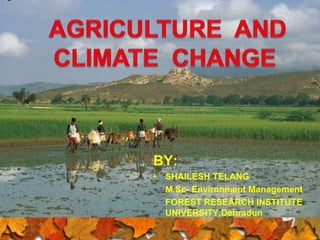
1AGRICULTURE  ANDCLIMATE  CHANGEBY:SHAILESH TELANG    M.Sc- Environment Management     FOREST RESEARCH INSTITUTE UNIVERSITY,Dehradun
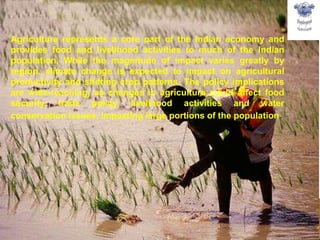
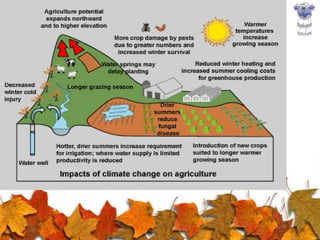
2Agriculture represents a core part of the Indian economy and provides food and livelihood activities to much of the Indian population. While the magnitude of impact varies greatly by region, climate change is expected to impact on agricultural productivity and shifting crop patterns. The policy implications are wide-reaching, as changes in agriculture could affect food security, trade policy, livelihood activities and water conservation issues, impacting large portions of the population.
3EFFECT OF CLIMATE CHANGE ON AGRICULTUREClimate change may have beneficial as well as  detrimental       consequences for agriculture.
A warming climate and decreasing soil moisture can also result in  increasing need for irrigation.
Benefits to agriculture might be offset by an increased likelihood of heat waves, drought, severe thunderstorms and tornadoes.
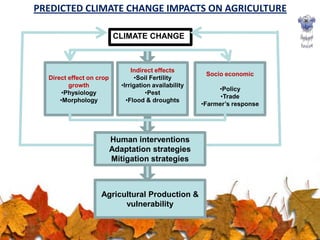
With the virtually certain likelihood of warmer and more frequent hot days and nights, there are projected to be increased insect outbreaks impacting agriculture, forestry and ecosystems. (IPCC )Predicted climate change impacts on agricultureCLIMATE CHANGEDirect effect on cropgrowthPhysiology
MorphologyIndirect effectsSoil Fertility
Irrigation availability
Pest
Flood & droughtsSocio economicPolicy
Trade
Farmer’s responseHuman interventionsAdaptation strategiesMitigation strategiesAgricultural Production & vulnerability
Impacts on Indian Agriculture Literature Review· Sinha and Swaminathan (1991) – showed that an increase of 2oC in temperature could decrease the rice yield by about 0.75 ton/ha in the high yield areas; and a 0.5oC increase in winter temperature would reduce wheat yield by 0.45 ton/ha. ·  Saseendran et al. (2000) – showed that for every one degree rise in temperature the decline in rice yield would be about 6%.Aggarwal et al. (2002) – on basis of recent climate change scenarios estimated impacts on wheat and other cereal crops.INDIA AND AGRICULTURE Population					:  1.14 Billion
GDP from Agriculture			:  18.6 % (2005)                                                                                         (Source: Map of India.com)Area under Agriculture			: 37.8%  (124.14 mha)(Source: npcm team)Population dependent on Agriculture	: 66%(Source: EconomyWatch.com)Average farm size: 			: 1 to5 haINDIAN AGRICULTURE-  STRENGTHS AND CHALLENGESStrong strides made in increasing the production in the    past 50 years, mainly due to adoption of HYVs and other technological developments
Subsistence agriculture with small land holdings
Wide variation in regional productivities
Majority still depend on rain-fed agriculture
Frequently affected by extreme weather events such as droughts and cyclones
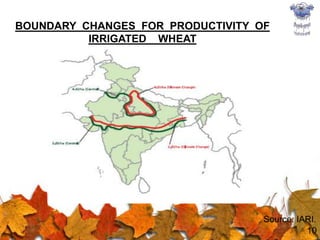
Significant proportion of population still reels under poverty, mal-nutrition and chronic hungerThe Indian Agricultural Research Institute (IARI) examined the vulnerability of agricultural production to climate change, with the objective of determining differences in climate change impacts on agriculture by region and by crop.The study found that increases in temperature (by about 2ºC) reduced potential grain yields in most places.Reductions in yields as a result of climate change are predicted to be more pronounced for rain fed crops (as opposed to irrigated crops)and under limited water supply situations because there are no coping mechanisms for rainfall variability.Climate change is also predicted to lead to boundary changes in areas suitable for growing certain crops. These are shown for wheat in Figure.9
10BOUNDARY  CHANGES  FOR  PRODUCTIVITY  OF IRRIGATED    WHEATSource: IARI.
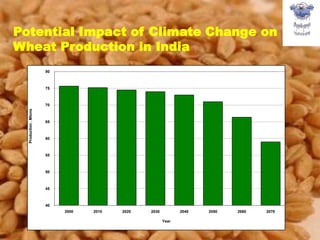
11Potential Impact of Climate Change on Wheat Production in India
12Effect of Climate change on SoybeanAccording to studies, soybean yields could go up by as much as 50 per cent if the concentration of carbon dioxide in the atmosphere doubles.
If this increase in carbon dioxide is accompanied by an increase in temperature, as expected, then soybean yields could actually decrease. If the maximum and minimum temperatures go up by 1°C and 1.5°C respectively, the gain in yield comes down to 35 per cent.Source: Centre for science & Environment
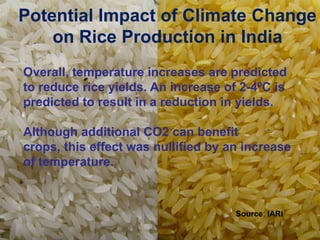
13Potential Impact of Climate Change on Rice Production in IndiaOverall, temperature increases are predicted to reduce rice yields. An increase of 2-4ºC is predicted to result in a reduction in yields.Although additional CO2 can benefit crops, this effect was nullified by an increase of temperature.Source: IARI

Agriculture and Climate Change

  • 1.
    1AGRICULTURE ANDCLIMATE CHANGEBY:SHAILESH TELANG M.Sc- Environment Management FOREST RESEARCH INSTITUTE UNIVERSITY,Dehradun
  • 2.
    2Agriculture represents acore part of the Indian economy and provides food and livelihood activities to much of the Indian population. While the magnitude of impact varies greatly by region, climate change is expected to impact on agricultural productivity and shifting crop patterns. The policy implications are wide-reaching, as changes in agriculture could affect food security, trade policy, livelihood activities and water conservation issues, impacting large portions of the population.
  • 3.
    3EFFECT OF CLIMATECHANGE ON AGRICULTUREClimate change may have beneficial as well as detrimental consequences for agriculture.
  • 4.
    A warming climateand decreasing soil moisture can also result in increasing need for irrigation.
  • 5.
    Benefits to agriculturemight be offset by an increased likelihood of heat waves, drought, severe thunderstorms and tornadoes.
  • 6.
    With the virtuallycertain likelihood of warmer and more frequent hot days and nights, there are projected to be increased insect outbreaks impacting agriculture, forestry and ecosystems. (IPCC )Predicted climate change impacts on agricultureCLIMATE CHANGEDirect effect on cropgrowthPhysiology
  • 7.
  • 8.
  • 9.
  • 10.
    Flood & droughtsSocioeconomicPolicy
  • 11.
  • 12.
    Farmer’s responseHuman interventionsAdaptationstrategiesMitigation strategiesAgricultural Production & vulnerability
  • 14.
    Impacts on IndianAgriculture Literature Review· Sinha and Swaminathan (1991) – showed that an increase of 2oC in temperature could decrease the rice yield by about 0.75 ton/ha in the high yield areas; and a 0.5oC increase in winter temperature would reduce wheat yield by 0.45 ton/ha. ·  Saseendran et al. (2000) – showed that for every one degree rise in temperature the decline in rice yield would be about 6%.Aggarwal et al. (2002) – on basis of recent climate change scenarios estimated impacts on wheat and other cereal crops.INDIA AND AGRICULTURE Population : 1.14 Billion
  • 15.
    GDP from Agriculture : 18.6 % (2005) (Source: Map of India.com)Area under Agriculture : 37.8% (124.14 mha)(Source: npcm team)Population dependent on Agriculture : 66%(Source: EconomyWatch.com)Average farm size: : 1 to5 haINDIAN AGRICULTURE- STRENGTHS AND CHALLENGESStrong strides made in increasing the production in the past 50 years, mainly due to adoption of HYVs and other technological developments
  • 16.
    Subsistence agriculture withsmall land holdings
  • 17.
    Wide variation inregional productivities
  • 18.
    Majority still dependon rain-fed agriculture
  • 19.
    Frequently affected byextreme weather events such as droughts and cyclones
  • 20.
    Significant proportion ofpopulation still reels under poverty, mal-nutrition and chronic hungerThe Indian Agricultural Research Institute (IARI) examined the vulnerability of agricultural production to climate change, with the objective of determining differences in climate change impacts on agriculture by region and by crop.The study found that increases in temperature (by about 2ºC) reduced potential grain yields in most places.Reductions in yields as a result of climate change are predicted to be more pronounced for rain fed crops (as opposed to irrigated crops)and under limited water supply situations because there are no coping mechanisms for rainfall variability.Climate change is also predicted to lead to boundary changes in areas suitable for growing certain crops. These are shown for wheat in Figure.9
  • 21.
    10BOUNDARY CHANGES FOR PRODUCTIVITY OF IRRIGATED WHEATSource: IARI.
  • 22.
    11Potential Impact ofClimate Change on Wheat Production in India
  • 23.
    12Effect of Climatechange on SoybeanAccording to studies, soybean yields could go up by as much as 50 per cent if the concentration of carbon dioxide in the atmosphere doubles.
  • 24.
    If this increasein carbon dioxide is accompanied by an increase in temperature, as expected, then soybean yields could actually decrease. If the maximum and minimum temperatures go up by 1°C and 1.5°C respectively, the gain in yield comes down to 35 per cent.Source: Centre for science & Environment
  • 25.
    13Potential Impact ofClimate Change on Rice Production in IndiaOverall, temperature increases are predicted to reduce rice yields. An increase of 2-4ºC is predicted to result in a reduction in yields.Although additional CO2 can benefit crops, this effect was nullified by an increase of temperature.Source: IARI