Drought and its mitigation strategies
in agriculture
SEMINAR
on
COLLEGE OF AGRICULTURE, DEPARTMENT OF AGRONOMY
PRESENTED BY:
Soumya Ranjan Bhuyan
I.D No.-160111022
MAJOR ADVISOR
Dr. Manish Bhan
Asst. Professor
Agronomy
SEMINAR INCHARGE
Dr.M.L Kewat
Professor,Agronomy
Sequence of presentation
 Introduction
 Concept of drought
 Mitigation techniques
 Mitigation through crop management practices
 Soil and water conservation techniques
 Conclusion
INTRODUCTION
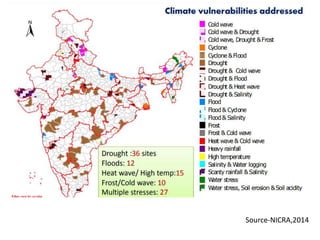
INTRODUCTION
Source-NICRA,2014
 Drought is a situation when the actual seasonal rainfall is deficient
by more than twice the mean deviation (Ramdas,1960)
 Drought is defined by deviation from the normal rainfall, it can
happen in all rainfall regions. It also occurs in high rainfall area
but severity or frequency may vary.
 Drought is considered to be a strictly meteorological phenomenon.
 It is also a complex phenomenon whose severity depends on the
precipitation amount, its time and space distribution, evapo-
transpiration and on hydrological factors.
Definition
Classification of drought
 Meteorological drought: It is defined as a situation when there is a
25% decrease in average rainfall for a given period of
time(IMD,Pune)
 Hydrological drought: Depletion of surface water and consequently
drying of reservoirs, tanks etc. It results in deficiency of water for
all sectors using water.
 Agricultural drought: It is the result of soil moisture stress due to
imbalance between available soil moisture and evapotranspiration
demand of a crop.
 Socio-economic drought: This is associated with the supply &
demand of some economic goods. This drought should be linked
hot only to precipitation but also trends of fluctuations in demand.
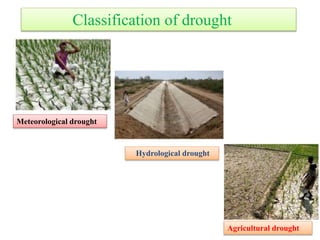
Classification of drought
Meteorological drought
Hydrological drought
Agricultural drought
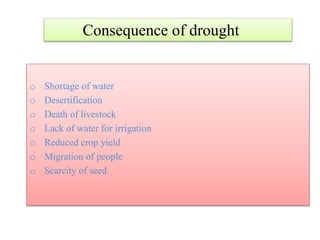
o Shortage of water
o Desertification
o Death of livestock
o Lack of water for irrigation
o Reduced crop yield
o Migration of people
o Scarcity of seed
Consequence of drought
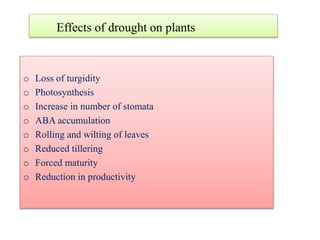
Effects of drought on plants
o Loss of turgidity
o Photosynthesis
o Increase in number of stomata
o ABA accumulation
o Rolling and wilting of leaves
o Reduced tillering
o Forced maturity
o Reduction in productivity
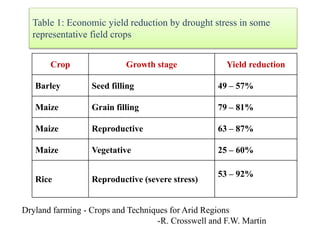
Table 1: Economic yield reduction by drought stress in some
representative field crops
Crop Growth stage Yield reduction
Barley Seed filling 49 – 57%
Maize Grain filling 79 – 81%
Maize Reproductive 63 – 87%
Maize Vegetative 25 – 60%
Rice Reproductive (severe stress)
53 – 92%
Dryland farming - Crops and Techniques for Arid Regions
-R. Crosswell and F.W. Martin
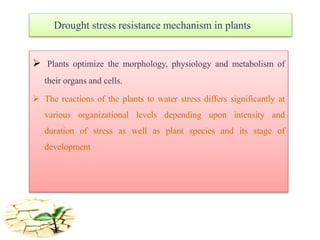
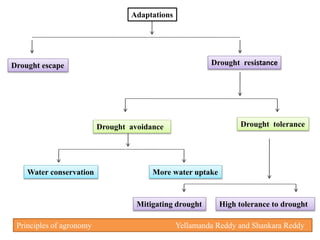
Drought stress resistance mechanism in plants
 Plants optimize the morphology, physiology and metabolism of
their organs and cells.
 The reactions of the plants to water stress differs significantly at
various organizational levels depending upon intensity and
duration of stress as well as plant species and its stage of
development
Adaptations
Drought escape Drought resistance
Drought toleranceDrought avoidance
Water conservation More water uptake
Mitigating drought High tolerance to drought
Principles of agronomy Yellamanda Reddy and Shankara Reddy
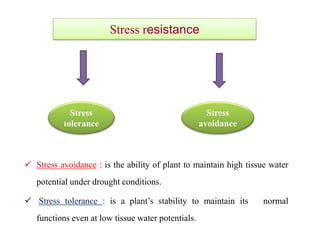
 Stress avoidance : is the ability of plant to maintain high tissue water
potential under drought conditions.
 Stress tolerance : is a plant’s stability to maintain its normal
functions even at low tissue water potentials.
Stress resistance
Stress
tolerance
Stress
avoidance
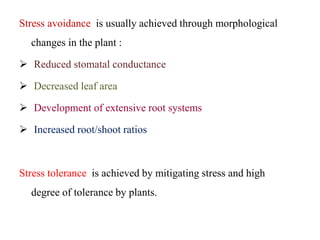
Stress avoidance is usually achieved through morphological
changes in the plant :
 Reduced stomatal conductance
 Decreased leaf area
 Development of extensive root systems
 Increased root/shoot ratios
Stress tolerance is achieved by mitigating stress and high
degree of tolerance by plants.
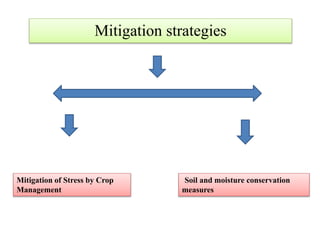
Mitigation strategies
Mitigation of Stress by Crop
Management
Soil and moisture conservation
measures
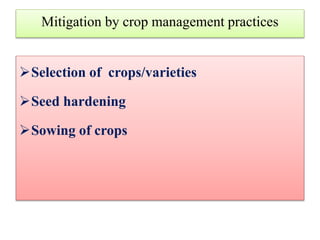
Mitigation by crop management practices
Selection of crops/varieties
Seed hardening
Sowing of crops
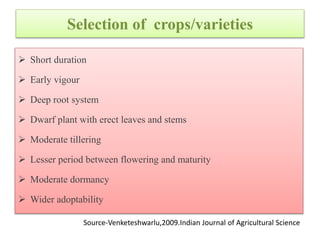
Selection of crops/varieties
 Short duration
 Early vigour
 Deep root system
 Dwarf plant with erect leaves and stems
 Moderate tillering
 Lesser period between flowering and maturity
 Moderate dormancy
 Wider adoptability
Source-Venketeshwarlu,2009.Indian Journal of Agricultural Science
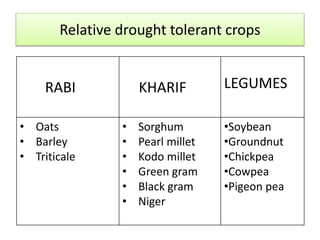
Relative drought tolerant crops
RABI KHARIF LEGUMES
• Oats
• Barley
• Triticale
• Sorghum
• Pearl millet
• Kodo millet
• Green gram
• Black gram
• Niger
•Soybean
•Groundnut
•Chickpea
•Cowpea
•Pigeon pea
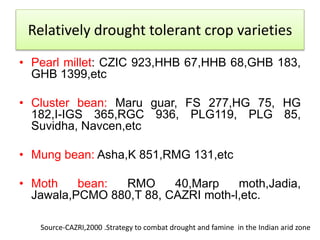
• Pearl millet: CZIC 923,HHB 67,HHB 68,GHB 183,
GHB 1399,etc
• Cluster bean: Maru guar, FS 277,HG 75, HG
182,I-IGS 365,RGC 936, PLG119, PLG 85,
Suvidha, Navcen,etc
• Mung bean: Asha,K 851,RMG 131,etc
• Moth bean: RMO 40,Marp moth,Jadia,
Jawala,PCMO 880,T 88, CAZRI moth-l,etc.
Relatively drought tolerant crop varieties
Source-CAZRI,2000 .Strategy to combat drought and famine in the Indian arid zone
Seed hardening
Seed hardening:
 Seed hardening refers to the technique of subjecting seeds to
soaking in water or appropriate chemical solutions and drying
in shade.
 It helps the plant to survive during initial moisture stress
conditions.
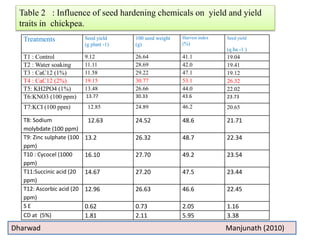
Treatments Seed yield
(g plant -1)
100 seed weight
(g)
Harvest index
(%)
Seed yield
(q ha -1 )
T1 : Control 9.12 26.64 41.1 19.04
T2 : Water soaking 11.11 28.69 42.0 19.41
T3 : CaC12 (1%) 11.58 29.22 47.1 19.12
T4 : CaC12 (2%) 19.15 30.77 53.1 26.32
T5: KH2PO4 (1%) 13.48 26.66 44.0 22.02
T6:KNO3 (100 ppm) 13.77 30.33 43.6 23.73
T7:KCI (100 ppm) 12.85 24.89 46.2 20.65
T8: Sodium
molybdate (100 ppm)
12.63 24.52 48.6 21.71
T9: Zinc sulphate (100
ppm)
13.2 26.32 48.7 22.34
T10 : Cycocel (1000
ppm)
16.10 27.70 49.2 23.54
T11:Succinic acid (20
ppm)
14.67 27.20 47.5 23.44
T12: Ascorbic acid (20
ppm)
12.96 26.63 46.6 22.45
S E 0.62 0.73 2.05 1.16
CD at (5%) 1.81 2.11 5.95 3.38
Table 2 : Influence of seed hardening chemicals on yield and yield
traits in chickpea.
Dharwad Manjunath (2010)
Management at sowing
Time of sowing
An increasing in yield has been found by advancing the date of
sowing of kharif and rabi crops.
Advantages
o Better moisture availability
o Good seedling vigour
o Longer growing season
soil and water conservation method
Soil and water conservation methods
 In-situ moisture conservation practices
 Water harvesting structures
 Mulching
 Anti-transpirants
 Adopting modern irrigation techniques
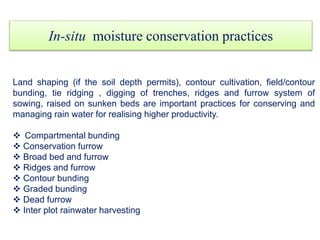
In-situ moisture conservation practices
Land shaping (if the soil depth permits), contour cultivation, field/contour
bunding, tie ridging , digging of trenches, ridges and furrow system of
sowing, raised on sunken beds are important practices for conserving and
managing rain water for realising higher productivity.
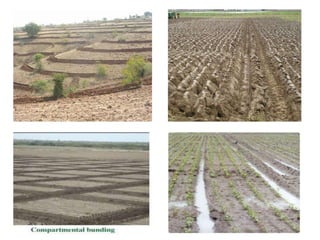
 Compartmental bunding
 Conservation furrow
 Broad bed and furrow
 Ridges and furrow
 Contour bunding
 Graded bunding
 Dead furrow
 Inter plot rainwater harvesting
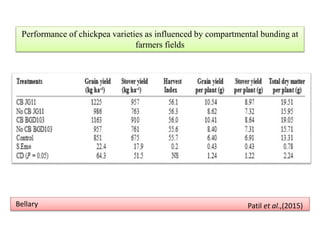
Performance of chickpea varieties as influenced by compartmental bunding at
farmers fields
Bellary Patil et al.,(2015)
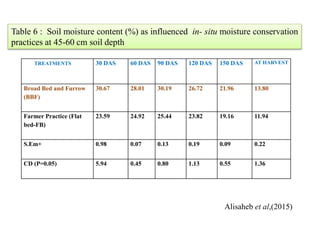
TREATMENTS 30 DAS 60 DAS 90 DAS 120 DAS 150 DAS AT HARVEST
Broad Bed and Furrow
(BBF)
30.67 28.01 30.19 26.72 21.96 13.80
Farmer Practice (Flat
bed-FB)
23.59 24.92 25.44 23.82 19.16 11.94
S.Em+ 0.98 0.07 0.13 0.19 0.09 0.22
CD (P=0.05) 5.94 0.45 0.80 1.13 0.55 1.36
Table 6 : Soil moisture content (%) as influenced in- situ moisture conservation
practices at 45-60 cm soil depth
Alisaheb et al,(2015)
Water harvesting structures
 Water harvesting is the process of collecting rainfall and/or runoff
from a larger catchments area to be used in a smaller target area
(Oweis et. al., 1999). The collected runoff water may be either
directly applied to an adjacent field as supplemental life saving
irrigation of crops during moisture stress condition.
Some of the water harvesting structures are:
• Cisterns/ tankas/ kund
• Khadin
• Village ponds (Nadis/ tobas)
• Series of check dams on natural streams
• Percolation tanks
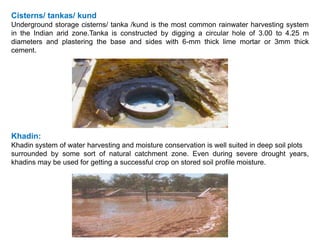
Cisterns/ tankas/ kund
Underground storage cisterns/ tanka /kund is the most common rainwater harvesting system
in the Indian arid zone.Tanka is constructed by digging a circular hole of 3.00 to 4.25 m
diameters and plastering the base and sides with 6-mm thick lime mortar or 3mm thick
cement.
Khadin:
Khadin system of water harvesting and moisture conservation is well suited in deep soil plots
surrounded by some sort of natural catchment zone. Even during severe drought years,
khadins may be used for getting a successful crop on stored soil profile moisture.
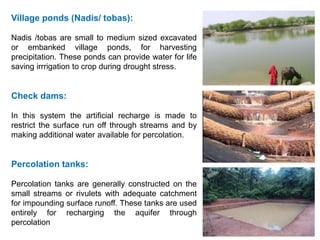
Village ponds (Nadis/ tobas):
Nadis /tobas are small to medium sized excavated
or embanked village ponds, for harvesting
precipitation. These ponds can provide water for life
saving irrrigation to crop during drought stress.
Check dams:
In this system the artificial recharge is made to
restrict the surface run off through streams and by
making additional water available for percolation.
Percolation tanks:
Percolation tanks are generally constructed on the
small streams or rivulets with adequate catchment
for impounding surface runoff. These tanks are used
entirely for recharging the aquifer through
percolation
MULCHING
o Any material used (spread) at surface or vertically in
soil to assist soil and water conservation and soil
productivity is called much. And process of applying
mulches to soil is known as mulching.
o Mulching helps in conserving moisture, lowering soil
temperatures around plant roots, reducing weed
growth, etc thus helps crops during moisture stress
conditions.
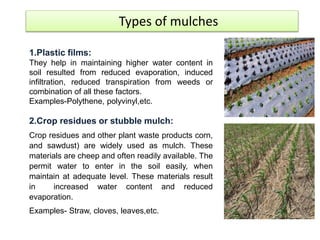
Types of mulches
1.Plastic films:
They help in maintaining higher water content in
soil resulted from reduced evaporation, induced
infiltration, reduced transpiration from weeds or
combination of all these factors.
Examples-Polythene, polyvinyl,etc.
2.Crop residues or stubble mulch:
Crop residues and other plant waste products corn,
and sawdust) are widely used as mulch. These
materials are cheep and often readily available. The
permit water to enter in the soil easily, when
maintain at adequate level. These materials result
in increased water content and reduced
evaporation.
Examples- Straw, cloves, leaves,etc.
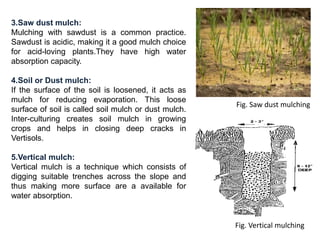
3.Saw dust mulch:
Mulching with sawdust is a common practice.
Sawdust is acidic, making it a good mulch choice
for acid-loving plants.They have high water
absorption capacity.
4.Soil or Dust mulch:
If the surface of the soil is loosened, it acts as
mulch for reducing evaporation. This loose
surface of soil is called soil mulch or dust mulch.
Inter-culturing creates soil mulch in growing
crops and helps in closing deep cracks in
Vertisols.
5.Vertical mulch:
Vertical mulch is a technique which consists of
digging suitable trenches across the slope and
thus making more surface are a available for
water absorption.
Fig. Vertical mulching
Fig. Saw dust mulching
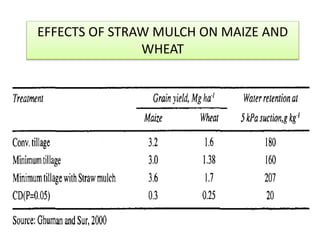
EFFECTS OF STRAW MULCH ON MAIZE AND
WHEAT
ANTI-TRANSPIRANTS
 Anti-transpirants are the materials or chemicals that applied to
transpiring plant surfaces for reducing water loss from the plant. The
purpose of ATs is to maintain the growth and productivity under
stress conditions and it is never recommended for high productivity /
unit area.
 The severity of intermittent drought of 6-10 days during critical
stages of the crop can reasonably be avoided by the use of
antitranspirants and thus crops can be save
 Mainly four types of anti-transpirants:
1. Stomatal closing type
2. Film forming type
3. Reflectance type
4. Growth retardant
Stomatal closing type:
Most of the transpiration occur through the stomata on the leaf surface. They induce
stomatal closing or decrease size and number of stomata which subsequently reduce the
photosynthesis.
Examples:
• Phenyl Mercuric Acetate (PMA)
• Atrazine
Film forming type:
Plastic and waxy material which form a thin colourless film over the leaf surface and result
in a physical barrier. These glossy films then reduce water loss on plants while at the same
time allow them to breathe normally.
Examples:
• Hexadecanol (Higher alcohols)
• Cetyl alcohol
• Methanol
• Paclobutrazol
• Brassinolide
• Resorcinol
Reflecting type:
They are white materials which form a coating on the leaves and increase the leaf
reflectance (albedo). By reflecting the radiation, vapour pressure gradient and thus reduce
transpiration.
Examples:
• Kaoline(5%)
• China Clay
• Calcium bicarbonate
• Lime water
Growth retardant:
These chemicals reduce shoot growth and increase root growth and thus enable the plants
to resist drought. They may also induce stomatal closure.
Examples:
• cycocel
Modern irrigation techniques
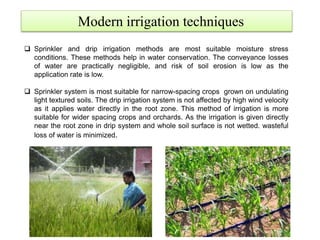
 Sprinkler and drip irrigation methods are most suitable moisture stress
conditions. These methods help in water conservation. The conveyance losses
of water are practically negligible, and risk of soil erosion is low as the
application rate is low.
 Sprinkler system is most suitable for narrow-spacing crops grown on undulating
light textured soils. The drip irrigation system is not affected by high wind velocity
as it applies water directly in the root zone. This method of irrigation is more
suitable for wider spacing crops and orchards. As the irrigation is given directly
near the root zone in drip system and whole soil surface is not wetted. wasteful
loss of water is minimized.
Contingency crop planning
 Late onset of monsoon :
 Transplanting
 Alternate crops/varieties
 Dry spells during crop periods :
 Ratooning and thinning
 Mulching
 Spraying of urea(2%)
 Weed control
 Water harvesting and life saving irrigation
 Early withdrawal of monsoon :
 Harvesting at physiological maturity
 Short duration varieties
 Strategies adopted for mitigating dry spells during crop periods
can be done
S.R Reddy, Principles of Agronomy
SOME OTHER LONG TERM
STRATEGIES TO MITIGATE
DROUGHT
Long-range forecast :
 It is in purview of IMD and accurate oceanographic pre-monsoon
conditions.Besides, date of onset and withdrawal of monsoon, accurate
forecast about amount and distribution of rainfall in ensuing kharif
season would be of great value for planners as well as farmers to
develop contingent plans, rather a all season weather coat, for
drought.as well as floods.
 IRS P-4 satellite with Oceansat OCM, MSMR sensor may prove of
great value in studying ocean situation. Great emphasis is to be laid in
future on long-range forecasts to combat drought.
 These forecasts are given for the benefit of farmers for planning their
agricultural operations and crop selection and for planners for advance
planning in case of an anticipated flood or drought
Source- CAZRI,2000. Strategy to combat drought and famine
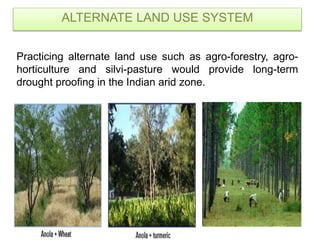
ALTERNATE LAND USE SYSTEM
Practicing alternate land use such as agro-forestry, agro-
horticulture and silvi-pasture would provide long-term
drought proofing in the Indian arid zone.
• Crop improvement for drought tolerance or escape, seed priming,
early sowing, soil conservation practices including tillage which
conserve moisture, in-situ moisture conservation practices and
water harvesting and use of antitranspirants and reflectants are
some of the mitigation strategies
• Breeding for drought resistance crop varieties i.e development of
transgenic plants for drought tolerance
• Adoption of long term strategies like integration of small
reservoirs with major reservoirs, integrated basin planning, etc.
• Long range rainfall forecast can prove as a warning tool for
drought mitigation
Conclusion
Soumya drought and its mitigation

Soumya drought and its mitigation

  • 1.
    Drought and itsmitigation strategies in agriculture SEMINAR on COLLEGE OF AGRICULTURE, DEPARTMENT OF AGRONOMY PRESENTED BY: Soumya Ranjan Bhuyan I.D No.-160111022 MAJOR ADVISOR Dr. Manish Bhan Asst. Professor Agronomy SEMINAR INCHARGE Dr.M.L Kewat Professor,Agronomy
  • 2.
    Sequence of presentation Introduction  Concept of drought  Mitigation techniques  Mitigation through crop management practices  Soil and water conservation techniques  Conclusion
  • 3.
  • 4.
  • 6.
     Drought isa situation when the actual seasonal rainfall is deficient by more than twice the mean deviation (Ramdas,1960)  Drought is defined by deviation from the normal rainfall, it can happen in all rainfall regions. It also occurs in high rainfall area but severity or frequency may vary.  Drought is considered to be a strictly meteorological phenomenon.  It is also a complex phenomenon whose severity depends on the precipitation amount, its time and space distribution, evapo- transpiration and on hydrological factors. Definition
  • 7.
    Classification of drought Meteorological drought: It is defined as a situation when there is a 25% decrease in average rainfall for a given period of time(IMD,Pune)  Hydrological drought: Depletion of surface water and consequently drying of reservoirs, tanks etc. It results in deficiency of water for all sectors using water.  Agricultural drought: It is the result of soil moisture stress due to imbalance between available soil moisture and evapotranspiration demand of a crop.  Socio-economic drought: This is associated with the supply & demand of some economic goods. This drought should be linked hot only to precipitation but also trends of fluctuations in demand.
  • 8.
    Classification of drought Meteorologicaldrought Hydrological drought Agricultural drought
  • 9.
    o Shortage ofwater o Desertification o Death of livestock o Lack of water for irrigation o Reduced crop yield o Migration of people o Scarcity of seed Consequence of drought
  • 10.
    Effects of droughton plants o Loss of turgidity o Photosynthesis o Increase in number of stomata o ABA accumulation o Rolling and wilting of leaves o Reduced tillering o Forced maturity o Reduction in productivity
  • 11.
    Table 1: Economicyield reduction by drought stress in some representative field crops Crop Growth stage Yield reduction Barley Seed filling 49 – 57% Maize Grain filling 79 – 81% Maize Reproductive 63 – 87% Maize Vegetative 25 – 60% Rice Reproductive (severe stress) 53 – 92% Dryland farming - Crops and Techniques for Arid Regions -R. Crosswell and F.W. Martin
  • 12.
    Drought stress resistancemechanism in plants  Plants optimize the morphology, physiology and metabolism of their organs and cells.  The reactions of the plants to water stress differs significantly at various organizational levels depending upon intensity and duration of stress as well as plant species and its stage of development
  • 13.
    Adaptations Drought escape Droughtresistance Drought toleranceDrought avoidance Water conservation More water uptake Mitigating drought High tolerance to drought Principles of agronomy Yellamanda Reddy and Shankara Reddy
  • 14.
     Stress avoidance: is the ability of plant to maintain high tissue water potential under drought conditions.  Stress tolerance : is a plant’s stability to maintain its normal functions even at low tissue water potentials. Stress resistance Stress tolerance Stress avoidance
  • 15.
    Stress avoidance isusually achieved through morphological changes in the plant :  Reduced stomatal conductance  Decreased leaf area  Development of extensive root systems  Increased root/shoot ratios Stress tolerance is achieved by mitigating stress and high degree of tolerance by plants.
  • 16.
    Mitigation strategies Mitigation ofStress by Crop Management Soil and moisture conservation measures
  • 17.
    Mitigation by cropmanagement practices Selection of crops/varieties Seed hardening Sowing of crops
  • 18.
    Selection of crops/varieties Short duration  Early vigour  Deep root system  Dwarf plant with erect leaves and stems  Moderate tillering  Lesser period between flowering and maturity  Moderate dormancy  Wider adoptability Source-Venketeshwarlu,2009.Indian Journal of Agricultural Science
  • 19.
    Relative drought tolerantcrops RABI KHARIF LEGUMES • Oats • Barley • Triticale • Sorghum • Pearl millet • Kodo millet • Green gram • Black gram • Niger •Soybean •Groundnut •Chickpea •Cowpea •Pigeon pea
  • 20.
    • Pearl millet:CZIC 923,HHB 67,HHB 68,GHB 183, GHB 1399,etc • Cluster bean: Maru guar, FS 277,HG 75, HG 182,I-IGS 365,RGC 936, PLG119, PLG 85, Suvidha, Navcen,etc • Mung bean: Asha,K 851,RMG 131,etc • Moth bean: RMO 40,Marp moth,Jadia, Jawala,PCMO 880,T 88, CAZRI moth-l,etc. Relatively drought tolerant crop varieties Source-CAZRI,2000 .Strategy to combat drought and famine in the Indian arid zone
  • 21.
    Seed hardening Seed hardening: Seed hardening refers to the technique of subjecting seeds to soaking in water or appropriate chemical solutions and drying in shade.  It helps the plant to survive during initial moisture stress conditions.
  • 22.
    Treatments Seed yield (gplant -1) 100 seed weight (g) Harvest index (%) Seed yield (q ha -1 ) T1 : Control 9.12 26.64 41.1 19.04 T2 : Water soaking 11.11 28.69 42.0 19.41 T3 : CaC12 (1%) 11.58 29.22 47.1 19.12 T4 : CaC12 (2%) 19.15 30.77 53.1 26.32 T5: KH2PO4 (1%) 13.48 26.66 44.0 22.02 T6:KNO3 (100 ppm) 13.77 30.33 43.6 23.73 T7:KCI (100 ppm) 12.85 24.89 46.2 20.65 T8: Sodium molybdate (100 ppm) 12.63 24.52 48.6 21.71 T9: Zinc sulphate (100 ppm) 13.2 26.32 48.7 22.34 T10 : Cycocel (1000 ppm) 16.10 27.70 49.2 23.54 T11:Succinic acid (20 ppm) 14.67 27.20 47.5 23.44 T12: Ascorbic acid (20 ppm) 12.96 26.63 46.6 22.45 S E 0.62 0.73 2.05 1.16 CD at (5%) 1.81 2.11 5.95 3.38 Table 2 : Influence of seed hardening chemicals on yield and yield traits in chickpea. Dharwad Manjunath (2010)
  • 23.
    Management at sowing Timeof sowing An increasing in yield has been found by advancing the date of sowing of kharif and rabi crops. Advantages o Better moisture availability o Good seedling vigour o Longer growing season
  • 24.
    soil and waterconservation method
  • 25.
    Soil and waterconservation methods  In-situ moisture conservation practices  Water harvesting structures  Mulching  Anti-transpirants  Adopting modern irrigation techniques
  • 26.
    In-situ moisture conservationpractices Land shaping (if the soil depth permits), contour cultivation, field/contour bunding, tie ridging , digging of trenches, ridges and furrow system of sowing, raised on sunken beds are important practices for conserving and managing rain water for realising higher productivity.  Compartmental bunding  Conservation furrow  Broad bed and furrow  Ridges and furrow  Contour bunding  Graded bunding  Dead furrow  Inter plot rainwater harvesting
  • 28.
    Performance of chickpeavarieties as influenced by compartmental bunding at farmers fields Bellary Patil et al.,(2015)
  • 29.
    TREATMENTS 30 DAS60 DAS 90 DAS 120 DAS 150 DAS AT HARVEST Broad Bed and Furrow (BBF) 30.67 28.01 30.19 26.72 21.96 13.80 Farmer Practice (Flat bed-FB) 23.59 24.92 25.44 23.82 19.16 11.94 S.Em+ 0.98 0.07 0.13 0.19 0.09 0.22 CD (P=0.05) 5.94 0.45 0.80 1.13 0.55 1.36 Table 6 : Soil moisture content (%) as influenced in- situ moisture conservation practices at 45-60 cm soil depth Alisaheb et al,(2015)
  • 30.
    Water harvesting structures Water harvesting is the process of collecting rainfall and/or runoff from a larger catchments area to be used in a smaller target area (Oweis et. al., 1999). The collected runoff water may be either directly applied to an adjacent field as supplemental life saving irrigation of crops during moisture stress condition. Some of the water harvesting structures are: • Cisterns/ tankas/ kund • Khadin • Village ponds (Nadis/ tobas) • Series of check dams on natural streams • Percolation tanks
  • 31.
    Cisterns/ tankas/ kund Undergroundstorage cisterns/ tanka /kund is the most common rainwater harvesting system in the Indian arid zone.Tanka is constructed by digging a circular hole of 3.00 to 4.25 m diameters and plastering the base and sides with 6-mm thick lime mortar or 3mm thick cement. Khadin: Khadin system of water harvesting and moisture conservation is well suited in deep soil plots surrounded by some sort of natural catchment zone. Even during severe drought years, khadins may be used for getting a successful crop on stored soil profile moisture.
  • 32.
    Village ponds (Nadis/tobas): Nadis /tobas are small to medium sized excavated or embanked village ponds, for harvesting precipitation. These ponds can provide water for life saving irrrigation to crop during drought stress. Check dams: In this system the artificial recharge is made to restrict the surface run off through streams and by making additional water available for percolation. Percolation tanks: Percolation tanks are generally constructed on the small streams or rivulets with adequate catchment for impounding surface runoff. These tanks are used entirely for recharging the aquifer through percolation
  • 33.
    MULCHING o Any materialused (spread) at surface or vertically in soil to assist soil and water conservation and soil productivity is called much. And process of applying mulches to soil is known as mulching. o Mulching helps in conserving moisture, lowering soil temperatures around plant roots, reducing weed growth, etc thus helps crops during moisture stress conditions.
  • 34.
    Types of mulches 1.Plasticfilms: They help in maintaining higher water content in soil resulted from reduced evaporation, induced infiltration, reduced transpiration from weeds or combination of all these factors. Examples-Polythene, polyvinyl,etc. 2.Crop residues or stubble mulch: Crop residues and other plant waste products corn, and sawdust) are widely used as mulch. These materials are cheep and often readily available. The permit water to enter in the soil easily, when maintain at adequate level. These materials result in increased water content and reduced evaporation. Examples- Straw, cloves, leaves,etc.
  • 35.
    3.Saw dust mulch: Mulchingwith sawdust is a common practice. Sawdust is acidic, making it a good mulch choice for acid-loving plants.They have high water absorption capacity. 4.Soil or Dust mulch: If the surface of the soil is loosened, it acts as mulch for reducing evaporation. This loose surface of soil is called soil mulch or dust mulch. Inter-culturing creates soil mulch in growing crops and helps in closing deep cracks in Vertisols. 5.Vertical mulch: Vertical mulch is a technique which consists of digging suitable trenches across the slope and thus making more surface are a available for water absorption. Fig. Vertical mulching Fig. Saw dust mulching
  • 36.
    EFFECTS OF STRAWMULCH ON MAIZE AND WHEAT
  • 37.
    ANTI-TRANSPIRANTS  Anti-transpirants arethe materials or chemicals that applied to transpiring plant surfaces for reducing water loss from the plant. The purpose of ATs is to maintain the growth and productivity under stress conditions and it is never recommended for high productivity / unit area.  The severity of intermittent drought of 6-10 days during critical stages of the crop can reasonably be avoided by the use of antitranspirants and thus crops can be save  Mainly four types of anti-transpirants: 1. Stomatal closing type 2. Film forming type 3. Reflectance type 4. Growth retardant
  • 38.
    Stomatal closing type: Mostof the transpiration occur through the stomata on the leaf surface. They induce stomatal closing or decrease size and number of stomata which subsequently reduce the photosynthesis. Examples: • Phenyl Mercuric Acetate (PMA) • Atrazine Film forming type: Plastic and waxy material which form a thin colourless film over the leaf surface and result in a physical barrier. These glossy films then reduce water loss on plants while at the same time allow them to breathe normally. Examples: • Hexadecanol (Higher alcohols) • Cetyl alcohol • Methanol • Paclobutrazol • Brassinolide • Resorcinol
  • 39.
    Reflecting type: They arewhite materials which form a coating on the leaves and increase the leaf reflectance (albedo). By reflecting the radiation, vapour pressure gradient and thus reduce transpiration. Examples: • Kaoline(5%) • China Clay • Calcium bicarbonate • Lime water Growth retardant: These chemicals reduce shoot growth and increase root growth and thus enable the plants to resist drought. They may also induce stomatal closure. Examples: • cycocel
  • 40.
    Modern irrigation techniques Sprinkler and drip irrigation methods are most suitable moisture stress conditions. These methods help in water conservation. The conveyance losses of water are practically negligible, and risk of soil erosion is low as the application rate is low.  Sprinkler system is most suitable for narrow-spacing crops grown on undulating light textured soils. The drip irrigation system is not affected by high wind velocity as it applies water directly in the root zone. This method of irrigation is more suitable for wider spacing crops and orchards. As the irrigation is given directly near the root zone in drip system and whole soil surface is not wetted. wasteful loss of water is minimized.
  • 41.
    Contingency crop planning Late onset of monsoon :  Transplanting  Alternate crops/varieties  Dry spells during crop periods :  Ratooning and thinning  Mulching  Spraying of urea(2%)  Weed control  Water harvesting and life saving irrigation  Early withdrawal of monsoon :  Harvesting at physiological maturity  Short duration varieties  Strategies adopted for mitigating dry spells during crop periods can be done S.R Reddy, Principles of Agronomy
  • 42.
    SOME OTHER LONGTERM STRATEGIES TO MITIGATE DROUGHT
  • 43.
    Long-range forecast : It is in purview of IMD and accurate oceanographic pre-monsoon conditions.Besides, date of onset and withdrawal of monsoon, accurate forecast about amount and distribution of rainfall in ensuing kharif season would be of great value for planners as well as farmers to develop contingent plans, rather a all season weather coat, for drought.as well as floods.  IRS P-4 satellite with Oceansat OCM, MSMR sensor may prove of great value in studying ocean situation. Great emphasis is to be laid in future on long-range forecasts to combat drought.  These forecasts are given for the benefit of farmers for planning their agricultural operations and crop selection and for planners for advance planning in case of an anticipated flood or drought Source- CAZRI,2000. Strategy to combat drought and famine
  • 44.
    ALTERNATE LAND USESYSTEM Practicing alternate land use such as agro-forestry, agro- horticulture and silvi-pasture would provide long-term drought proofing in the Indian arid zone.
  • 45.
    • Crop improvementfor drought tolerance or escape, seed priming, early sowing, soil conservation practices including tillage which conserve moisture, in-situ moisture conservation practices and water harvesting and use of antitranspirants and reflectants are some of the mitigation strategies • Breeding for drought resistance crop varieties i.e development of transgenic plants for drought tolerance • Adoption of long term strategies like integration of small reservoirs with major reservoirs, integrated basin planning, etc. • Long range rainfall forecast can prove as a warning tool for drought mitigation Conclusion