Prehistory 1:
Geologic
Time
ppt. by Robin D. Seamon
Resource: TEXTBOOK:
Prentice Hall Earth Science
notes
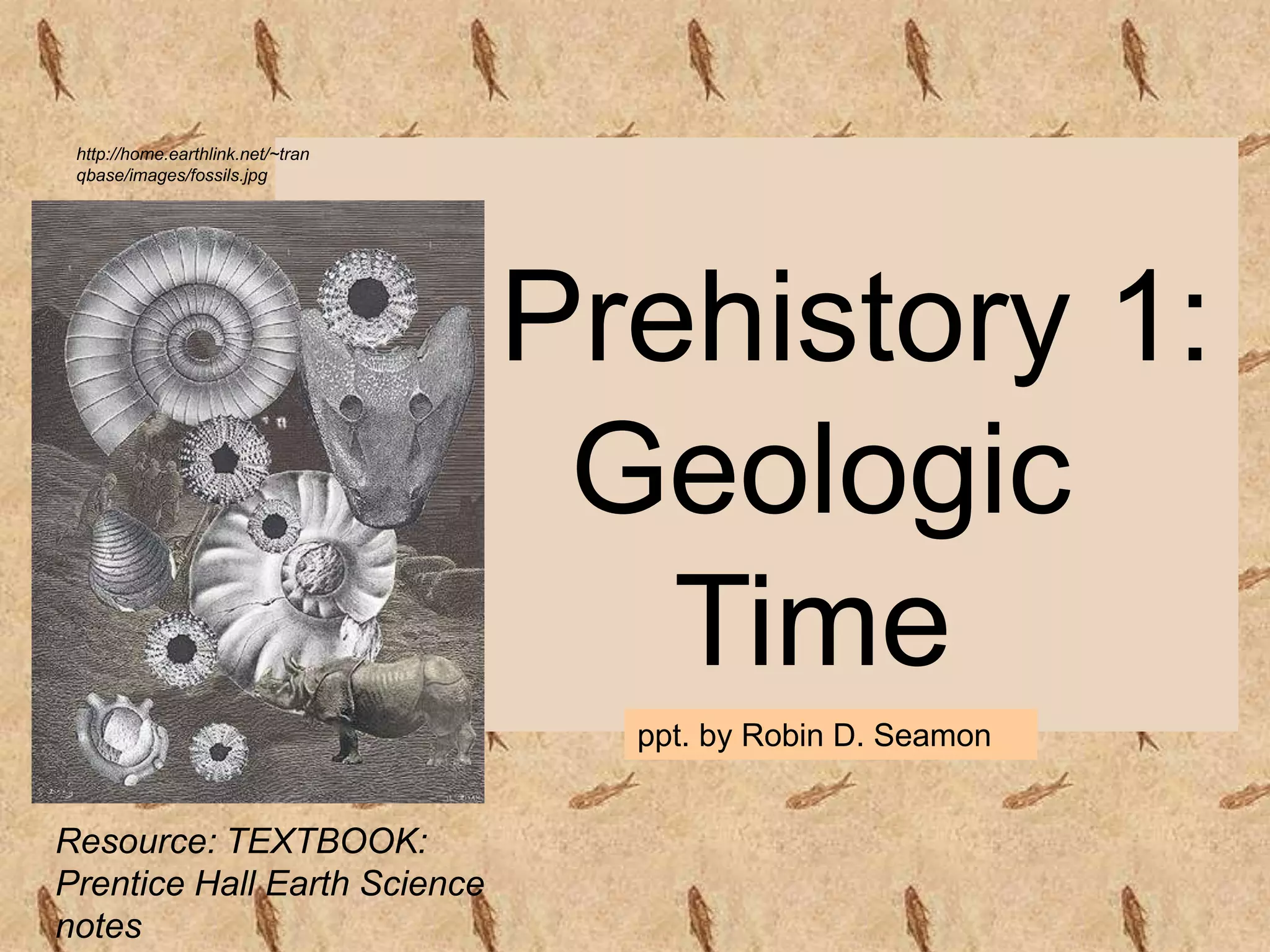
http://home.earthlink.net/~tran
qbase/images/fossils.jpg
HIGHLIGHTS:
• Earth: 4.5 billion years old
• ¾ of the geologic timeline holds life
• Life forms changed Earth’s chemistry
• Catastrophes affected the evolution of life-
extinctions
• New weedy species thrives & takes over after
an extinction
VIDEO: How Much is A Million?
Geologic Time Scale
Geologic
Timeline in
Excel
LINK
Neogene
Paleogene
EXTINCTIONS: widespread & rapid decreases in
amount of life on Earth.
5 major Extinctions:
65
mya
K-Pg Extinction 75% extinct
(killed
dinosaurs)
Mammals &
birds survive
200
mya
Triassic-Jurassic
extinction event
75% extinct Dinos & birds
survive
251
mya
Permian-Triassic
extinction event
95% life extinct
“Great Dying”
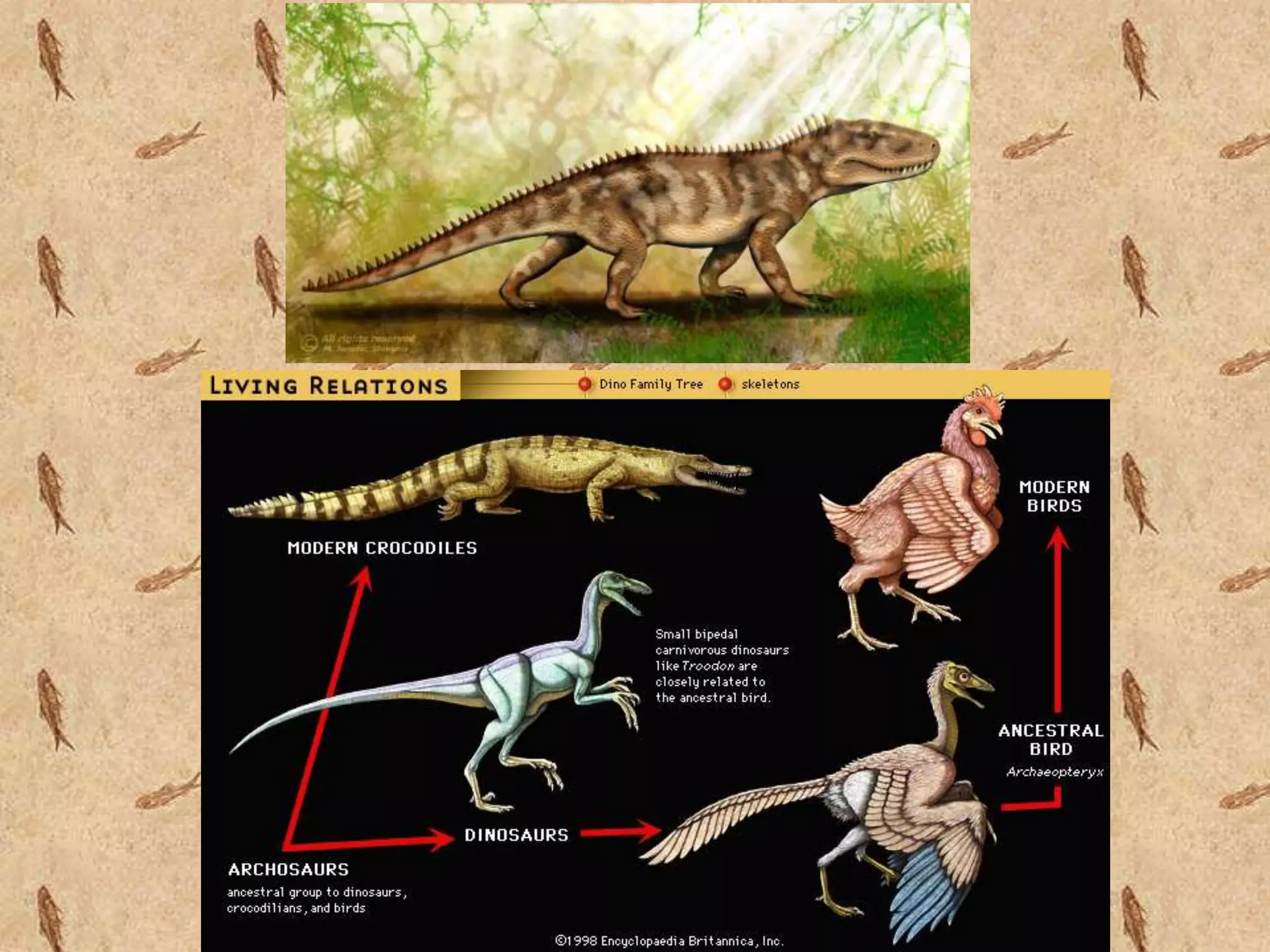
Archosaurs
survive
375
mya
Devonian
extinction
70% extinct Marine life
changed
450
mya
Ordovician-
Silurian extinction
70% extinct X 2 2 events
Mass extinctions:
• Long-term stress compounded by short-term
shock (2 things)
POSSIBLE CAUSES
• Flood basalt events (LIP)
• Sea level falls
• Impact events (asteroid/comet)
• Sustained & significant global cooling
• Sustained & significant global warming
• Anoxic events: (lack of O in oceans-warming)
• Oceanic overturn (disruption of thermohaline
circulation)
• Plate tectonics
• Initiate/end Ice Ages
• Change ocean & wind patterns
• Close off or open land bridges
• Decrease continental shelf
• Arid interior
• OTHER:
• New disease
• Out-competition
• Man-made extinction of species
EFFECTS & RECOVERY
• Weedy species- species that can quickly adapt
to the environment; becomes dominate
• Reproduce quickly
• Disperse widely
• Live in a variety of habitats
• Establish populations in strange places
• Resist eradication once established
• 5-10 million years before re-diversification
Geologic Timeline CALENDAR LAB
If Earth’s whole history was
compressed into 1 year, each
day would represent 12.5
million years.
According to this calendar,
animals & plants didn’t
evolve on Earth until the
late Fall.
First fish started crawling
onto land, evolving into
amphibious creatures with
legs in early December
Primates (group that today
contains lemurs, monkeys,
humans) only appeared in
the last week of December.
PH1 UNIT CHECK1
1. Age of the Earth according to geologists
2. How many major extinctions has Earth experienced?
3. How long does it take for biological re-diversification to
happen on Earth?
4-5. Name two supercontinents that were once on the Earth.
6. What is the species that is able to withstand the
environmental changes and resulting mass extinctions? They
repopulate Earth.
A- Mesozoic Era
B- Paleozoic Era
C- Cenozoic Era
D- Precambrian
1. Era in which we live
2. Era in which dinosaurs were dominant
3. Era in which fish and marine animals
were dominant
4. Earliest time period- only bacteria
4.5 billion years old
5
5-10 million years
Rodinia, Pangaea
Weedy species
C
A
B
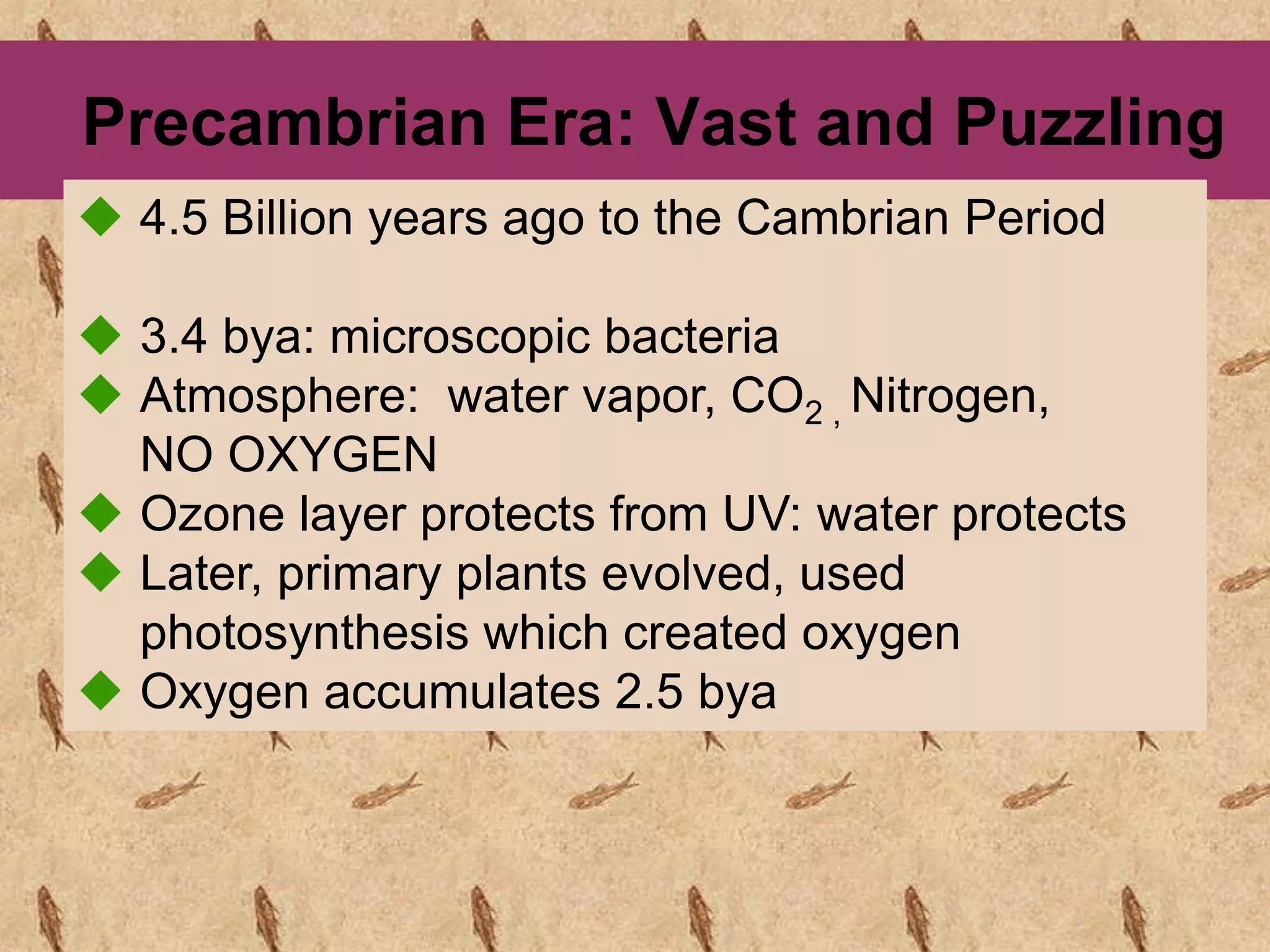
D
Precambrian Era: Vast and Puzzling
 4.5 Billion years ago to the Cambrian Period
 3.4 bya: microscopic bacteria
 Atmosphere: water vapor, CO2 , Nitrogen,
NO OXYGEN
 Ozone layer protects from UV: water protects
 Later, primary plants evolved, used
photosynthesis which created oxygen
 Oxygen accumulates 2.5 bya
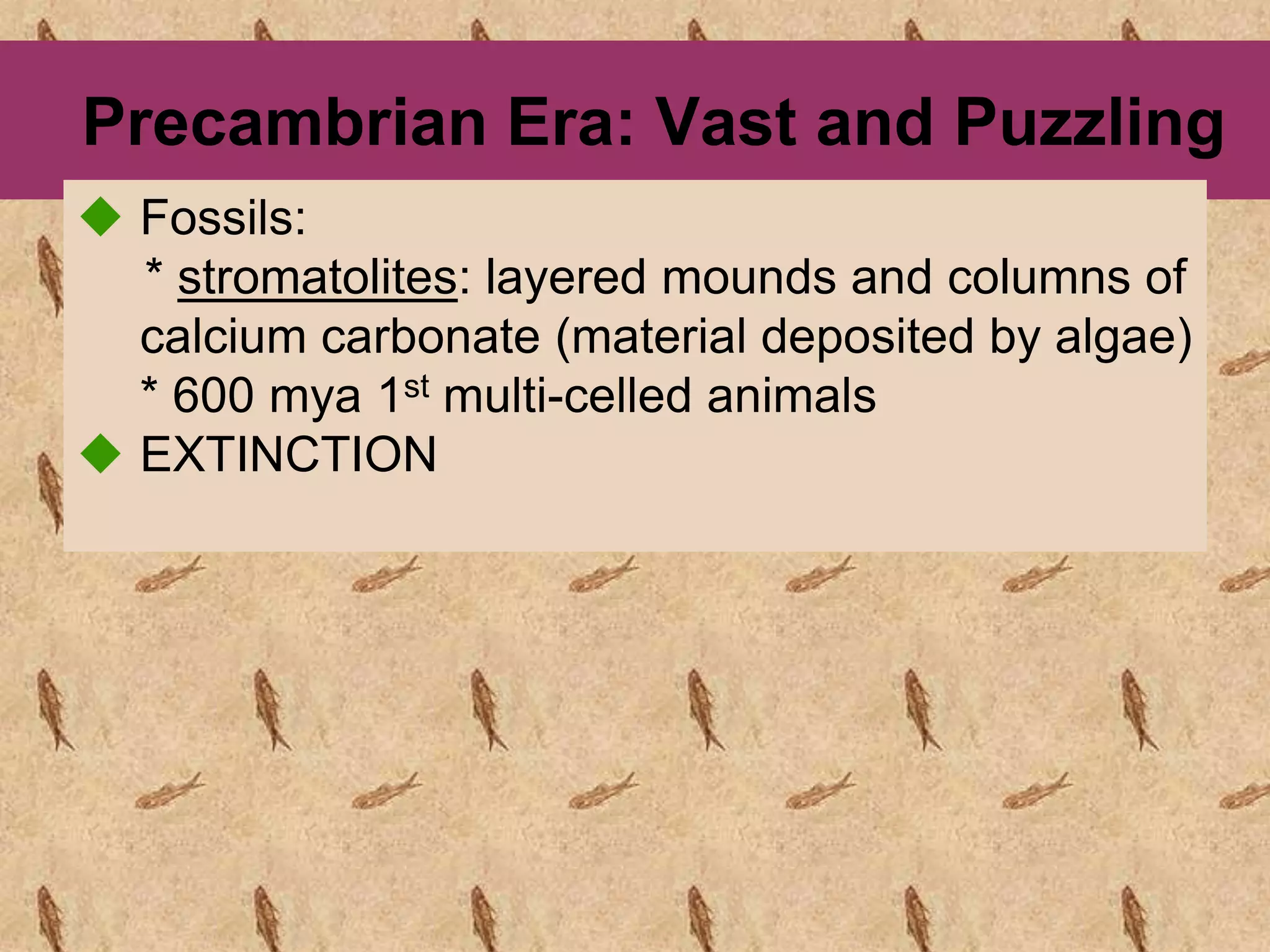
Precambrian Era: Vast and Puzzling
 Fossils:
* stromatolites: layered mounds and columns of
calcium carbonate (material deposited by algae)
* 600 mya 1st multi-celled animals
 EXTINCTION
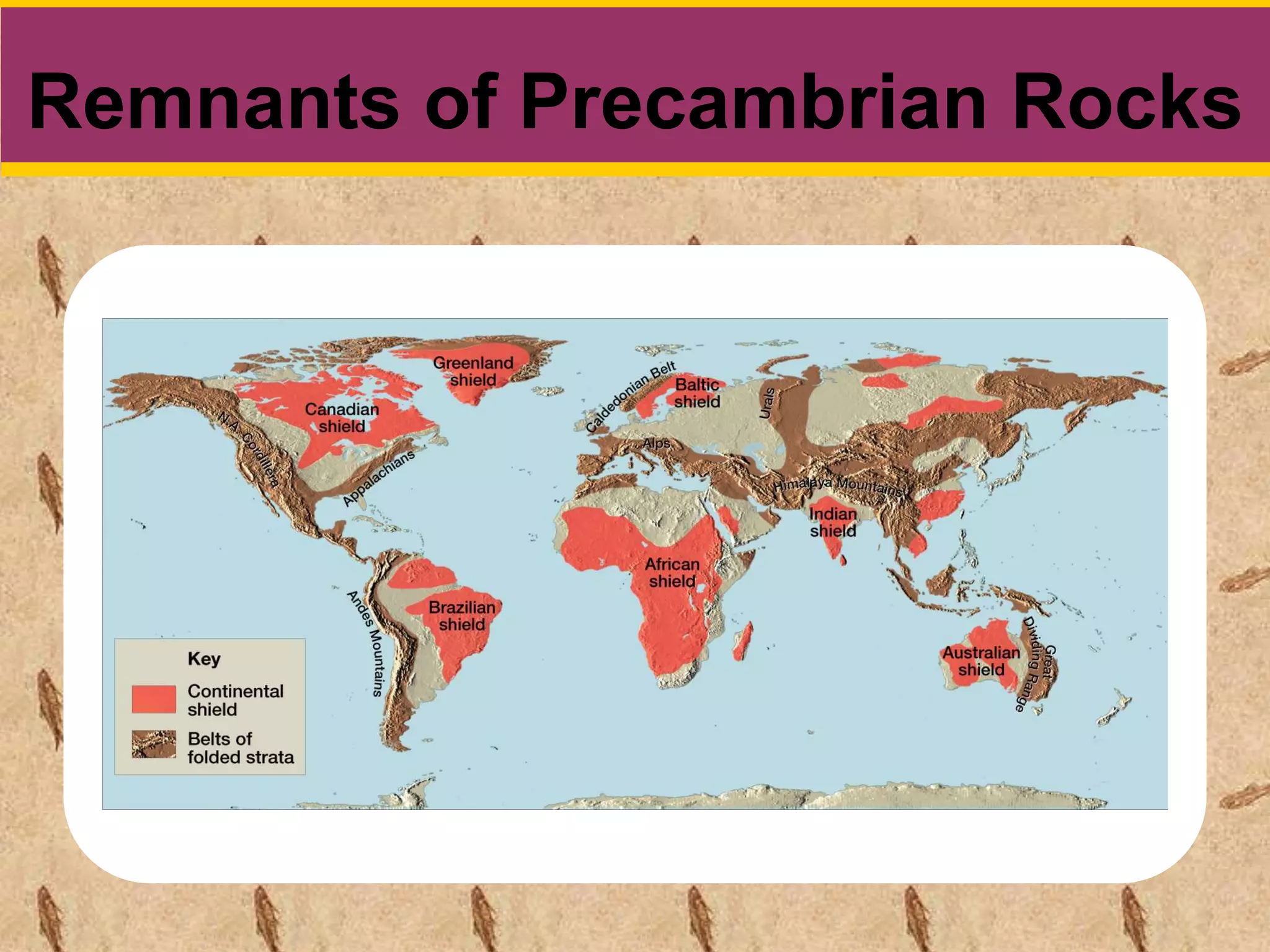
Remnants of Precambrian Rocks
 After Precambrian Era, time is divided into 3
other eras:
* Paleozoic Era
(Invertebrates Fish Amphibians)
* Mesozoic Era
* Cenozoic Era
Early Paleozoic Era: Life Evolves
 540 mya
 Divided into 6 time periods:
* Cambrian Period
* Ordovician Period
* Silurian Period
* Devonian Period
* Carboniferous Period
* Permian Period
 Paleozoic Era
 LIFE EVOLVES
early life began in the seas
shells, trilobites
Early Paleozoic Era: Life Evolves
Land masses:
* First: Gondwana ( S. Amer, Africa, Australia,
Antarctica, Asia) MAP
*Then another mass is raised: Laurasia
(N. Amer, Eurasia) MAP
* Then in Permian Period, there was: Pangaea
(all continents together) MAP
ADVANCE
BACK
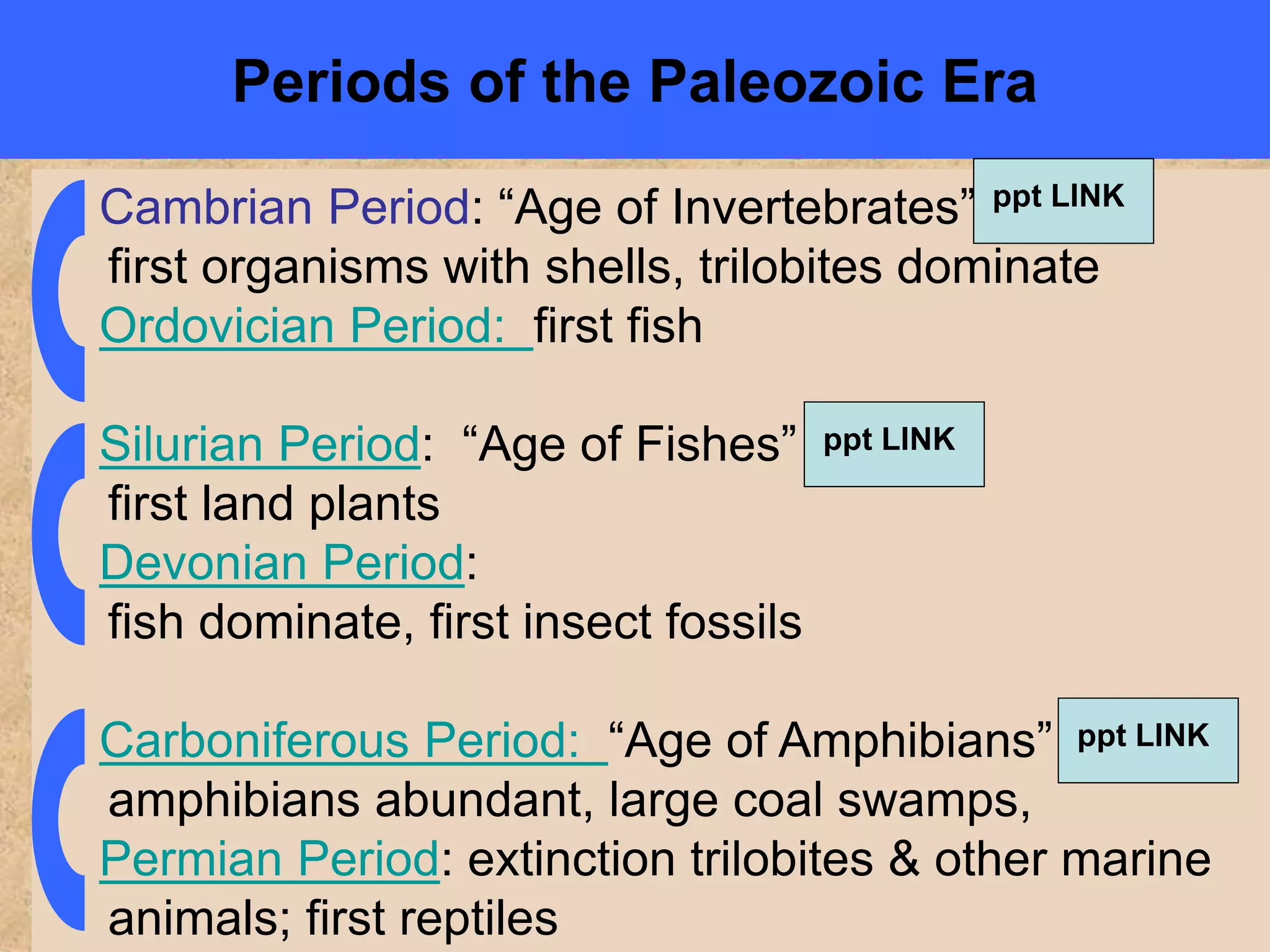
Cambrian Period: “Age of Invertebrates”
first organisms with shells, trilobites dominate
Ordovician Period: first fish
Silurian Period: “Age of Fishes”
first land plants
Devonian Period:
fish dominate, first insect fossils
Carboniferous Period: “Age of Amphibians”
amphibians abundant, large coal swamps,
Permian Period: extinction trilobites & other marine
animals; first reptiles
Periods of the Paleozoic Era
ppt LINK
ppt LINK
ppt LINK
Late Paleozoic Era
 At the end of the Paleozoic Era, (400mya)
plants adapted to water’s edge to inland
 Amphibians diversified
 Greatest of 5 mass extinctions
(Climate became seasonal)
ADVANCE
Silurian Period
BACK
BACK
Ordovician Period
Armor-Plated Fish
BACK
Model of a Pennsylvanian
Coal Swamp
BACK
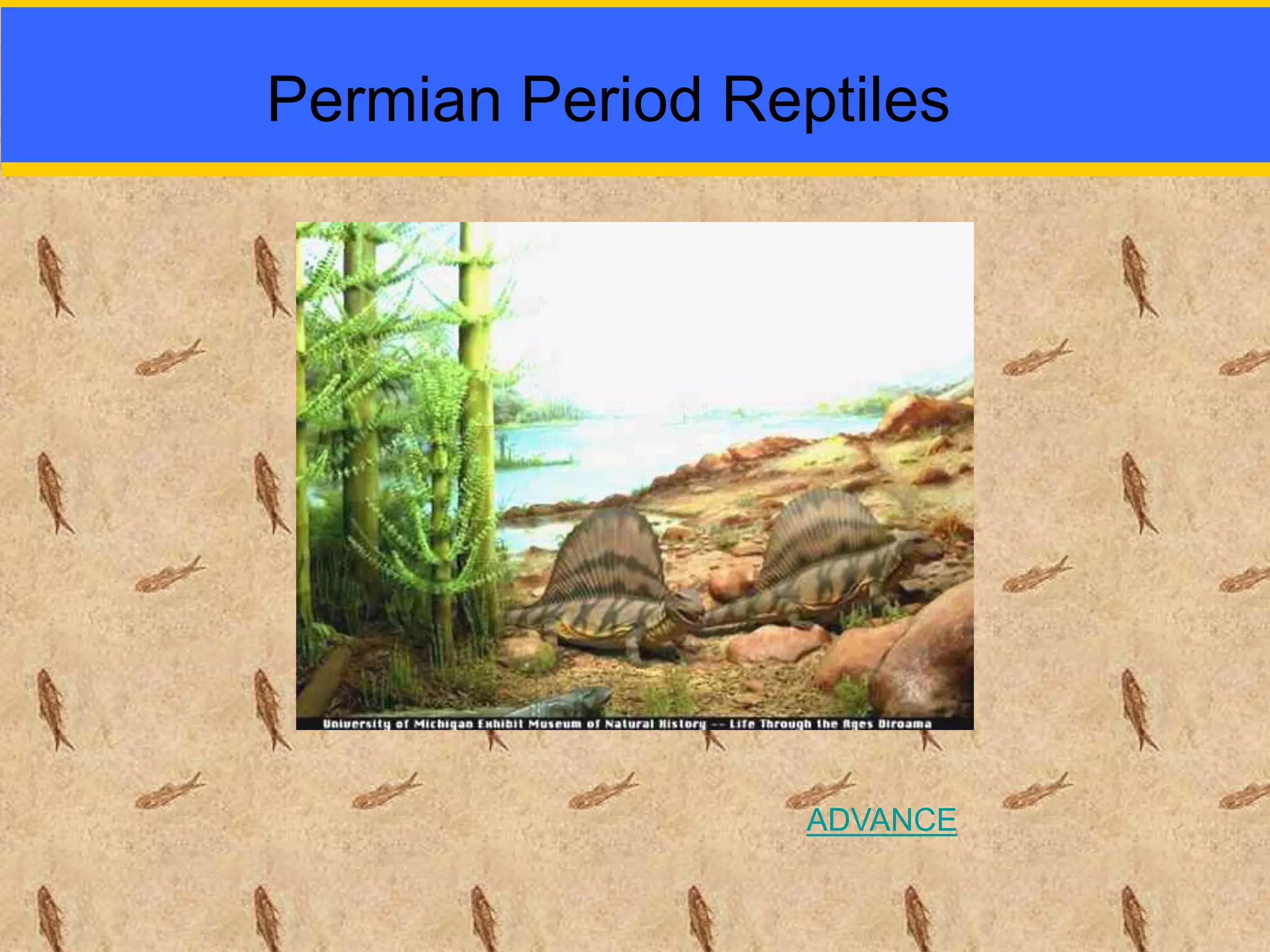
Permian Period Reptiles
ADVANCE
Mesozoic Era: “Age of Reptiles”
 350 mya
 Divided into 3 time periods:
* Triassic Period
* Jurassic Period
* Cretaceous Period
 Dinosaurs were land-dwelling reptiles that
were dominate during Mesozoic Era
 Major event: breakup of Pangea
Mesozoic Era: “Age of Reptiles”
 Life:
* gymnosperms
* Canadian Rockies formed
* shelled egg: adaptation favoring land birth
IMPORTANT EVOLUTIONARY STEP
* Reptiles dominate
ADVANCE
BACK
The Flying Reptile Pteranodon
ADVANCE
Fossil Skull of an Extinct Crocodile
Periods of the Mesozoic Era
Triassic Period “Age of Reptiles”
Dinosaurs dominate
Jurassic Period
First birds, dinosaurs dominate
Cretaceous Period
First angiosperms (flowering plants)
ADVANCE
Jurassic Period
BACK
Cretaceous Period
MASS EXTINCTION!!!
K-Pg Boundary- Earth struck by 6-mile wide asteroid,
resulting in mass extinction: 65 mya
End of the Mesozoic Era:
Badlands, SD
Cenozoic Era: “Age of Mammals”
 65 mya
 Considered the “Age of Mammals”
 Divided into three periods
* Paleogene Period
* Neogene Period
* Quaternary Period
 Plate movement led to much mountain building,
volcanism, earthquakes
Cenozoic Era: “Age of Mammals”
 Angiosperms replace gymnosperms as
dominate land plants
 Mammals (animals that bear live young,
maintain steady body temperature) replace
reptiles as dominate animal
 adaptations such as insulating body hair, more
efficient heart & lungs, allow mammals to lead
more active lives
Fossils from La Brea Tar Pits
Cenozoic Era: “Age of Mammals”
 Life
Large mammals & extinction:
* In N. America, mastodon & mammoth
(huge relatives of elephant), saber-toothed cats,
giant beavers, large ground sloths, horses,
camels, giant bison become extinct
???? WHY???
Cenozoic Era: “Age of Mammals”
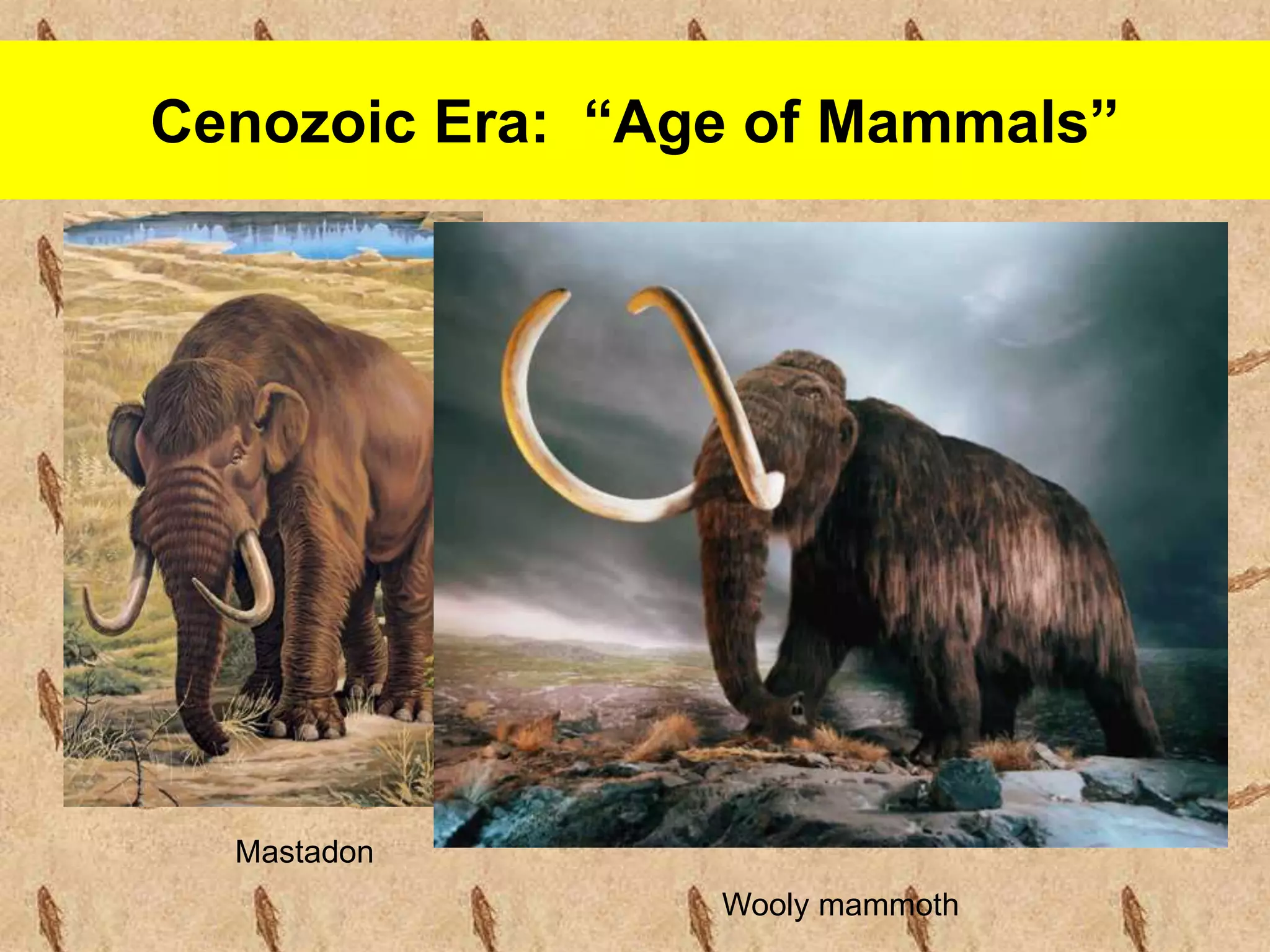
Mastadon
Wooly mammoth
Cenozoic Era: “Age of Mammals”
Saber-toothed tiger
Giant ground sloth
Cenozoic Era: Human Ancestors
2 mya – 10mya humans?
PH1 UNIT CHECK1
Reader’s Theater:
North American History
Character
LINK
Script
LINK
LAB:
Geologic Beaded
Timeline
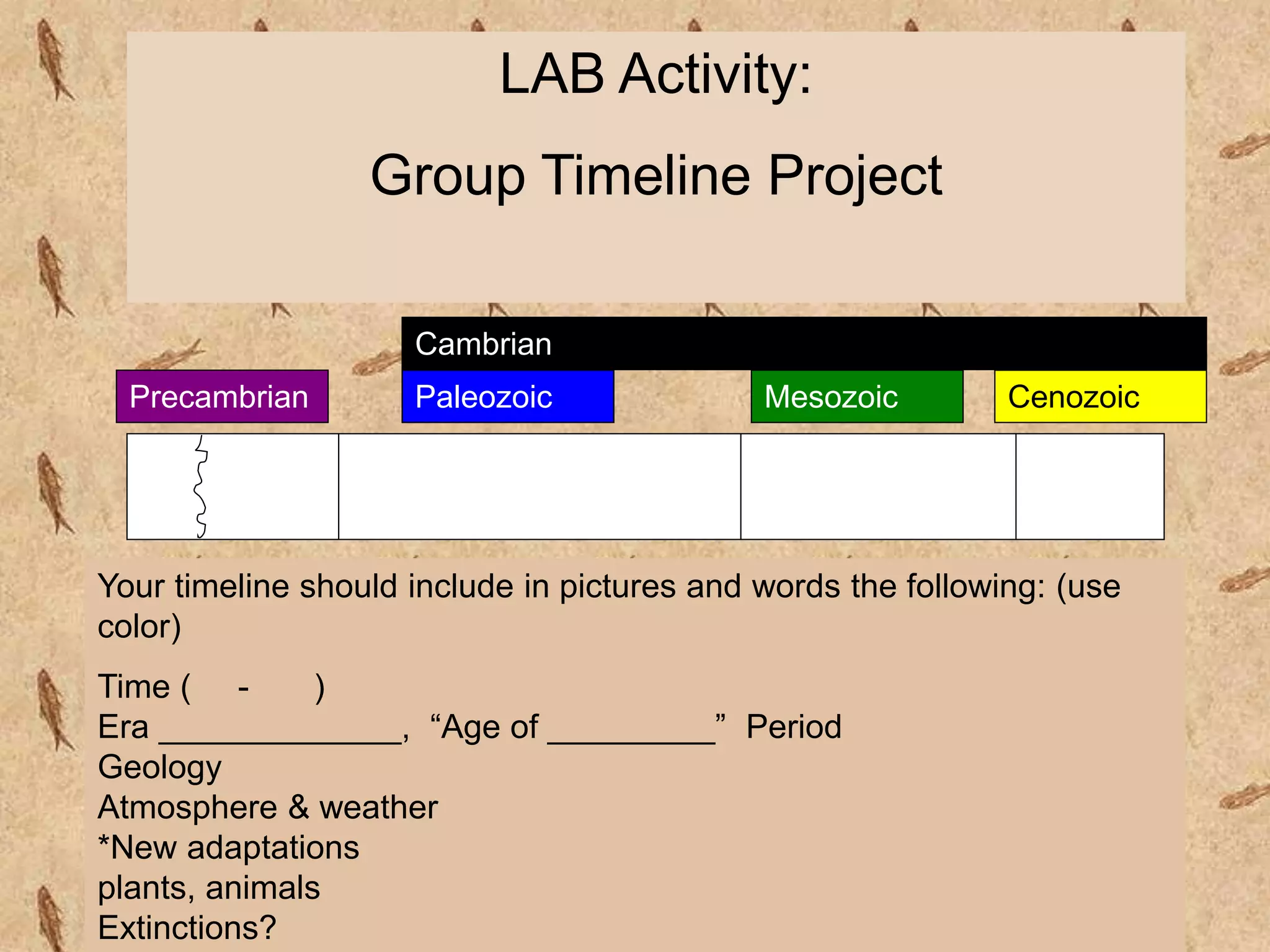
LAB Activity:
Group Timeline Project
Precambrian Paleozoic Mesozoic Cenozoic
Cambrian
Your timeline should include in pictures and words the following: (use
color)
Time ( - )
Era _____________, “Age of _________” Period
Geology
Atmosphere & weather
*New adaptations
plants, animals
Extinctions?
COMPUTER LAB Activity:
Geologic Timeline in Excel
LINK
RESOURCE:
TEXTBOOK: Prentice Hall Earth Science
notes 6th grade

Prehistory 1: Geologic Timeline- Notes on the geologic & life history of Earth from Precambrian to the present Cenozoic Era

  • 1.
    Prehistory 1: Geologic Time ppt. byRobin D. Seamon Resource: TEXTBOOK: Prentice Hall Earth Science notes http://home.earthlink.net/~tran qbase/images/fossils.jpg
  • 2.
    HIGHLIGHTS: • Earth: 4.5billion years old • ¾ of the geologic timeline holds life • Life forms changed Earth’s chemistry • Catastrophes affected the evolution of life- extinctions • New weedy species thrives & takes over after an extinction VIDEO: How Much is A Million?
  • 3.
    Geologic Time Scale Geologic Timelinein Excel LINK Neogene Paleogene
  • 4.
    EXTINCTIONS: widespread &rapid decreases in amount of life on Earth. 5 major Extinctions: 65 mya K-Pg Extinction 75% extinct (killed dinosaurs) Mammals & birds survive 200 mya Triassic-Jurassic extinction event 75% extinct Dinos & birds survive 251 mya Permian-Triassic extinction event 95% life extinct “Great Dying” Archosaurs survive 375 mya Devonian extinction 70% extinct Marine life changed 450 mya Ordovician- Silurian extinction 70% extinct X 2 2 events
  • 6.
    Mass extinctions: • Long-termstress compounded by short-term shock (2 things) POSSIBLE CAUSES • Flood basalt events (LIP) • Sea level falls • Impact events (asteroid/comet) • Sustained & significant global cooling • Sustained & significant global warming • Anoxic events: (lack of O in oceans-warming) • Oceanic overturn (disruption of thermohaline circulation)
  • 7.
    • Plate tectonics •Initiate/end Ice Ages • Change ocean & wind patterns • Close off or open land bridges • Decrease continental shelf • Arid interior • OTHER: • New disease • Out-competition • Man-made extinction of species
  • 8.
    EFFECTS & RECOVERY •Weedy species- species that can quickly adapt to the environment; becomes dominate • Reproduce quickly • Disperse widely • Live in a variety of habitats • Establish populations in strange places • Resist eradication once established • 5-10 million years before re-diversification
  • 9.
    Geologic Timeline CALENDARLAB If Earth’s whole history was compressed into 1 year, each day would represent 12.5 million years. According to this calendar, animals & plants didn’t evolve on Earth until the late Fall. First fish started crawling onto land, evolving into amphibious creatures with legs in early December Primates (group that today contains lemurs, monkeys, humans) only appeared in the last week of December.
  • 11.
    PH1 UNIT CHECK1 1.Age of the Earth according to geologists 2. How many major extinctions has Earth experienced? 3. How long does it take for biological re-diversification to happen on Earth? 4-5. Name two supercontinents that were once on the Earth. 6. What is the species that is able to withstand the environmental changes and resulting mass extinctions? They repopulate Earth. A- Mesozoic Era B- Paleozoic Era C- Cenozoic Era D- Precambrian 1. Era in which we live 2. Era in which dinosaurs were dominant 3. Era in which fish and marine animals were dominant 4. Earliest time period- only bacteria 4.5 billion years old 5 5-10 million years Rodinia, Pangaea Weedy species C A B D
  • 12.
    Precambrian Era: Vastand Puzzling  4.5 Billion years ago to the Cambrian Period  3.4 bya: microscopic bacteria  Atmosphere: water vapor, CO2 , Nitrogen, NO OXYGEN  Ozone layer protects from UV: water protects  Later, primary plants evolved, used photosynthesis which created oxygen  Oxygen accumulates 2.5 bya
  • 13.
    Precambrian Era: Vastand Puzzling  Fossils: * stromatolites: layered mounds and columns of calcium carbonate (material deposited by algae) * 600 mya 1st multi-celled animals  EXTINCTION
  • 14.
  • 15.
     After PrecambrianEra, time is divided into 3 other eras: * Paleozoic Era (Invertebrates Fish Amphibians) * Mesozoic Era * Cenozoic Era
  • 16.
    Early Paleozoic Era:Life Evolves  540 mya  Divided into 6 time periods: * Cambrian Period * Ordovician Period * Silurian Period * Devonian Period * Carboniferous Period * Permian Period  Paleozoic Era  LIFE EVOLVES early life began in the seas shells, trilobites
  • 17.
    Early Paleozoic Era:Life Evolves Land masses: * First: Gondwana ( S. Amer, Africa, Australia, Antarctica, Asia) MAP *Then another mass is raised: Laurasia (N. Amer, Eurasia) MAP * Then in Permian Period, there was: Pangaea (all continents together) MAP ADVANCE
  • 18.
  • 19.
    Cambrian Period: “Ageof Invertebrates” first organisms with shells, trilobites dominate Ordovician Period: first fish Silurian Period: “Age of Fishes” first land plants Devonian Period: fish dominate, first insect fossils Carboniferous Period: “Age of Amphibians” amphibians abundant, large coal swamps, Permian Period: extinction trilobites & other marine animals; first reptiles Periods of the Paleozoic Era ppt LINK ppt LINK ppt LINK
  • 20.
    Late Paleozoic Era At the end of the Paleozoic Era, (400mya) plants adapted to water’s edge to inland  Amphibians diversified  Greatest of 5 mass extinctions (Climate became seasonal) ADVANCE
  • 21.
  • 22.
  • 23.
  • 24.
    Model of aPennsylvanian Coal Swamp BACK
  • 25.
  • 26.
    Mesozoic Era: “Ageof Reptiles”  350 mya  Divided into 3 time periods: * Triassic Period * Jurassic Period * Cretaceous Period  Dinosaurs were land-dwelling reptiles that were dominate during Mesozoic Era  Major event: breakup of Pangea
  • 27.
    Mesozoic Era: “Ageof Reptiles”  Life: * gymnosperms * Canadian Rockies formed * shelled egg: adaptation favoring land birth IMPORTANT EVOLUTIONARY STEP * Reptiles dominate ADVANCE
  • 28.
  • 29.
    The Flying ReptilePteranodon ADVANCE
  • 30.
    Fossil Skull ofan Extinct Crocodile
  • 31.
    Periods of theMesozoic Era Triassic Period “Age of Reptiles” Dinosaurs dominate Jurassic Period First birds, dinosaurs dominate Cretaceous Period First angiosperms (flowering plants) ADVANCE
  • 32.
  • 33.
  • 34.
    MASS EXTINCTION!!! K-Pg Boundary-Earth struck by 6-mile wide asteroid, resulting in mass extinction: 65 mya End of the Mesozoic Era: Badlands, SD
  • 35.
    Cenozoic Era: “Ageof Mammals”  65 mya  Considered the “Age of Mammals”  Divided into three periods * Paleogene Period * Neogene Period * Quaternary Period  Plate movement led to much mountain building, volcanism, earthquakes
  • 36.
    Cenozoic Era: “Ageof Mammals”  Angiosperms replace gymnosperms as dominate land plants  Mammals (animals that bear live young, maintain steady body temperature) replace reptiles as dominate animal  adaptations such as insulating body hair, more efficient heart & lungs, allow mammals to lead more active lives
  • 37.
    Fossils from LaBrea Tar Pits
  • 38.
    Cenozoic Era: “Ageof Mammals”  Life Large mammals & extinction: * In N. America, mastodon & mammoth (huge relatives of elephant), saber-toothed cats, giant beavers, large ground sloths, horses, camels, giant bison become extinct ???? WHY???
  • 39.
    Cenozoic Era: “Ageof Mammals” Mastadon Wooly mammoth
  • 40.
    Cenozoic Era: “Ageof Mammals” Saber-toothed tiger Giant ground sloth
  • 41.
    Cenozoic Era: HumanAncestors 2 mya – 10mya humans?
  • 42.
  • 43.
    Reader’s Theater: North AmericanHistory Character LINK Script LINK
  • 44.
  • 45.
    LAB Activity: Group TimelineProject Precambrian Paleozoic Mesozoic Cenozoic Cambrian Your timeline should include in pictures and words the following: (use color) Time ( - ) Era _____________, “Age of _________” Period Geology Atmosphere & weather *New adaptations plants, animals Extinctions?
  • 46.
    COMPUTER LAB Activity: GeologicTimeline in Excel LINK
  • 47.
    RESOURCE: TEXTBOOK: Prentice HallEarth Science notes 6th grade

Editor's Notes

  • #3 Makes no sense without caption in book
  • #7 Makes no sense without caption in book
  • #16 Makes no sense without caption in book
  • #17 Makes no sense without caption in book
  • #22 Makes no sense without caption in book
  • #23 Makes no sense without caption in book
  • #30 Makes no sense without caption in book