SA National Science Week
Theme: Facing the harsh realities of climate change
29 July-3 August 2019
Abiodun Adeola(PhD)
Lead Scientist: Climate Change and Variability
Thabo Makgoale
Scientist: Climate Change and Variability
South African Weather Service
Climate change and variability
WEATHER AND CLIMATE
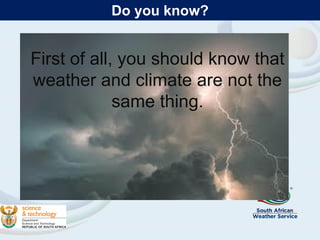
First of all, you should know that
weather and climate are not the
same thing.
Do you know?
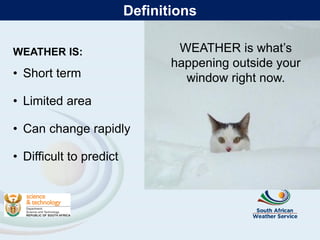
WEATHER IS:
• Short term
• Limited area
• Can change rapidly
• Difficult to predict
WEATHER is what’s
happening outside your
window right now.
Definitions
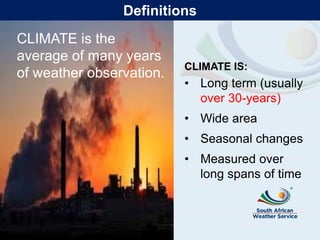
CLIMATE IS:
• Long term (usually
over 30-years)
• Wide area
• Seasonal changes
• Measured over
long spans of time
CLIMATE is the
average of many years
of weather observation.
Definitions
WEATHER: the state of the atmosphere at a particular place and time as
regards temperature, cloudiness, dryness, sunshine, wind, rain, etc.
CLIMATE: the weather conditions prevailing in an area in general or over a
long period usually over 30-years
CLIMATE CHANGE: is a change in the statistical properties (principally
its mean and spread) of the climate system when considered over long
periods of time, regardless of cause
Definitions
Climate Variability and Climate Change?
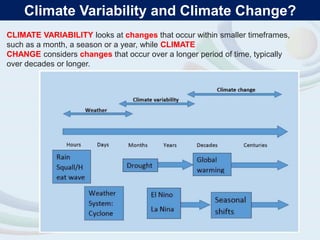
CLIMATE VARIABILITY looks at changes that occur within smaller timeframes,
such as a month, a season or a year, while CLIMATE
CHANGE considers changes that occur over a longer period of time, typically
over decades or longer.
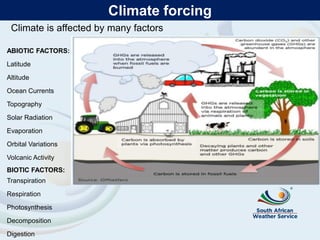
ABIOTIC FACTORS:
Latitude
Altitude
Ocean Currents
Topography
Solar Radiation
Evaporation
Orbital Variations
Volcanic Activity
BIOTIC FACTORS:
Transpiration
Respiration
Photosynthesis
Decomposition
Digestion
Climate forcing
Climate is affected by many factors
A number of greenhouse gases occur
naturally in the Earth’s atmosphere
• Water vapor
• Carbon dioxide
• Methane
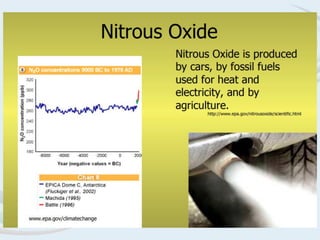
• Nitrous oxide
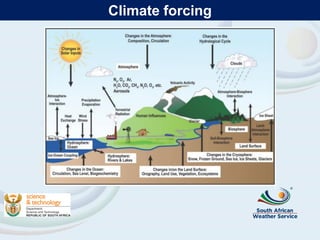
Climate forcing
https://www.niwa.co.nz/atmosphere/faq/what-is-the-greenhouse-effect
The Greenhouse Effect
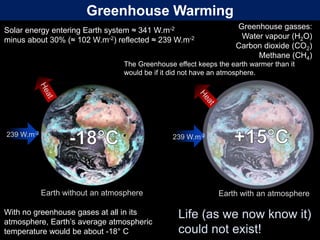
Solar energy entering Earth system ≈ 341 W.m-2
minus about 30% (≈ 102 W.m-2) reflected ≈ 239 W.m-2
Earth with an atmosphere
Greenhouse gasses:
Water vapour (H2O)
Carbon dioxide (CO2)
Methane (CH4)
Greenhouse Warming
239 W.m-2239 W.m-2
Earth without an atmosphere
The Greenhouse effect keeps the earth warmer than it
would be if it did not have an atmosphere.
With no greenhouse gases at all in its
atmosphere, Earth’s average atmospheric
temperature would be about -18° C
Life (as we now know it)
could not exist!
https://www.youtube.com/watch?v=oJAbATJCugs
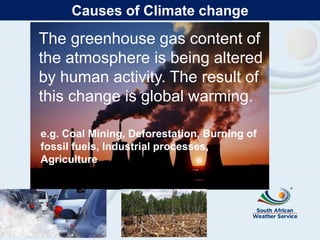
The greenhouse gas content of
the atmosphere is being altered
by human activity. The result of
this change is global warming.
e.g. Coal Mining, Deforestation, Burning of
fossil fuels, Industrial processes,
Agriculture
Causes of Climate change
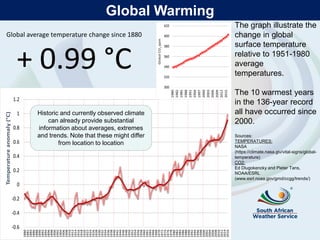
Global average temperature change since 1880
+ 0.99 °C
The graph illustrate the
change in global
surface temperature
relative to 1951-1980
average
temperatures.
The 10 warmest years
in the 136-year record
all have occurred since
2000.
Sources:
TEMPERATURES:
NASA
(https://climate.nasa.giv/vital-signs/global-
temperature)
CO2:
Ed Dlugokencky and Pieter Tans,
NOAA/ESRL
(www.esrl.noaa.gov/gmd/ccgg/trends/)
-0.6
-0.4
-0.2
0
0.2
0.4
0.6
0.8
1
1.2
1880
1882
1884
1886
1888
1890
1892
1894
1896
1898
1900
1902
1904
1906
1908
1910
1912
1914
1916
1918
1920
1922
1924
1926
1928
1930
1932
1934
1936
1938
1940
1942
1944
1946
1948
1950
1952
1954
1956
1958
1960
1962
1964
1966
1968
1970
1972
1974
1976
1978
1980
1982
1984
1986
1988
1990
1992
1994
1996
1998
2000
2002
2004
2006
2008
2010
2012
2014
2016
Temperatureanomaly(C)
300
320
340
360
380
400
420
1980
1982
1985
1988
1991
1994
1997
2000
2003
2006
2009
2012
2015
GlobalCO2ppm
Historic and currently observed climate
can already provide substantial
information about averages, extremes
and trends. Note that these might differ
from location to location
Global Warming
Historical Global Temperature Trends
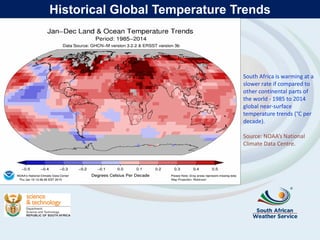
South Africa is warming at a
slower rate if compared to
other continental parts of
the world - 1985 to 2014
global near-surface
temperature trends (°C per
decade).
Source: NOAA’s National
Climate Data Centre.
DANGERS OF CLIMATE CHANGE
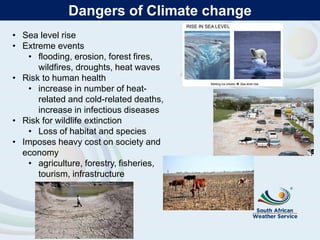
Dangers of Climate change
• Sea level rise
• Extreme events
• flooding, erosion, forest fires,
wildfires, droughts, heat waves
• Risk to human health
• increase in number of heat-
related and cold-related deaths,
increase in infectious diseases
• Risk for wildlife extinction
• Loss of habitat and species
• Imposes heavy cost on society and
economy
• agriculture, forestry, fisheries,
tourism, infrastructure
WHAT CAN WE DO?
What can we Do?
First we must admit that climate
change is everyone’s problem. No
agency, government, or scientist can
“fix it” for us. We are all in this together.
We got here because of our lifestyle.
So our lifestyle has to change.
Here’s what you can do…
FINAL REMARKS
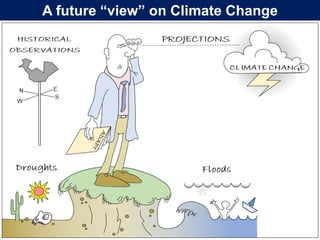
A future “view” on Climate Change
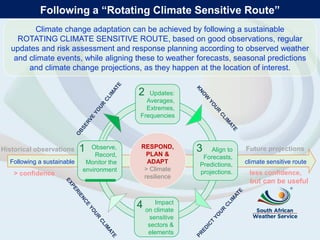
Following a “Rotating Climate Sensitive Route”
Following a sustainable climate sensitive route
Impact
on climate
sensitive
sectors &
elements
Updates:
Averages,
Extremes,
Frequencies
Observe,
Record,
Monitor the
environment
Align to
Forecasts,
Predictions,
projections.
RESPOND,
PLAN &
ADAPT
> Climate
resilience
Climate change adaptation can be achieved by following a sustainable
ROTATING CLIMATE SENSITIVE ROUTE, based on good observations, regular
updates and risk assessment and response planning according to observed weather
and climate events, while aligning these to weather forecasts, seasonal predictions
and climate change projections, as they happen at the location of interest.
1
2
3
4
Historical observations
> confidence
Future projections
less confidence,
but can be useful
Our Climate Comfort Zone
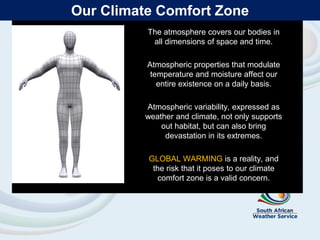
The atmosphere covers our bodies in
all dimensions of space and time.
Atmospheric properties that modulate
temperature and moisture affect our
entire existence on a daily basis.
Atmospheric variability, expressed as
weather and climate, not only supports
out habitat, but can also bring
devastation in its extremes.
GLOBAL WARMING is a reality, and
the risk that it poses to our climate
comfort zone is a valid concern.
Climate terminology
• Climate: Climate in a narrow sense is usually defined as the average weather, or more rigorously,
as the statistical description in terms of the mean and variability of relevant quantities over a period
of time ranging from months to thousands or millions of years.
• Climate change: A change in the state of the climate that can be identified (e.g., by using statistical
tests) by changes in the mean and/or the variability of its properties and that persists for an
extended period, typically decades or longer. Climate change may be due to natural internal
processes or external forcings, or to persistent anthropogenic changes in the composition of the
atmosphere or in land use (IPCC 2012).
• Climate extreme (extreme weather or climate event): The occurrence of a value of a weather or
climate variable above (or below) a threshold value near the upper (or lower) ends of the range of
observed values of the variable. For simplicity, both extreme weather events and extreme climate
events are referred to collectively as ‘climate extremes.’ (IPCC 2012)
• Climate forecast: The result of an attempt to produce an estimate of the actual evolution of the
climate in the future, e.g., at seasonal, interannual or long-term time scales (IPCC 2007, WGII).
• Climate model: A numerical representation of the climate system that is based on the physical,
chemical, and biological properties of its components, their interactions, and feedback processes,
and that accounts for all or some of its known properties.
• Climate projection: A projection of the response of the climate system to emissions or
concentration scenarios of greenhouse gases and aerosols, or radiative forcing scenarios,
often based upon simulations by climate models.
• Climate scenario: A plausible and often simplified representation of the future climate, based
on an internally consistent set of climatological relationships that has been constructed for
explicit use in investigating the potential consequences of anthropogenic climate change,
often serving as input to impact models.
Climate Glossary
Thank you
Abiodun.adeola@weathersa.co.za
Thabo.Makgoale@weathersa.co.za
www.weathersa.co.za

Climate change and variability/ Abiodun Adeola

  • 1.
    SA National ScienceWeek Theme: Facing the harsh realities of climate change 29 July-3 August 2019 Abiodun Adeola(PhD) Lead Scientist: Climate Change and Variability Thabo Makgoale Scientist: Climate Change and Variability South African Weather Service Climate change and variability
  • 2.
  • 3.
    First of all,you should know that weather and climate are not the same thing. Do you know?
  • 4.
    WEATHER IS: • Shortterm • Limited area • Can change rapidly • Difficult to predict WEATHER is what’s happening outside your window right now. Definitions
  • 5.
    CLIMATE IS: • Longterm (usually over 30-years) • Wide area • Seasonal changes • Measured over long spans of time CLIMATE is the average of many years of weather observation. Definitions
  • 6.
    WEATHER: the stateof the atmosphere at a particular place and time as regards temperature, cloudiness, dryness, sunshine, wind, rain, etc. CLIMATE: the weather conditions prevailing in an area in general or over a long period usually over 30-years CLIMATE CHANGE: is a change in the statistical properties (principally its mean and spread) of the climate system when considered over long periods of time, regardless of cause Definitions
  • 7.
    Climate Variability andClimate Change? CLIMATE VARIABILITY looks at changes that occur within smaller timeframes, such as a month, a season or a year, while CLIMATE CHANGE considers changes that occur over a longer period of time, typically over decades or longer.
  • 8.
    ABIOTIC FACTORS: Latitude Altitude Ocean Currents Topography SolarRadiation Evaporation Orbital Variations Volcanic Activity BIOTIC FACTORS: Transpiration Respiration Photosynthesis Decomposition Digestion Climate forcing Climate is affected by many factors
  • 9.
    A number ofgreenhouse gases occur naturally in the Earth’s atmosphere • Water vapor • Carbon dioxide • Methane • Nitrous oxide
  • 10.
  • 11.
  • 14.
    Solar energy enteringEarth system ≈ 341 W.m-2 minus about 30% (≈ 102 W.m-2) reflected ≈ 239 W.m-2 Earth with an atmosphere Greenhouse gasses: Water vapour (H2O) Carbon dioxide (CO2) Methane (CH4) Greenhouse Warming 239 W.m-2239 W.m-2 Earth without an atmosphere The Greenhouse effect keeps the earth warmer than it would be if it did not have an atmosphere. With no greenhouse gases at all in its atmosphere, Earth’s average atmospheric temperature would be about -18° C Life (as we now know it) could not exist!
  • 15.
  • 16.
    The greenhouse gascontent of the atmosphere is being altered by human activity. The result of this change is global warming. e.g. Coal Mining, Deforestation, Burning of fossil fuels, Industrial processes, Agriculture Causes of Climate change
  • 20.
    Global average temperaturechange since 1880 + 0.99 °C The graph illustrate the change in global surface temperature relative to 1951-1980 average temperatures. The 10 warmest years in the 136-year record all have occurred since 2000. Sources: TEMPERATURES: NASA (https://climate.nasa.giv/vital-signs/global- temperature) CO2: Ed Dlugokencky and Pieter Tans, NOAA/ESRL (www.esrl.noaa.gov/gmd/ccgg/trends/) -0.6 -0.4 -0.2 0 0.2 0.4 0.6 0.8 1 1.2 1880 1882 1884 1886 1888 1890 1892 1894 1896 1898 1900 1902 1904 1906 1908 1910 1912 1914 1916 1918 1920 1922 1924 1926 1928 1930 1932 1934 1936 1938 1940 1942 1944 1946 1948 1950 1952 1954 1956 1958 1960 1962 1964 1966 1968 1970 1972 1974 1976 1978 1980 1982 1984 1986 1988 1990 1992 1994 1996 1998 2000 2002 2004 2006 2008 2010 2012 2014 2016 Temperatureanomaly(C) 300 320 340 360 380 400 420 1980 1982 1985 1988 1991 1994 1997 2000 2003 2006 2009 2012 2015 GlobalCO2ppm Historic and currently observed climate can already provide substantial information about averages, extremes and trends. Note that these might differ from location to location Global Warming
  • 21.
    Historical Global TemperatureTrends South Africa is warming at a slower rate if compared to other continental parts of the world - 1985 to 2014 global near-surface temperature trends (°C per decade). Source: NOAA’s National Climate Data Centre.
  • 22.
  • 23.
    Dangers of Climatechange • Sea level rise • Extreme events • flooding, erosion, forest fires, wildfires, droughts, heat waves • Risk to human health • increase in number of heat- related and cold-related deaths, increase in infectious diseases • Risk for wildlife extinction • Loss of habitat and species • Imposes heavy cost on society and economy • agriculture, forestry, fisheries, tourism, infrastructure
  • 24.
  • 25.
    What can weDo? First we must admit that climate change is everyone’s problem. No agency, government, or scientist can “fix it” for us. We are all in this together. We got here because of our lifestyle. So our lifestyle has to change. Here’s what you can do…
  • 30.
  • 31.
    A future “view”on Climate Change
  • 32.
    Following a “RotatingClimate Sensitive Route” Following a sustainable climate sensitive route Impact on climate sensitive sectors & elements Updates: Averages, Extremes, Frequencies Observe, Record, Monitor the environment Align to Forecasts, Predictions, projections. RESPOND, PLAN & ADAPT > Climate resilience Climate change adaptation can be achieved by following a sustainable ROTATING CLIMATE SENSITIVE ROUTE, based on good observations, regular updates and risk assessment and response planning according to observed weather and climate events, while aligning these to weather forecasts, seasonal predictions and climate change projections, as they happen at the location of interest. 1 2 3 4 Historical observations > confidence Future projections less confidence, but can be useful
  • 33.
    Our Climate ComfortZone The atmosphere covers our bodies in all dimensions of space and time. Atmospheric properties that modulate temperature and moisture affect our entire existence on a daily basis. Atmospheric variability, expressed as weather and climate, not only supports out habitat, but can also bring devastation in its extremes. GLOBAL WARMING is a reality, and the risk that it poses to our climate comfort zone is a valid concern.
  • 35.
    Climate terminology • Climate:Climate in a narrow sense is usually defined as the average weather, or more rigorously, as the statistical description in terms of the mean and variability of relevant quantities over a period of time ranging from months to thousands or millions of years. • Climate change: A change in the state of the climate that can be identified (e.g., by using statistical tests) by changes in the mean and/or the variability of its properties and that persists for an extended period, typically decades or longer. Climate change may be due to natural internal processes or external forcings, or to persistent anthropogenic changes in the composition of the atmosphere or in land use (IPCC 2012). • Climate extreme (extreme weather or climate event): The occurrence of a value of a weather or climate variable above (or below) a threshold value near the upper (or lower) ends of the range of observed values of the variable. For simplicity, both extreme weather events and extreme climate events are referred to collectively as ‘climate extremes.’ (IPCC 2012) • Climate forecast: The result of an attempt to produce an estimate of the actual evolution of the climate in the future, e.g., at seasonal, interannual or long-term time scales (IPCC 2007, WGII). • Climate model: A numerical representation of the climate system that is based on the physical, chemical, and biological properties of its components, their interactions, and feedback processes, and that accounts for all or some of its known properties. • Climate projection: A projection of the response of the climate system to emissions or concentration scenarios of greenhouse gases and aerosols, or radiative forcing scenarios, often based upon simulations by climate models. • Climate scenario: A plausible and often simplified representation of the future climate, based on an internally consistent set of climatological relationships that has been constructed for explicit use in investigating the potential consequences of anthropogenic climate change, often serving as input to impact models. Climate Glossary
  • 36.