Land Suitability Classification
Presented By :
Dr. R.K. Thakur
Assistant Professor (Soil Science)
College of Agriculture, Balaghat
Jawaharlal Nehru Krishi Vishwa Vidyalaya Jabalpur (M.P.)
◼ The terms suitability and capability have often been
confused or even regarded as synonymous.
◼ There is a distinction between suitability for a single
clearly defined, reasonably homogenous purpose is
practices, and capability for a broader use such as
agriculture development.
◼ Thus, suitability assessment has a sharp focus, looking
for sites possessing the positive features associated with
successful production or use.
◼ Suitability is largely a matter of producing high yields
with relatively low inputs.
Introduction :-
▪ According to the United Nations Food and Agriculture
Organization—FAO (1976) Land suitability is the fitness of a
given area for a land utilization type (or land use), or the
degree to which it satisfies the land user.
▪ It is generally presented as a class or rating.
▪ Internationally recognized suitability classes outlined by FAO
can be adapted and applied at both regional and local scale.
▪ Thus, land suitability classification system has four different
categories :
1. Orders
2. Classes
3. Subclasses
4. Units
Land Suitability Classification (LSC) :-
Basic Principles of Land Suitability :-
▪ It is assessed for specified kinds of use.
▪ Evaluation requires a comparison of benefit obtained with
inputs needed.
▪ Suitability is for use on a sustained basis, i.e. the use must
not bring about severe or progressive degradation.
▪ Land suitability orders, which reflect kinds of suitability.
▪ Land suitability classes, which reflect degrees of suitability
within orders.
▪ Land suitability sub-classes, which reflect kinds of
limitation or the main kinds of improvements required
within classes.
▪ Land suitability units, which reflect minor differences
within sub-classes in the required management.
1. “S” - Suitable land : Land on which sustained use for the
defined purpose in the defined manner is expected to
yield benefits that will justify required recurrent
inputs without unacceptable risk to land resources.
2. “N” - Unsuitable land : Land having characteristics
which appear to preclude its sustained use for the
defined purpose in the defined manner or which would
create production, upkeep and/or conservation
problems requiring a level of recurrent inputs
unacceptable at the time of interpretation.
Land Suitability Orders :-
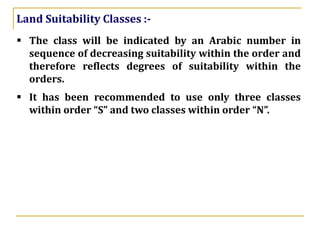
▪ The class will be indicated by an Arabic number in
sequence of decreasing suitability within the order and
therefore reflects degrees of suitability within the
orders.
▪ It has been recommended to use only three classes
within order “S” and two classes within order “N”.
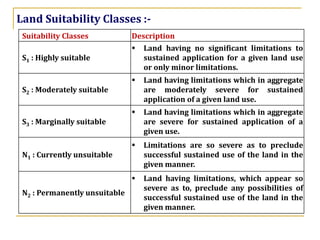
Land Suitability Classes :-
Suitability Classes Description
S1 : Highly suitable
▪ Land having no significant limitations to
sustained application for a given land use
or only minor limitations.
S2 : Moderately suitable
▪ Land having limitations which in aggregate
are moderately severe for sustained
application of a given land use.
S3 : Marginally suitable
▪ Land having limitations which in aggregate
are severe for sustained application of a
given use.
N1 : Currently unsuitable
▪ Limitations are so severe as to preclude
successful sustained use of the land in the
given manner.
N2 : Permanently unsuitable
▪ Land having limitations, which appear so
severe as to, preclude any possibilities of
successful sustained use of the land in the
given manner.
▪ The sub classes reflect kinds of limitations or main
kinds of improvement measures required within
classes.
▪ They are indicated in the symbol using lower case
letters :
Land Suitability Sub-Classes :-
c : Climatic conditions
t : Topographic limitations
w : Wetness limitations
n : Salinity(and/or alkalinity) limitations
f : Soil fertility limitations
s : Physical soil limitations
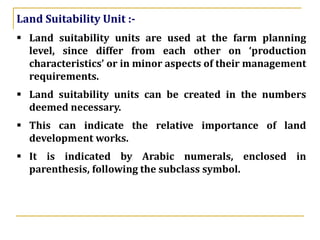
▪ Land suitability units are used at the farm planning
level, since differ from each other on ‘production
characteristics’ or in minor aspects of their management
requirements.
▪ Land suitability units can be created in the numbers
deemed necessary.
▪ This can indicate the relative importance of land
development works.
▪ It is indicated by Arabic numerals, enclosed in
parenthesis, following the subclass symbol.
Land Suitability Unit :-
Thanks
Best PDF Encryption Reviews

Land Suitability Classification

  • 1.
    Land Suitability Classification PresentedBy : Dr. R.K. Thakur Assistant Professor (Soil Science) College of Agriculture, Balaghat Jawaharlal Nehru Krishi Vishwa Vidyalaya Jabalpur (M.P.)
  • 2.
    ◼ The termssuitability and capability have often been confused or even regarded as synonymous. ◼ There is a distinction between suitability for a single clearly defined, reasonably homogenous purpose is practices, and capability for a broader use such as agriculture development. ◼ Thus, suitability assessment has a sharp focus, looking for sites possessing the positive features associated with successful production or use. ◼ Suitability is largely a matter of producing high yields with relatively low inputs. Introduction :-
  • 3.
    ▪ According tothe United Nations Food and Agriculture Organization—FAO (1976) Land suitability is the fitness of a given area for a land utilization type (or land use), or the degree to which it satisfies the land user. ▪ It is generally presented as a class or rating. ▪ Internationally recognized suitability classes outlined by FAO can be adapted and applied at both regional and local scale. ▪ Thus, land suitability classification system has four different categories : 1. Orders 2. Classes 3. Subclasses 4. Units Land Suitability Classification (LSC) :-
  • 4.
    Basic Principles ofLand Suitability :- ▪ It is assessed for specified kinds of use. ▪ Evaluation requires a comparison of benefit obtained with inputs needed. ▪ Suitability is for use on a sustained basis, i.e. the use must not bring about severe or progressive degradation. ▪ Land suitability orders, which reflect kinds of suitability. ▪ Land suitability classes, which reflect degrees of suitability within orders. ▪ Land suitability sub-classes, which reflect kinds of limitation or the main kinds of improvements required within classes. ▪ Land suitability units, which reflect minor differences within sub-classes in the required management.
  • 5.
    1. “S” -Suitable land : Land on which sustained use for the defined purpose in the defined manner is expected to yield benefits that will justify required recurrent inputs without unacceptable risk to land resources. 2. “N” - Unsuitable land : Land having characteristics which appear to preclude its sustained use for the defined purpose in the defined manner or which would create production, upkeep and/or conservation problems requiring a level of recurrent inputs unacceptable at the time of interpretation. Land Suitability Orders :-
  • 6.
    ▪ The classwill be indicated by an Arabic number in sequence of decreasing suitability within the order and therefore reflects degrees of suitability within the orders. ▪ It has been recommended to use only three classes within order “S” and two classes within order “N”. Land Suitability Classes :-
  • 7.
    Land Suitability Classes:- Suitability Classes Description S1 : Highly suitable ▪ Land having no significant limitations to sustained application for a given land use or only minor limitations. S2 : Moderately suitable ▪ Land having limitations which in aggregate are moderately severe for sustained application of a given land use. S3 : Marginally suitable ▪ Land having limitations which in aggregate are severe for sustained application of a given use. N1 : Currently unsuitable ▪ Limitations are so severe as to preclude successful sustained use of the land in the given manner. N2 : Permanently unsuitable ▪ Land having limitations, which appear so severe as to, preclude any possibilities of successful sustained use of the land in the given manner.
  • 8.
    ▪ The subclasses reflect kinds of limitations or main kinds of improvement measures required within classes. ▪ They are indicated in the symbol using lower case letters : Land Suitability Sub-Classes :- c : Climatic conditions t : Topographic limitations w : Wetness limitations n : Salinity(and/or alkalinity) limitations f : Soil fertility limitations s : Physical soil limitations
  • 9.
    ▪ Land suitabilityunits are used at the farm planning level, since differ from each other on ‘production characteristics’ or in minor aspects of their management requirements. ▪ Land suitability units can be created in the numbers deemed necessary. ▪ This can indicate the relative importance of land development works. ▪ It is indicated by Arabic numerals, enclosed in parenthesis, following the subclass symbol. Land Suitability Unit :-
  • 10.