Trobada  pedagògica: CLIL Putting CLIL into practice Dr Jon Wright [email_address]
Introductions 1 Introduce yourself to the people next to you. 2 Find out two things you have in common. 3 Who had the most active weekend?
Creative mechanism of this activity 1 It was natural 2 It necessarily involved pairs 3 You learnt about another person 4 You had a chance to talk about you 5 There was a specific outcome as a target 6 It was not demanding 7 There were different ways of doing it 8 The activity could be repeated by varying pairs
Overview: key points 1 The benefits of CLIL 2 Background to CLIL 3 How any to make any lesson a CLIL lesson 4 What CLIL teachers do 5 CLIL activities to try out in your classes 6 CLIL and EFL 7 CLIL and expectations of success 8 CLIL and the 4Cs
The key to communicative language Let’s talk about ME!
Connecting with your learners They are the experts: My world My family My hopes, fears, worries My hobbies My favourite activities My life My learning style My way of doing things My ideas
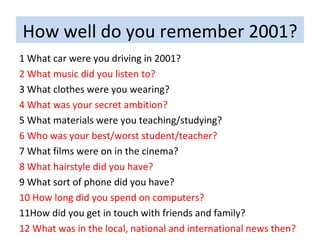
How well do you remember 2001? 1 What car were you driving in 2001? 2 What music did you listen to? 3 What clothes were you wearing? 4 What was your secret ambition? 5 What materials were you teaching/studying? 6 Who was your best/worst student/teacher? 7 What films were on in the cinema? 8 What hairstyle did you have? 9 What sort of phone did you have? 10 How long did you spend on computers? 11How did you get in touch with friends and family? 12 What was in the local, national and international news then?
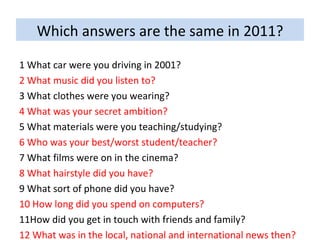
Which answers are the same in 2011? 1 What car were you driving in 2001? 2 What music did you listen to? 3 What clothes were you wearing? 4 What was your secret ambition? 5 What materials were you teaching/studying? 6 Who was your best/worst student/teacher? 7 What films were on in the cinema? 8 What hairstyle did you have? 9 What sort of phone did you have? 10 How long did you spend on computers? 11How did you get in touch with friends and family? 12 What was in the local, national and international news then?
The educational challenge: How can we  take the learners of today … …  and help form the citizens, business people and happy, well-balanced individuals of tomorrow  …  using the teaching methods of yesterday?
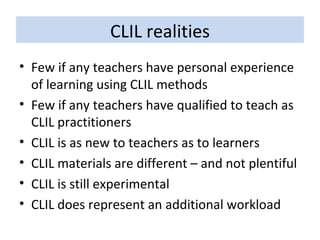
CLIL realities Few if any teachers have personal experience of learning using CLIL methods Few if any teachers have qualified to teach as CLIL practitioners CLIL is as new to teachers as to learners CLIL materials are different – and not plentiful CLIL is still experimental  CLIL does represent an additional workload
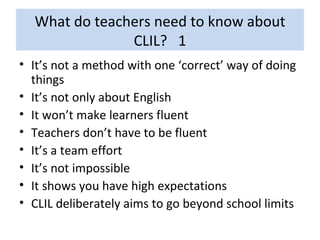
What do teachers need to know about CLIL?  1 It’s not a method with one ‘correct’ way of doing things It’s not only about English It won’t make learners fluent Teachers don’t have to be fluent It’s a team effort It’s not impossible It shows you have high expectations CLIL deliberately aims to go beyond school limits
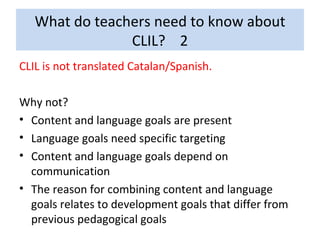
What do teachers need to know about CLIL?  2 CLIL is not translated Catalan/Spanish. Why not? Content and language goals are present Language goals need specific targeting Content and language goals depend on communication The reason for combining content and language goals relates to development goals that differ from previous pedagogical goals
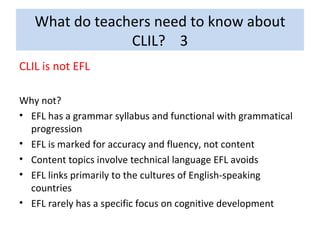
What do teachers need to know about CLIL?  3 CLIL is not EFL Why not? EFL has a grammar syllabus and functional with grammatical progression EFL is marked for accuracy and fluency, not content Content topics involve technical language EFL avoids EFL links primarily to the cultures of English-speaking countries EFL rarely has a specific focus on cognitive development
Learner benefits of CLIL Global citizens in a time of accelerating change Multiple perspectives and intercultural communication skills Enhanced range of skills for working life  Armed for life-long learning with effective strategies Problem-solving expertise Teamworkers confident of working alone
Values in the classroom “ The values we take with us into the classroom have a significant impact upon how we teach, upon our expectations of students and, in turn, upon how students respond.” Ollerton, M. (2004).  Creating Positive Classrooms . London: Continuum
Example: Copying the class rules No discussion No focus on understanding No emphasis on agreement No credit to sensible students No evidence of trust No promotion of ownership No pairwork or team effort  
CLIL Values Confidence Thinking skills Decision making Learner autonomy Open to new ideas/otherness Committed to lifelong learning Cooperative  Flexible and adaptable Good communicators Intercultural competence
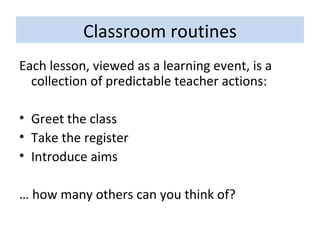
Classroom routines Each lesson, viewed as a learning event, is a collection of predictable teacher actions: Greet the class Take the register Introduce aims …  how many others can you think of?
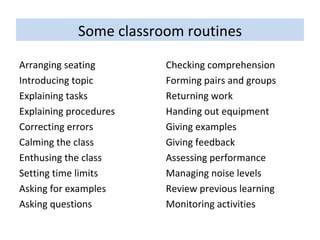
Some classroom routines Arranging seating Introducing topic Explaining tasks Explaining procedures Correcting errors Calming the class Enthusing the class Setting time limits Asking for examples Asking questions Checking comprehension Forming pairs and groups Returning work Handing out equipment Giving examples Giving feedback Assessing performance Managing noise levels Review previous learning Monitoring activities
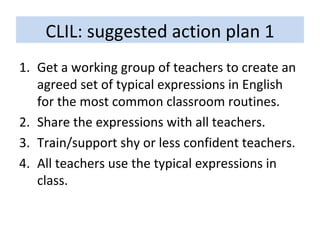
CLIL: suggested action plan 1 Get a working group of teachers to create an agreed set of typical expressions in English for the most common classroom routines. Share the expressions with all teachers. Train/support shy or less confident teachers. All teachers use the typical expressions in class.
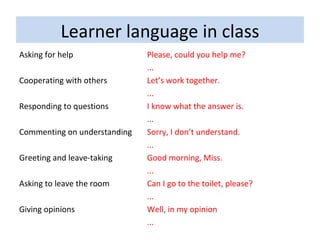
Learner language in class Asking for help  Please, could you help me?  ... Cooperating with others Let’s work together. ... Responding to questions I know what the answer is. ... Commenting on understanding Sorry, I don’t understand. ... Greeting and leave-taking Good morning, Miss. ... Asking to leave the room Can I go to the toilet, please? ... Giving opinions Well, in my opinion ...
CLIL: suggested action plan 2 Work with the learners to make an ongoing record of useful expressions for classes. Display as one or more posters Create a booklet for each learner Include in their vocabulary books
The creativity of language … Hi, I’m Jon. Call me Jon. My name’s Jon. I’m Jon. I’m Jonathan, Jon for short. People call me Jon. Hi, Jon. Jon Wright, nice to meet you. This is Dr Wright speaking…
How many ways can you express this? Elephants live in both Africa and Asia. Match the sentence parts: 1 You find elephants  a. but also in Asia.  2 Africa and Asia are both  b. in Africa and Asia.  3 There are elephants in African c. and Asian countries. 4 Elephants live not only in Africa d. home to elephants. Any others?
Fill in the gaps 1 Elephants are f... in the w... in Africa and Asia. 2 Two c... are h... to elephants, Africa and Asia. 3 The elephant has n... h...s on two continents.
Did you guess? 1 Elephants are  found  in the  wild  in Africa and Asia. 2 Two  continents  are  home  to elephants, Africa and Asia. 3 The elephant has  natural habitats  on two continents.
Exploiting texts: 1 Pre-text Start with one or more Pre-reading tasks Why? To introduce the topic To check what the learners know To motivate the learners for the task To activate their knowledge and readiness to learn To reduce any element of ‘difficulty’ To underline a positive ‘can-do’ attitude
Pre-text tasks Predictions from headings Talk about a picture Have a quiz Work with vocabulary Paired interviews Guessing games Brainstorm Discussion
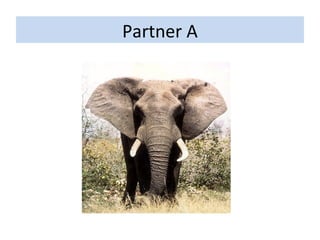
Partner A
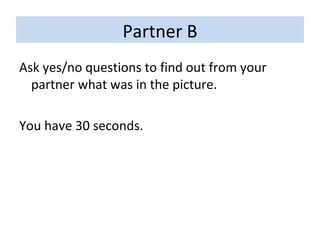
Partner B Ask yes/no questions to find out from your partner what was in the picture. You have 30 seconds.
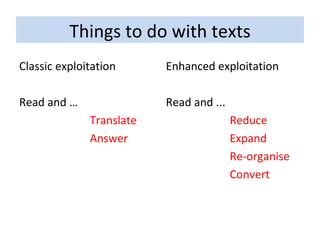
Things to do with texts Classic exploitation Read and … Translate Answer  Enhanced exploitation Read and ... Reduce Expand Re-organise Convert
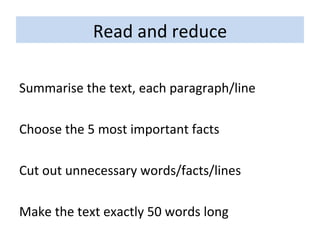
Read and reduce Summarise the text, each paragraph/line Choose the 5 most important facts Cut out unnecessary words/facts/lines Make the text exactly 50 words long
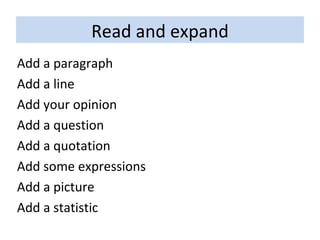
Read and expand Add a paragraph Add a line Add your opinion Add a question Add a quotation Add some expressions Add a picture Add a statistic
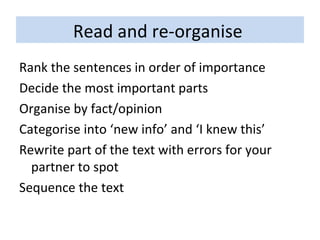
Read and re-organise  Rank the sentences in order of importance Decide the most important parts Organise by fact/opinion Categorise into ‘new info’ and ‘I knew this’ Rewrite part of the text with errors for your partner to spot Sequence the text
Read and convert Convert the text  ... into a play ... into a role-play ... into a news programme ... into a quiz ... into a poster
The Reading Model -Stimulate  –  Read  –  Process  –  Personalise  - Review
Outcomes Posters Leaflets Magazines Booklets Article Recipe Review Story Menu Cartoon Calendar Play Map Interview Dance Poem Set of rules Role play Debate Picture Instruction manual Diary
The function of outcomes Creativity as learning mechanism Increased time on task Decision-making skills Teamwork, cooperation and learning from others Opens the class to different learning preferences Enhances strategic competence Allows the teacher more time to monitor and help Can be used for evaluation Memorable
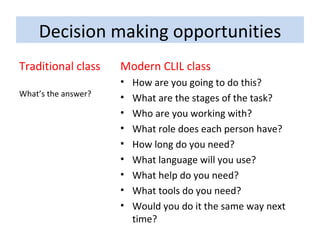
Decision making opportunities Traditional class What’s the answer? Modern CLIL class How are you going to do this? What are the stages of the task? Who are you working with? What role does each person have? How long do you need? What language will you use? What help do you need? What tools do you need? Would you do it the same way next time?
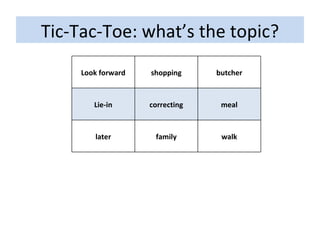
Tic-Tac-Toe: what’s the topic? Look forward shopping butcher Lie-in correcting meal later family walk
Over to you
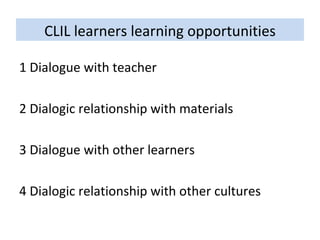
CLIL learners learning opportunities 1 Dialogue with teacher 2 Dialogic relationship with materials 3 Dialogue with other learners 4 Dialogic relationship with other cultures
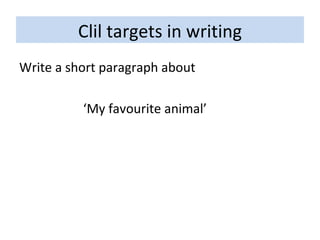
Clil targets in writing Write a short paragraph about  ‘ My favourite animal’
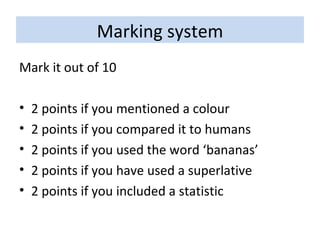
Marking system Mark it out of 10 2 points if you mentioned a colour 2 points if you compared it to humans 2 points if you used the word ‘bananas’ 2 points if you have used a superlative 2 points if you included a statistic
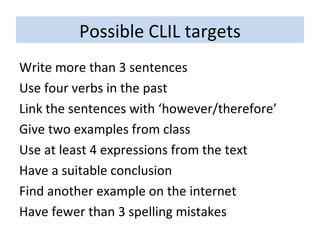
Possible CLIL targets Write more than 3 sentences Use four verbs in the past Link the sentences with ‘however/therefore’ Give two examples from class Use at least 4 expressions from the text Have a suitable conclusion Find another example on the internet Have fewer than 3 spelling mistakes
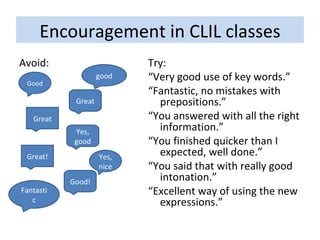
Encouragement in CLIL classes Avoid: Try: “ Very good use of key words.” “ Fantastic, no mistakes with prepositions.” “ You answered with all the right information.” “ You finished quicker than I expected, well done.” “ You said that with really good intonation.” “ Excellent way of using the new expressions.” Good good Great! Yes, nice Good! Great Yes, good Fantastic Great
The importance of encouragement Suggestions for effective encouragement: •  Use positive reinforcement to affirm good behaviour •  Be careful about praising one learner to motivate others •  Show you are pleased rather than just say so. •  Be specific •  Look for positives  For more, see: Bluestein, J. (2004). Practical Strategies for Working Successfully with Difficult students. Bellevue, WA: Bureau of Education and Research.
Writing task Work in groups of 4 Choose the topic of the booklet you will write: Elephants My favourite animals CLIL Barcelona Sport ... other
Contents: 8 pages Cover with illustration and title Contents page Pictures/diagrams Background/Overview Key facts ... And what else?
School as a language-friendly environment Signs in English Refectory with menu in English Rules in English Greetings policy Meetings - agenda Newsletter – section in English Website  Reports to parents Weather forecast Posters Marking criteria  Library has content books in English Visiting speakers Music Maps
The End Thanks for coming Thanks for listening
Dr Jon Wright Teacher Teacher trainer Lecturer  EFL author Examiner Consultant CLIL courses in  Barcelona with

CLIL_by_Jon_Wright

  • 1.
    Trobada  pedagògica: CLILPutting CLIL into practice Dr Jon Wright [email_address]
  • 2.
    Introductions 1 Introduceyourself to the people next to you. 2 Find out two things you have in common. 3 Who had the most active weekend?
  • 3.
    Creative mechanism ofthis activity 1 It was natural 2 It necessarily involved pairs 3 You learnt about another person 4 You had a chance to talk about you 5 There was a specific outcome as a target 6 It was not demanding 7 There were different ways of doing it 8 The activity could be repeated by varying pairs
  • 4.
    Overview: key points1 The benefits of CLIL 2 Background to CLIL 3 How any to make any lesson a CLIL lesson 4 What CLIL teachers do 5 CLIL activities to try out in your classes 6 CLIL and EFL 7 CLIL and expectations of success 8 CLIL and the 4Cs
  • 5.
    The key tocommunicative language Let’s talk about ME!
  • 6.
    Connecting with yourlearners They are the experts: My world My family My hopes, fears, worries My hobbies My favourite activities My life My learning style My way of doing things My ideas
  • 7.
    How well doyou remember 2001? 1 What car were you driving in 2001? 2 What music did you listen to? 3 What clothes were you wearing? 4 What was your secret ambition? 5 What materials were you teaching/studying? 6 Who was your best/worst student/teacher? 7 What films were on in the cinema? 8 What hairstyle did you have? 9 What sort of phone did you have? 10 How long did you spend on computers? 11How did you get in touch with friends and family? 12 What was in the local, national and international news then?
  • 8.
    Which answers arethe same in 2011? 1 What car were you driving in 2001? 2 What music did you listen to? 3 What clothes were you wearing? 4 What was your secret ambition? 5 What materials were you teaching/studying? 6 Who was your best/worst student/teacher? 7 What films were on in the cinema? 8 What hairstyle did you have? 9 What sort of phone did you have? 10 How long did you spend on computers? 11How did you get in touch with friends and family? 12 What was in the local, national and international news then?
  • 9.
    The educational challenge:How can we take the learners of today … … and help form the citizens, business people and happy, well-balanced individuals of tomorrow … using the teaching methods of yesterday?
  • 10.
    CLIL realities Fewif any teachers have personal experience of learning using CLIL methods Few if any teachers have qualified to teach as CLIL practitioners CLIL is as new to teachers as to learners CLIL materials are different – and not plentiful CLIL is still experimental CLIL does represent an additional workload
  • 11.
    What do teachersneed to know about CLIL? 1 It’s not a method with one ‘correct’ way of doing things It’s not only about English It won’t make learners fluent Teachers don’t have to be fluent It’s a team effort It’s not impossible It shows you have high expectations CLIL deliberately aims to go beyond school limits
  • 12.
    What do teachersneed to know about CLIL? 2 CLIL is not translated Catalan/Spanish. Why not? Content and language goals are present Language goals need specific targeting Content and language goals depend on communication The reason for combining content and language goals relates to development goals that differ from previous pedagogical goals
  • 13.
    What do teachersneed to know about CLIL? 3 CLIL is not EFL Why not? EFL has a grammar syllabus and functional with grammatical progression EFL is marked for accuracy and fluency, not content Content topics involve technical language EFL avoids EFL links primarily to the cultures of English-speaking countries EFL rarely has a specific focus on cognitive development
  • 14.
    Learner benefits ofCLIL Global citizens in a time of accelerating change Multiple perspectives and intercultural communication skills Enhanced range of skills for working life Armed for life-long learning with effective strategies Problem-solving expertise Teamworkers confident of working alone
  • 15.
    Values in theclassroom “ The values we take with us into the classroom have a significant impact upon how we teach, upon our expectations of students and, in turn, upon how students respond.” Ollerton, M. (2004). Creating Positive Classrooms . London: Continuum
  • 16.
    Example: Copying theclass rules No discussion No focus on understanding No emphasis on agreement No credit to sensible students No evidence of trust No promotion of ownership No pairwork or team effort  
  • 17.
    CLIL Values ConfidenceThinking skills Decision making Learner autonomy Open to new ideas/otherness Committed to lifelong learning Cooperative Flexible and adaptable Good communicators Intercultural competence
  • 18.
    Classroom routines Eachlesson, viewed as a learning event, is a collection of predictable teacher actions: Greet the class Take the register Introduce aims … how many others can you think of?
  • 19.
    Some classroom routinesArranging seating Introducing topic Explaining tasks Explaining procedures Correcting errors Calming the class Enthusing the class Setting time limits Asking for examples Asking questions Checking comprehension Forming pairs and groups Returning work Handing out equipment Giving examples Giving feedback Assessing performance Managing noise levels Review previous learning Monitoring activities
  • 20.
    CLIL: suggested actionplan 1 Get a working group of teachers to create an agreed set of typical expressions in English for the most common classroom routines. Share the expressions with all teachers. Train/support shy or less confident teachers. All teachers use the typical expressions in class.
  • 21.
    Learner language inclass Asking for help Please, could you help me? ... Cooperating with others Let’s work together. ... Responding to questions I know what the answer is. ... Commenting on understanding Sorry, I don’t understand. ... Greeting and leave-taking Good morning, Miss. ... Asking to leave the room Can I go to the toilet, please? ... Giving opinions Well, in my opinion ...
  • 22.
    CLIL: suggested actionplan 2 Work with the learners to make an ongoing record of useful expressions for classes. Display as one or more posters Create a booklet for each learner Include in their vocabulary books
  • 23.
    The creativity oflanguage … Hi, I’m Jon. Call me Jon. My name’s Jon. I’m Jon. I’m Jonathan, Jon for short. People call me Jon. Hi, Jon. Jon Wright, nice to meet you. This is Dr Wright speaking…
  • 24.
    How many wayscan you express this? Elephants live in both Africa and Asia. Match the sentence parts: 1 You find elephants a. but also in Asia. 2 Africa and Asia are both b. in Africa and Asia. 3 There are elephants in African c. and Asian countries. 4 Elephants live not only in Africa d. home to elephants. Any others?
  • 25.
    Fill in thegaps 1 Elephants are f... in the w... in Africa and Asia. 2 Two c... are h... to elephants, Africa and Asia. 3 The elephant has n... h...s on two continents.
  • 26.
    Did you guess?1 Elephants are found in the wild in Africa and Asia. 2 Two continents are home to elephants, Africa and Asia. 3 The elephant has natural habitats on two continents.
  • 27.
    Exploiting texts: 1Pre-text Start with one or more Pre-reading tasks Why? To introduce the topic To check what the learners know To motivate the learners for the task To activate their knowledge and readiness to learn To reduce any element of ‘difficulty’ To underline a positive ‘can-do’ attitude
  • 28.
    Pre-text tasks Predictionsfrom headings Talk about a picture Have a quiz Work with vocabulary Paired interviews Guessing games Brainstorm Discussion
  • 29.
  • 30.
    Partner B Askyes/no questions to find out from your partner what was in the picture. You have 30 seconds.
  • 31.
    Things to dowith texts Classic exploitation Read and … Translate Answer Enhanced exploitation Read and ... Reduce Expand Re-organise Convert
  • 32.
    Read and reduceSummarise the text, each paragraph/line Choose the 5 most important facts Cut out unnecessary words/facts/lines Make the text exactly 50 words long
  • 33.
    Read and expandAdd a paragraph Add a line Add your opinion Add a question Add a quotation Add some expressions Add a picture Add a statistic
  • 34.
    Read and re-organise Rank the sentences in order of importance Decide the most important parts Organise by fact/opinion Categorise into ‘new info’ and ‘I knew this’ Rewrite part of the text with errors for your partner to spot Sequence the text
  • 35.
    Read and convertConvert the text ... into a play ... into a role-play ... into a news programme ... into a quiz ... into a poster
  • 36.
    The Reading Model-Stimulate – Read – Process – Personalise - Review
  • 37.
    Outcomes Posters LeafletsMagazines Booklets Article Recipe Review Story Menu Cartoon Calendar Play Map Interview Dance Poem Set of rules Role play Debate Picture Instruction manual Diary
  • 38.
    The function ofoutcomes Creativity as learning mechanism Increased time on task Decision-making skills Teamwork, cooperation and learning from others Opens the class to different learning preferences Enhances strategic competence Allows the teacher more time to monitor and help Can be used for evaluation Memorable
  • 39.
    Decision making opportunitiesTraditional class What’s the answer? Modern CLIL class How are you going to do this? What are the stages of the task? Who are you working with? What role does each person have? How long do you need? What language will you use? What help do you need? What tools do you need? Would you do it the same way next time?
  • 40.
    Tic-Tac-Toe: what’s thetopic? Look forward shopping butcher Lie-in correcting meal later family walk
  • 41.
  • 42.
    CLIL learners learningopportunities 1 Dialogue with teacher 2 Dialogic relationship with materials 3 Dialogue with other learners 4 Dialogic relationship with other cultures
  • 43.
    Clil targets inwriting Write a short paragraph about ‘ My favourite animal’
  • 44.
    Marking system Markit out of 10 2 points if you mentioned a colour 2 points if you compared it to humans 2 points if you used the word ‘bananas’ 2 points if you have used a superlative 2 points if you included a statistic
  • 45.
    Possible CLIL targetsWrite more than 3 sentences Use four verbs in the past Link the sentences with ‘however/therefore’ Give two examples from class Use at least 4 expressions from the text Have a suitable conclusion Find another example on the internet Have fewer than 3 spelling mistakes
  • 46.
    Encouragement in CLILclasses Avoid: Try: “ Very good use of key words.” “ Fantastic, no mistakes with prepositions.” “ You answered with all the right information.” “ You finished quicker than I expected, well done.” “ You said that with really good intonation.” “ Excellent way of using the new expressions.” Good good Great! Yes, nice Good! Great Yes, good Fantastic Great
  • 47.
    The importance ofencouragement Suggestions for effective encouragement: • Use positive reinforcement to affirm good behaviour • Be careful about praising one learner to motivate others • Show you are pleased rather than just say so. • Be specific • Look for positives For more, see: Bluestein, J. (2004). Practical Strategies for Working Successfully with Difficult students. Bellevue, WA: Bureau of Education and Research.
  • 48.
    Writing task Workin groups of 4 Choose the topic of the booklet you will write: Elephants My favourite animals CLIL Barcelona Sport ... other
  • 49.
    Contents: 8 pagesCover with illustration and title Contents page Pictures/diagrams Background/Overview Key facts ... And what else?
  • 50.
    School as alanguage-friendly environment Signs in English Refectory with menu in English Rules in English Greetings policy Meetings - agenda Newsletter – section in English Website Reports to parents Weather forecast Posters Marking criteria Library has content books in English Visiting speakers Music Maps
  • 51.
    The End Thanksfor coming Thanks for listening
  • 52.
    Dr Jon WrightTeacher Teacher trainer Lecturer EFL author Examiner Consultant CLIL courses in Barcelona with