CLIL
eTwinning Learning Event
“Teaching English differently”
Marina Screpanti
Italian eTwinning Ambassador


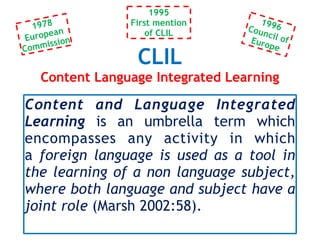
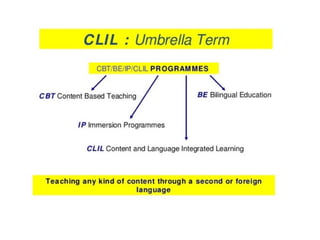
CLIL

Content Language Integrated Learning
Content and Language Integrated
Learning  is an umbrella term which
encompasses any activity in which
a  foreign language is used as a tool in
the learning of a non language subject,
where both language and subject have a
joint role (Marsh 2002:58).
1995
First mention
of CLIL
1978
European
Commission
1996Council ofEurope
European Commission :
"Content and Language Integrated Learning (CLIL), in which pupils
learn a subject through the medium of a foreign language……"
"CLIL refers to situations where subjects, or parts of subjects, are
taught through a foreign languagewith dual-focused aims, namely
the learning of content, and the simultaneous learning of a foreign
language".
"It [CLIL] provides exposure to the language without requiring
extra time in the curriculum".
"…an approach to bilingual education in which both curriculum
content (such as science or geography) and English are taught
together.  It differs from simple English-medium education in
that the learner is not necessarily expected to have the English
proficiency required to cope with the subject before beginning
study". 
Why CLIL?
CLIL can:
develop subject knowledge
increase intercultural awareness
develop FL ability
improve cognitive skills
prepare students for a wider job market
It provides exposure to language
without extra-time in the school
timetable
How many kinds of CLIL?
Different kinds of immersion: from partial to total where some,
most or all of subject content is taught through the target
language
Subject courses where curricular subjects apart from language
can be taught through the target language (specific classes with
CLIL approach)
CLIL language showers where there is a regular, short exposure to
CLIL usually in one subject area, delivered in the target language
for 15 or 30 minutes several times per week
Language classes based on thematic units with emphasis on
content
Double immersion programmes where two foreign languages plus
the mother tongue are used to teach the curriculum
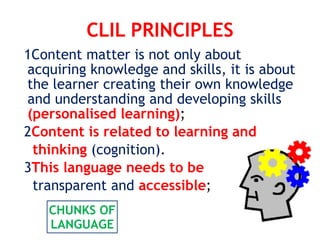
CLIL PRINCIPLES
1Content matter is not only about
acquiring knowledge and skills, it is about
the learner creating their own knowledge
and understanding and developing skills
(personalised learning);
2Content is related to learning and
thinking (cognition).
3This language needs to be
transparent and accessible;
CHUNKS OF
LANGUAGE
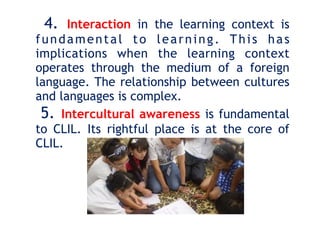
4. Interaction in the learning context is
fundamental to learning. This has
implications when the learning context
operates through the medium of a foreign
language. The relationship between cultures
and languages is complex.
5. Intercultural awareness is fundamental
to CLIL. Its rightful place is at the core of
CLIL.
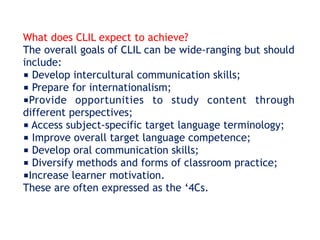
What does CLIL expect to achieve?
The overall goals of CLIL can be wide-ranging but should
include:
■ Develop intercultural communication skills;
■ Prepare for internationalism;
■Provide opportunities to study content through
different perspectives;
■ Access subject-specific target language terminology;
■ Improve overall target language competence;
■ Develop oral communication skills;
■ Diversify methods and forms of classroom practice;
■Increase learner motivation.
These are often expressed as the ‘4Cs.
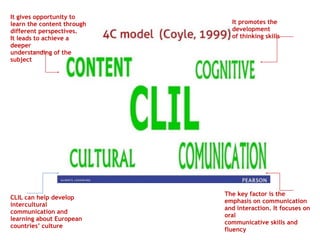
It gives opportunity to
learn the content through
different perspectives.
It leads to achieve a
deeper
understanding of the
subject
The key factor is the
emphasis on communication
and interaction. It focuses on
oral
communicative skills and
fluency
It promotes the
development
of thinking skills
CLIL can help develop
intercultural
communication and
learning about European
countries’ culture
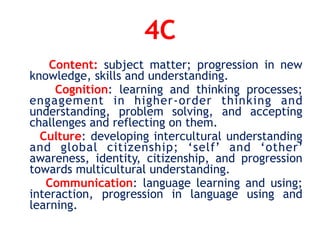
4C
Content: subject matter; progression in new
knowledge, skills and understanding.
Cognition: learning and thinking processes;
engagement in higher-order thinking and
understanding, problem solving, and accepting
challenges and reflecting on them.
Culture: developing intercultural understanding
and global citizenship; ‘self’ and ‘other’
awareness, identity, citizenship, and progression
towards multicultural understanding.
Communication: language learning and using;
interaction, progression in language using and
learning.
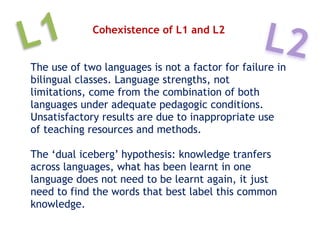
Cohexistence of L1 and L2
The use of two languages is not a factor for failure in
bilingual classes. Language strengths, not
limitations, come from the combination of both
languages under adequate pedagogic conditions.
Unsatisfactory results are due to inappropriate use
of teaching resources and methods.
The ‘dual iceberg’ hypothesis: knowledge tranfers
across languages, what has been learnt in one
language does not need to be learnt again, it just
need to find the words that best label this common
knowledge.
L1 L2
Advantages in students working
with CLIL modules
Listening and understanding, speaking,
reading;
Fluency and a large quantity of spoken
language;
Vocabulary;
Morphology;
Technical language (specific of each school
subject)
Creativity;
risk-taking;
collaborative skills;
development thinking skills (cognitional
development)
Motivation
Motivation may increase when ‘real
issues’ become the centre of study.
Learners who are interested in a
particular topic are motivated to acquire
language in order to communicate. So the
focus is not on language but there is a
huge language improvement.
Meaningful learning/
activities
Meaningful activities
Involving learners in whatever there is to
be learned seems to be the crucial point in
teaching. Learning can occur if learners are
involved in meaningful interaction with
others. The task for CLIL teachers, then, is
to enable learners to become engaged in
meaningful interaction in a foreign
language regarding topics and problems
posed by the curriculum of the subject.
TIPS
1) Always start from the pupils’ perspective (BRAINSTORMING)
2) Create opportunities for the integrated use of content and language
3) The final product must integrate language and content; it can be a
talk, a film, a poster, an interview, a mind map, a dialogue, a quiz, an
experiment etc. These products need to be seen, watched, listened to,
perceived by others, by classmates, teachers, parents or other pupils;
4) Use textbooks and texts written in the second language. These only
become too challenging if pupils do not learn how to work efficiently
with them. Specialist terms play a key role in subject texts.
5) Create opportunities for communication about the subject in the
second language in every lesson. Pupils can for example be asked to
discuss in pairs which aspects of the lesson they felt were most
important, providing arguments to support their views. This does not
take up much time, but brings major benefits. The introduction of
complicated specialist terms in a foreign language is easier when
illustrations are used.
Principles for successful and sustainable CLIL
teaching and learning (from Meyer 2010)
■ Rich input: classroom materials should be meaningful, challenging, and authentic, so
that new topics enhance motivation and link to prior knowledge. This may include
Video clips, flash-animations, web-quests, pod-casts or other interactive
materials on foreign language websites. Such materials can offer challenging tasks,
creative thinking and create opportunities for meaningful language output.
■ Scaffolding: it is a support students and enable them to accomplish a given task
through appropriate, supportive language production by providing phrases, subject-
specific vocabulary and collocations needed to complete assignments.
■ Rich interaction and pushed output: Task-Based Language Teaching (TBLT) should be
an integral part of CLIL teaching. TBLT focuses on bringing authentic communication
into the classroom. Authentic communication in tasks promotes negotiation of
meaning necessary and enables a greater depth and bandwidth of content learning.
■ Intercultural communication: students need to become aware of the hidden cultural
codes and the appropriate linguistic and non-linguistic means and strategies to
address them.
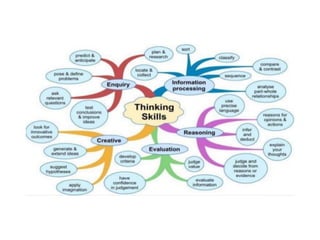
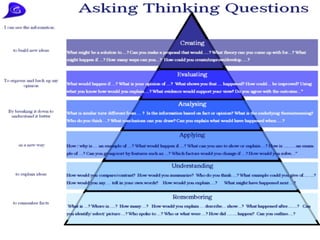
■Thinking skills: the intersection of content, cognition and language, the ability to
express complex thought processes appropriately. Cognitive skills are crucial and
systematic language work is of paramount importance when teaching thinking.
Students need to be shown how to express their thoughts in an increasingly complex
manner.
REALLY IMPORTANT !!!
Put in the right order: taxonomy game
http://en.educaplay.com/en/learningresources/
2284041/unscramble_taxonomy.htm
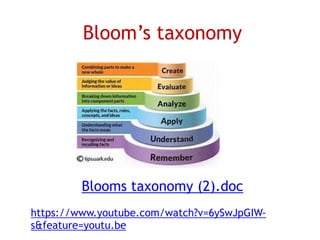
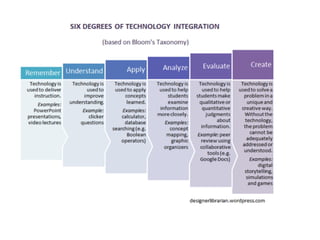
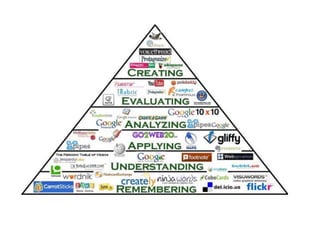
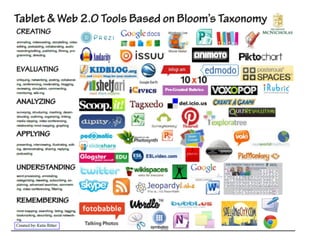
Bloom’s taxonomy
Blooms taxonomy (2).doc
https://www.youtube.com/watch?v=6ySwJpGIW-
s&feature=youtu.be
http://farr-integratingit.net/Theory/CriticalThinking/revisedcog-creating.htm
types of thinking.pdf
Table of cognitive skills-1.pdf
Thinking skills_UVIC-1.pdf
https://www.youtube.com/watch?v=GvWZtiSfuo8
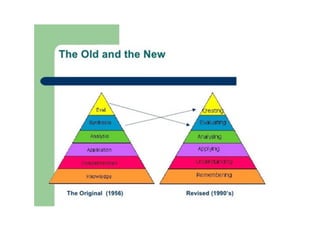
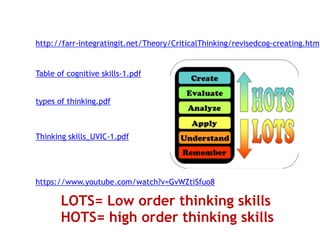
LOTS= Low order thinking skills
HOTS= high order thinking skills
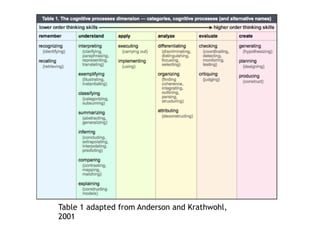
Table 1 adapted from Anderson and Krathwohl,
2001
WHAT HAPPENS IN NORMAL FL
LESSONS?
Generally, in the normal FL lessons there
is insufficient exposition to the language.
Very often, in these lessons, the language
the children are exposed to is composed
precisely of the language items that are
to be. Thus the children are exposed to
language objectives rather than to
naturally-occurring language
What is LEARNING?
Learning is an active process of making
sense.
The starting point of playing CLIL is to see
learning as an active mental process of
making sense of the world. Learning aims
for understanding, for giving meaning to
experience. There are infinitely numerous
ways of experiencing the world and giving
meaning to it (e.g. from various
perspectives or affective states)
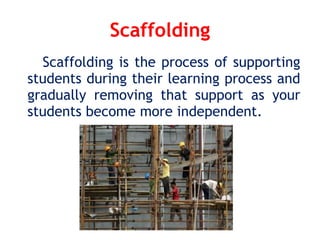
Scaffolding
Scaffolding is the process of supporting
students during their learning process and
gradually removing that support as your
students become more independent.
Scaffolding
Language and Learning
You can scaffold both the language as well as
the learning process of students.
Scaffolding a language can be done by
providing language frames or example
sentences (CHUNKS OF LANGUAGE)
Scaffolding learning can be done by
providing the step by step instructions for
the task ahead. This can also be an example
exercise
Language of learning/language for
learning/ Language through learning
Language of learning: It is the type of language that learners
have to acquire in order to be able to access the new
knowledge that is going to be introduced through the specific
content of the subject. It is language specific to the subject,
so it can be related to the genre. For instance, a CLIL lesson of
History would include terms and vocabulary related to houses,
clothes, customs, etc., together with descriptions and
generalizations and the use of, for example, the past tense.
Language for learning: It is the language that learners will
need to use during the lessons, so that they can develop and
do the tasks and activities efficiently. It is related to the
classroom language. This type of language would include a vast
number of examples.
Language through learning: It is the kind of language that
cannot be planned in advance and which will ‘emerge’ through
the learning process.
Resources and materials for CLIL lessons in the web
iTunes
You tube
Teacher tube: http://www.teachertube.com/
Teachers TV: http://www.teachers.tv/
Learning English (BBC): http://www.bbc.co.uk/worldservice/
learningenglish/
Learn English (British Council): http://
learnenglish.britishcouncil.org/en/
English central: http://www.englishcentral.com/watch
Voxy: http://voxy.com/
Yappr: http://es.englishyappr.com/welcome/VideoList.action
Ted subtitles: http://www.ted.com/translate/languages/spa
Scoop.it: http://www.scoop.it/clil%20resources
Lesson planning has to take into account the
following aspects:
• choice of a subject content or a portion of it appropriate for the
age and included in the school curriculum;
• examination of children’s language proficiency and cognitive
skills required to deal with the content;
• consideration of children’s learning styles and multiple
intelligences;
• definition of content objectives in terms of what children will
learn or do;
• definition of language objectives in terms of receptive and
productive skills, academic language, functional language;
• choice of strategies to activate children’s background
experiences and prior learning (see “tuning in” activities in the
planning format);
• choice of appropriate activities aimed to facilitate language and
content learning, organise knowledge, develop higher-order
thinking skills (observe, recognize, locate, identify, collect,
distinguish, categorize, select, construct, etc.) and apply
knowledge to new;
• choice of outcomes
Tools for planning a CLIL
module/lesson
http://learningdesigner.org/
Lesson plan samples
http://www.onestopenglish.com/clil/
http://www.teachingenglish.org.uk/
teaching-kids/resources/clil
http://multidict.net/clilstore/
Some references
• Coyle, D., Hood, P., Marsh, D., (2010), CLIL: Content and Language Integrated
Learning, Cambridge University Press, Cambridge.
• Coonan C.M., (2014), I principi base di CLIL, I Quaderni della Ricerca. Fare CLIL -
Strumenti per un insegnamento integrato di lingua e di disciplina nella scuola
secondaria, Torino, Loescher Editore.
• Marsh, D., Wolff, D., (2007), Diverse contexts – Converging goals, CLIL in Europe,
Peter Lang, Francoforte.
• Marsh, D., Mehisto, P., Wolff, D., Frigols, M. J.. (2010), European Framework for
CLIL Teacher Education: A framework for the professional development of CLIL
teachers, European Centre for Modern Languages, Graz.
• Marsh, D. (2013), The CLIL Trajectory: Educational Innovation for the 21st century
iGeneration, University of Cordoba.
• Mehisto, P., Marsh, D., Frigols, M.J., (2008), Uncovering CLIL, Macmillan.
• Serragiotto G., (2014), Dalle microlingue disciplinari al CLIL, Torino, UTET.
• Bentley, K., (2010), The TKT Course – CLIL Module, Cambridge University Press.
• Dale L., Tanner R., (2012), CLIL Activities. A resource for subject and language
teachers, Cambridge University Press.
• Last modified: Monday, 23 November 2015, 4:09 AM

CLIL_TEACHINGENGLISGDIFFERENTLY_SCREPANTI_MARINA

  • 1.
    CLIL eTwinning Learning Event “TeachingEnglish differently” Marina Screpanti Italian eTwinning Ambassador
  • 2.
    
 CLIL
 Content Language IntegratedLearning Content and Language Integrated Learning  is an umbrella term which encompasses any activity in which a  foreign language is used as a tool in the learning of a non language subject, where both language and subject have a joint role (Marsh 2002:58). 1995 First mention of CLIL 1978 European Commission 1996Council ofEurope
  • 3.
    European Commission : "Contentand Language Integrated Learning (CLIL), in which pupils learn a subject through the medium of a foreign language……" "CLIL refers to situations where subjects, or parts of subjects, are taught through a foreign languagewith dual-focused aims, namely the learning of content, and the simultaneous learning of a foreign language". "It [CLIL] provides exposure to the language without requiring extra time in the curriculum". "…an approach to bilingual education in which both curriculum content (such as science or geography) and English are taught together.  It differs from simple English-medium education in that the learner is not necessarily expected to have the English proficiency required to cope with the subject before beginning study". 
  • 5.
    Why CLIL? CLIL can: developsubject knowledge increase intercultural awareness develop FL ability improve cognitive skills prepare students for a wider job market It provides exposure to language without extra-time in the school timetable
  • 6.
    How many kindsof CLIL? Different kinds of immersion: from partial to total where some, most or all of subject content is taught through the target language Subject courses where curricular subjects apart from language can be taught through the target language (specific classes with CLIL approach) CLIL language showers where there is a regular, short exposure to CLIL usually in one subject area, delivered in the target language for 15 or 30 minutes several times per week Language classes based on thematic units with emphasis on content Double immersion programmes where two foreign languages plus the mother tongue are used to teach the curriculum
  • 7.
    CLIL PRINCIPLES 1Content matteris not only about acquiring knowledge and skills, it is about the learner creating their own knowledge and understanding and developing skills (personalised learning); 2Content is related to learning and thinking (cognition). 3This language needs to be transparent and accessible; CHUNKS OF LANGUAGE
  • 8.
    4. Interaction inthe learning context is fundamental to learning. This has implications when the learning context operates through the medium of a foreign language. The relationship between cultures and languages is complex. 5. Intercultural awareness is fundamental to CLIL. Its rightful place is at the core of CLIL.
  • 9.
    What does CLILexpect to achieve? The overall goals of CLIL can be wide-ranging but should include: ■ Develop intercultural communication skills; ■ Prepare for internationalism; ■Provide opportunities to study content through different perspectives; ■ Access subject-specific target language terminology; ■ Improve overall target language competence; ■ Develop oral communication skills; ■ Diversify methods and forms of classroom practice; ■Increase learner motivation. These are often expressed as the ‘4Cs.
  • 10.
    It gives opportunityto learn the content through different perspectives. It leads to achieve a deeper understanding of the subject The key factor is the emphasis on communication and interaction. It focuses on oral communicative skills and fluency It promotes the development of thinking skills CLIL can help develop intercultural communication and learning about European countries’ culture
  • 11.
    4C Content: subject matter;progression in new knowledge, skills and understanding. Cognition: learning and thinking processes; engagement in higher-order thinking and understanding, problem solving, and accepting challenges and reflecting on them. Culture: developing intercultural understanding and global citizenship; ‘self’ and ‘other’ awareness, identity, citizenship, and progression towards multicultural understanding. Communication: language learning and using; interaction, progression in language using and learning.
  • 12.
    Cohexistence of L1and L2 The use of two languages is not a factor for failure in bilingual classes. Language strengths, not limitations, come from the combination of both languages under adequate pedagogic conditions. Unsatisfactory results are due to inappropriate use of teaching resources and methods. The ‘dual iceberg’ hypothesis: knowledge tranfers across languages, what has been learnt in one language does not need to be learnt again, it just need to find the words that best label this common knowledge. L1 L2
  • 13.
    Advantages in studentsworking with CLIL modules Listening and understanding, speaking, reading; Fluency and a large quantity of spoken language; Vocabulary; Morphology; Technical language (specific of each school subject) Creativity; risk-taking; collaborative skills; development thinking skills (cognitional development)
  • 14.
    Motivation Motivation may increasewhen ‘real issues’ become the centre of study. Learners who are interested in a particular topic are motivated to acquire language in order to communicate. So the focus is not on language but there is a huge language improvement. Meaningful learning/ activities
  • 15.
    Meaningful activities Involving learnersin whatever there is to be learned seems to be the crucial point in teaching. Learning can occur if learners are involved in meaningful interaction with others. The task for CLIL teachers, then, is to enable learners to become engaged in meaningful interaction in a foreign language regarding topics and problems posed by the curriculum of the subject.
  • 16.
    TIPS 1) Always startfrom the pupils’ perspective (BRAINSTORMING) 2) Create opportunities for the integrated use of content and language 3) The final product must integrate language and content; it can be a talk, a film, a poster, an interview, a mind map, a dialogue, a quiz, an experiment etc. These products need to be seen, watched, listened to, perceived by others, by classmates, teachers, parents or other pupils; 4) Use textbooks and texts written in the second language. These only become too challenging if pupils do not learn how to work efficiently with them. Specialist terms play a key role in subject texts. 5) Create opportunities for communication about the subject in the second language in every lesson. Pupils can for example be asked to discuss in pairs which aspects of the lesson they felt were most important, providing arguments to support their views. This does not take up much time, but brings major benefits. The introduction of complicated specialist terms in a foreign language is easier when illustrations are used.
  • 17.
    Principles for successfuland sustainable CLIL teaching and learning (from Meyer 2010) ■ Rich input: classroom materials should be meaningful, challenging, and authentic, so that new topics enhance motivation and link to prior knowledge. This may include Video clips, flash-animations, web-quests, pod-casts or other interactive materials on foreign language websites. Such materials can offer challenging tasks, creative thinking and create opportunities for meaningful language output. ■ Scaffolding: it is a support students and enable them to accomplish a given task through appropriate, supportive language production by providing phrases, subject- specific vocabulary and collocations needed to complete assignments. ■ Rich interaction and pushed output: Task-Based Language Teaching (TBLT) should be an integral part of CLIL teaching. TBLT focuses on bringing authentic communication into the classroom. Authentic communication in tasks promotes negotiation of meaning necessary and enables a greater depth and bandwidth of content learning. ■ Intercultural communication: students need to become aware of the hidden cultural codes and the appropriate linguistic and non-linguistic means and strategies to address them. ■Thinking skills: the intersection of content, cognition and language, the ability to express complex thought processes appropriately. Cognitive skills are crucial and systematic language work is of paramount importance when teaching thinking. Students need to be shown how to express their thoughts in an increasingly complex manner. REALLY IMPORTANT !!!
  • 18.
    Put in theright order: taxonomy game http://en.educaplay.com/en/learningresources/ 2284041/unscramble_taxonomy.htm
  • 19.
    Bloom’s taxonomy Blooms taxonomy(2).doc https://www.youtube.com/watch?v=6ySwJpGIW- s&feature=youtu.be
  • 21.
    http://farr-integratingit.net/Theory/CriticalThinking/revisedcog-creating.htm types of thinking.pdf Tableof cognitive skills-1.pdf Thinking skills_UVIC-1.pdf https://www.youtube.com/watch?v=GvWZtiSfuo8 LOTS= Low order thinking skills HOTS= high order thinking skills
  • 23.
    Table 1 adaptedfrom Anderson and Krathwohl, 2001
  • 26.
    WHAT HAPPENS INNORMAL FL LESSONS? Generally, in the normal FL lessons there is insufficient exposition to the language. Very often, in these lessons, the language the children are exposed to is composed precisely of the language items that are to be. Thus the children are exposed to language objectives rather than to naturally-occurring language
  • 27.
    What is LEARNING? Learningis an active process of making sense. The starting point of playing CLIL is to see learning as an active mental process of making sense of the world. Learning aims for understanding, for giving meaning to experience. There are infinitely numerous ways of experiencing the world and giving meaning to it (e.g. from various perspectives or affective states)
  • 30.
    Scaffolding Scaffolding is theprocess of supporting students during their learning process and gradually removing that support as your students become more independent.
  • 31.
    Scaffolding Language and Learning Youcan scaffold both the language as well as the learning process of students. Scaffolding a language can be done by providing language frames or example sentences (CHUNKS OF LANGUAGE) Scaffolding learning can be done by providing the step by step instructions for the task ahead. This can also be an example exercise
  • 32.
    Language of learning/languagefor learning/ Language through learning Language of learning: It is the type of language that learners have to acquire in order to be able to access the new knowledge that is going to be introduced through the specific content of the subject. It is language specific to the subject, so it can be related to the genre. For instance, a CLIL lesson of History would include terms and vocabulary related to houses, clothes, customs, etc., together with descriptions and generalizations and the use of, for example, the past tense. Language for learning: It is the language that learners will need to use during the lessons, so that they can develop and do the tasks and activities efficiently. It is related to the classroom language. This type of language would include a vast number of examples. Language through learning: It is the kind of language that cannot be planned in advance and which will ‘emerge’ through the learning process.
  • 33.
    Resources and materialsfor CLIL lessons in the web iTunes You tube Teacher tube: http://www.teachertube.com/ Teachers TV: http://www.teachers.tv/ Learning English (BBC): http://www.bbc.co.uk/worldservice/ learningenglish/ Learn English (British Council): http:// learnenglish.britishcouncil.org/en/ English central: http://www.englishcentral.com/watch Voxy: http://voxy.com/ Yappr: http://es.englishyappr.com/welcome/VideoList.action Ted subtitles: http://www.ted.com/translate/languages/spa Scoop.it: http://www.scoop.it/clil%20resources
  • 34.
    Lesson planning hasto take into account the following aspects: • choice of a subject content or a portion of it appropriate for the age and included in the school curriculum; • examination of children’s language proficiency and cognitive skills required to deal with the content; • consideration of children’s learning styles and multiple intelligences; • definition of content objectives in terms of what children will learn or do; • definition of language objectives in terms of receptive and productive skills, academic language, functional language; • choice of strategies to activate children’s background experiences and prior learning (see “tuning in” activities in the planning format); • choice of appropriate activities aimed to facilitate language and content learning, organise knowledge, develop higher-order thinking skills (observe, recognize, locate, identify, collect, distinguish, categorize, select, construct, etc.) and apply knowledge to new; • choice of outcomes
  • 36.
    Tools for planninga CLIL module/lesson http://learningdesigner.org/
  • 37.
  • 38.
    Some references • Coyle,D., Hood, P., Marsh, D., (2010), CLIL: Content and Language Integrated Learning, Cambridge University Press, Cambridge. • Coonan C.M., (2014), I principi base di CLIL, I Quaderni della Ricerca. Fare CLIL - Strumenti per un insegnamento integrato di lingua e di disciplina nella scuola secondaria, Torino, Loescher Editore. • Marsh, D., Wolff, D., (2007), Diverse contexts – Converging goals, CLIL in Europe, Peter Lang, Francoforte. • Marsh, D., Mehisto, P., Wolff, D., Frigols, M. J.. (2010), European Framework for CLIL Teacher Education: A framework for the professional development of CLIL teachers, European Centre for Modern Languages, Graz. • Marsh, D. (2013), The CLIL Trajectory: Educational Innovation for the 21st century iGeneration, University of Cordoba. • Mehisto, P., Marsh, D., Frigols, M.J., (2008), Uncovering CLIL, Macmillan. • Serragiotto G., (2014), Dalle microlingue disciplinari al CLIL, Torino, UTET. • Bentley, K., (2010), The TKT Course – CLIL Module, Cambridge University Press. • Dale L., Tanner R., (2012), CLIL Activities. A resource for subject and language teachers, Cambridge University Press. • Last modified: Monday, 23 November 2015, 4:09 AM