
NA1 2009 Teacher: Inma Garín
General  Linguistic Range B2 Can express himself/herself clearly and without much sign of having to restrict  what s/he wants to say. B2 has a sufficient range of language to be able to give clear descriptions, express viewpoints and develop arguments without much conspicuous searching for words, using some complex sentence forms to do so.
General objectives Reflect on the way the English language works in its formal aspects at communication level, and use this reflection as an element which favours the students’ own productions.  Use autonomous foreign language learning strategies –worked out from previous experience of the languages students already know-, and from reflection about their own learning processes (language learner’s diary).   To produce oral and written messages in English, appropriate to the different communicative situations, using different strategies which allow a satisfactory communication.
Specific objectives Know how to express oneself in formal and informal situations. Narrate events. Describe people and places. Use communicative strategies of interaction. Use learning tools.
Content (B2a CEFR) ‏ Language processing: listening and reading Language production: speaking and writing Vocabulary and idiomatic expressions Metalinguistic awareness: Grammar Pronunciation, stress and intonation. Pragmatics: discourse, sociolinguistics, etc.
Topics People: Life and Style (Paris fashion week) ‏ Health: children obesity Nature: Environment (climate change) ‏ Education: language learning, drop-outs Work: finding a job, early retirement Leisure: travelling, sports Art : museums, cinema, music. Places: countries, nationalities.  The Media: Politics and the media Social Issues: age of criminal responsibility. The Future: what will financial crisis mean?
Methodology Integration of  the different components of linguistic and communicative learning Attention to students’ diversity The classroom as a place for authentic communication Social Interaction as the best way to learn a foreign language Metalinguistic awareness as the best way to foster  language production
Evaluation Learning process Class attendance and attitude Oral and written production (portfolio) Tests (reading and listening comprehension)
Materials Face to Face Upper Intermediate Student’s Book Workbook English Vocabulary in Use (self-study), CUP Grammar for First Certificate Self Study Pack Book with Answers and audio CD, Louise Hashemi and Barbara Thomas, CUP. http://inmagarin.blogspot.com/  (class blog)
Building the group Names and presentations. My name’s…. I’m from… I’m a secretary. I work at… I started studying English….I always enjoy…. I think that I’ve…
Speaking. (Groups of 3).  Tell your partners  3 things about your family Something about your job The best holiday you’ve ever had Your hobbies The best book you’ve ever read 3 things about your hometown The last film you’ve seen 3 things you dislike What you like doing at the weekend Something you can do well
Listening How do you feel about listening to English? What do you know about listening to English? How well are you doing? What do you need to do next? How do you prefer to paractise your listening? Do you need to build up your confidence? How do you organise your listening practice?
What kind of language learner are you? Discuss (groups of 3) Learning a language is frustrating. When I speak English I feel tongue-tied. Learning a language in class involves listening to the teacher, practising in pairs… Language learning is like learning to ride a bike, play the piano, words in a play… The best way to learn English is speaking as much as possible, learning grammar rules…
Thinking about groups Discuss (groups of 3) ‏ What groups have you been a member of? (colleagues, family…) ‏ Did you have a good/bad experience as member of these groups? Think about the good groups. Did they have anything in common? What did they give you? Think about the group you are in now. What do you think  they will be able to give you? What can you offer them? What might you have to give up?
Class records (find out) Find out how many times people in your group have flown in a plane. …  have been in hospital. … have travelled on board a ship. …  have been to a concert. …  have been to a play. … how many countries peope in your group have visited. … have had pets. …  h ave changed jobs.
Language L e arner’s Diary Definition: A learner’s/teacher’s diary is an account of a second language experience as recorded in a first-person-journal. The central characteristic is that it is introspective: the diarist studies his/her own teaching or learning. S/he can report on affective factors, language learning strategies and his/her own perceptions, facets of the language learning experience which are normally hidden or largely innacessible to an external observer.
Why? It promotes learner autonomy It makes you aware of what type of learner you are (your preferences) ‏ It makes you think of ways to become more independent It helps you think how well you are doing and what areas need more work It helps you to keep up your motivation To know if you benefited from the lesson and record your reasons why or why not . To ask for help from the teacher and ask her additional techniques to suit your style . When? After every lesson so that sentiments about the lesson can be recorded .
Student and Teacher’s roles What prior experiences have you had? How have you learned other languages? What differences are there between children and adults? Have you done pairwork and group work before?   What are the benefits? What is the teacher’s role? Facilitator, organizer, etc.
El M EC R  (Marco Europeo Común de Referencia)  (2001) The Common European Framework provides a Common basis for the elaboration of language syllabuses,  currículo  guidelines, examinations, textbooks, etc. across Europe. It describes what language learners have to learn to do in order to use a language for communication and what knowledge and skills they have to develop so as to be able to act effectively. The description also covers the cultural context in which language is set. The Framework also defines levels of proficiency which allow learners’ progress to be measured at each stage of learning and on a life-long basis. Language competence is broken down into separate components. Communication calls upon the whole human being. As a social agent, each individual forms relationships with a widening cluster of overlapping social groups, which together define identity. In an intercultural approach, it is a central objective of language education to promote the favourable development of the learner’s whole personality and sense of identity in response to the enriching experience of otherness in language and culture.
Common European Framework http://www.coe.int/T/DG4/Portfolio/documents/Common%20European%20Framework%20hyperlinked.pdf
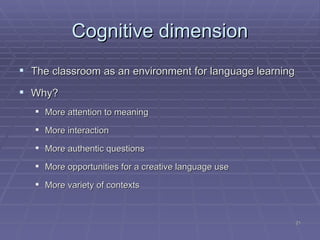
Cognitive dimension The classroom as an environment for language learning Why? More attention to meaning More interaction More authentic questions More opportunities for a creative language use More variety of contexts
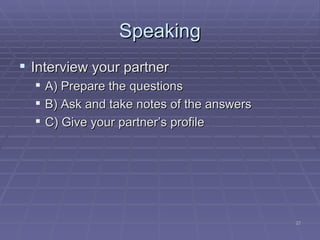
Speaking Interview your partner A) Prepare the questions B) Ask and take notes of the answers C) Give your partner’s profile
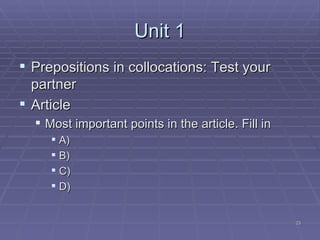
Unit 1 Prepositions in collocations: Test your partner Article Most important points in the article. Fill in A) ‏ B) ‏ C) ‏ D) ‏
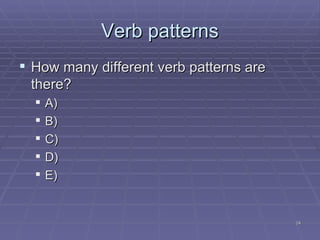
Verb patterns How many different verb patterns are there? A) ‏ B) ‏ C) ‏ D) ‏ E) ‏
Speaking Do you like exams? Why? When… Where were you… What… Make questions and follow up answers Summarize the conversation
Grammar Revision of the English Verb System State Activity verbs Tenses Simple Perfect Progressive/ Continuous Modal verbs Auxiliaries Other modal verbs
Speaking Prepare a conversation Practise it Interpret it
Article Discuss the main ideas A) ‏ B) ‏ C) ‏ D) ‏ Summarize the article in a single sentence
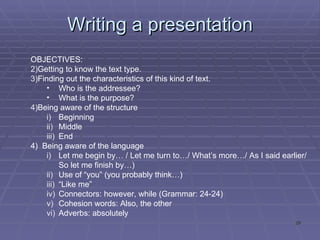
Writing a presentation OBJECTIVES: Getting to know the text type. Finding out the characteristics of this kind of text. Who is the addressee? What is the purpose? Being aware of the structure Beginning Middle End 4)  Being aware of the language Let me begin by… / Let me turn to…/ What’s more…/ As I said earlier/ So let me finish by…) Use of “you” (you probably think…) “ Like me” Connectors: however, while (Grammar: 24-24) Cohesion words: Also, the other Adverbs: absolutely

A1 2009

  • 1.
    NA1 2009 Teacher:Inma Garín
  • 2.
    General LinguisticRange B2 Can express himself/herself clearly and without much sign of having to restrict what s/he wants to say. B2 has a sufficient range of language to be able to give clear descriptions, express viewpoints and develop arguments without much conspicuous searching for words, using some complex sentence forms to do so.
  • 3.
    General objectives Reflecton the way the English language works in its formal aspects at communication level, and use this reflection as an element which favours the students’ own productions. Use autonomous foreign language learning strategies –worked out from previous experience of the languages students already know-, and from reflection about their own learning processes (language learner’s diary). To produce oral and written messages in English, appropriate to the different communicative situations, using different strategies which allow a satisfactory communication.
  • 4.
    Specific objectives Knowhow to express oneself in formal and informal situations. Narrate events. Describe people and places. Use communicative strategies of interaction. Use learning tools.
  • 5.
    Content (B2a CEFR)‏ Language processing: listening and reading Language production: speaking and writing Vocabulary and idiomatic expressions Metalinguistic awareness: Grammar Pronunciation, stress and intonation. Pragmatics: discourse, sociolinguistics, etc.
  • 6.
    Topics People: Lifeand Style (Paris fashion week) ‏ Health: children obesity Nature: Environment (climate change) ‏ Education: language learning, drop-outs Work: finding a job, early retirement Leisure: travelling, sports Art : museums, cinema, music. Places: countries, nationalities. The Media: Politics and the media Social Issues: age of criminal responsibility. The Future: what will financial crisis mean?
  • 7.
    Methodology Integration of the different components of linguistic and communicative learning Attention to students’ diversity The classroom as a place for authentic communication Social Interaction as the best way to learn a foreign language Metalinguistic awareness as the best way to foster language production
  • 8.
    Evaluation Learning processClass attendance and attitude Oral and written production (portfolio) Tests (reading and listening comprehension)
  • 9.
    Materials Face toFace Upper Intermediate Student’s Book Workbook English Vocabulary in Use (self-study), CUP Grammar for First Certificate Self Study Pack Book with Answers and audio CD, Louise Hashemi and Barbara Thomas, CUP. http://inmagarin.blogspot.com/ (class blog)
  • 10.
    Building the groupNames and presentations. My name’s…. I’m from… I’m a secretary. I work at… I started studying English….I always enjoy…. I think that I’ve…
  • 11.
    Speaking. (Groups of3). Tell your partners 3 things about your family Something about your job The best holiday you’ve ever had Your hobbies The best book you’ve ever read 3 things about your hometown The last film you’ve seen 3 things you dislike What you like doing at the weekend Something you can do well
  • 12.
    Listening How doyou feel about listening to English? What do you know about listening to English? How well are you doing? What do you need to do next? How do you prefer to paractise your listening? Do you need to build up your confidence? How do you organise your listening practice?
  • 13.
    What kind oflanguage learner are you? Discuss (groups of 3) Learning a language is frustrating. When I speak English I feel tongue-tied. Learning a language in class involves listening to the teacher, practising in pairs… Language learning is like learning to ride a bike, play the piano, words in a play… The best way to learn English is speaking as much as possible, learning grammar rules…
  • 14.
    Thinking about groupsDiscuss (groups of 3) ‏ What groups have you been a member of? (colleagues, family…) ‏ Did you have a good/bad experience as member of these groups? Think about the good groups. Did they have anything in common? What did they give you? Think about the group you are in now. What do you think they will be able to give you? What can you offer them? What might you have to give up?
  • 15.
    Class records (findout) Find out how many times people in your group have flown in a plane. … have been in hospital. … have travelled on board a ship. … have been to a concert. … have been to a play. … how many countries peope in your group have visited. … have had pets. … h ave changed jobs.
  • 16.
    Language L earner’s Diary Definition: A learner’s/teacher’s diary is an account of a second language experience as recorded in a first-person-journal. The central characteristic is that it is introspective: the diarist studies his/her own teaching or learning. S/he can report on affective factors, language learning strategies and his/her own perceptions, facets of the language learning experience which are normally hidden or largely innacessible to an external observer.
  • 17.
    Why? It promoteslearner autonomy It makes you aware of what type of learner you are (your preferences) ‏ It makes you think of ways to become more independent It helps you think how well you are doing and what areas need more work It helps you to keep up your motivation To know if you benefited from the lesson and record your reasons why or why not . To ask for help from the teacher and ask her additional techniques to suit your style . When? After every lesson so that sentiments about the lesson can be recorded .
  • 18.
    Student and Teacher’sroles What prior experiences have you had? How have you learned other languages? What differences are there between children and adults? Have you done pairwork and group work before? What are the benefits? What is the teacher’s role? Facilitator, organizer, etc.
  • 19.
    El M ECR (Marco Europeo Común de Referencia) (2001) The Common European Framework provides a Common basis for the elaboration of language syllabuses, currículo guidelines, examinations, textbooks, etc. across Europe. It describes what language learners have to learn to do in order to use a language for communication and what knowledge and skills they have to develop so as to be able to act effectively. The description also covers the cultural context in which language is set. The Framework also defines levels of proficiency which allow learners’ progress to be measured at each stage of learning and on a life-long basis. Language competence is broken down into separate components. Communication calls upon the whole human being. As a social agent, each individual forms relationships with a widening cluster of overlapping social groups, which together define identity. In an intercultural approach, it is a central objective of language education to promote the favourable development of the learner’s whole personality and sense of identity in response to the enriching experience of otherness in language and culture.
  • 20.
    Common European Frameworkhttp://www.coe.int/T/DG4/Portfolio/documents/Common%20European%20Framework%20hyperlinked.pdf
  • 21.
    Cognitive dimension Theclassroom as an environment for language learning Why? More attention to meaning More interaction More authentic questions More opportunities for a creative language use More variety of contexts
  • 22.
    Speaking Interview yourpartner A) Prepare the questions B) Ask and take notes of the answers C) Give your partner’s profile
  • 23.
    Unit 1 Prepositionsin collocations: Test your partner Article Most important points in the article. Fill in A) ‏ B) ‏ C) ‏ D) ‏
  • 24.
    Verb patterns Howmany different verb patterns are there? A) ‏ B) ‏ C) ‏ D) ‏ E) ‏
  • 25.
    Speaking Do youlike exams? Why? When… Where were you… What… Make questions and follow up answers Summarize the conversation
  • 26.
    Grammar Revision ofthe English Verb System State Activity verbs Tenses Simple Perfect Progressive/ Continuous Modal verbs Auxiliaries Other modal verbs
  • 27.
    Speaking Prepare aconversation Practise it Interpret it
  • 28.
    Article Discuss themain ideas A) ‏ B) ‏ C) ‏ D) ‏ Summarize the article in a single sentence
  • 29.
    Writing a presentationOBJECTIVES: Getting to know the text type. Finding out the characteristics of this kind of text. Who is the addressee? What is the purpose? Being aware of the structure Beginning Middle End 4) Being aware of the language Let me begin by… / Let me turn to…/ What’s more…/ As I said earlier/ So let me finish by…) Use of “you” (you probably think…) “ Like me” Connectors: however, while (Grammar: 24-24) Cohesion words: Also, the other Adverbs: absolutely

Editor's Notes

  • #8 Traditional methods understand that memorizing rules from a grammar book affords applying these rules and that applying the rules results in better language use. Interaction theory, on the other hand, considers learning as a product of social interaction. Learning is the result of internalizing knowledge that has been built in collaboration in contextualized social activities in cultural environments. Building linguistic knowledge is a process from the social to the individual, from that which is unconscious to that which is conscious.