Content and Language
Integrated Learning:
Methodological Orientations
for a Better Practice

(Core elements of CLIL)


                            Dr. Javier Barbero Andrés
                      Dr. Jesús Ángel González López
                                     Dpto. de Filología
Why CLIL?
 Social   and historical
 requirements.
 Institutional   requirements (a
 new University ahead…)
 Scientific   requirements
 (English as a lingua franca)
DEFINITION
CLIL is a dual-focused teaching
and learning approach in which
the L1 and an additional language
or two are used for promoting
both content mastery and
language acquisition to pre-
defined levels
                   (Peeter Mehisto)
TYPES OF CLIL


SoftCLIL.
Hard CLIL.
WHAT SHOULD WE DO IN CLASS?

    We only teach the language that the
students need for the content of the lesson –
 and this may be PHRASES and words rather
      than complete grammar patterns.

        THE 4 Cs of CLIL =
   CONTENT + COMMUNICATION +
      COGNITION + CULTURE
REQUIREMENTS
•Teachers need a good level of the
language.
•Teacher training required.
•Group working (students AND
teachers)
•Methodology (especially
assessment and testing) has to be
coherent with CLIL teaching.
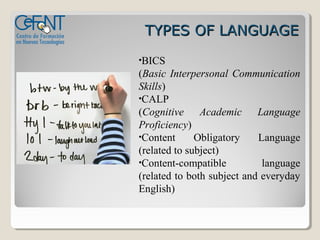
TYPES OF LANGUAGE
•BICS
(Basic Interpersonal Communication
Skills)
•CALP
(Cognitive Academic Language
Proficiency)
•Content      Obligatory    Language
(related to subject)
•Content-compatible          language
(related to both subject and everyday
English)
GRAMMAR AND CLIL
(just a few examples…)

 Present Continuous
  (Chemistry / Physics)
 Present Simple (Music /
  Geography)
 Passive Voice (History /
  Science)
 Past Tenses (History)
LANGUAGE FOR A PURPOSE
(FUNCTIONS AND TASKS REQUIRED…)
         Giving opinions.
         Describing processes.
         Agreeing and disagreeing.
         Punctuation conventions.
         Defining.
         Generalizing.
         Explaining, demonstrating,
          identifying…
         Hypothesizing,
          experiments…
         Timelines.
         Visual organizers.
GENRE AND CLIL
 CLIL  genres are things like
 encyclopaedia entries,
 letters, poems, reports,
 scientific descriptions, oral
 presentations, newspaper
 articles, discursive essays,
 etc.

A particular genre requires a
 register (formality +
 adaptation to subject) + a
 particular layout + coherence.
HELPING STUDENTS
         TO UNDERSTAND AND PRODUCE
                     GENRE FEATURES

 What is the purpose of the text?
 Where does it come from?
 How is the subject / name of the entry presented?
 How are the subjects´s dates given (and where)?
 What information is given in the first paragraph?
 What order are the events in the entry presented in?
 What time adverbials are used?
 How and why are brackets (or whatever) used in…?
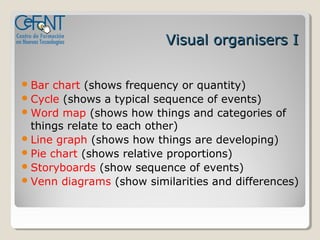
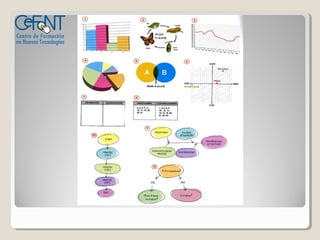
Visual organisers I

 Bar chart (shows frequency or quantity)
 Cycle (shows a typical sequence of events)
 Word map (shows how things and categories of
  things relate to each other)
 Line graph (shows how things are developing)
 Pie chart (shows relative proportions)
 Storyboards (show sequence of events)
 Venn diagrams (show similarities and differences)
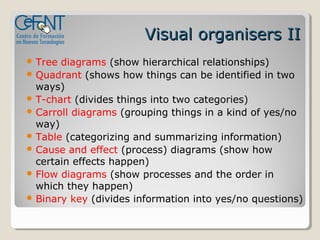
Visual organisers II
 Tree diagrams (show hierarchical relationships)
 Quadrant (shows how things can be identified in two
  ways)
 T-chart (divides things into two categories)
 Carroll diagrams (grouping things in a kind of yes/no
  way)
 Table (categorizing and summarizing information)
 Cause and effect (process) diagrams (show how
  certain effects happen)
 Flow diagrams (show processes and the order in
  which they happen)
 Binary key (divides information into yes/no questions)
CLIL RESOURCES
 Encyclopedias,   dictionaries, coursebooks, stories,
  content-specific books…
 Materials such as paper, cardboard, pens, glue
  and scissors, models, charts, displays, realia…
 Texts, illustrations, visual organizers, audio and
  video…
 IWB
 The key is to use a range of different resources to
  explain particular concepts.
 The internet, apps, CD, DVD, research…
THE TEACHER´S
                                   RESPONSABILITIES

 Enhancing     cooperation.
 Pairwork,    groupwork, scaffolding, support and feedback.
 Activating   students´ prior knowledge.
 L1   is welcome if there´s a particular content which is not
  understood (communication blocking)
 Students    need “wait time” as answers cannot be
  delivered instantly (they´re facing complex tasks)
PROBLEMS?
PROBLEMS?

1.   Teachers’ level of L2. Language specialists or content
     specialists?
2.   Coherent system. Extensive exposure to L2.
3.   Material production
4.   Methodology: how do you teach students who lack
     language knowledge?
5.   Assessment : how do you assess students who don’t
     know enough about the language? Do you penalize
     them for language mistakes?
6.   Money: All of this costs a lot of money
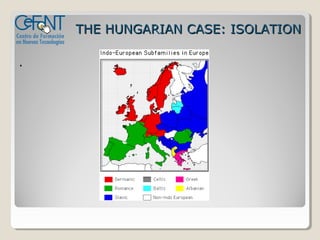
THE HUNGARIAN CASE: ISOLATION

.
THE HUNGARIAN SOLUTION

         1.Teachers’ level of L2.
Language specialists or content specialists?

  They demand two degrees. They offer ongoing
 training at University level. Teachers involved in
        CLIL programs receive a 15% bonus
THE HUNGARIAN SOLUTION
2. Coherent system. Extensive exposure to L2
 Primary Education:
    5 hours a week in L2 classes + 3 CLIL subjects. The subjects vary
    according to the year (1st year: Music, Drawing, Physical Education;
    8th year: History, Science and English Culture)
   Secondary Education:
    Preparatory year (for students not coming from a bilingual program):
    20 hours a week to L2. The rest (10 hours): Preparatory CLIL
    Regular Secondary: 5 hours a week in L2, 3 subjects minimum of
    CLIL subjects
   Minimum Requirements for a school to use the term
    “Bilingual”:
    30 % of CLIL subjects and a high number of CLIL teachers with
    double qualification. Classes split in two in CLIL classes.
THE HUNGARIAN SOLUTION


            3. Material production

Still open, hard work for the teachers, but getting
                 better every year…
THE HUNGARIAN SOLUTION

    4. Methodology: how do you teach students
           who lack language knowledge?

    An extension of methodology used in language classes:
-    Communicative approach
-    Active participation of students
-    Variable size of groups
-    Student-centered activities
-    Emphasis on lexis
THE HUNGARIAN SOLUTION

5. Assessment : how do you assess students
       who don’t know enough about the
      language? Do you penalize them for
             language mistakes?

Still open. Priority of content over language. No
  demonization of L1 (the system is so complete
      that this doesn’t jeopardize the results).
THE HUNGARIAN SOLUTION

   6. Money: All of this costs a lot of money

It is expensive. But the results
are excellent (B2 after primary,
C1 after secondary)

Public and free, but segregated.
Our Project:
Development of
Guides and
Resources for CLIL
at University
                     -Bibliography and Reviews
                     -Interviews with Secondary
                     School CLIL Teachers in
                     Cantabria
                     -Methodological Decalogue
                     -Lesson Plans
Qualitative Research.
The Long Interview. The method can take us into the
                     mental world of the individual:
                       •to glimpse the categories and
                       logic by which he or she sees
                       the world.
                       •to see the content and pattern
                       of daily experience.
                       •to step into the mind of
                       another person,
                       •to see and experience the
                       world as they do themselves
                                   (Grant McCracken)
Check out our blog!
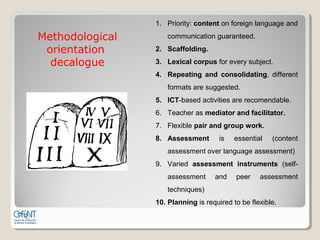
1. Priority: content on foreign language and

Methodological      communication guaranteed.

 orientation     2. Scaffolding.

  decalogue      3. Lexical corpus for every subject.
                 4. Repeating and consolidating, different
                    formats are suggested.
                 5. ICT-based activities are recomendable.
                 6. Teacher as mediator and facilitator.
                 7. Flexible pair and group work.
                 8. Assessment        is   essential   (content
                    assessment over language assessment)
                 9. Varied assessment instruments (self-
                    assessment      and    peer    assessment
                    techniques)
                 10. Planning is required to be flexible.
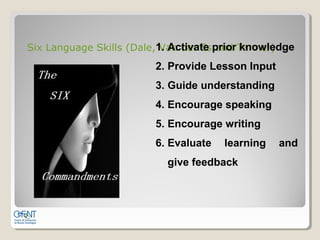
Six Language Skills (Dale,1. Activate prior Tanner)
                           Van der Es and knowledge
                        2. Provide Lesson Input
                        3. Guide understanding
                        4. Encourage speaking
                        5. Encourage writing
                        6. Evaluate   learning    and
                          give feedback

3 core elements clil

  • 1.
    Content and Language IntegratedLearning: Methodological Orientations for a Better Practice (Core elements of CLIL) Dr. Javier Barbero Andrés Dr. Jesús Ángel González López Dpto. de Filología
  • 2.
    Why CLIL?  Social and historical requirements.  Institutional requirements (a new University ahead…)  Scientific requirements (English as a lingua franca)
  • 3.
    DEFINITION CLIL is adual-focused teaching and learning approach in which the L1 and an additional language or two are used for promoting both content mastery and language acquisition to pre- defined levels (Peeter Mehisto)
  • 4.
  • 5.
    WHAT SHOULD WEDO IN CLASS? We only teach the language that the students need for the content of the lesson – and this may be PHRASES and words rather than complete grammar patterns. THE 4 Cs of CLIL = CONTENT + COMMUNICATION + COGNITION + CULTURE
  • 6.
    REQUIREMENTS •Teachers need agood level of the language. •Teacher training required. •Group working (students AND teachers) •Methodology (especially assessment and testing) has to be coherent with CLIL teaching.
  • 7.
    TYPES OF LANGUAGE •BICS (BasicInterpersonal Communication Skills) •CALP (Cognitive Academic Language Proficiency) •Content Obligatory Language (related to subject) •Content-compatible language (related to both subject and everyday English)
  • 8.
    GRAMMAR AND CLIL (justa few examples…) Present Continuous (Chemistry / Physics) Present Simple (Music / Geography) Passive Voice (History / Science) Past Tenses (History)
  • 9.
    LANGUAGE FOR APURPOSE (FUNCTIONS AND TASKS REQUIRED…) Giving opinions. Describing processes. Agreeing and disagreeing. Punctuation conventions. Defining. Generalizing. Explaining, demonstrating, identifying… Hypothesizing, experiments… Timelines. Visual organizers.
  • 10.
    GENRE AND CLIL CLIL genres are things like encyclopaedia entries, letters, poems, reports, scientific descriptions, oral presentations, newspaper articles, discursive essays, etc. A particular genre requires a register (formality + adaptation to subject) + a particular layout + coherence.
  • 11.
    HELPING STUDENTS TO UNDERSTAND AND PRODUCE GENRE FEATURES  What is the purpose of the text?  Where does it come from?  How is the subject / name of the entry presented?  How are the subjects´s dates given (and where)?  What information is given in the first paragraph?  What order are the events in the entry presented in?  What time adverbials are used?  How and why are brackets (or whatever) used in…?
  • 12.
    Visual organisers I Bar chart (shows frequency or quantity)  Cycle (shows a typical sequence of events)  Word map (shows how things and categories of things relate to each other)  Line graph (shows how things are developing)  Pie chart (shows relative proportions)  Storyboards (show sequence of events)  Venn diagrams (show similarities and differences)
  • 13.
    Visual organisers II Tree diagrams (show hierarchical relationships)  Quadrant (shows how things can be identified in two ways)  T-chart (divides things into two categories)  Carroll diagrams (grouping things in a kind of yes/no way)  Table (categorizing and summarizing information)  Cause and effect (process) diagrams (show how certain effects happen)  Flow diagrams (show processes and the order in which they happen)  Binary key (divides information into yes/no questions)
  • 15.
    CLIL RESOURCES  Encyclopedias, dictionaries, coursebooks, stories, content-specific books…  Materials such as paper, cardboard, pens, glue and scissors, models, charts, displays, realia…  Texts, illustrations, visual organizers, audio and video…  IWB  The key is to use a range of different resources to explain particular concepts.  The internet, apps, CD, DVD, research…
  • 16.
    THE TEACHER´S RESPONSABILITIES  Enhancing cooperation.  Pairwork, groupwork, scaffolding, support and feedback.  Activating students´ prior knowledge.  L1 is welcome if there´s a particular content which is not understood (communication blocking)  Students need “wait time” as answers cannot be delivered instantly (they´re facing complex tasks)
  • 17.
  • 18.
    PROBLEMS? 1. Teachers’ level of L2. Language specialists or content specialists? 2. Coherent system. Extensive exposure to L2. 3. Material production 4. Methodology: how do you teach students who lack language knowledge? 5. Assessment : how do you assess students who don’t know enough about the language? Do you penalize them for language mistakes? 6. Money: All of this costs a lot of money
  • 19.
  • 20.
    THE HUNGARIAN SOLUTION 1.Teachers’ level of L2. Language specialists or content specialists? They demand two degrees. They offer ongoing training at University level. Teachers involved in CLIL programs receive a 15% bonus
  • 21.
    THE HUNGARIAN SOLUTION 2.Coherent system. Extensive exposure to L2  Primary Education: 5 hours a week in L2 classes + 3 CLIL subjects. The subjects vary according to the year (1st year: Music, Drawing, Physical Education; 8th year: History, Science and English Culture)  Secondary Education: Preparatory year (for students not coming from a bilingual program): 20 hours a week to L2. The rest (10 hours): Preparatory CLIL Regular Secondary: 5 hours a week in L2, 3 subjects minimum of CLIL subjects  Minimum Requirements for a school to use the term “Bilingual”: 30 % of CLIL subjects and a high number of CLIL teachers with double qualification. Classes split in two in CLIL classes.
  • 22.
    THE HUNGARIAN SOLUTION 3. Material production Still open, hard work for the teachers, but getting better every year…
  • 23.
    THE HUNGARIAN SOLUTION 4. Methodology: how do you teach students who lack language knowledge? An extension of methodology used in language classes: - Communicative approach - Active participation of students - Variable size of groups - Student-centered activities - Emphasis on lexis
  • 24.
    THE HUNGARIAN SOLUTION 5.Assessment : how do you assess students who don’t know enough about the language? Do you penalize them for language mistakes? Still open. Priority of content over language. No demonization of L1 (the system is so complete that this doesn’t jeopardize the results).
  • 25.
    THE HUNGARIAN SOLUTION 6. Money: All of this costs a lot of money It is expensive. But the results are excellent (B2 after primary, C1 after secondary) Public and free, but segregated.
  • 26.
    Our Project: Development of Guidesand Resources for CLIL at University -Bibliography and Reviews -Interviews with Secondary School CLIL Teachers in Cantabria -Methodological Decalogue -Lesson Plans
  • 27.
    Qualitative Research. The LongInterview. The method can take us into the mental world of the individual: •to glimpse the categories and logic by which he or she sees the world. •to see the content and pattern of daily experience. •to step into the mind of another person, •to see and experience the world as they do themselves (Grant McCracken)
  • 28.
  • 29.
    1. Priority: contenton foreign language and Methodological communication guaranteed. orientation 2. Scaffolding. decalogue 3. Lexical corpus for every subject. 4. Repeating and consolidating, different formats are suggested. 5. ICT-based activities are recomendable. 6. Teacher as mediator and facilitator. 7. Flexible pair and group work. 8. Assessment is essential (content assessment over language assessment) 9. Varied assessment instruments (self- assessment and peer assessment techniques) 10. Planning is required to be flexible.
  • 30.
    Six Language Skills(Dale,1. Activate prior Tanner) Van der Es and knowledge 2. Provide Lesson Input 3. Guide understanding 4. Encourage speaking 5. Encourage writing 6. Evaluate learning and give feedback