Classroom Procedures
   and Transitions
   By: Susan Douglas and
     Mallory Friedman
Classroom Procedures
• Procedures for the classroom should be
  established the first week of school.
• Schedule and rules should be clearly displayed.
• The teacher and students should understand the
  procedures of the class.
• Transitions are an integral part of the classroom
  procedures.
• Each part of the day should have a set procedure,
  the most important thing to remember is
  consistency.
Transitions in the classroom

• Most profoundly, try to bridge a
  transition with a developmentally
  appropriate and meaningful song,
  game, or learning activity.
• Find any excuse to weave in an
  academic twist to every transition.
Transition Times
•   Morning arrival into the classroom
•   Gathering for circle or meeting time
•   Cleaning up
•   Lining up to go to different places
•   Settling down for rest (Kindergarten)
•   Changing groups or activities
•   Getting student’s attention
•   Waiting
•   Ending the school day
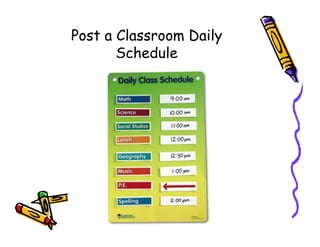
Post a Classroom Daily
       Schedule
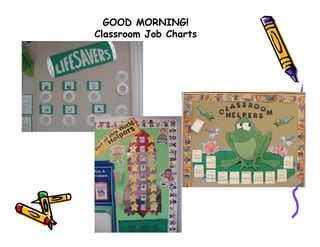
GOOD MORNING!
Classroom Job Charts
Other Classroom Helper
            Ideas
• Kings, Queens and Helpers - select a King (boy)
  and a Queen (girl) each day. Provide the students
  with a special decorated royal crown. (younger
  students)

• Helper Can – Creatively decorate a big aluminum
  can. Place each child’s name on a star die cut in
  the can and call upon a special helper requests
  throughout the day. Store the used names in an
  envelope and repeat the process when all the
  names have been used.
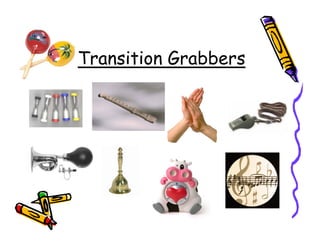
Transition Grabbers
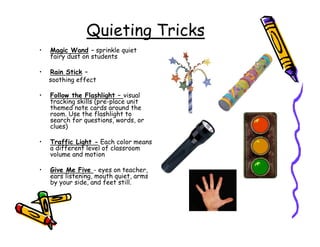
Quieting Tricks
•   Magic Wand – sprinkle quiet
    fairy dust on students

•   Rain Stick –
    soothing effect

•   Follow the Flashlight – visual
    tracking skills (pre-place unit
    themed note cards around the
    room. Use the flashlight to
    search for questions, words, or
    clues)

•   Traffic Light - Each color means
    a different level of classroom
    volume and motion

•   Give Me Five - eyes on teacher,
    ears listening, mouth quiet, arms
    by your side, and feet still.
More Transition Ideas

• Silent Math -During the times your entire class is lined up
  and waiting, have one child start by using fingers and hand
  signals to give math problems. (Example: Hold up one finger
  (1), then make a plus sign (+), then two fingers (1+2). Lastly,
  put one hand above the other facing in opposite directions
  for the equal sign(=).) If a student wants to answer, he/she
  must raise their hand to be called on. They must give the
  answer using fingers and hand signals.

• Lining Up Ideas – Have students line in alphabetical order,
  in sequence of their birthdays, have the students spell or
  define vocabulary words while lining up, spell a spelling word,
  by height, by colors, or patterns, etc.
More Transition Ideas
•   Marvelous Microphone – Pre-make out of a cardboard roll, aluminum foil,
    black tissue paper and glue. This could used as an attention grabber or
    used when students would like to speak during circle/meeting time.

•   Sensory Starters – Before kicking off a lesson give students a clue of
    what they’ll be learning about by creatively appealing to one or several of
    the senses – smell, hear, taste, touch, and sight.

•   Picture Talk- Collect a series of different pictures or postcards that are
    related to a learning unit – ex: places, animals, people from other cultures,
    homes, seasons, etc. Use the pictures as a tool to create math word
    problems, as writing prompts, to ask open-ended questions, or as a visual
    memory game, etc.

•   Pass the Parcel – Cover a small box in brown paper. It is played like hot
    potato. It could be used as a lesson summarizer - when the music or
    counting stops that student has to say a fact that they learned about in
    the learning unit, ask a question about the unit, or answer a question.

•   Create a classroom “Happy Box” – decorate several shoe boxes with
    contact paper/wrapping paper/or fabric. Fill it with a variety of themed
    materials. These materials should correlate with your specific learning unit.
    Rotate the materials out for each unit and add to items every few weeks.
    This could be a filler for students who finish an activity early.
End of the Day
• Make an effort to have a structured daily closure activity
  that is geared for your grade level.

•   Collectively read a poem –
    Ex: “Love grows, One by one, Two by two, And four by four. Love
    grows, Round and round, And comes right back to your door.”
•   Sing a Goodbye Song –
     Ex: “The more we get together,
    Together, together,
    The more we get together
    The happier we’ll be.
     For your friends are my friends,
    And my friends are your friends.
    The more we get together,
    The happier we’ll be.”
Tips and Tricks
• Be prepared, transitions should be thought out and
  made part of the lesson.
• Establish and maintain daily routine.
• Tell students your expectations.
• Try to eliminate as much wait time as possible.
• Make sure enjoyable activities follow a less motivating
  one.
• Don’t give too many verbal directions at one time.
• Give students a task to complete while they wait. For
  example counting, spelling, or guessing activities while
  waiting in line.
• Be sure to have back up plans in sticky situations.
Resources
• www.atozteacherstuff.com
• Every Teacher’s Guide to Classroom
  Management by Alice Terry
• www.ilovethatteachingidea.com
• Transition Time – Let’s Do Something
  Different by: Jean Feldman

Classroom Transitions

  • 1.
    Classroom Procedures and Transitions By: Susan Douglas and Mallory Friedman
  • 2.
    Classroom Procedures • Proceduresfor the classroom should be established the first week of school. • Schedule and rules should be clearly displayed. • The teacher and students should understand the procedures of the class. • Transitions are an integral part of the classroom procedures. • Each part of the day should have a set procedure, the most important thing to remember is consistency.
  • 3.
    Transitions in theclassroom • Most profoundly, try to bridge a transition with a developmentally appropriate and meaningful song, game, or learning activity. • Find any excuse to weave in an academic twist to every transition.
  • 4.
    Transition Times • Morning arrival into the classroom • Gathering for circle or meeting time • Cleaning up • Lining up to go to different places • Settling down for rest (Kindergarten) • Changing groups or activities • Getting student’s attention • Waiting • Ending the school day
  • 5.
    Post a ClassroomDaily Schedule
  • 6.
  • 7.
    Other Classroom Helper Ideas • Kings, Queens and Helpers - select a King (boy) and a Queen (girl) each day. Provide the students with a special decorated royal crown. (younger students) • Helper Can – Creatively decorate a big aluminum can. Place each child’s name on a star die cut in the can and call upon a special helper requests throughout the day. Store the used names in an envelope and repeat the process when all the names have been used.
  • 8.
  • 9.
    Quieting Tricks • Magic Wand – sprinkle quiet fairy dust on students • Rain Stick – soothing effect • Follow the Flashlight – visual tracking skills (pre-place unit themed note cards around the room. Use the flashlight to search for questions, words, or clues) • Traffic Light - Each color means a different level of classroom volume and motion • Give Me Five - eyes on teacher, ears listening, mouth quiet, arms by your side, and feet still.
  • 10.
    More Transition Ideas •Silent Math -During the times your entire class is lined up and waiting, have one child start by using fingers and hand signals to give math problems. (Example: Hold up one finger (1), then make a plus sign (+), then two fingers (1+2). Lastly, put one hand above the other facing in opposite directions for the equal sign(=).) If a student wants to answer, he/she must raise their hand to be called on. They must give the answer using fingers and hand signals. • Lining Up Ideas – Have students line in alphabetical order, in sequence of their birthdays, have the students spell or define vocabulary words while lining up, spell a spelling word, by height, by colors, or patterns, etc.
  • 11.
    More Transition Ideas • Marvelous Microphone – Pre-make out of a cardboard roll, aluminum foil, black tissue paper and glue. This could used as an attention grabber or used when students would like to speak during circle/meeting time. • Sensory Starters – Before kicking off a lesson give students a clue of what they’ll be learning about by creatively appealing to one or several of the senses – smell, hear, taste, touch, and sight. • Picture Talk- Collect a series of different pictures or postcards that are related to a learning unit – ex: places, animals, people from other cultures, homes, seasons, etc. Use the pictures as a tool to create math word problems, as writing prompts, to ask open-ended questions, or as a visual memory game, etc. • Pass the Parcel – Cover a small box in brown paper. It is played like hot potato. It could be used as a lesson summarizer - when the music or counting stops that student has to say a fact that they learned about in the learning unit, ask a question about the unit, or answer a question. • Create a classroom “Happy Box” – decorate several shoe boxes with contact paper/wrapping paper/or fabric. Fill it with a variety of themed materials. These materials should correlate with your specific learning unit. Rotate the materials out for each unit and add to items every few weeks. This could be a filler for students who finish an activity early.
  • 12.
    End of theDay • Make an effort to have a structured daily closure activity that is geared for your grade level. • Collectively read a poem – Ex: “Love grows, One by one, Two by two, And four by four. Love grows, Round and round, And comes right back to your door.” • Sing a Goodbye Song – Ex: “The more we get together, Together, together, The more we get together The happier we’ll be. For your friends are my friends, And my friends are your friends. The more we get together, The happier we’ll be.”
  • 13.
    Tips and Tricks •Be prepared, transitions should be thought out and made part of the lesson. • Establish and maintain daily routine. • Tell students your expectations. • Try to eliminate as much wait time as possible. • Make sure enjoyable activities follow a less motivating one. • Don’t give too many verbal directions at one time. • Give students a task to complete while they wait. For example counting, spelling, or guessing activities while waiting in line. • Be sure to have back up plans in sticky situations.
  • 14.
    Resources • www.atozteacherstuff.com • EveryTeacher’s Guide to Classroom Management by Alice Terry • www.ilovethatteachingidea.com • Transition Time – Let’s Do Something Different by: Jean Feldman