




SOLVING CLASSROOM PROBLEMS: IN BETTER WORDS, how to be a teacher and avoid high blood pressure
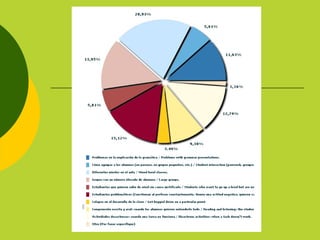
Presentation of the questionnaire Problems with grammar presentations. Student interaction (pairwork, groupwork, etc.) Mixed level classes. Large groups. Students who want to go up a level but are not strong enough to do so. Problem students (question everything the teacher does, negative about everything, want to know it all, etc.) Get bogged down on a particular point. Reading and listening: the students want to understand everything. Disastrous activities: when a task doesn't work. Others
 
Questionnaire results These are the most common issues that you have raised in your comments from in the questionnaire we sent you .
Mixed level class. Differences between younger students and older students. Different rhythms among students (for example in the time taken to complete an activity). Bad levelling from the beginning of the course or those students who scrape levels. Different skills in different areas (for example, students who are fluent but don’t have accuracy vs. students who are strong in grammar but weak orally). Frustration vs. Boredom for some students
Problem students: Students who arrive late and disrupt the lesson. Students who don’t do the homework which is necessary for the following lesson. Students who create a bad atmosphere: Troublemakers, with negative attitude, who question the teacher.  Arrogant students.  Students who don’t want to work in groups.  Students who constantly use L1.  Students who speak to their friends while the teacher or other students are speaking. Students who think they should be in a higher level when they shouldn’t. Students who ask questions that are not relevant to the teaching point. Students who want to know more than they should know at their level.
Large groups Students who are lost in large groups. Difficulty in identifying individual learner problems. Difficulty in identifying individual learner problems. Problems with grouping students (nationalities, age, abilities, etc.). Teacher getting lost in the crowd.
TYPICAL PROBLEMATIC UAB GROUP FROM THE ENGLISH DEPARTMENT 16 students  4 younger students (17-22), most students between 30 and 40 and 3 older students (over 50) Level B1.2 (CEF) The younger students are very strong in grammar, therefore finish grammar activities quickly and easily. However, they’re very lazy in speaking  The older students are weak on grammar and nervous with speaking activities therefore they do need some special attention One student thinks the level’s too low for him Some of the older students feel the level is too high or the pace is too fast One student questions everything and gets everybody involved
1 .  MIXED LEVEL CLASS
Case 1 You’re doing a pairwork activity and three pairs finish quickly  while the rest are still coming to terms with the task. The  difference in rhythm can frustrate certain students, or even bore  some of them. What can we do in this case? Choose the  solution you think most adequate: a Let the fast students relax a little while the others catch up b Set a series of spare activities handy for early finishers c. Give them an activity that is directly directed to the previous one (explanation, summary, story, etc.) that they then have to present to the class, so that the rest don’t feel they’re missing something d Have a conversation with the early finishers e Others
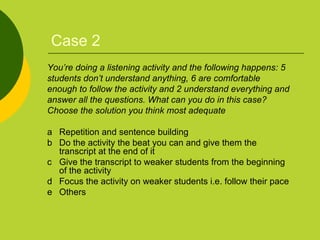
Case 2 You’re doing a listening activity and the following happens: 5  students don’t understand anything, 6 are comfortable enough to follow the activity and 2 understand everything and  answer all the questions. What can you do in this case? Choose the solution you think most adequate a Repetition and sentence building  b Do the activity the beat you can and give them the transcript at the end of it c Give the transcript to weaker students from the beginning of the activity d Focus the activity on weaker students i.e. follow their pace e Others
2. PROBLEMATIC STUDENTS
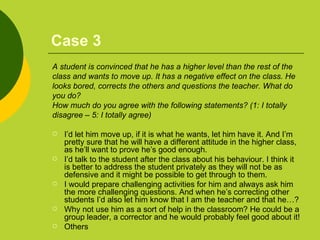
Case 3 A student is convinced that he has a higher level than the rest of the class and wants to move up. It has a negative effect on the class. He  looks bored, corrects the others and questions the teacher. What do  you do? How much do you agree with the following statements? (1: I totally disagree – 5: I totally agree) I’d let him move up, if it is what he wants, let him have it. And I’m pretty sure that he will have a different attitude in the higher class, as he’ll want to prove he’s good enough. I’d talk to the student after the class about his behaviour. I think it is better to address the student privately as they will not be as defensive and it might be possible to get through to them. I would prepare challenging activities for him and always ask him the more challenging questions. And when he’s correcting other students I’d also let him know that I am the teacher and that he…? Why not use him as a sort of help in the classroom? He could be a group leader, a corrector and he would probably feel good about it! Others
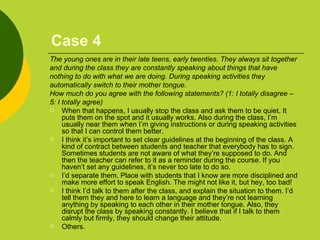
Case 4 The young ones are in their late teens, early twenties. They always sit together and during the class they are constantly speaking about things that have  nothing to do with what we are doing. During speaking activities they  automatically switch to their mother tongue. How much do you agree with the following statements? (1: I totally disagree –  5: I totally agree) When that happens, I usually stop the class and ask them to be quiet. It puts them on the spot and it usually works. Also during the class, I’m usually near them when I’m giving instructions or during speaking activities so that I can control them better. I think it’s important to set clear guidelines at the beginning of the class. A kind of contract between students and teacher that everybody has to sign. Sometimes students are not aware of what they’re supposed to do. And then the teacher can refer to it as a reminder during the course. If you haven’t set any guidelines, it’s never too late to do so. I’d separate them. Place with students that I know are more disciplined and make more effort to speak English. The might not like it, but hey, too bad! I think I’d talk to them after the class, and explain the situation to them. I’d tell them they and here to learn a language and they’re not learning anything by speaking to each other in their mother tongue. Also, they disrupt the class by speaking constantly. I believe that if I talk to them calmly but firmly, they should change their attitude. Others.
3.   LARGE GROUPS
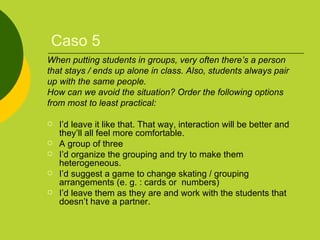
Caso 5 When putting students in groups, very often there’s a person that stays / ends up alone in class. Also, students always pair  up with the same people.  How can we avoid the situation? Order the following options  from most to least practical: I’d leave it like that. That way, interaction will be better and they’ll all feel more comfortable. A group of three I’d organize the grouping and try to make them heterogeneous. I’d suggest a game to change skating / grouping arrangements (e. g. : cards or  numbers) I’d leave them as they are and work with the students that doesn’t have a partner.
Caso 6 The teacher explains a new point on the board. Then (s)he  asks: Is that clear? They all say yes. They do an exercise and  quite a few of them start asking each other questions and  speaking in L1 because they haven’t really understood.  How can this be avoided? Order the following options from most to least practical: Moving / circulating around the different groups to make sure they’ve understood without stopping the activity.  Before starting the activity, check they’ve understood it involving the whole group. Modify / revise / adjust your grammatical approach if it is a recurring problem.  Revisando tu forma de explicar la gramática si es un problema habitual. It’s their fault (not mine)  Explain again with a different wording
Actividades desastrosas. Ask yourself these questions in pairs What went wrong? Did you plan the activity or wing it? Did you have a clear purpose in mind? What? Did you think about the people you planned it for? In what way? Did you prepare your students? Were your instructions clear? How would you do it differently next time?

Solving classroom problems

  • 1.
    SOLVING CLASSROOM PROBLEMS:IN BETTER WORDS, how to be a teacher and avoid high blood pressure
  • 2.
    Presentation of thequestionnaire Problems with grammar presentations. Student interaction (pairwork, groupwork, etc.) Mixed level classes. Large groups. Students who want to go up a level but are not strong enough to do so. Problem students (question everything the teacher does, negative about everything, want to know it all, etc.) Get bogged down on a particular point. Reading and listening: the students want to understand everything. Disastrous activities: when a task doesn't work. Others
  • 3.
  • 4.
    Questionnaire results Theseare the most common issues that you have raised in your comments from in the questionnaire we sent you .
  • 5.
    Mixed level class.Differences between younger students and older students. Different rhythms among students (for example in the time taken to complete an activity). Bad levelling from the beginning of the course or those students who scrape levels. Different skills in different areas (for example, students who are fluent but don’t have accuracy vs. students who are strong in grammar but weak orally). Frustration vs. Boredom for some students
  • 6.
    Problem students: Studentswho arrive late and disrupt the lesson. Students who don’t do the homework which is necessary for the following lesson. Students who create a bad atmosphere: Troublemakers, with negative attitude, who question the teacher. Arrogant students. Students who don’t want to work in groups. Students who constantly use L1. Students who speak to their friends while the teacher or other students are speaking. Students who think they should be in a higher level when they shouldn’t. Students who ask questions that are not relevant to the teaching point. Students who want to know more than they should know at their level.
  • 7.
    Large groups Studentswho are lost in large groups. Difficulty in identifying individual learner problems. Difficulty in identifying individual learner problems. Problems with grouping students (nationalities, age, abilities, etc.). Teacher getting lost in the crowd.
  • 8.
    TYPICAL PROBLEMATIC UABGROUP FROM THE ENGLISH DEPARTMENT 16 students 4 younger students (17-22), most students between 30 and 40 and 3 older students (over 50) Level B1.2 (CEF) The younger students are very strong in grammar, therefore finish grammar activities quickly and easily. However, they’re very lazy in speaking The older students are weak on grammar and nervous with speaking activities therefore they do need some special attention One student thinks the level’s too low for him Some of the older students feel the level is too high or the pace is too fast One student questions everything and gets everybody involved
  • 9.
    1 . MIXED LEVEL CLASS
  • 10.
    Case 1 You’redoing a pairwork activity and three pairs finish quickly while the rest are still coming to terms with the task. The difference in rhythm can frustrate certain students, or even bore some of them. What can we do in this case? Choose the solution you think most adequate: a Let the fast students relax a little while the others catch up b Set a series of spare activities handy for early finishers c. Give them an activity that is directly directed to the previous one (explanation, summary, story, etc.) that they then have to present to the class, so that the rest don’t feel they’re missing something d Have a conversation with the early finishers e Others
  • 11.
    Case 2 You’redoing a listening activity and the following happens: 5 students don’t understand anything, 6 are comfortable enough to follow the activity and 2 understand everything and answer all the questions. What can you do in this case? Choose the solution you think most adequate a Repetition and sentence building b Do the activity the beat you can and give them the transcript at the end of it c Give the transcript to weaker students from the beginning of the activity d Focus the activity on weaker students i.e. follow their pace e Others
  • 12.
  • 13.
    Case 3 Astudent is convinced that he has a higher level than the rest of the class and wants to move up. It has a negative effect on the class. He looks bored, corrects the others and questions the teacher. What do you do? How much do you agree with the following statements? (1: I totally disagree – 5: I totally agree) I’d let him move up, if it is what he wants, let him have it. And I’m pretty sure that he will have a different attitude in the higher class, as he’ll want to prove he’s good enough. I’d talk to the student after the class about his behaviour. I think it is better to address the student privately as they will not be as defensive and it might be possible to get through to them. I would prepare challenging activities for him and always ask him the more challenging questions. And when he’s correcting other students I’d also let him know that I am the teacher and that he…? Why not use him as a sort of help in the classroom? He could be a group leader, a corrector and he would probably feel good about it! Others
  • 14.
    Case 4 Theyoung ones are in their late teens, early twenties. They always sit together and during the class they are constantly speaking about things that have nothing to do with what we are doing. During speaking activities they automatically switch to their mother tongue. How much do you agree with the following statements? (1: I totally disagree – 5: I totally agree) When that happens, I usually stop the class and ask them to be quiet. It puts them on the spot and it usually works. Also during the class, I’m usually near them when I’m giving instructions or during speaking activities so that I can control them better. I think it’s important to set clear guidelines at the beginning of the class. A kind of contract between students and teacher that everybody has to sign. Sometimes students are not aware of what they’re supposed to do. And then the teacher can refer to it as a reminder during the course. If you haven’t set any guidelines, it’s never too late to do so. I’d separate them. Place with students that I know are more disciplined and make more effort to speak English. The might not like it, but hey, too bad! I think I’d talk to them after the class, and explain the situation to them. I’d tell them they and here to learn a language and they’re not learning anything by speaking to each other in their mother tongue. Also, they disrupt the class by speaking constantly. I believe that if I talk to them calmly but firmly, they should change their attitude. Others.
  • 15.
    3. LARGE GROUPS
  • 16.
    Caso 5 Whenputting students in groups, very often there’s a person that stays / ends up alone in class. Also, students always pair up with the same people. How can we avoid the situation? Order the following options from most to least practical: I’d leave it like that. That way, interaction will be better and they’ll all feel more comfortable. A group of three I’d organize the grouping and try to make them heterogeneous. I’d suggest a game to change skating / grouping arrangements (e. g. : cards or numbers) I’d leave them as they are and work with the students that doesn’t have a partner.
  • 17.
    Caso 6 Theteacher explains a new point on the board. Then (s)he asks: Is that clear? They all say yes. They do an exercise and quite a few of them start asking each other questions and speaking in L1 because they haven’t really understood. How can this be avoided? Order the following options from most to least practical: Moving / circulating around the different groups to make sure they’ve understood without stopping the activity. Before starting the activity, check they’ve understood it involving the whole group. Modify / revise / adjust your grammatical approach if it is a recurring problem. Revisando tu forma de explicar la gramática si es un problema habitual. It’s their fault (not mine) Explain again with a different wording
  • 18.
    Actividades desastrosas. Askyourself these questions in pairs What went wrong? Did you plan the activity or wing it? Did you have a clear purpose in mind? What? Did you think about the people you planned it for? In what way? Did you prepare your students? Were your instructions clear? How would you do it differently next time?