Using works and materials from the Internet Some aspects to take into account 
Àrea de Tecnologies per a l'Aprenentatge i el Coneixement
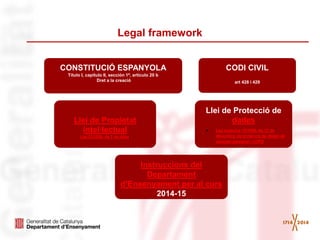
Legal framework 
Llei de Propietat intel·lectual 
Llei 23/2006, de 7 de juliol, 
Llei de Protecció de dades 
●Llei orgànica 15/1999, de 13 de desembre, de protecció de dades de caràcter personal - LOPD 
CONSTITUCIÓ ESPANYOLA 
Título I, capítulo II, sección 1ª, artículo 20 b 
Dret a la creació 
Instruccions del Departament d’Ensenyament per al curs 2014-15 
CODI CIVIL 
art 428 i 429
What is intellectual property? 
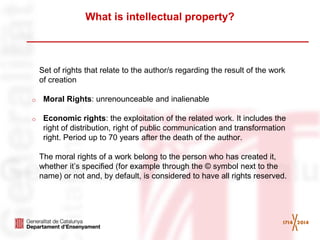
Set of rights that relate to the author/s regarding the result of the work of creation 
oMoral Rights: unrenounceable and inalienable 
oEconomic rights: the exploitation of the related work. It includes the right of distribution, right of public communication and transformation right. Period up to 70 years after the death of the author. 
The moral rights of a work belong to the person who has created it, whether it’s specified (for example through the © symbol next to the name) or not and, by default, is considered to have all rights reserved.
Intellectual property and copyright 
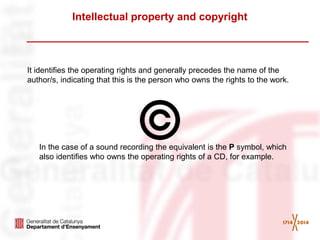
It identifies the operating rights and generally precedes the name of the author/s, indicating that this is the person who owns the rights to the work. 
In the case of a sound recording the equivalent is the P symbol, which also identifies who owns the operating rights of a CD, for example.
Creative Commons Licensing 
oIt relies on the intellectual property law and rights of authorship 
oIt releases certain rights the author owns, in a way that other people may use the work without having to ask for explicit permission. 
Some examples: 
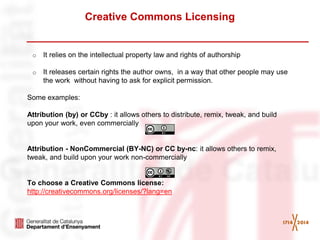
Attribution (by) or CCby : it allows others to distribute, remix, tweak, and build upon your work, even commercially 
Attribution - NonCommercial (BY-NC) or CC by-nc: it allows others to remix, tweak, and build upon your work non-commercially 
To choose a Creative Commons license: http://creativecommons.org/licenses/?lang=en
Using works for educational purposes Quoting right 
The Spanish law allows (art. 32) the use of fragments of a work (textbooks excluded) in a derived work without a permission demand when the following circumstances concur: 
oThe works are disseminated 
oQuoting the author or source 
oOnly fragments of text (Remember the images!) 
oTeaching purposes (Remember the cartoon images or music files that may go with it)
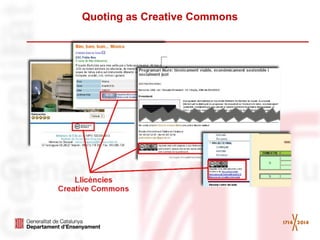
Quoting as Creative Commons
Audiovisual open resources 
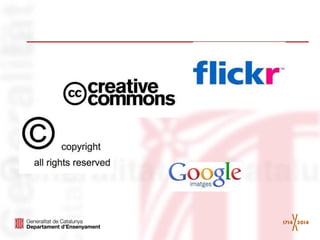
Any audiovisual resource on the Internet IS PROTECTED BY AUTHOR RIGHTS. The fact that it’s available on the web doesn’t mean that the rights confered to its author by law (reproduction, distribution, 
public communication, etc.) are not fully in force. 
It’s recommended not to use photographs from Google Images or similar search engines. 
Image repositories 
Sounds and music
Using images from Wikimedia Commons 
Referencing images 
Author's name and license type 
By T.Voekler (Own work) [CC-BY-SA-3.0 (www.creativecommons.org/licenses/by-sa/3.0)], via Wikimedia Commons 
Address of the page describing the image and name of the author 
In T.Voekler via Wikimedia Commons 
http://commons.wikimedia.org/wiki/File:Leontopodium_palibinianum.jpg
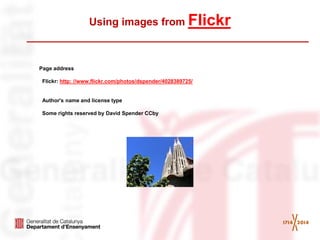
Using images from Flickr 
Page address 
Flickr: http: //www.flickr.com/photos/dspender/4028389725/ 
Author's name and license type 
Some rights reserved by David Spender CCby
Intellectual property and students works 
Original works: 
●stories 
●poems 
●videos 
●pictures 
●drawings 
●.... 
For publishing in the Internet we need parental authorization (under 18 years legal representatives) 
Model: 
http://www.xtec.cat/alfresco/d/d/workspace/SpacesStore/cf965702-4ca8-459f-ab39- c3e592df3717/Publics_autoritzacio_imatges_menors.pdf
Using students personal images
References 
xtec/recursos/tecnologies de la informació 
●Propietat intel·lectual i drets d'autoria: 
http://www.xtec.cat/web/centres/instruccions/propintel_dretauto/us_obres 
●Internet segura 
http://www.xtec.cat/web/recursos/tecinformacio/internet_segura 
●Modelsd'autorització 
http://www.xtec.cat/web/recursos/tecinformacio/internet_segura/documents/autoritzacio 
Aquesta presentació ha estat elaborada per l'Àrea de Tecnologies per a l'Aprenentatge i el Coneixement del Departament d'Ensenyament i està sota una llicència CC-by de Reconeixement 3.0 Espanya de Creative Commons.
THANK YOU 
Àrea de Tecnologies per a l'Aprenentatge i el Coneixement

Using works and materials from the internet

  • 1.
    Using works andmaterials from the Internet Some aspects to take into account Àrea de Tecnologies per a l'Aprenentatge i el Coneixement
  • 3.
    Legal framework Lleide Propietat intel·lectual Llei 23/2006, de 7 de juliol, Llei de Protecció de dades ●Llei orgànica 15/1999, de 13 de desembre, de protecció de dades de caràcter personal - LOPD CONSTITUCIÓ ESPANYOLA Título I, capítulo II, sección 1ª, artículo 20 b Dret a la creació Instruccions del Departament d’Ensenyament per al curs 2014-15 CODI CIVIL art 428 i 429
  • 4.
    What is intellectualproperty? Set of rights that relate to the author/s regarding the result of the work of creation oMoral Rights: unrenounceable and inalienable oEconomic rights: the exploitation of the related work. It includes the right of distribution, right of public communication and transformation right. Period up to 70 years after the death of the author. The moral rights of a work belong to the person who has created it, whether it’s specified (for example through the © symbol next to the name) or not and, by default, is considered to have all rights reserved.
  • 5.
    Intellectual property andcopyright It identifies the operating rights and generally precedes the name of the author/s, indicating that this is the person who owns the rights to the work. In the case of a sound recording the equivalent is the P symbol, which also identifies who owns the operating rights of a CD, for example.
  • 6.
    Creative Commons Licensing oIt relies on the intellectual property law and rights of authorship oIt releases certain rights the author owns, in a way that other people may use the work without having to ask for explicit permission. Some examples: Attribution (by) or CCby : it allows others to distribute, remix, tweak, and build upon your work, even commercially Attribution - NonCommercial (BY-NC) or CC by-nc: it allows others to remix, tweak, and build upon your work non-commercially To choose a Creative Commons license: http://creativecommons.org/licenses/?lang=en
  • 7.
    Using works foreducational purposes Quoting right The Spanish law allows (art. 32) the use of fragments of a work (textbooks excluded) in a derived work without a permission demand when the following circumstances concur: oThe works are disseminated oQuoting the author or source oOnly fragments of text (Remember the images!) oTeaching purposes (Remember the cartoon images or music files that may go with it)
  • 8.
  • 9.
    Audiovisual open resources Any audiovisual resource on the Internet IS PROTECTED BY AUTHOR RIGHTS. The fact that it’s available on the web doesn’t mean that the rights confered to its author by law (reproduction, distribution, public communication, etc.) are not fully in force. It’s recommended not to use photographs from Google Images or similar search engines. Image repositories Sounds and music
  • 10.
    Using images fromWikimedia Commons Referencing images Author's name and license type By T.Voekler (Own work) [CC-BY-SA-3.0 (www.creativecommons.org/licenses/by-sa/3.0)], via Wikimedia Commons Address of the page describing the image and name of the author In T.Voekler via Wikimedia Commons http://commons.wikimedia.org/wiki/File:Leontopodium_palibinianum.jpg
  • 11.
    Using images fromFlickr Page address Flickr: http: //www.flickr.com/photos/dspender/4028389725/ Author's name and license type Some rights reserved by David Spender CCby
  • 12.
    Intellectual property andstudents works Original works: ●stories ●poems ●videos ●pictures ●drawings ●.... For publishing in the Internet we need parental authorization (under 18 years legal representatives) Model: http://www.xtec.cat/alfresco/d/d/workspace/SpacesStore/cf965702-4ca8-459f-ab39- c3e592df3717/Publics_autoritzacio_imatges_menors.pdf
  • 13.
  • 14.
    References xtec/recursos/tecnologies dela informació ●Propietat intel·lectual i drets d'autoria: http://www.xtec.cat/web/centres/instruccions/propintel_dretauto/us_obres ●Internet segura http://www.xtec.cat/web/recursos/tecinformacio/internet_segura ●Modelsd'autorització http://www.xtec.cat/web/recursos/tecinformacio/internet_segura/documents/autoritzacio Aquesta presentació ha estat elaborada per l'Àrea de Tecnologies per a l'Aprenentatge i el Coneixement del Departament d'Ensenyament i està sota una llicència CC-by de Reconeixement 3.0 Espanya de Creative Commons.
  • 15.
    THANK YOU Àreade Tecnologies per a l'Aprenentatge i el Coneixement