Educational Psychology II: Teaching and Managing Diverse Learners in the Classroom Session 3 Creating a Productive and Inclusive Learning Environment:  Establishing Rules and Routines & Building Rapport
Today’s Menu Tuning-in activity Establishing and teaching rules and routines Developing consequences for non-compliance of rules Optimising teaching and learning time In-class activities Establishing rapport Peer Teaching by Groups Conclusion
Wiki Page  http://ep2tg17nov2010.pbworks.com/w/page/33433575/Educational-Psychology-2-TG17 Type in the url Request for permission by keying in your email address
Tuning-in In  groups , work on the following tasks (5 mins): Read the scenario given Identify the problems faced by the student teacher Analyse the problems (e.g., Why did these problems arise?) Suggest strategies that the student teacher in this case could use to prevent similar problems in future Share your discussion with the class
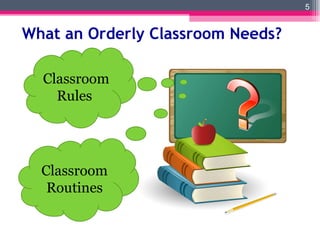
What an Orderly Classroom Needs? Classroom Rules  Classroom Routines
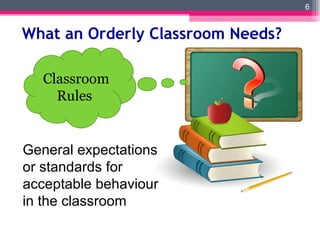
What an Orderly Classroom Needs? Classroom Rules  General expectations or standards for acceptable behaviour in the classroom
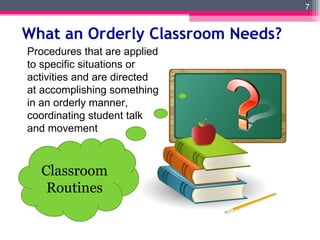
What an Orderly Classroom Needs? Classroom Routines Procedures that are applied to specific situations or activities and are directed at accomplishing something in an orderly manner, coordinating student talk and movement
Importance of Rules and Routines Reduces confusion Increases teaching and learning time Guides students in developing appropriate behaviours Enables lesson to function successfully Creates a predictable, secure, relaxed classroom environment
Classroom Rules
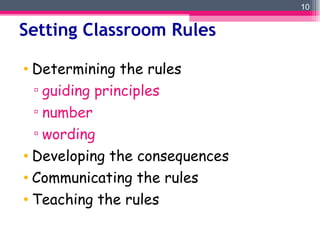
Setting Classroom Rules Determining the rules guiding principles number wording Developing the consequences Communicating the rules Teaching the rules
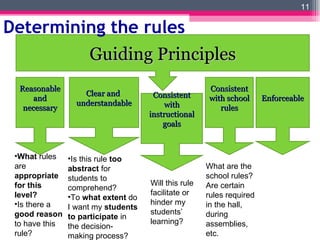
Determining the rules Guiding Principles What  rules are  appropriate for this level? Is there a  good reason  to have this rule? Reasonable and necessary Clear and  understandable Consistent with instructional goals Consistent with school rules Enforceable Is this rule  too abstract  for students to comprehend? To  what extent  do I want my  students to participate  in the decision-making process? Will this rule facilitate or hinder my students’ learning? What are the school rules? Are certain rules required in the hall, during assemblies, etc.
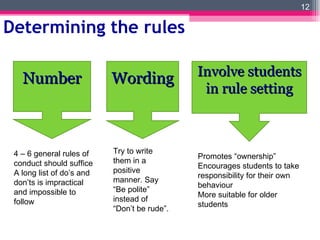
Determining the rules Number Wording Involve students in rule setting 4 – 6 general rules of conduct should suffice A long list of do’s and don’ts is impractical and impossible to follow Try to write them in a positive manner. Say “Be polite” instead of “Don’t be rude”. Promotes “ownership” Encourages students to take responsibility for their own behaviour More suitable for older students
An Example of a Set of Classroom Rules Be polite and helpful Respect other people’s property Raise your hand when you want to talk Listen when someone else is talking Work quietly.  Settle disagreements peacefully.
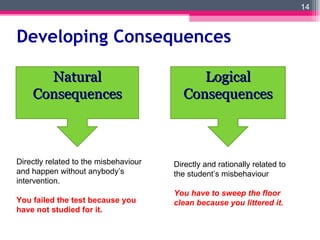
Developing Consequences Natural Consequences Logical Consequences Directly related to the misbehaviour and happen without anybody’s intervention.  You failed the test because you have not studied for it.  Directly and rationally related to the student’s misbehaviour  You have to sweep the floor clean because you littered it.
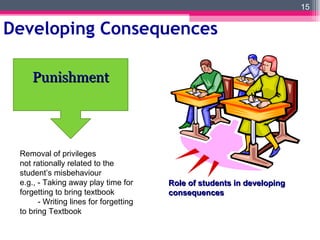
Developing Consequences Punishment Role of students in developing consequences Removal of privileges not rationally related to the student’s misbehaviour e.g., - Taking away play time for forgetting to bring textbook - Writing lines for forgetting to bring Textbook
Communicating Rules Inform the students of the classroom rules on the first day Explain the rationale of each rule to them When students understand the purpose of the rule, they are more likely to view them as fair and reasonable, and as a result be more willing to abide by it Give examples of what each rule means e.g., what does “Be polite and helpful” mean
Teaching Rules Teach rules as you would teach a subject Get students to practise following the rule until they become familiar with it Obtain feedback from the students about the rules so as to modify them where necessary Enforce the rules (very crucial!) Reinforce the correct behaviour
Classroom Routines
Establishing your Classroom Routines (procedures ) Classroom routines are procedures that are applied to specific situations or activities with the intention of getting them accomplished in an orderly manner, by coordinating student talk and movement For each situation/activity, you will need to: determine the routines for it communicate the routines to the students teach the routines to the students
Situations/Activities for Establishing Classroom Routines starting and ending lesson leaving and entering room housekeeping - cleaning of the room, taking attendance distributing and collecting materials making transitions between activities
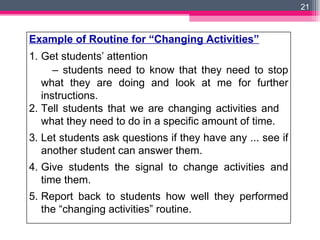
Example of Routine for “Changing Activities” Get students’ attention  –  students need to know that they need to stop what they are doing and look at me for further instructions. 2. Tell students that we are changing activities and  what they need to do in a specific amount of time. 3. Let students ask questions if they have any ... see if another student can answer them. 4. Give students the signal to change activities and time them. 5. Report back to students how well they performed the “changing activities” routine.
Situations/Activities for Establishing Classroom Routines story-telling, reading independent seat work, pair work, group work giving directions questioning and responding using media other instances (examples???)
Communicating and Teaching Classroom Routines Teacher explains the routine (procedure) Teacher demonstrates/models how the procedure is to be carried out  Students practise carrying out the routine Teacher provides feedback to students about their performance of the routine Teacher re-teaches the procedure if necessary
Have materials and equipment ready prior to class Begin on time Establish and  enforce  rules for entering classroom and beginning class Establish and  enforce  procedures for routine tasks and transitions (e.g., handing in work) so that students can do these without your direction Optimising Teaching and Learning Time
Maintain a relatively brisk pace and highly interactive instructional pattern Review work with students when lesson ends early  - avoid unnecessary "free time" Establish signals/cues with class to save time   Optimising Teaching and Learning Time
Establishing Rapport
Establishing Rapport Be welcoming Greet students with a smile Address your students by their names Introduce yourself at your first encounter Get to know your students personally Nod/smile when your students ask or answer questions Speak in a friendly tone
Establishing Rapport Show enthusiasm in your teaching Help students in need  –  show them that you care Maintain an open channel of communication Reward students appropriately Dress professionally
Why is it Important to Build Rapport with the Students? Think about these questions: What are the differences between setting rules and routines and building rapport with students?  Why do we need to do both?  What if rapport is not built properly?
Establishing Rapport Watch the video clip from ‘I not Stupid 2’ (6 mins) In pairs, discuss what in the video struck you most with regards to building rapport with students
Activity  In your groups, conduct the activity in  one  of the following three topics, as assigned by your tutor (10 mins): Establishing rules  (Groups  5 & 6 ) Establishing routines  (Groups  1 & 2 ) Building rapport  (Groups  3 & 4 )
Key Principles:  A carefully planned system of rules and routines (procedures) makes it easier for the teachers to communicate expectations to their students, and helps ensure that the procedures that they set up will be workable and appropriate. Time is finite – effective teachers know how to optimize its use with the help of a system of rules and routines. Effective teachers create focused and nurturing classrooms that result in increased student learning . What have we learnt today?
Individual Assignment (Instructions on Using SafeAssign)
Individual Assignment (40%) (due Session 6 – week of 10 Jan 2011) Discuss your personal pedagogy (e.g., attitudes, beliefs, perceptions, and values) about inclusiveness in the classroom (5 marks). Support your answers with reference to:  your own personal classroom experiences  as a student  (Primary, Secondary and/or JC) (5 marks) and, the content taught in this course (10 marks). Describe the profile of a class that you are likely to be in charge of at the beginning of the school year. With that class in mind, based on your personal pedagogy, what will you do to create an inclusive learning environment in that new class during the first two weeks? (15 marks) Clarity, coherence, and organization of the written assignment. (5 marks) ( Format : no more than 2000 words, 12 point, Arial, double line spacing) References to follow APA format 5 th  edition. Refer to Academic Dishonesty policies uploaded in BB when preparing your essays.
References for Today’s Session Quek, C. L., Wong, Angela F. L., & Tay, M. Y. (Eds.) (2008).  Engaging and managing learners: Practitioners’ perspectives  (Chapters 1, 4 & 6). Singapore: Pearson Education . Levin, J., & Nolan, J.F. (2007 ). Principles of classroom management – A professional decision-making model  (5 th  ed., chapter 6). Boston: Allyn & Bacon. Evertson, C.M., Emmer, E.T., & Worsham, M.E. (2006).  Classroom management for  elementary  teachers  (7 th  ed., chapters 2 & 4). Boston: Allyn & Bacon. OR Emmer, E.T., Evertson, C.M., & Worsham, M.E. (2006).  Classroom management for  middle and high school  teachers  (7 th  ed., chapter 2). Boston: Allyn & Bacon.
Reminders for Session 4 Read Quek, C. L., Wong, Angela F. L., & Tay, M. Y. (Eds.) (2008).  Engaging and managing learners: Practitioners’ perspectives  (Chapter 2). Singapore: Pearson Education . Lim, L., Thaver, T., & Slee, R. (2008).  Exploring disability in Singapore: A personal learning journey . (Chapter 3). Singapore: McGraw-Hill. Download assignment document and bring to class  Download all items in the Session 4 folder before class -END-

S03 ppt (sec_group) modified mano

  • 1.
    Educational Psychology II:Teaching and Managing Diverse Learners in the Classroom Session 3 Creating a Productive and Inclusive Learning Environment: Establishing Rules and Routines & Building Rapport
  • 2.
    Today’s Menu Tuning-inactivity Establishing and teaching rules and routines Developing consequences for non-compliance of rules Optimising teaching and learning time In-class activities Establishing rapport Peer Teaching by Groups Conclusion
  • 3.
    Wiki Page http://ep2tg17nov2010.pbworks.com/w/page/33433575/Educational-Psychology-2-TG17 Type in the url Request for permission by keying in your email address
  • 4.
    Tuning-in In groups , work on the following tasks (5 mins): Read the scenario given Identify the problems faced by the student teacher Analyse the problems (e.g., Why did these problems arise?) Suggest strategies that the student teacher in this case could use to prevent similar problems in future Share your discussion with the class
  • 5.
    What an OrderlyClassroom Needs? Classroom Rules Classroom Routines
  • 6.
    What an OrderlyClassroom Needs? Classroom Rules General expectations or standards for acceptable behaviour in the classroom
  • 7.
    What an OrderlyClassroom Needs? Classroom Routines Procedures that are applied to specific situations or activities and are directed at accomplishing something in an orderly manner, coordinating student talk and movement
  • 8.
    Importance of Rulesand Routines Reduces confusion Increases teaching and learning time Guides students in developing appropriate behaviours Enables lesson to function successfully Creates a predictable, secure, relaxed classroom environment
  • 9.
  • 10.
    Setting Classroom RulesDetermining the rules guiding principles number wording Developing the consequences Communicating the rules Teaching the rules
  • 11.
    Determining the rulesGuiding Principles What rules are appropriate for this level? Is there a good reason to have this rule? Reasonable and necessary Clear and understandable Consistent with instructional goals Consistent with school rules Enforceable Is this rule too abstract for students to comprehend? To what extent do I want my students to participate in the decision-making process? Will this rule facilitate or hinder my students’ learning? What are the school rules? Are certain rules required in the hall, during assemblies, etc.
  • 12.
    Determining the rulesNumber Wording Involve students in rule setting 4 – 6 general rules of conduct should suffice A long list of do’s and don’ts is impractical and impossible to follow Try to write them in a positive manner. Say “Be polite” instead of “Don’t be rude”. Promotes “ownership” Encourages students to take responsibility for their own behaviour More suitable for older students
  • 13.
    An Example ofa Set of Classroom Rules Be polite and helpful Respect other people’s property Raise your hand when you want to talk Listen when someone else is talking Work quietly. Settle disagreements peacefully.
  • 14.
    Developing Consequences NaturalConsequences Logical Consequences Directly related to the misbehaviour and happen without anybody’s intervention. You failed the test because you have not studied for it. Directly and rationally related to the student’s misbehaviour You have to sweep the floor clean because you littered it.
  • 15.
    Developing Consequences PunishmentRole of students in developing consequences Removal of privileges not rationally related to the student’s misbehaviour e.g., - Taking away play time for forgetting to bring textbook - Writing lines for forgetting to bring Textbook
  • 16.
    Communicating Rules Informthe students of the classroom rules on the first day Explain the rationale of each rule to them When students understand the purpose of the rule, they are more likely to view them as fair and reasonable, and as a result be more willing to abide by it Give examples of what each rule means e.g., what does “Be polite and helpful” mean
  • 17.
    Teaching Rules Teachrules as you would teach a subject Get students to practise following the rule until they become familiar with it Obtain feedback from the students about the rules so as to modify them where necessary Enforce the rules (very crucial!) Reinforce the correct behaviour
  • 18.
  • 19.
    Establishing your ClassroomRoutines (procedures ) Classroom routines are procedures that are applied to specific situations or activities with the intention of getting them accomplished in an orderly manner, by coordinating student talk and movement For each situation/activity, you will need to: determine the routines for it communicate the routines to the students teach the routines to the students
  • 20.
    Situations/Activities for EstablishingClassroom Routines starting and ending lesson leaving and entering room housekeeping - cleaning of the room, taking attendance distributing and collecting materials making transitions between activities
  • 21.
    Example of Routinefor “Changing Activities” Get students’ attention – students need to know that they need to stop what they are doing and look at me for further instructions. 2. Tell students that we are changing activities and what they need to do in a specific amount of time. 3. Let students ask questions if they have any ... see if another student can answer them. 4. Give students the signal to change activities and time them. 5. Report back to students how well they performed the “changing activities” routine.
  • 22.
    Situations/Activities for EstablishingClassroom Routines story-telling, reading independent seat work, pair work, group work giving directions questioning and responding using media other instances (examples???)
  • 23.
    Communicating and TeachingClassroom Routines Teacher explains the routine (procedure) Teacher demonstrates/models how the procedure is to be carried out Students practise carrying out the routine Teacher provides feedback to students about their performance of the routine Teacher re-teaches the procedure if necessary
  • 24.
    Have materials andequipment ready prior to class Begin on time Establish and enforce rules for entering classroom and beginning class Establish and enforce procedures for routine tasks and transitions (e.g., handing in work) so that students can do these without your direction Optimising Teaching and Learning Time
  • 25.
    Maintain a relativelybrisk pace and highly interactive instructional pattern Review work with students when lesson ends early - avoid unnecessary "free time" Establish signals/cues with class to save time Optimising Teaching and Learning Time
  • 26.
  • 27.
    Establishing Rapport Bewelcoming Greet students with a smile Address your students by their names Introduce yourself at your first encounter Get to know your students personally Nod/smile when your students ask or answer questions Speak in a friendly tone
  • 28.
    Establishing Rapport Showenthusiasm in your teaching Help students in need – show them that you care Maintain an open channel of communication Reward students appropriately Dress professionally
  • 29.
    Why is itImportant to Build Rapport with the Students? Think about these questions: What are the differences between setting rules and routines and building rapport with students? Why do we need to do both? What if rapport is not built properly?
  • 30.
    Establishing Rapport Watchthe video clip from ‘I not Stupid 2’ (6 mins) In pairs, discuss what in the video struck you most with regards to building rapport with students
  • 31.
    Activity Inyour groups, conduct the activity in one of the following three topics, as assigned by your tutor (10 mins): Establishing rules (Groups 5 & 6 ) Establishing routines (Groups 1 & 2 ) Building rapport (Groups 3 & 4 )
  • 32.
    Key Principles: A carefully planned system of rules and routines (procedures) makes it easier for the teachers to communicate expectations to their students, and helps ensure that the procedures that they set up will be workable and appropriate. Time is finite – effective teachers know how to optimize its use with the help of a system of rules and routines. Effective teachers create focused and nurturing classrooms that result in increased student learning . What have we learnt today?
  • 33.
  • 34.
    Individual Assignment (40%)(due Session 6 – week of 10 Jan 2011) Discuss your personal pedagogy (e.g., attitudes, beliefs, perceptions, and values) about inclusiveness in the classroom (5 marks). Support your answers with reference to: your own personal classroom experiences as a student (Primary, Secondary and/or JC) (5 marks) and, the content taught in this course (10 marks). Describe the profile of a class that you are likely to be in charge of at the beginning of the school year. With that class in mind, based on your personal pedagogy, what will you do to create an inclusive learning environment in that new class during the first two weeks? (15 marks) Clarity, coherence, and organization of the written assignment. (5 marks) ( Format : no more than 2000 words, 12 point, Arial, double line spacing) References to follow APA format 5 th edition. Refer to Academic Dishonesty policies uploaded in BB when preparing your essays.
  • 35.
    References for Today’sSession Quek, C. L., Wong, Angela F. L., & Tay, M. Y. (Eds.) (2008). Engaging and managing learners: Practitioners’ perspectives (Chapters 1, 4 & 6). Singapore: Pearson Education . Levin, J., & Nolan, J.F. (2007 ). Principles of classroom management – A professional decision-making model (5 th ed., chapter 6). Boston: Allyn & Bacon. Evertson, C.M., Emmer, E.T., & Worsham, M.E. (2006). Classroom management for elementary teachers (7 th ed., chapters 2 & 4). Boston: Allyn & Bacon. OR Emmer, E.T., Evertson, C.M., & Worsham, M.E. (2006). Classroom management for middle and high school teachers (7 th ed., chapter 2). Boston: Allyn & Bacon.
  • 36.
    Reminders for Session4 Read Quek, C. L., Wong, Angela F. L., & Tay, M. Y. (Eds.) (2008). Engaging and managing learners: Practitioners’ perspectives (Chapter 2). Singapore: Pearson Education . Lim, L., Thaver, T., & Slee, R. (2008). Exploring disability in Singapore: A personal learning journey . (Chapter 3). Singapore: McGraw-Hill. Download assignment document and bring to class Download all items in the Session 4 folder before class -END-