What Is a Clause? Like…What Am I? Help! I’M Freaking out man!
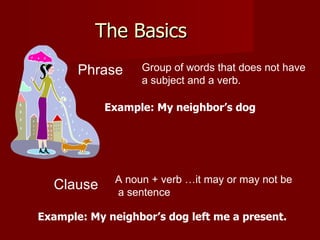
The Basics  Phrase Clause Group of words that does not have a subject and a verb. A noun + verb …it may or may not be a sentence Example: My neighbor’s dog Example: My neighbor’s dog left me a present.
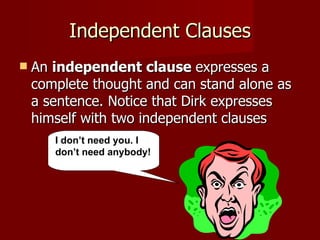
Independent Clauses An  independent clause  expresses a complete thought and can stand alone as a sentence. Notice that Dirk expresses himself with two independent clauses  I don’t need you. I don’t need anybody!
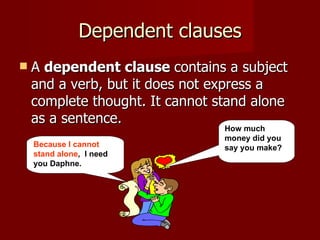
Dependent clauses A  dependent clause  contains a subject and a verb, but it does not express a complete thought. It cannot stand alone as a sentence.  How much money did you say you make? Because I cannot stand alone ,  I need you Daphne.
Caution! Independent clauses can  stand alone  as fully functioning sentences. Dependent clauses do not communicate a complete thought . They  do not make sense  by themselves because they are  incomplete .
How do we identify and use  dependent clauses?
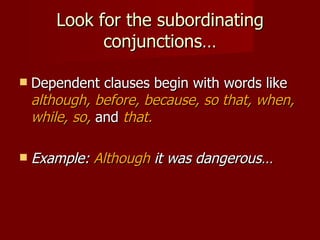
Look for the subordinating conjunctions… Dependent clauses begin with words like  although, before, because, so that, when, while, so,   and  that. Example:  Although  it was dangerous…
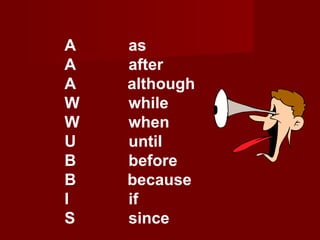
A as A after A   although W while W when U until B before B   because I if S since
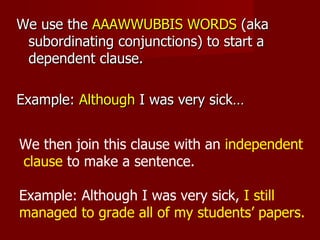
We use the  AAAWWUBBIS WORDS  (aka subordinating conjunctions) to start a dependent clause.  Example:  Although  I was very sick… We then join this clause with an  independent clause  to make a sentence.  Example: Although I was very sick,  I still managed to grade all of my students’ papers.

Clauses power point

  • 1.
    What Is aClause? Like…What Am I? Help! I’M Freaking out man!
  • 2.
    The Basics Phrase Clause Group of words that does not have a subject and a verb. A noun + verb …it may or may not be a sentence Example: My neighbor’s dog Example: My neighbor’s dog left me a present.
  • 3.
    Independent Clauses An independent clause expresses a complete thought and can stand alone as a sentence. Notice that Dirk expresses himself with two independent clauses I don’t need you. I don’t need anybody!
  • 4.
    Dependent clauses A dependent clause contains a subject and a verb, but it does not express a complete thought. It cannot stand alone as a sentence. How much money did you say you make? Because I cannot stand alone , I need you Daphne.
  • 5.
    Caution! Independent clausescan stand alone as fully functioning sentences. Dependent clauses do not communicate a complete thought . They do not make sense by themselves because they are incomplete .
  • 6.
    How do weidentify and use dependent clauses?
  • 7.
    Look for thesubordinating conjunctions… Dependent clauses begin with words like although, before, because, so that, when, while, so, and that. Example: Although it was dangerous…
  • 8.
    A as Aafter A although W while W when U until B before B because I if S since
  • 9.
    We use the AAAWWUBBIS WORDS (aka subordinating conjunctions) to start a dependent clause. Example: Although I was very sick… We then join this clause with an independent clause to make a sentence. Example: Although I was very sick, I still managed to grade all of my students’ papers.

Editor's Notes

  • #6 So remember . . . Main clauses can stand alone as fully functioning sentences. Subordinate clauses depend for their sense on the main clause. They do not make sense by themselves because they are incomplete .