Poetry Terms You Need to Know
Simile A simile is a comparison between two unlike things using the words  like  or  as . Example:  The car was as slow as a snail. Example:  The fish’s scales sparkled in the sunlight like rare jewels.
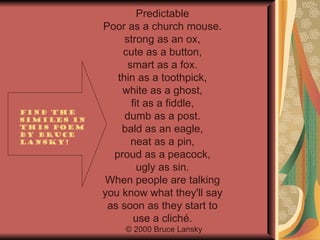
Predictable  Poor as a church mouse.  strong as an ox,  cute as a button,  smart as a fox.  thin as a toothpick,  white as a ghost,  fit as a fiddle,  dumb as a post.  bald as an eagle,  neat as a pin,  proud as a peacock,  ugly as sin.  When people are talking  you know what they'll say  as soon as they start to  use a cliché.  © 2000 Bruce Lansky Find the similes in this poem by Bruce Lansky!
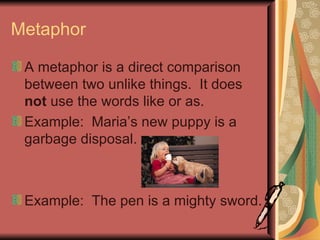
Metaphor A metaphor is a direct comparison between two unlike things.  It does  not  use the words like or as.  Example:  Maria’s new puppy is a garbage disposal.  Example:  The pen is a mighty sword.
Alliteration Alliteration is when the same sound is repeated at the beginning of several words of a line of poetry or a sentence.  Example:  Bobby blew ten big bubbles.
Onomatopoeia Onomatopoeia is when words are used that sound like the noises they describe.  Examples:  Ding dong!  Pow!  Buzz!  Bang!
Idiom An idiom is a common expression that makes no sense unless you know its figurative meaning.  Example:  That test was a piece of cake.  Example:  She got a taste of her own medicine.  Example:  That shirt cost me an arm and a leg.
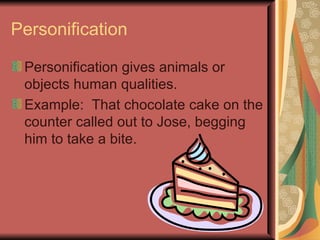
Personification Personification gives animals or objects human qualities.  Example:  That chocolate cake on the counter called out to Jose, begging him to take a bite.
Couplet A couplet is a poem with two rhyming lines.  Both have the same rhythm.  Example:  Twinkle, twinkle, little star How I wonder what you are.
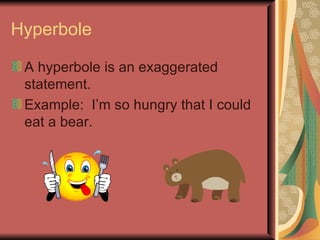
Hyperbole A hyperbole is an exaggerated statement.  Example:  I’m so hungry that I could eat a bear.
Concrete Poem Concrete poems are shape poems spaced to form pictures of what the poem is about.
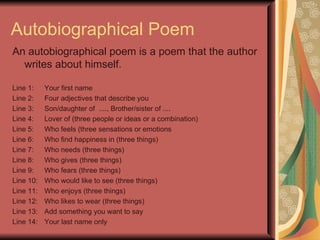
Autobiographical Poem An autobiographical poem is a poem that the author writes about himself.  Line 1: Your first name Line 2: Four adjectives that describe you Line 3:  Son/daughter of  ...., Brother/sister of .... Line 4: Lover of (three people or ideas or a combination) Line 5: Who feels (three sensations or emotions Line 6: Who find happiness in (three things) Line 7: Who needs (three things) Line 8: Who gives (three things) Line 9: Who fears (three things) Line 10: Who would like to see (three things) Line 11: Who enjoys (three things) Line 12: Who likes to wear (three things) Line 13: Add something you want to say Line 14: Your last name only
Haiku A haiku is a short poem invented in Japan.  It often describes nature with very simple observations about the world around us.  A haiku consists of three unrhymed lines of 5-7-5 syllables. So many breezes Wander through my summer room: But never enough
Limericks Limericks have five lines, and they are usually funny or silly.  The rhyme scheme is AABBA.  Example:  There was a young lady whose chin resembled the point of a pin; so she had it made sharp, and purchased a harp, and played several tunes with her chin. -Edward Lear
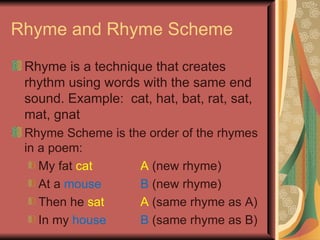
Rhyme and Rhyme Scheme Rhyme is a technique that creates rhythm using words with the same end sound. Example:  cat, hat, bat, rat, sat, mat, gnat Rhyme Scheme is the order of the rhymes in a poem: My fat  cat A  (new rhyme) At a  mouse B  (new rhyme) Then he  sat A  (same rhyme as A) In my  house B  (same rhyme as B)
Rhythm Rhythm is the beat of a poem Limericks have a definite rhythm Limericks have five lines, and they are usually funny or silly.  The rhyme scheme is AABBA.
Repetition Poets often use repetition to stress important points or sounds in their poetry Yak   ~Jack Prelutsky~  Yickity-yackity, yickity-yak,  the yak has a scriffily, scraffily back,  some yaks are brown yaks and some yaks are black,  yickity-yackity, yickity-yak.  Sniggildy-snaggildy, sniggildy-snag, the yak is all covered with shiggildy-shag;  he walks with a ziggildy-zaggildy-sag,  sniggildy-snaggildy, sniggildy-snag.
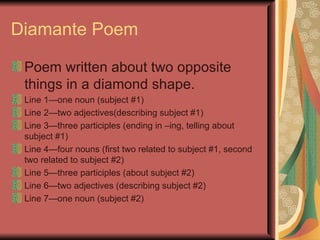
Diamante Poem Poem written about two opposite things in a diamond shape.  Line 1—one noun (subject #1) Line 2—two adjectives(describing subject #1) Line 3—three participles (ending in –ing, telling about subject #1) Line 4—four nouns (first two related to subject #1, second two related to subject #2) Line 5—three participles (about subject #2) Line 6—two adjectives (describing subject #2) Line 7—one noun (subject #2)
Example of Diamante Poem Cat clever, cuddly crouching, pouncing, purring meow, feline, canine, bark running, sniffing, yelping lovable, smart Dog
Acrostic Poem An acrostic poem uses each letter of a word to begin each line. E lizabeth Jane Smith L oves animals I s a great student Z oos are a favorite place to visit A lways tries to have a smile B elieves in being a good friend E ats pizza and fries  T hinks that I want to be a doctor H as a great family
Imagery The use of vivid or figurative language to represent objects, actions, or ideas.
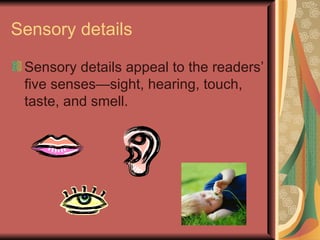
Sensory details Sensory details appeal to the readers’ five senses—sight, hearing, touch, taste, and smell.
“ Dreams” by Langston Hughes Hold fast to dreams For if dreams die Life is a broken-winged bird That cannot fly. Hold fast to dreams For when dreams go Life is a barren field Frozen with snow.

Poetry terms notes

  • 1.
    Poetry Terms YouNeed to Know
  • 2.
    Simile A simileis a comparison between two unlike things using the words like or as . Example: The car was as slow as a snail. Example: The fish’s scales sparkled in the sunlight like rare jewels.
  • 3.
    Predictable Pooras a church mouse. strong as an ox, cute as a button, smart as a fox. thin as a toothpick, white as a ghost, fit as a fiddle, dumb as a post. bald as an eagle, neat as a pin, proud as a peacock, ugly as sin. When people are talking you know what they'll say as soon as they start to use a cliché. © 2000 Bruce Lansky Find the similes in this poem by Bruce Lansky!
  • 4.
    Metaphor A metaphoris a direct comparison between two unlike things. It does not use the words like or as. Example: Maria’s new puppy is a garbage disposal. Example: The pen is a mighty sword.
  • 5.
    Alliteration Alliteration iswhen the same sound is repeated at the beginning of several words of a line of poetry or a sentence. Example: Bobby blew ten big bubbles.
  • 6.
    Onomatopoeia Onomatopoeia iswhen words are used that sound like the noises they describe. Examples: Ding dong! Pow! Buzz! Bang!
  • 7.
    Idiom An idiomis a common expression that makes no sense unless you know its figurative meaning. Example: That test was a piece of cake. Example: She got a taste of her own medicine. Example: That shirt cost me an arm and a leg.
  • 8.
    Personification Personification givesanimals or objects human qualities. Example: That chocolate cake on the counter called out to Jose, begging him to take a bite.
  • 9.
    Couplet A coupletis a poem with two rhyming lines. Both have the same rhythm. Example: Twinkle, twinkle, little star How I wonder what you are.
  • 10.
    Hyperbole A hyperboleis an exaggerated statement. Example: I’m so hungry that I could eat a bear.
  • 11.
    Concrete Poem Concretepoems are shape poems spaced to form pictures of what the poem is about.
  • 12.
    Autobiographical Poem Anautobiographical poem is a poem that the author writes about himself. Line 1: Your first name Line 2: Four adjectives that describe you Line 3: Son/daughter of ...., Brother/sister of .... Line 4: Lover of (three people or ideas or a combination) Line 5: Who feels (three sensations or emotions Line 6: Who find happiness in (three things) Line 7: Who needs (three things) Line 8: Who gives (three things) Line 9: Who fears (three things) Line 10: Who would like to see (three things) Line 11: Who enjoys (three things) Line 12: Who likes to wear (three things) Line 13: Add something you want to say Line 14: Your last name only
  • 13.
    Haiku A haikuis a short poem invented in Japan. It often describes nature with very simple observations about the world around us. A haiku consists of three unrhymed lines of 5-7-5 syllables. So many breezes Wander through my summer room: But never enough
  • 14.
    Limericks Limericks havefive lines, and they are usually funny or silly. The rhyme scheme is AABBA. Example: There was a young lady whose chin resembled the point of a pin; so she had it made sharp, and purchased a harp, and played several tunes with her chin. -Edward Lear
  • 15.
    Rhyme and RhymeScheme Rhyme is a technique that creates rhythm using words with the same end sound. Example: cat, hat, bat, rat, sat, mat, gnat Rhyme Scheme is the order of the rhymes in a poem: My fat cat A (new rhyme) At a mouse B (new rhyme) Then he sat A (same rhyme as A) In my house B (same rhyme as B)
  • 16.
    Rhythm Rhythm isthe beat of a poem Limericks have a definite rhythm Limericks have five lines, and they are usually funny or silly. The rhyme scheme is AABBA.
  • 17.
    Repetition Poets oftenuse repetition to stress important points or sounds in their poetry Yak ~Jack Prelutsky~ Yickity-yackity, yickity-yak, the yak has a scriffily, scraffily back, some yaks are brown yaks and some yaks are black, yickity-yackity, yickity-yak. Sniggildy-snaggildy, sniggildy-snag, the yak is all covered with shiggildy-shag; he walks with a ziggildy-zaggildy-sag, sniggildy-snaggildy, sniggildy-snag.
  • 18.
    Diamante Poem Poemwritten about two opposite things in a diamond shape. Line 1—one noun (subject #1) Line 2—two adjectives(describing subject #1) Line 3—three participles (ending in –ing, telling about subject #1) Line 4—four nouns (first two related to subject #1, second two related to subject #2) Line 5—three participles (about subject #2) Line 6—two adjectives (describing subject #2) Line 7—one noun (subject #2)
  • 19.
    Example of DiamantePoem Cat clever, cuddly crouching, pouncing, purring meow, feline, canine, bark running, sniffing, yelping lovable, smart Dog
  • 20.
    Acrostic Poem Anacrostic poem uses each letter of a word to begin each line. E lizabeth Jane Smith L oves animals I s a great student Z oos are a favorite place to visit A lways tries to have a smile B elieves in being a good friend E ats pizza and fries T hinks that I want to be a doctor H as a great family
  • 21.
    Imagery The useof vivid or figurative language to represent objects, actions, or ideas.
  • 22.
    Sensory details Sensorydetails appeal to the readers’ five senses—sight, hearing, touch, taste, and smell.
  • 23.
    “ Dreams” byLangston Hughes Hold fast to dreams For if dreams die Life is a broken-winged bird That cannot fly. Hold fast to dreams For when dreams go Life is a barren field Frozen with snow.