Conquering the Confusion
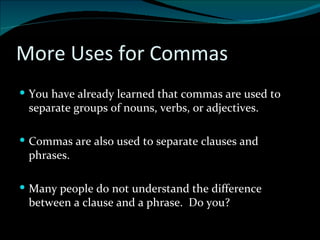
More Uses for Commas You have already learned that commas are used to separate groups of nouns, verbs, or adjectives. Commas are also used to separate clauses and phrases. Many people do not understand the difference between a clause and a phrase.  Do you?
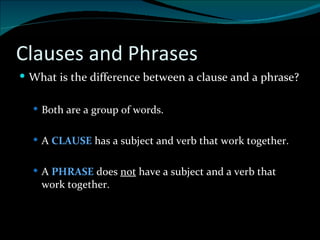
Clauses and Phrases What is the difference between a clause and a phrase? Both are a group of words. A  CLAUSE  has a subject and verb that work together. A  PHRASE  does  not  have a subject and a verb that work together.
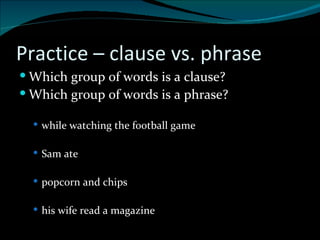
Practice – clause vs. phrase Which group of words is a clause?  Which group of words is a phrase? while watching the football game Sam ate  popcorn and chips his wife read a magazine
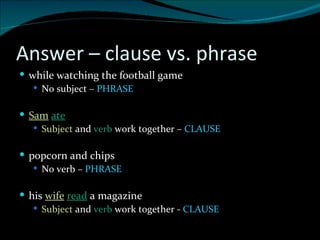
Answer – clause vs. phrase while watching the football game No subject –  PHRASE Sam   ate Subject  and  verb  work together –  CLAUSE popcorn and chips No verb –  PHRASE his  wife   read  a magazine Subject  and  verb  work together -  CLAUSE
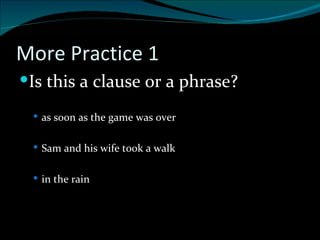
More Practice 1 Is this a clause or a phrase? as soon as the game was over Sam and his wife took a walk in the rain
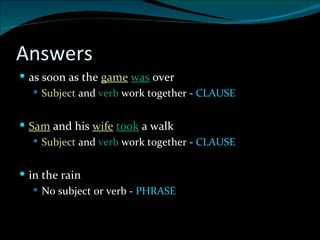
Answers as soon as the  game   was  over Subject  and  verb  work together -  CLAUSE Sam   and his  wife   took  a walk Subject  and  verb  work together -  CLAUSE in the rain No subject or verb -  PHRASE
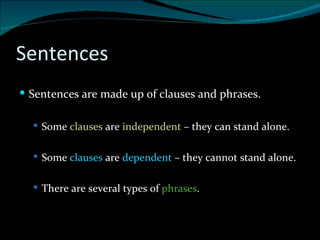
Sentences Sentences are made up of clauses and phrases. Some  clauses  are  independent  – they can stand alone. Some  clauses  are  dependent  – they cannot stand alone. There are several types of  phrases .
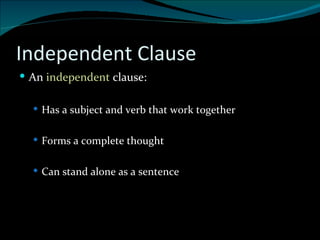
Independent Clause An  independent  clause: Has a subject and verb that work together Forms a complete thought Can stand alone as a sentence
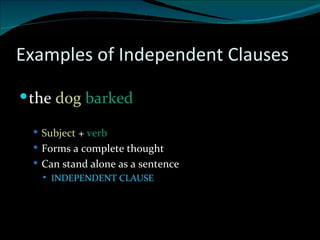
Examples of Independent Clauses the  dog   barked Subject  +  verb  Forms a complete thought Can stand alone as a sentence INDEPENDENT CLAUSE
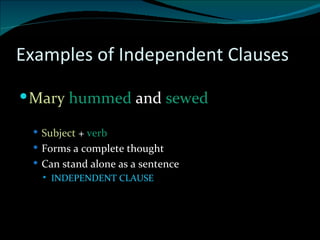
Examples of Independent Clauses Mary  hummed  and  sewed Subject  +  verb  Forms a complete thought Can stand alone as a sentence INDEPENDENT CLAUSE
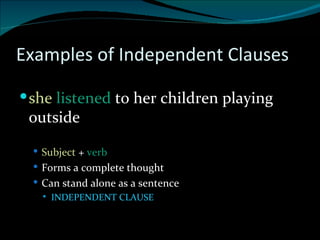
Examples of Independent Clauses she  listened  to her children playing outside Subject  +  verb  Forms a complete thought Can stand alone as a sentence INDEPENDENT CLAUSE
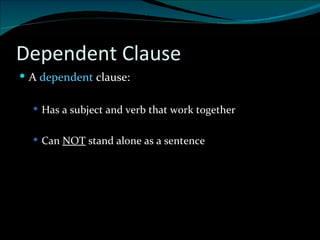
Dependent Clause A  dependent  clause: Has a subject and verb that work together Can  NOT  stand alone as a sentence
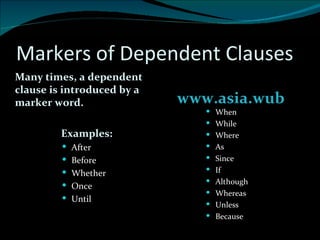
Markers of Dependent Clauses Many times, a dependent clause is introduced by a marker word. Examples: www.asia.wub After Before Whether Once Until When While Where As Since If Although Whereas Unless Because
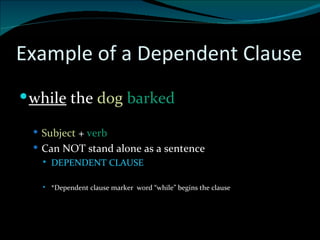
Example of a Dependent Clause while  the  dog   barked Subject  +  verb  Can NOT stand alone as a sentence DEPENDENT CLAUSE *Dependent clause marker  word “while” begins the clause
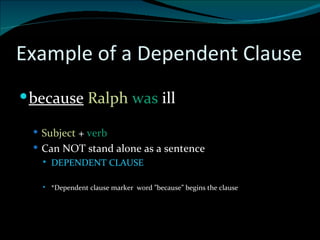
Example of a Dependent Clause because   Ralph  was  ill Subject  +  verb  Can NOT stand alone as a sentence DEPENDENT CLAUSE *Dependent clause marker  word ”because” begins the clause
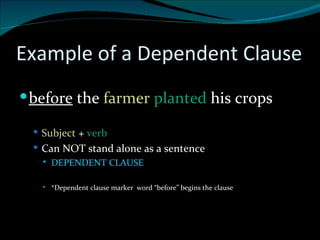
Example of a Dependent Clause before  the  farmer  planted  his crops Subject  +  verb  Can NOT stand alone as a sentence DEPENDENT CLAUSE *Dependent clause marker  word “before” begins the clause
Practice 1 Independent or Dependent Clause? Jim   bent  over the wounded toe
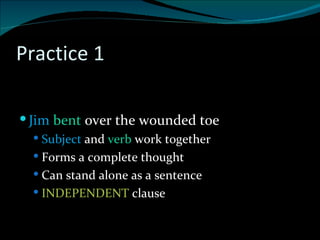
Practice 1 . Jim   bent  over the wounded toe Subject  and  verb  work together Forms a complete thought Can stand alone as a sentence INDEPENDENT  clause
Practice 2 Independent or Dependent Clause? while the  bandage  was being unwound
Practice 2 . while the  bandage  was being unwound Subject  and  verb  work together Does NOT form a complete thought Can NOT stand alone as a sentence DEPENDENT  clause * NOTE: marker word “while” begins clause
Practice 3 Independent or Dependent Clause? Tom  whitewashed  with vigor
Practice 3 . Tom  whitewashed  with vigor Subject  and  verb  work together Forms a complete thought Can stand alone as a sentence INDEPENDENT  clause
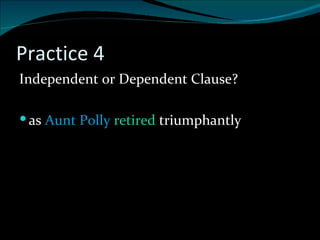
Practice 4 Independent or Dependent Clause? as  Aunt Polly  retired  triumphantly
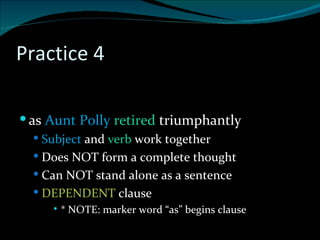
Practice 4 . as  Aunt Polly  retired  triumphantly Subject  and  verb  work together Does NOT form a complete thought Can NOT stand alone as a sentence DEPENDENT  clause * NOTE: marker word “as” begins clause
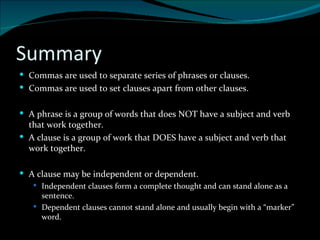
Summary Commas are used to separate series of phrases or clauses. Commas are used to set clauses apart from other clauses. A phrase is a group of words that does NOT have a subject and verb that work together. A clause is a group of work that DOES have a subject and verb that work together. A clause may be independent or dependent. Independent clauses form a complete thought and can stand alone as a sentence. Dependent clauses cannot stand alone and usually begin with a “marker” word.

Commas with Clauses and Phrases

  • 1.
  • 2.
    More Uses forCommas You have already learned that commas are used to separate groups of nouns, verbs, or adjectives. Commas are also used to separate clauses and phrases. Many people do not understand the difference between a clause and a phrase. Do you?
  • 3.
    Clauses and PhrasesWhat is the difference between a clause and a phrase? Both are a group of words. A CLAUSE has a subject and verb that work together. A PHRASE does not have a subject and a verb that work together.
  • 4.
    Practice – clausevs. phrase Which group of words is a clause? Which group of words is a phrase? while watching the football game Sam ate popcorn and chips his wife read a magazine
  • 5.
    Answer – clausevs. phrase while watching the football game No subject – PHRASE Sam ate Subject and verb work together – CLAUSE popcorn and chips No verb – PHRASE his wife read a magazine Subject and verb work together - CLAUSE
  • 6.
    More Practice 1Is this a clause or a phrase? as soon as the game was over Sam and his wife took a walk in the rain
  • 7.
    Answers as soonas the game was over Subject and verb work together - CLAUSE Sam and his wife took a walk Subject and verb work together - CLAUSE in the rain No subject or verb - PHRASE
  • 8.
    Sentences Sentences aremade up of clauses and phrases. Some clauses are independent – they can stand alone. Some clauses are dependent – they cannot stand alone. There are several types of phrases .
  • 9.
    Independent Clause An independent clause: Has a subject and verb that work together Forms a complete thought Can stand alone as a sentence
  • 10.
    Examples of IndependentClauses the dog barked Subject + verb Forms a complete thought Can stand alone as a sentence INDEPENDENT CLAUSE
  • 11.
    Examples of IndependentClauses Mary hummed and sewed Subject + verb Forms a complete thought Can stand alone as a sentence INDEPENDENT CLAUSE
  • 12.
    Examples of IndependentClauses she listened to her children playing outside Subject + verb Forms a complete thought Can stand alone as a sentence INDEPENDENT CLAUSE
  • 13.
    Dependent Clause A dependent clause: Has a subject and verb that work together Can NOT stand alone as a sentence
  • 14.
    Markers of DependentClauses Many times, a dependent clause is introduced by a marker word. Examples: www.asia.wub After Before Whether Once Until When While Where As Since If Although Whereas Unless Because
  • 15.
    Example of aDependent Clause while the dog barked Subject + verb Can NOT stand alone as a sentence DEPENDENT CLAUSE *Dependent clause marker word “while” begins the clause
  • 16.
    Example of aDependent Clause because Ralph was ill Subject + verb Can NOT stand alone as a sentence DEPENDENT CLAUSE *Dependent clause marker word ”because” begins the clause
  • 17.
    Example of aDependent Clause before the farmer planted his crops Subject + verb Can NOT stand alone as a sentence DEPENDENT CLAUSE *Dependent clause marker word “before” begins the clause
  • 18.
    Practice 1 Independentor Dependent Clause? Jim bent over the wounded toe
  • 19.
    Practice 1 .Jim bent over the wounded toe Subject and verb work together Forms a complete thought Can stand alone as a sentence INDEPENDENT clause
  • 20.
    Practice 2 Independentor Dependent Clause? while the bandage was being unwound
  • 21.
    Practice 2 .while the bandage was being unwound Subject and verb work together Does NOT form a complete thought Can NOT stand alone as a sentence DEPENDENT clause * NOTE: marker word “while” begins clause
  • 22.
    Practice 3 Independentor Dependent Clause? Tom whitewashed with vigor
  • 23.
    Practice 3 .Tom whitewashed with vigor Subject and verb work together Forms a complete thought Can stand alone as a sentence INDEPENDENT clause
  • 24.
    Practice 4 Independentor Dependent Clause? as Aunt Polly retired triumphantly
  • 25.
    Practice 4 .as Aunt Polly retired triumphantly Subject and verb work together Does NOT form a complete thought Can NOT stand alone as a sentence DEPENDENT clause * NOTE: marker word “as” begins clause
  • 26.
    Summary Commas areused to separate series of phrases or clauses. Commas are used to set clauses apart from other clauses. A phrase is a group of words that does NOT have a subject and verb that work together. A clause is a group of work that DOES have a subject and verb that work together. A clause may be independent or dependent. Independent clauses form a complete thought and can stand alone as a sentence. Dependent clauses cannot stand alone and usually begin with a “marker” word.