Pronouns He They Themselves What This Me Mine Yours Him I Those
Pronouns replace nouns
Pronouns  come in many different varieties.
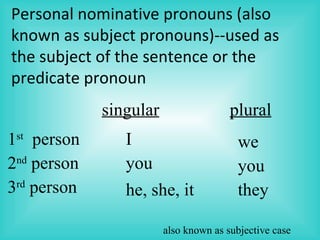
PERSONAL PRONOUNS
singular plural 1 st   person      Personal nominative pronouns (also known as subject pronouns)--used as the subject of the sentence or the predicate pronoun also known as subjective case I you he, she, it they you we 2 nd  person      3 rd  person
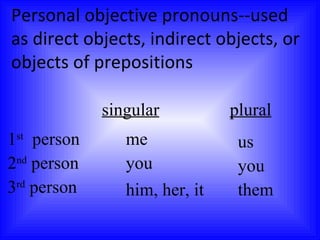
singular plural 1 st   person      Personal objective pronouns--used as direct objects, indirect objects, or objects of prepositions me you him, her, it them you us 2 nd  person      3 rd  person
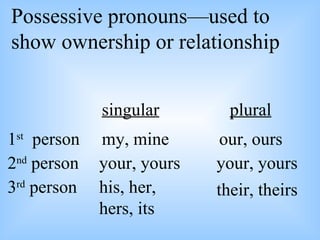
singular plural 1 st   person      Possessive pronouns—used to show ownership or relationship my, mine your, yours his, her, hers, its their, theirs your, yours our, ours 2 nd  person      3 rd  person
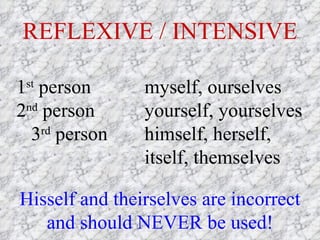
REFLEXIVE / INTENSIVE 1 st  person myself, ourselves  2 nd  person yourself, yourselves  3 rd  person himself, herself,  itself, themselves   Hisself and theirselves are incorrect and should NEVER be used!
Since they have the same form . . .  When are they reflexive?  When are they intensive? Omit the pronoun.  If the meaning of the sentence stays the same, the pronoun is intensive.
Mercedes designed the costume herself. intensive
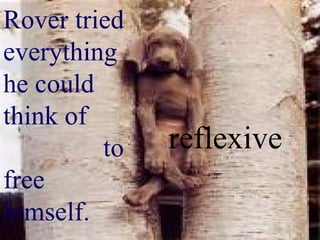
Rover tried everything he could think of  to free  himself. reflexive
demonstrative  pronouns—point out a particular person, place, thing, or idea that this these those
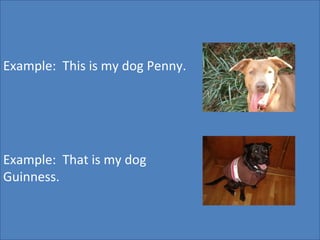
! Example:  This is my dog Penny. Example:  That is my dog  Guinness.
INTERROGATIVE  PRONOUNS These pronouns are used to introduce  questions.
 
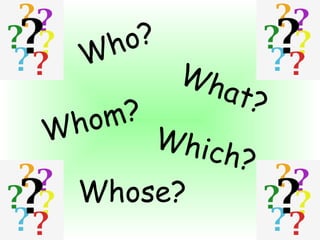
Who? What? Whom? Which? Whose?
indefinite pronouns
These pronouns replace nouns that are not specifically named.
SINGULAR  INDEFINITE PRONOUNS another  anybody  anyone  anything either  everybody  everyone  everything  neither  nobody  no one  nothing  somebody  someone  something each  much  one
PLURAL  INDEFINITE PRONOUNS both    few  many  several
INDEFINITE PRONOUNS  SINGULAR OR PLURAL all  any  most  none  some
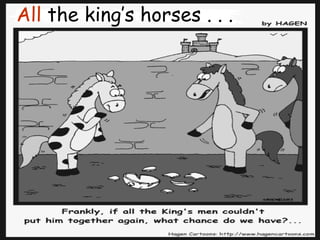
All  the king’s horses . . .
RELATIVE PRONOUNS
A relative pronoun introduces a subordinate (dependent) clause. that  which  who  whom  whose
The red Ferrari is  the one  that I want .
What is an antecedent, and what does it have to do with pronouns?
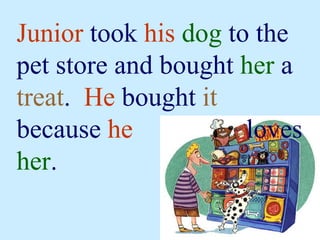
An antecedent is the noun that the pronoun replaces.
Junior  took  his   dog  to the pet store and bought  her  a  treat .  He  bought  it  because  he   loves  her .

Pronouns powerpoint