Sentence and Fragments
Sentence
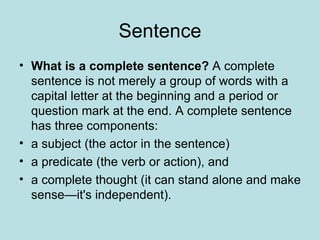
• What is a complete sentence? A complete
  sentence is not merely a group of words with a
  capital letter at the beginning and a period or
  question mark at the end. A complete sentence
  has three components:
• a subject (the actor in the sentence)
• a predicate (the verb or action), and
• a complete thought (it can stand alone and make
  sense—it's independent).
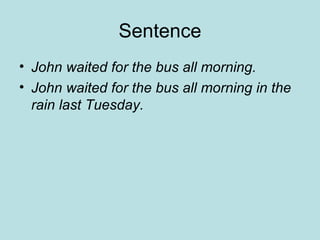
Sentence
• John waited for the bus all morning.
• John waited for the bus all morning in the
  rain last Tuesday.
Fragments
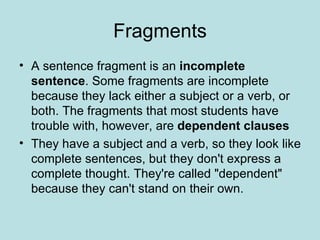
• A sentence fragment is an incomplete
  sentence. Some fragments are incomplete
  because they lack either a subject or a verb, or
  both. The fragments that most students have
  trouble with, however, are dependent clauses
• They have a subject and a verb, so they look like
  complete sentences, but they don't express a
  complete thought. They're called "dependent"
  because they can't stand on their own.
Fragments
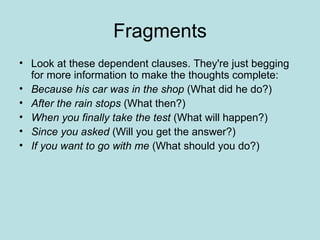
• Look at these dependent clauses. They're just begging
  for more information to make the thoughts complete:
• Because his car was in the shop (What did he do?)
• After the rain stops (What then?)
• When you finally take the test (What will happen?)
• Since you asked (Will you get the answer?)
• If you want to go with me (What should you do?)
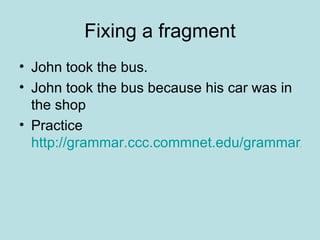
Fixing a fragment
• John took the bus.
• John took the bus because his car was in
  the shop
• Practice
  http://grammar.ccc.commnet.edu/grammar/cgi

Sentence Vs. Fragment

  • 1.
  • 2.
    Sentence • What isa complete sentence? A complete sentence is not merely a group of words with a capital letter at the beginning and a period or question mark at the end. A complete sentence has three components: • a subject (the actor in the sentence) • a predicate (the verb or action), and • a complete thought (it can stand alone and make sense—it's independent).
  • 3.
    Sentence • John waitedfor the bus all morning. • John waited for the bus all morning in the rain last Tuesday.
  • 4.
    Fragments • A sentencefragment is an incomplete sentence. Some fragments are incomplete because they lack either a subject or a verb, or both. The fragments that most students have trouble with, however, are dependent clauses • They have a subject and a verb, so they look like complete sentences, but they don't express a complete thought. They're called "dependent" because they can't stand on their own.
  • 5.
    Fragments • Look atthese dependent clauses. They're just begging for more information to make the thoughts complete: • Because his car was in the shop (What did he do?) • After the rain stops (What then?) • When you finally take the test (What will happen?) • Since you asked (Will you get the answer?) • If you want to go with me (What should you do?)
  • 6.
    Fixing a fragment •John took the bus. • John took the bus because his car was in the shop • Practice http://grammar.ccc.commnet.edu/grammar/cgi