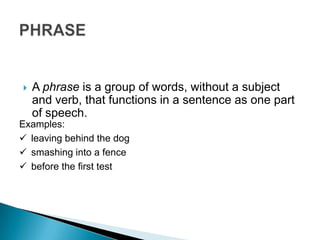
   A phrase is a group of words, without a subject
    and verb, that functions in a sentence as one part
    of speech.
Examples:
 leaving behind the dog
 smashing into a fence
 before the first test
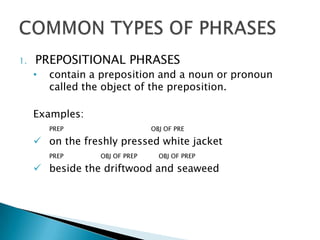
1.   PREPOSITIONAL PHRASES
     •   contain a preposition and a noun or pronoun
         called the object of the preposition.

     Examples:
         PREP                   OBJ OF PRE

      on the freshly pressed white jacket
         PREP     OBJ OF PREP     OBJ OF PREP

      beside the driftwood and seaweed
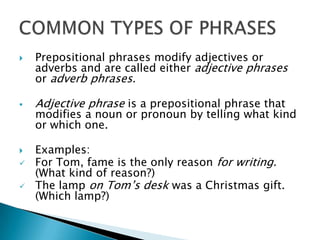
   Prepositional phrases modify adjectives or
    adverbs and are called either adjective phrases
    or adverb phrases.

   Adjective phrase is a prepositional phrase that
    modifies a noun or pronoun by telling what kind
    or which one.

   Examples:
   For Tom, fame is the only reason for writing.
    (What kind of reason?)
   The lamp on Tom’s desk was a Christmas gift.
    (Which lamp?)
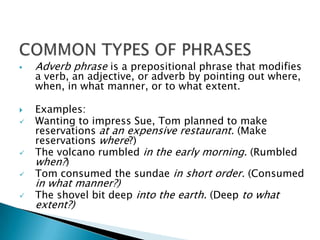
   Adverb phrase is a prepositional phrase that modifies
    a verb, an adjective, or adverb by pointing out where,
    when, in what manner, or to what extent.

   Examples:
   Wanting to impress Sue, Tom planned to make
    reservations at an expensive restaurant. (Make
    reservations where?)
   The volcano rumbled in the early morning. (Rumbled
    when?)
   Tom consumed the sundae in short order. (Consumed
    in what manner?)
   The shovel bit deep into the earth. (Deep to what
    extent?)
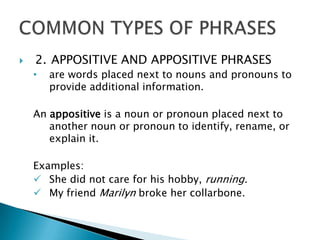
   2. APPOSITIVE AND APPOSITIVE PHRASES
    •   are words placed next to nouns and pronouns to
        provide additional information.

    An appositive is a noun or pronoun placed next to
       another noun or pronoun to identify, rename, or
       explain it.

    Examples:
     She did not care for his hobby, running.
     My friend Marilyn broke her collarbone.
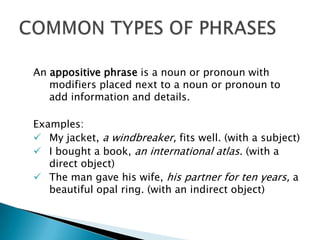
An appositive phrase is a noun or pronoun with
   modifiers placed next to a noun or pronoun to
   add information and details.

Examples:
 My jacket, a windbreaker, fits well. (with a subject)
 I bought a book, an international atlas. (with a
   direct object)
 The man gave his wife, his partner for ten years, a
   beautiful opal ring. (with an indirect object)
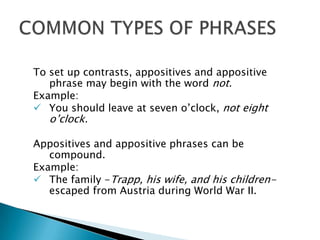
To set up contrasts, appositives and appositive
   phrase may begin with the word not.
Example:
 You should leave at seven o’clock, not eight
   o’clock.

Appositives and appositive phrases can be
   compound.
Example:
 The family -Trapp, his wife, and his children-
   escaped from Austria during World War II.
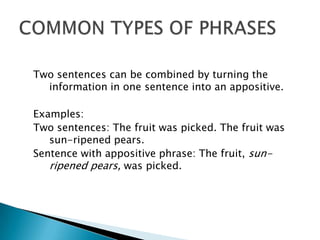
Two sentences can be combined by turning the
  information in one sentence into an appositive.

Examples:
Two sentences: The fruit was picked. The fruit was
   sun-ripened pears.
Sentence with appositive phrase: The fruit, sun-
   ripened pears, was picked.
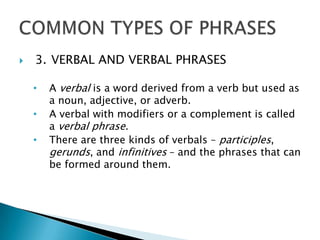
   3. VERBAL AND VERBAL PHRASES

    •   A verbal is a word derived from a verb but used as
        a noun, adjective, or adverb.
    •   A verbal with modifiers or a complement is called
        a verbal phrase.
    •   There are three kinds of verbals – participles,
        gerunds, and infinitives – and the phrases that can
        be formed around them.
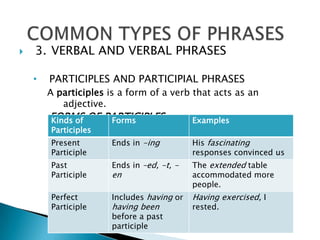
   3. VERBAL AND VERBAL PHRASES

    •   PARTICIPLES AND PARTICIPIAL PHRASES
        A participles is a form of a verb that acts as an
           adjective.
        FORMS OF PARTICIPLES
        Kinds of  Forms                    Examples
        Participles
        Present       Ends in -ing         His fascinating
        Participle                         responses convinced us
        Past          Ends in –ed, -t, -   The extended table
        Participle    en                   accommodated more
                                           people.
        Perfect       Includes having or   Having exercised, I
        Participle    having been          rested.
                      before a past
                      participle
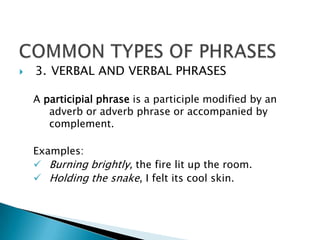
   3. VERBAL AND VERBAL PHRASES

    A participial phrase is a participle modified by an
       adverb or adverb phrase or accompanied by
       complement.

    Examples:
     Burning brightly, the fire lit up the room.
     Holding the snake, I felt its cool skin.
3.   VERBAL AND VERBAL PHRASES

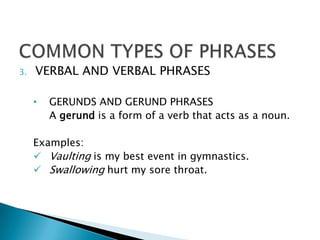
     •   GERUNDS AND GERUND PHRASES
         A gerund is a form of a verb that acts as a noun.

     Examples:
      Vaulting is my best event in gymnastics.
      Swallowing hurt my sore throat.
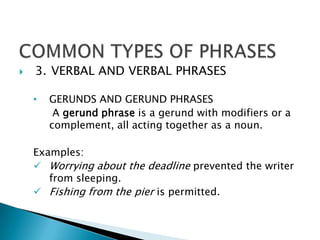
   3. VERBAL AND VERBAL PHRASES

    •   GERUNDS AND GERUND PHRASES
         A gerund phrase is a gerund with modifiers or a
        complement, all acting together as a noun.

    Examples:
     Worrying about the deadline prevented the writer
       from sleeping.
     Fishing from the pier is permitted.
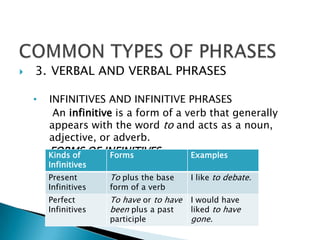
   3. VERBAL AND VERBAL PHRASES

    •   INFINITIVES AND INFINITIVE PHRASES
         An infinitive is a form of a verb that generally
        appears with the word to and acts as a noun,
        adjective, or adverb.
        Kinds of OF
        FORMS         INFINITIVES
                       Forms                Examples
        Infinitives
        Present        To plus the base     I like to debate.
        Infinitives    form of a verb
        Perfect        To have or to have   I would have
        Infinitives    been plus a past     liked to have
                       participle           gone.
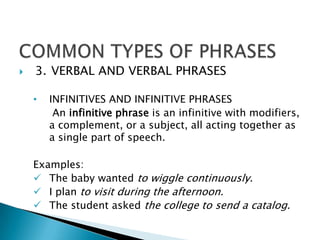
   3. VERBAL AND VERBAL PHRASES

    •   INFINITIVES AND INFINITIVE PHRASES
         An infinitive phrase is an infinitive with modifiers,
        a complement, or a subject, all acting together as
        a single part of speech.

    Examples:
     The baby wanted to wiggle continuously.
     I plan to visit during the afternoon.
     The student asked the college to send a catalog.
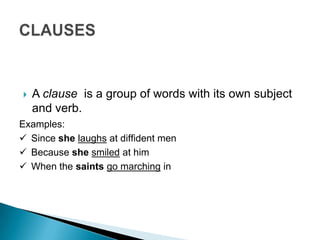
   A clause is a group of words with its own subject
    and verb.
Examples:
 Since she laughs at diffident men
 Because she smiled at him
 When the saints go marching in
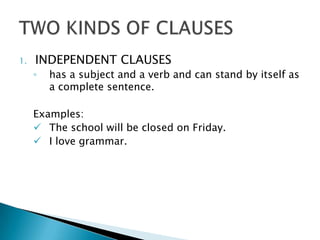
1.   INDEPENDENT CLAUSES
     ◦   has a subject and a verb and can stand by itself as
         a complete sentence.

     Examples:
      The school will be closed on Friday.
      I love grammar.
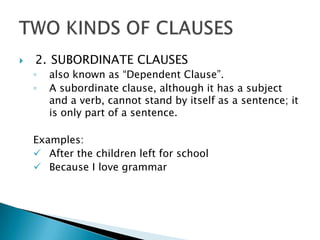
   2. SUBORDINATE CLAUSES
    ◦   also known as “Dependent Clause”.
    ◦   A subordinate clause, although it has a subject
        and a verb, cannot stand by itself as a sentence; it
        is only part of a sentence.

    Examples:
     After the children left for school
     Because I love grammar
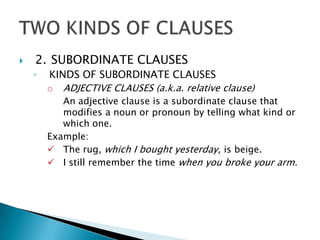
   2. SUBORDINATE CLAUSES
    ◦   KINDS OF SUBORDINATE CLAUSES
        o ADJECTIVE CLAUSES (a.k.a. relative clause)
           An adjective clause is a subordinate clause that
           modifies a noun or pronoun by telling what kind or
           which one.
        Example:
         The rug, which I bought yesterday, is beige.
         I still remember the time when you broke your arm.
   2. SUBORDINATE CLAUSES
    ◦   KINDS OF SUBORDINATE CLAUSES
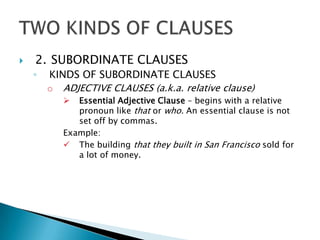
        o ADJECTIVE CLAUSES (a.k.a. relative clause)
             Essential Adjective Clause – begins with a relative
              pronoun like that or who. An essential clause is not
              set off by commas.
           Example:
            The building that they built in San Francisco sold for
              a lot of money.
   2. SUBORDINATE CLAUSES
    ◦   KINDS OF SUBORDINATE CLAUSES
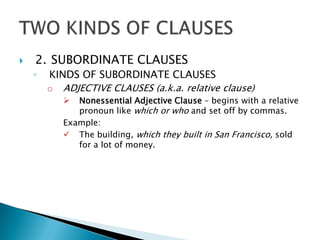
        o ADJECTIVE CLAUSES (a.k.a. relative clause)
             Nonessential Adjective Clause – begins with a relative
              pronoun like which or who and set off by commas.
           Example:
            The building, which they built in San Francisco, sold
              for a lot of money.
   2. SUBORDINATE CLAUSES
    ◦   KINDS OF SUBORDINATE CLAUSES
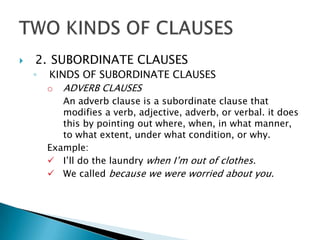
        o ADVERB CLAUSES
           An adverb clause is a subordinate clause that
           modifies a verb, adjective, adverb, or verbal. it does
           this by pointing out where, when, in what manner,
           to what extent, under what condition, or why.
        Example:
         I’ll do the laundry when I’m out of clothes.
         We called because we were worried about you.
   2. SUBORDINATE CLAUSES
    ◦   KINDS OF SUBORDINATE CLAUSES
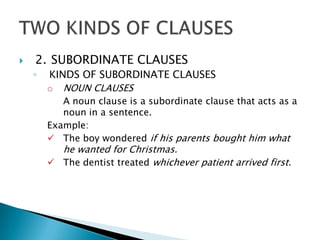
        o NOUN CLAUSES
           A noun clause is a subordinate clause that acts as a
           noun in a sentence.
        Example:
         The boy wondered if his parents bought him what
          he wanted for Christmas.
         The dentist treated whichever patient arrived first.
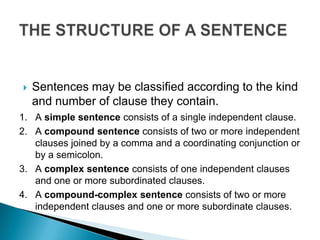
   Sentences may be classified according to the kind
    and number of clause they contain.
1. A simple sentence consists of a single independent clause.
2. A compound sentence consists of two or more independent
   clauses joined by a comma and a coordinating conjunction or
   by a semicolon.
3. A complex sentence consists of one independent clauses
   and one or more subordinated clauses.
4. A compound-complex sentence consists of two or more
   independent clauses and one or more subordinate clauses.
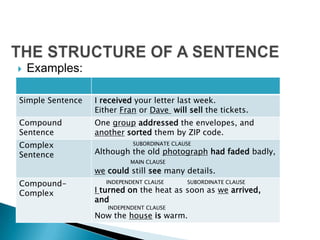
   Examples:

Simple Sentence   I received your letter last week.
                  Either Fran or Dave will sell the tickets.
Compound          One group addressed the envelopes, and
Sentence          another sorted them by ZIP code.
Complex                      SUBORDINATE CLAUSE

Sentence          Although the old photograph had faded badly,
                            MAIN CLAUSE
                  we could still see many details.
Compound-            INDEPENDENT CLAUSE      SUBORDINATE CLAUSE

Complex           I turned on the heat as soon as we arrived,
                  and
                     INDEPENDENT CLAUSE
                  Now the house is warm.
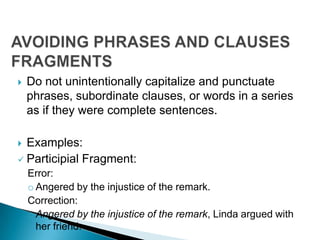
   Do not unintentionally capitalize and punctuate
    phrases, subordinate clauses, or words in a series
    as if they were complete sentences.

 Examples:
 Participial Fragment:
    Error:
    o Angered by the injustice of the remark.
    Correction:
    o Angered by the injustice of the remark, Linda argued with
      her friend.
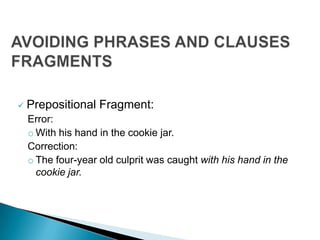
   Prepositional Fragment:
    Error:
    o With his hand in the cookie jar.
    Correction:
    o The four-year old culprit was caught with his hand in the
      cookie jar.
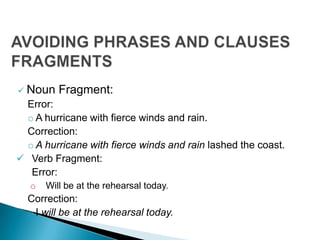
   Noun Fragment:
 Error:
 o A hurricane with fierce winds and rain.
 Correction:
 o A hurricane with fierce winds and rain lashed the coast.
 Verb Fragment:
  Error:
    o   Will be at the rehearsal today.
    Correction:
    o I will be at the rehearsal today.

Phrases and clauses

  • 2.
    A phrase is a group of words, without a subject and verb, that functions in a sentence as one part of speech. Examples:  leaving behind the dog  smashing into a fence  before the first test
  • 3.
    1. PREPOSITIONAL PHRASES • contain a preposition and a noun or pronoun called the object of the preposition. Examples: PREP OBJ OF PRE  on the freshly pressed white jacket PREP OBJ OF PREP OBJ OF PREP  beside the driftwood and seaweed
  • 4.
    Prepositional phrases modify adjectives or adverbs and are called either adjective phrases or adverb phrases.  Adjective phrase is a prepositional phrase that modifies a noun or pronoun by telling what kind or which one.  Examples:  For Tom, fame is the only reason for writing. (What kind of reason?)  The lamp on Tom’s desk was a Christmas gift. (Which lamp?)
  • 5.
    Adverb phrase is a prepositional phrase that modifies a verb, an adjective, or adverb by pointing out where, when, in what manner, or to what extent.  Examples:  Wanting to impress Sue, Tom planned to make reservations at an expensive restaurant. (Make reservations where?)  The volcano rumbled in the early morning. (Rumbled when?)  Tom consumed the sundae in short order. (Consumed in what manner?)  The shovel bit deep into the earth. (Deep to what extent?)
  • 6.
    2. APPOSITIVE AND APPOSITIVE PHRASES • are words placed next to nouns and pronouns to provide additional information. An appositive is a noun or pronoun placed next to another noun or pronoun to identify, rename, or explain it. Examples:  She did not care for his hobby, running.  My friend Marilyn broke her collarbone.
  • 7.
    An appositive phraseis a noun or pronoun with modifiers placed next to a noun or pronoun to add information and details. Examples:  My jacket, a windbreaker, fits well. (with a subject)  I bought a book, an international atlas. (with a direct object)  The man gave his wife, his partner for ten years, a beautiful opal ring. (with an indirect object)
  • 8.
    To set upcontrasts, appositives and appositive phrase may begin with the word not. Example:  You should leave at seven o’clock, not eight o’clock. Appositives and appositive phrases can be compound. Example:  The family -Trapp, his wife, and his children- escaped from Austria during World War II.
  • 9.
    Two sentences canbe combined by turning the information in one sentence into an appositive. Examples: Two sentences: The fruit was picked. The fruit was sun-ripened pears. Sentence with appositive phrase: The fruit, sun- ripened pears, was picked.
  • 10.
    3. VERBAL AND VERBAL PHRASES • A verbal is a word derived from a verb but used as a noun, adjective, or adverb. • A verbal with modifiers or a complement is called a verbal phrase. • There are three kinds of verbals – participles, gerunds, and infinitives – and the phrases that can be formed around them.
  • 11.
    3. VERBAL AND VERBAL PHRASES • PARTICIPLES AND PARTICIPIAL PHRASES A participles is a form of a verb that acts as an adjective. FORMS OF PARTICIPLES Kinds of Forms Examples Participles Present Ends in -ing His fascinating Participle responses convinced us Past Ends in –ed, -t, - The extended table Participle en accommodated more people. Perfect Includes having or Having exercised, I Participle having been rested. before a past participle
  • 12.
    3. VERBAL AND VERBAL PHRASES A participial phrase is a participle modified by an adverb or adverb phrase or accompanied by complement. Examples:  Burning brightly, the fire lit up the room.  Holding the snake, I felt its cool skin.
  • 13.
    3. VERBAL AND VERBAL PHRASES • GERUNDS AND GERUND PHRASES A gerund is a form of a verb that acts as a noun. Examples:  Vaulting is my best event in gymnastics.  Swallowing hurt my sore throat.
  • 14.
    3. VERBAL AND VERBAL PHRASES • GERUNDS AND GERUND PHRASES A gerund phrase is a gerund with modifiers or a complement, all acting together as a noun. Examples:  Worrying about the deadline prevented the writer from sleeping.  Fishing from the pier is permitted.
  • 15.
    3. VERBAL AND VERBAL PHRASES • INFINITIVES AND INFINITIVE PHRASES An infinitive is a form of a verb that generally appears with the word to and acts as a noun, adjective, or adverb. Kinds of OF FORMS INFINITIVES Forms Examples Infinitives Present To plus the base I like to debate. Infinitives form of a verb Perfect To have or to have I would have Infinitives been plus a past liked to have participle gone.
  • 16.
    3. VERBAL AND VERBAL PHRASES • INFINITIVES AND INFINITIVE PHRASES An infinitive phrase is an infinitive with modifiers, a complement, or a subject, all acting together as a single part of speech. Examples:  The baby wanted to wiggle continuously.  I plan to visit during the afternoon.  The student asked the college to send a catalog.
  • 17.
    A clause is a group of words with its own subject and verb. Examples:  Since she laughs at diffident men  Because she smiled at him  When the saints go marching in
  • 18.
    1. INDEPENDENT CLAUSES ◦ has a subject and a verb and can stand by itself as a complete sentence. Examples:  The school will be closed on Friday.  I love grammar.
  • 19.
    2. SUBORDINATE CLAUSES ◦ also known as “Dependent Clause”. ◦ A subordinate clause, although it has a subject and a verb, cannot stand by itself as a sentence; it is only part of a sentence. Examples:  After the children left for school  Because I love grammar
  • 20.
    2. SUBORDINATE CLAUSES ◦ KINDS OF SUBORDINATE CLAUSES o ADJECTIVE CLAUSES (a.k.a. relative clause) An adjective clause is a subordinate clause that modifies a noun or pronoun by telling what kind or which one. Example:  The rug, which I bought yesterday, is beige.  I still remember the time when you broke your arm.
  • 21.
    2. SUBORDINATE CLAUSES ◦ KINDS OF SUBORDINATE CLAUSES o ADJECTIVE CLAUSES (a.k.a. relative clause)  Essential Adjective Clause – begins with a relative pronoun like that or who. An essential clause is not set off by commas. Example:  The building that they built in San Francisco sold for a lot of money.
  • 22.
    2. SUBORDINATE CLAUSES ◦ KINDS OF SUBORDINATE CLAUSES o ADJECTIVE CLAUSES (a.k.a. relative clause)  Nonessential Adjective Clause – begins with a relative pronoun like which or who and set off by commas. Example:  The building, which they built in San Francisco, sold for a lot of money.
  • 23.
    2. SUBORDINATE CLAUSES ◦ KINDS OF SUBORDINATE CLAUSES o ADVERB CLAUSES An adverb clause is a subordinate clause that modifies a verb, adjective, adverb, or verbal. it does this by pointing out where, when, in what manner, to what extent, under what condition, or why. Example:  I’ll do the laundry when I’m out of clothes.  We called because we were worried about you.
  • 24.
    2. SUBORDINATE CLAUSES ◦ KINDS OF SUBORDINATE CLAUSES o NOUN CLAUSES A noun clause is a subordinate clause that acts as a noun in a sentence. Example:  The boy wondered if his parents bought him what he wanted for Christmas.  The dentist treated whichever patient arrived first.
  • 25.
    Sentences may be classified according to the kind and number of clause they contain. 1. A simple sentence consists of a single independent clause. 2. A compound sentence consists of two or more independent clauses joined by a comma and a coordinating conjunction or by a semicolon. 3. A complex sentence consists of one independent clauses and one or more subordinated clauses. 4. A compound-complex sentence consists of two or more independent clauses and one or more subordinate clauses.
  • 26.
    Examples: Simple Sentence I received your letter last week. Either Fran or Dave will sell the tickets. Compound One group addressed the envelopes, and Sentence another sorted them by ZIP code. Complex SUBORDINATE CLAUSE Sentence Although the old photograph had faded badly, MAIN CLAUSE we could still see many details. Compound- INDEPENDENT CLAUSE SUBORDINATE CLAUSE Complex I turned on the heat as soon as we arrived, and INDEPENDENT CLAUSE Now the house is warm.
  • 27.
    Do not unintentionally capitalize and punctuate phrases, subordinate clauses, or words in a series as if they were complete sentences.  Examples:  Participial Fragment: Error: o Angered by the injustice of the remark. Correction: o Angered by the injustice of the remark, Linda argued with her friend.
  • 28.
    Prepositional Fragment: Error: o With his hand in the cookie jar. Correction: o The four-year old culprit was caught with his hand in the cookie jar.
  • 29.
    Noun Fragment: Error: o A hurricane with fierce winds and rain. Correction: o A hurricane with fierce winds and rain lashed the coast.  Verb Fragment: Error: o Will be at the rehearsal today. Correction: o I will be at the rehearsal today.