Participle Adjectives
Past participle adjectives
Present participle adjectives
Tara L. Lockhart
Participle adjectives
These are adjectives that come from verbs that
end in ‘ed’ or ‘ing’ (often describe feelings)
(verb)
The magician amazed the audience with his tricks.
(present participle adjective)
The magician is amazing.
(past participle adjective)
The audience felt amazed when the magician disappeared.
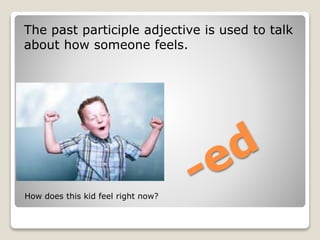
The past participle adjective is used to talk
about how someone feels.
How does this kid feel right now?
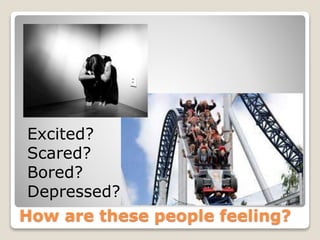
How are these people feeling?
Excited?
Scared?
Bored?
Depressed?
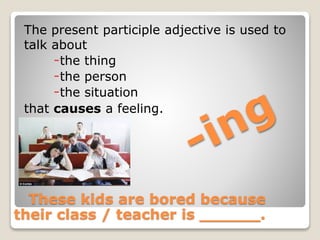
The present participle adjective is used to
talk about
-the thing
-the person
-the situation
that causes a feeling.
These kids are bored because
their class / teacher is ______.
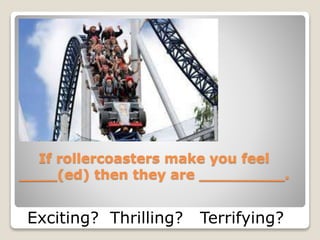
If rollercoasters make you feel
____(ed) then they are _________.
Exciting? Thrilling? Terrifying?
Speaking Time
Ask your partner some questions using past and present
participle adjectives.
Use the adjectives in your answers.
(Questions are on the next slide) 
1. What is the most exciting place you have ever been?
2. What is the most thrilling movie you have ever seen?
3. What is something that makes you feel depressed?
4. Name someone in your family that makes you feel annoyed?
5. What career do you think is demanding?
6. If you were homesick, what would make you feel comforted?
7. What would be the most confusing thing about your language
for someone to learn?
8. What is something that you think is relaxing?
9. What do you do to feel energized?
10. What is something that would be challenging to do?
11. Some books / movies like “P.S. I love you” are very
touching, what book/movie have you read that you think is
touching.
12. When was the last time you felt disappointed? Why?
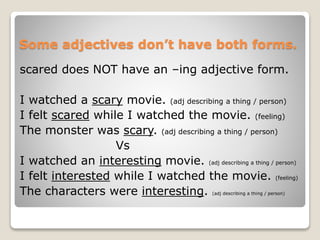
Some adjectives don’t have both forms.
scared does NOT have an –ing adjective form.
I watched a scary movie. (adj describing a thing / person)
I felt scared while I watched the movie. (feeling)
The monster was scary. (adj describing a thing / person)
Vs
I watched an interesting movie. (adj describing a thing / person)
I felt interested while I watched the movie. (feeling)
The characters were interesting. (adj describing a thing / person)
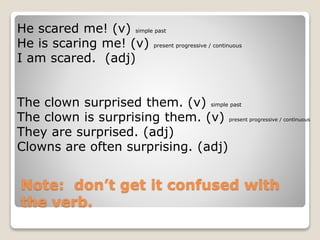
Note: don’t get it confused with
the verb.
He scared me! (v) simple past
He is scaring me! (v) present progressive / continuous
I am scared. (adj)
The clown surprised them. (v) simple past
The clown is surprising them. (v) present progressive / continuous
They are surprised. (adj)
Clowns are often surprising. (adj)
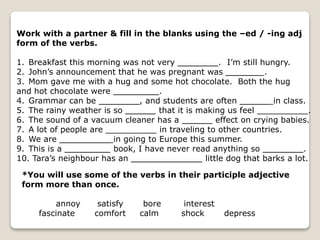
Work with a partner & fill in the blanks using the –ed / -ing adj
form of the verbs.
1. Breakfast this morning was not very ________. I’m still hungry.
2. John’s announcement that he was pregnant was _______ .
3. Mom gave me with a hug and some hot chocolate. Both the hug
and hot chocolate were _________.
4. Grammar can be ________, and students are often ______ in class.
5. The rainy weather is so ______ that it is making us feel __________.
6. The sound of a vacuum cleaner has a ______ effect on crying babies.
7. A lot of people are __________ in traveling to other countries.
8. We are __________ in going to Europe this summer.
9. This is a _________ book, I have never read anything so ________.
10. Tara’s neighbour has an ______________ little dog that barks a lot.
*You will use some of the verbs in their participle adjective
form more than once.
annoy satisfy bore interest
fascinate comfort calm shock depress
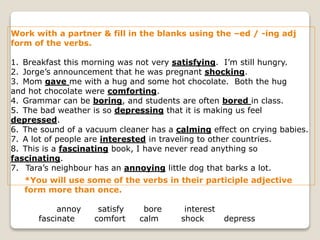
Work with a partner & fill in the blanks using the –ed / -ing adj
form of the verbs.
1. Breakfast this morning was not very satisfying. I’m still hungry.
2. Jorge’s announcement that he was pregnant shocking.
3. Mom gave me with a hug and some hot chocolate. Both the hug
and hot chocolate were comforting.
4. Grammar can be boring, and students are often bored in class.
5. The bad weather is so depressing that it is making us feel
depressed.
6. The sound of a vacuum cleaner has a calming effect on crying babies.
7. A lot of people are interested in traveling to other countries.
8. This is a fascinating book, I have never read anything so
fascinating.
7. Tara’s neighbour has an annoying little dog that barks a lot.
*You will use some of the verbs in their participle adjective
form more than once.
annoy satisfy bore interest
fascinate comfort calm shock depress
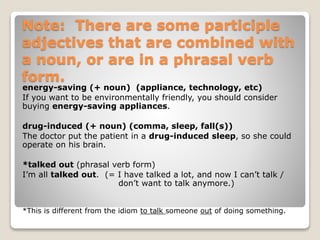
Note: There are some participle
adjectives that are combined with
a noun, or are in a phrasal verb
form.
energy-saving (+ noun) (appliance, technology, etc)
If you want to be environmentally friendly, you should consider
buying energy-saving appliances.
drug-induced (+ noun) (comma, sleep, fall(s))
The doctor put the patient in a drug-induced sleep, so she could
operate on his brain.
*talked out (phrasal verb form)
I’m all talked out. (= I have talked a lot, and now I can’t talk /
don’t want to talk anymore.)
*This is different from the idiom to talk someone out of doing something.
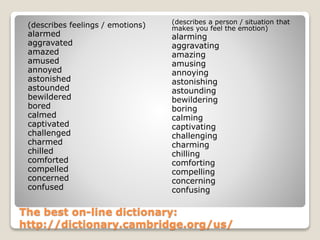
The best on-line dictionary:
http://dictionary.cambridge.org/us/
(describes a person / situation that
makes you feel the emotion)
alarming
aggravating
amazing
amusing
annoying
astonishing
astounding
bewildering
boring
calming
captivating
challenging
charming
chilling
comforting
compelling
concerning
confusing
(describes feelings / emotions)
alarmed
aggravated
amazed
amused
annoyed
astonished
astounded
bewildered
bored
calmed
captivated
challenged
charmed
chilled
comforted
compelled
concerned
confused
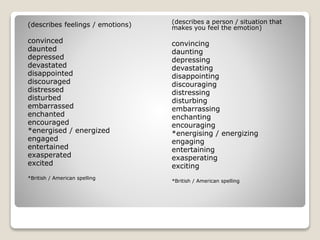
(describes a person / situation that
makes you feel the emotion)
convincing
daunting
depressing
devastating
disappointing
discouraging
distressing
disturbing
embarrassing
enchanting
encouraging
*energising / energizing
engaging
entertaining
exasperating
exciting
*British / American spelling
(describes feelings / emotions)
convinced
daunted
depressed
devastated
disappointed
discouraged
distressed
disturbed
embarrassed
enchanted
encouraged
*energised / energized
engaged
entertained
exasperated
excited
*British / American spelling
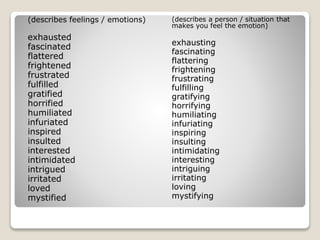
(describes a person / situation that
makes you feel the emotion)
exhausting
fascinating
flattering
frightening
frustrating
fulfilling
gratifying
horrifying
humiliating
infuriating
inspiring
insulting
intimidating
interesting
intriguing
irritating
loving
mystifying
(describes feelings / emotions)
exhausted
fascinated
flattered
frightened
frustrated
fulfilled
gratified
horrified
humiliated
infuriated
inspired
insulted
interested
intimidated
intrigued
irritated
loved
mystified
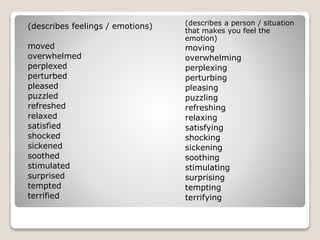
(describes a person / situation
that makes you feel the
emotion)
moving
overwhelming
perplexing
perturbing
pleasing
puzzling
refreshing
relaxing
satisfying
shocking
sickening
soothing
stimulating
surprising
tempting
terrifying
(describes feelings / emotions)
moved
overwhelmed
perplexed
perturbed
pleased
puzzled
refreshed
relaxed
satisfied
shocked
sickened
soothed
stimulated
surprised
tempted
terrified
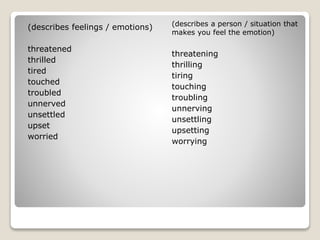
(describes a person / situation that
makes you feel the emotion)
threatening
thrilling
tiring
touching
troubling
unnerving
unsettling
upsetting
worrying
(describes feelings / emotions)
threatened
thrilled
tired
touched
troubled
unnerved
unsettled
upset
worried

Participle Adjectives

  • 1.
    Participle Adjectives Past participleadjectives Present participle adjectives Tara L. Lockhart
  • 2.
    Participle adjectives These areadjectives that come from verbs that end in ‘ed’ or ‘ing’ (often describe feelings) (verb) The magician amazed the audience with his tricks. (present participle adjective) The magician is amazing. (past participle adjective) The audience felt amazed when the magician disappeared.
  • 3.
    The past participleadjective is used to talk about how someone feels. How does this kid feel right now?
  • 4.
    How are thesepeople feeling? Excited? Scared? Bored? Depressed?
  • 5.
    The present participleadjective is used to talk about -the thing -the person -the situation that causes a feeling. These kids are bored because their class / teacher is ______.
  • 6.
    If rollercoasters makeyou feel ____(ed) then they are _________. Exciting? Thrilling? Terrifying?
  • 7.
    Speaking Time Ask yourpartner some questions using past and present participle adjectives. Use the adjectives in your answers. (Questions are on the next slide) 
  • 8.
    1. What isthe most exciting place you have ever been? 2. What is the most thrilling movie you have ever seen? 3. What is something that makes you feel depressed? 4. Name someone in your family that makes you feel annoyed? 5. What career do you think is demanding? 6. If you were homesick, what would make you feel comforted? 7. What would be the most confusing thing about your language for someone to learn? 8. What is something that you think is relaxing? 9. What do you do to feel energized? 10. What is something that would be challenging to do? 11. Some books / movies like “P.S. I love you” are very touching, what book/movie have you read that you think is touching. 12. When was the last time you felt disappointed? Why?
  • 9.
    Some adjectives don’thave both forms. scared does NOT have an –ing adjective form. I watched a scary movie. (adj describing a thing / person) I felt scared while I watched the movie. (feeling) The monster was scary. (adj describing a thing / person) Vs I watched an interesting movie. (adj describing a thing / person) I felt interested while I watched the movie. (feeling) The characters were interesting. (adj describing a thing / person)
  • 10.
    Note: don’t getit confused with the verb. He scared me! (v) simple past He is scaring me! (v) present progressive / continuous I am scared. (adj) The clown surprised them. (v) simple past The clown is surprising them. (v) present progressive / continuous They are surprised. (adj) Clowns are often surprising. (adj)
  • 11.
    Work with apartner & fill in the blanks using the –ed / -ing adj form of the verbs. 1. Breakfast this morning was not very ________. I’m still hungry. 2. John’s announcement that he was pregnant was _______ . 3. Mom gave me with a hug and some hot chocolate. Both the hug and hot chocolate were _________. 4. Grammar can be ________, and students are often ______ in class. 5. The rainy weather is so ______ that it is making us feel __________. 6. The sound of a vacuum cleaner has a ______ effect on crying babies. 7. A lot of people are __________ in traveling to other countries. 8. We are __________ in going to Europe this summer. 9. This is a _________ book, I have never read anything so ________. 10. Tara’s neighbour has an ______________ little dog that barks a lot. *You will use some of the verbs in their participle adjective form more than once. annoy satisfy bore interest fascinate comfort calm shock depress
  • 12.
    Work with apartner & fill in the blanks using the –ed / -ing adj form of the verbs. 1. Breakfast this morning was not very satisfying. I’m still hungry. 2. Jorge’s announcement that he was pregnant shocking. 3. Mom gave me with a hug and some hot chocolate. Both the hug and hot chocolate were comforting. 4. Grammar can be boring, and students are often bored in class. 5. The bad weather is so depressing that it is making us feel depressed. 6. The sound of a vacuum cleaner has a calming effect on crying babies. 7. A lot of people are interested in traveling to other countries. 8. This is a fascinating book, I have never read anything so fascinating. 7. Tara’s neighbour has an annoying little dog that barks a lot. *You will use some of the verbs in their participle adjective form more than once. annoy satisfy bore interest fascinate comfort calm shock depress
  • 13.
    Note: There aresome participle adjectives that are combined with a noun, or are in a phrasal verb form. energy-saving (+ noun) (appliance, technology, etc) If you want to be environmentally friendly, you should consider buying energy-saving appliances. drug-induced (+ noun) (comma, sleep, fall(s)) The doctor put the patient in a drug-induced sleep, so she could operate on his brain. *talked out (phrasal verb form) I’m all talked out. (= I have talked a lot, and now I can’t talk / don’t want to talk anymore.) *This is different from the idiom to talk someone out of doing something.
  • 14.
    The best on-linedictionary: http://dictionary.cambridge.org/us/ (describes a person / situation that makes you feel the emotion) alarming aggravating amazing amusing annoying astonishing astounding bewildering boring calming captivating challenging charming chilling comforting compelling concerning confusing (describes feelings / emotions) alarmed aggravated amazed amused annoyed astonished astounded bewildered bored calmed captivated challenged charmed chilled comforted compelled concerned confused
  • 15.
    (describes a person/ situation that makes you feel the emotion) convincing daunting depressing devastating disappointing discouraging distressing disturbing embarrassing enchanting encouraging *energising / energizing engaging entertaining exasperating exciting *British / American spelling (describes feelings / emotions) convinced daunted depressed devastated disappointed discouraged distressed disturbed embarrassed enchanted encouraged *energised / energized engaged entertained exasperated excited *British / American spelling
  • 16.
    (describes a person/ situation that makes you feel the emotion) exhausting fascinating flattering frightening frustrating fulfilling gratifying horrifying humiliating infuriating inspiring insulting intimidating interesting intriguing irritating loving mystifying (describes feelings / emotions) exhausted fascinated flattered frightened frustrated fulfilled gratified horrified humiliated infuriated inspired insulted interested intimidated intrigued irritated loved mystified
  • 17.
    (describes a person/ situation that makes you feel the emotion) moving overwhelming perplexing perturbing pleasing puzzling refreshing relaxing satisfying shocking sickening soothing stimulating surprising tempting terrifying (describes feelings / emotions) moved overwhelmed perplexed perturbed pleased puzzled refreshed relaxed satisfied shocked sickened soothed stimulated surprised tempted terrified
  • 18.
    (describes a person/ situation that makes you feel the emotion) threatening thrilling tiring touching troubling unnerving unsettling upsetting worrying (describes feelings / emotions) threatened thrilled tired touched troubled unnerved unsettled upset worried

Editor's Notes

  • #14 http://grammar.yourdictionary.com/parts-of-speech/adjectives/what-is-a-participial-adjective.html
  • #19 Tara L. Lockhart