Navleen Multani
 Group of words having a syntactic structure , subject
and predicate of its own.
 Group of words which form a part of sentence.
 Can stand on its own.
 May or may not make complete sense
 May be classified as either main or subordinate
(depending on whether it makes complete sense or not
 Part of a larger sentence
oThere are two clauses in the
sentence
Sentence 1
My father travels by train till the New
Delhi Railway Station and then takes
a bus to reach his office in Noida .
(Subject Predicate )
Sentence 2
I met your cousin who has blue eyes .
oClause 1 – I met your cousin
oClause 2 – who has blue eyes
• Sentence 3 – It has a single independent
clause
The eleventh edition is out of stock.
Main/Independent/Principal Clause
In Sentence 2, the first clause is complete in
itself and thus is Independent.
Main or Independent or Principal Clause
expresses complete sense on its own.
Dependent or Subordinate Clause
In Sentence 2 , the second clause cannot stand by
itself.
Dependent or subordinate clause cannot stand by
itself and begins with a subordinating conjunction
Subordinate clause may precede , follow or be
embedded in the main clause.
Examples: (a) Since Alok was the most qualified
applicant , he was offered the job.
(b) Alok was offered the job since he was the most
qualified applicant.
(c) Alok , who was the most qualified applicant ,
was offered the job
•Group of words which contains a
subject and predicate and does the
work of Noun.
•Subordinate clause ;Subordinating
Conjunction introduces /precedes
the Noun clause.
•Nominal clause(nominal means a
word or group of words that
functions as a Noun).
1. I bought a watch .
I bought what I needed the
most.
2.I am looking for a help.
I am looking for someone
who will clean my room daily.
Replace Noun Clause by Noun
Phrase :
1.I don’t believe what he says .
2.He does not know where I live.
3.The doctor is hopeful that she will
soon recover.
Replace the underlined words by
suitable Noun Clause:
1.I heard of his success
2. He confessed his guilt.
3.The reason for his failure will never be
known.
oGroup of words which contains a subject
and predicate of its own and functions as an
Adjective.
oAlso know as relative clauses since they are
introduced by relative pronouns (related to
antecedent)
oSubordinating conjunctions introduce
relative adjectival clauses.
 Restrictive or Defining Relative/Adjective Clause
It gives essential information that identifies or defines
person or thing.
Eating food that is stale can upset the stomach.
The man who killed the King was arrested.
 Non-Restrictive/Non-Defining Adjective Clause
It gives additional information that is not required to identify
person or thing.
Swimming, which is very good sport, makes people healthy.
His parents, who live in New York, have come to visit him.
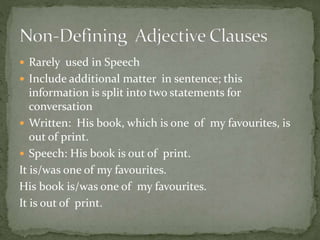
 Rarely used in Speech
 Include additional matter in sentence; this
information is split into two statements for
conversation
 Written: His book, which is one of my favourites, is
out of print.
 Speech: His book is out of print.
It is/was one of my favourites.
His book is/was one of my favourites.
It is out of print.
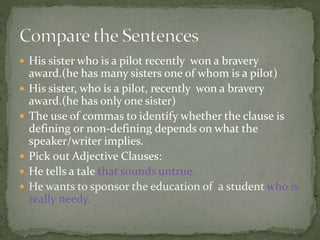
 His sister who is a pilot recently won a bravery
award.(he has many sisters one of whom is a pilot)
 His sister, who is a pilot, recently won a bravery
award.(he has only one sister)
 The use of commas to identify whether the clause is
defining or non-defining depends on what the
speaker/writer implies.
 Pick out Adjective Clauses:
 He tells a tale that sounds untrue.
 He wants to sponsor the education of a student who is
really needy.
 We all admire a man of courage.
 A city on the hill cannot be hid.
 You can have anything of your liking.
Replace Adjective Clauses by Adjectives or Adjective
Phrases:
 People who eat too much die early.
 The reason why he failed is obvious.
 The sun, which at mid-day was hot, made the traveller
thirsty.
 Group of words having a Subject and a Predicate of its
own that function as an Adverb
 Gives more information about Verb; modifies Verb in
the main clause
 Begins with Subordinating Conjunctions – before,
after, because, if, as soon as
 May be present either in the first half or second part
of the Sentence; Comma is used to separate Adverbial
Clause
Example: The girl woke up late.
The girl woke up when she heard the door bell.
 TIME : Call me when dinner is ready.
 MANNER : The child cries as if he is hurt.
 PLACE : This variety does not grow where the climate
is in extreme.
 PURPOSE: The monetary policy was revised in order
to keep to the schedule.
 REASON : Since tomorrow is a holiday , you will have
to complete the work today.
 CONDITION : If it rains, stay indoors.
 COMPARISON : She is as tall as her sister.
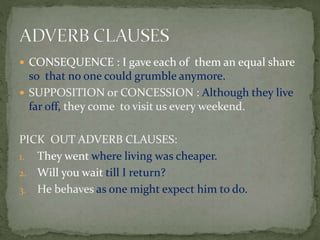
 CONSEQUENCE : I gave each of them an equal share
so that no one could grumble anymore.
 SUPPOSITION or CONCESSION : Although they live
far off, they come to visit us every weekend.
PICK OUT ADVERB CLAUSES:
1. They went where living was cheaper.
2. Will you wait till I return?
3. He behaves as one might expect him to do.
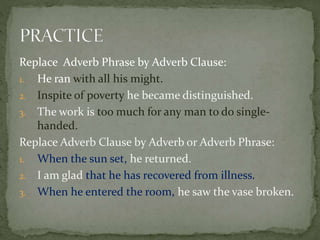
Replace Adverb Phrase by Adverb Clause:
1. He ran with all his might.
2. Inspite of poverty he became distinguished.
3. The work is too much for any man to do single-
handed.
Replace Adverb Clause by Adverb or Adverb Phrase:
1. When the sun set, he returned.
2. I am glad that he has recovered from illness.
3. When he entered the room, he saw the vase broken.
THANK YOU

Clauses

  • 1.
  • 2.
     Group ofwords having a syntactic structure , subject and predicate of its own.  Group of words which form a part of sentence.  Can stand on its own.  May or may not make complete sense  May be classified as either main or subordinate (depending on whether it makes complete sense or not  Part of a larger sentence
  • 3.
    oThere are twoclauses in the sentence Sentence 1 My father travels by train till the New Delhi Railway Station and then takes a bus to reach his office in Noida . (Subject Predicate ) Sentence 2 I met your cousin who has blue eyes . oClause 1 – I met your cousin oClause 2 – who has blue eyes
  • 4.
    • Sentence 3– It has a single independent clause The eleventh edition is out of stock. Main/Independent/Principal Clause In Sentence 2, the first clause is complete in itself and thus is Independent. Main or Independent or Principal Clause expresses complete sense on its own.
  • 5.
    Dependent or SubordinateClause In Sentence 2 , the second clause cannot stand by itself. Dependent or subordinate clause cannot stand by itself and begins with a subordinating conjunction Subordinate clause may precede , follow or be embedded in the main clause. Examples: (a) Since Alok was the most qualified applicant , he was offered the job. (b) Alok was offered the job since he was the most qualified applicant. (c) Alok , who was the most qualified applicant , was offered the job
  • 6.
    •Group of wordswhich contains a subject and predicate and does the work of Noun. •Subordinate clause ;Subordinating Conjunction introduces /precedes the Noun clause. •Nominal clause(nominal means a word or group of words that functions as a Noun).
  • 7.
    1. I boughta watch . I bought what I needed the most. 2.I am looking for a help. I am looking for someone who will clean my room daily.
  • 11.
    Replace Noun Clauseby Noun Phrase : 1.I don’t believe what he says . 2.He does not know where I live. 3.The doctor is hopeful that she will soon recover.
  • 12.
    Replace the underlinedwords by suitable Noun Clause: 1.I heard of his success 2. He confessed his guilt. 3.The reason for his failure will never be known.
  • 13.
    oGroup of wordswhich contains a subject and predicate of its own and functions as an Adjective. oAlso know as relative clauses since they are introduced by relative pronouns (related to antecedent) oSubordinating conjunctions introduce relative adjectival clauses.
  • 14.
     Restrictive orDefining Relative/Adjective Clause It gives essential information that identifies or defines person or thing. Eating food that is stale can upset the stomach. The man who killed the King was arrested.  Non-Restrictive/Non-Defining Adjective Clause It gives additional information that is not required to identify person or thing. Swimming, which is very good sport, makes people healthy. His parents, who live in New York, have come to visit him.
  • 15.
     Rarely usedin Speech  Include additional matter in sentence; this information is split into two statements for conversation  Written: His book, which is one of my favourites, is out of print.  Speech: His book is out of print. It is/was one of my favourites. His book is/was one of my favourites. It is out of print.
  • 16.
     His sisterwho is a pilot recently won a bravery award.(he has many sisters one of whom is a pilot)  His sister, who is a pilot, recently won a bravery award.(he has only one sister)  The use of commas to identify whether the clause is defining or non-defining depends on what the speaker/writer implies.  Pick out Adjective Clauses:  He tells a tale that sounds untrue.  He wants to sponsor the education of a student who is really needy.
  • 17.
     We alladmire a man of courage.  A city on the hill cannot be hid.  You can have anything of your liking. Replace Adjective Clauses by Adjectives or Adjective Phrases:  People who eat too much die early.  The reason why he failed is obvious.  The sun, which at mid-day was hot, made the traveller thirsty.
  • 18.
     Group ofwords having a Subject and a Predicate of its own that function as an Adverb  Gives more information about Verb; modifies Verb in the main clause  Begins with Subordinating Conjunctions – before, after, because, if, as soon as  May be present either in the first half or second part of the Sentence; Comma is used to separate Adverbial Clause Example: The girl woke up late. The girl woke up when she heard the door bell.
  • 19.
     TIME :Call me when dinner is ready.  MANNER : The child cries as if he is hurt.  PLACE : This variety does not grow where the climate is in extreme.  PURPOSE: The monetary policy was revised in order to keep to the schedule.  REASON : Since tomorrow is a holiday , you will have to complete the work today.  CONDITION : If it rains, stay indoors.  COMPARISON : She is as tall as her sister.
  • 20.
     CONSEQUENCE :I gave each of them an equal share so that no one could grumble anymore.  SUPPOSITION or CONCESSION : Although they live far off, they come to visit us every weekend. PICK OUT ADVERB CLAUSES: 1. They went where living was cheaper. 2. Will you wait till I return? 3. He behaves as one might expect him to do.
  • 21.
    Replace Adverb Phraseby Adverb Clause: 1. He ran with all his might. 2. Inspite of poverty he became distinguished. 3. The work is too much for any man to do single- handed. Replace Adverb Clause by Adverb or Adverb Phrase: 1. When the sun set, he returned. 2. I am glad that he has recovered from illness. 3. When he entered the room, he saw the vase broken.
  • 22.