Clauses and Phrase
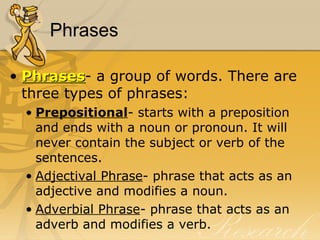
Phrases Phrases - a group of words. There are three types of phrases:  Prepositional - starts with a preposition and ends with a noun or pronoun. It will never contain the subject or verb of the sentences.  Adjectival Phrase - phrase that acts as an adjective and modifies a noun.  Adverbial Phrase - phrase that acts as an adverb and modifies a verb.
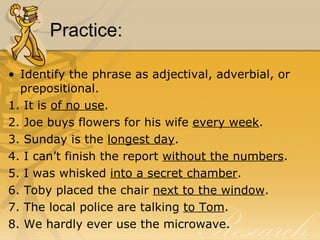
Practice:  Identify the phrase as adjectival, adverbial, or prepositional.  1. It is  of no use .  2. Joe buys flowers for his wife  every week .  3. Sunday is the  longest day .  4. I can’t finish the report  without the numbers .  5. I was whisked  into a secret chamber .  6. Toby placed the chair  next to the window .  7. The local police are talking  to Tom .  8. We hardly ever use the microwave.
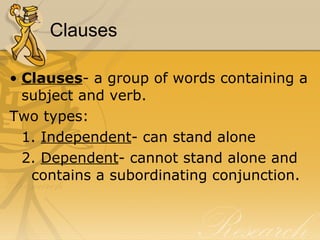
Clauses Clauses - a group of words containing a subject and verb.  Two types:  1.  Independent - can stand alone  2.  Dependent - cannot stand alone and  contains a subordinating conjunction.
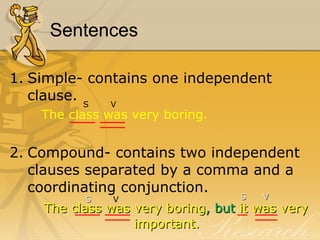
Sentences Simple- contains one independent clause.  The class was very boring.  Compound- contains two independent clauses separated by a comma and a coordinating conjunction.  The class was very boring ,   but  it was very important.  S V S V V S
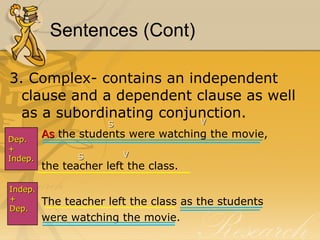
Sentences (Cont) 3. Complex- contains an independent clause and a dependent clause as well as a subordinating conjunction.  As  the students were watching the movie,   the teacher left the class.  The teacher left the class as the students were watching the movie.  Dep.  + Indep. S S V V Indep. +  Dep.
Video- Clauses
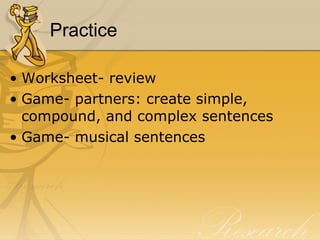
Practice Worksheet- review Game- partners: create simple, compound, and complex sentences Game- musical sentences
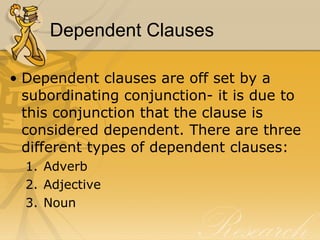
Dependent Clauses Dependent clauses are off set by a subordinating conjunction- it is due to this conjunction that the clause is considered dependent. There are three different types of dependent clauses:  Adverb Adjective Noun
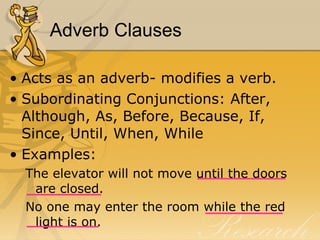
Adverb Clauses Acts as an adverb- modifies a verb.  Subordinating Conjunctions: After, Although, As, Before, Because, If, Since, Until, When, While Examples:  The elevator will not move until the doors are closed.  No one may enter the room while the red light is on.
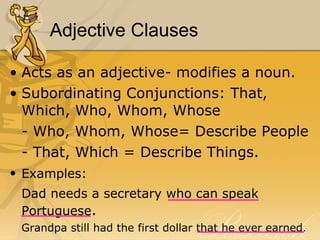
Adjective Clauses Acts as an adjective- modifies a noun.  Subordinating Conjunctions: That, Which, Who, Whom, Whose - Who, Whom, Whose= Describe People - That, Which = Describe Things.  Examples:   Dad needs a secretary who can speak Portuguese .  Grandpa still had the first dollar that he ever earned.
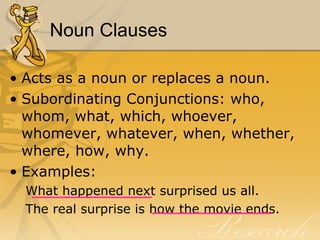
Noun Clauses Acts as a noun or replaces a noun.  Subordinating Conjunctions: who, whom, what, which, whoever, whomever, whatever, when, whether, where, how, why.  Examples:  What happened next surprised us all.  The real surprise is how the movie ends.

Clauses And Phrase

  • 1.
  • 2.
    Phrases Phrases -a group of words. There are three types of phrases: Prepositional - starts with a preposition and ends with a noun or pronoun. It will never contain the subject or verb of the sentences. Adjectival Phrase - phrase that acts as an adjective and modifies a noun. Adverbial Phrase - phrase that acts as an adverb and modifies a verb.
  • 3.
    Practice: Identifythe phrase as adjectival, adverbial, or prepositional. 1. It is of no use . 2. Joe buys flowers for his wife every week . 3. Sunday is the longest day . 4. I can’t finish the report without the numbers . 5. I was whisked into a secret chamber . 6. Toby placed the chair next to the window . 7. The local police are talking to Tom . 8. We hardly ever use the microwave.
  • 4.
    Clauses Clauses -a group of words containing a subject and verb. Two types: 1. Independent - can stand alone 2. Dependent - cannot stand alone and contains a subordinating conjunction.
  • 5.
    Sentences Simple- containsone independent clause. The class was very boring. Compound- contains two independent clauses separated by a comma and a coordinating conjunction. The class was very boring , but it was very important. S V S V V S
  • 6.
    Sentences (Cont) 3.Complex- contains an independent clause and a dependent clause as well as a subordinating conjunction. As the students were watching the movie, the teacher left the class. The teacher left the class as the students were watching the movie. Dep. + Indep. S S V V Indep. + Dep.
  • 7.
  • 8.
    Practice Worksheet- reviewGame- partners: create simple, compound, and complex sentences Game- musical sentences
  • 9.
    Dependent Clauses Dependentclauses are off set by a subordinating conjunction- it is due to this conjunction that the clause is considered dependent. There are three different types of dependent clauses: Adverb Adjective Noun
  • 10.
    Adverb Clauses Actsas an adverb- modifies a verb. Subordinating Conjunctions: After, Although, As, Before, Because, If, Since, Until, When, While Examples: The elevator will not move until the doors are closed. No one may enter the room while the red light is on.
  • 11.
    Adjective Clauses Actsas an adjective- modifies a noun. Subordinating Conjunctions: That, Which, Who, Whom, Whose - Who, Whom, Whose= Describe People - That, Which = Describe Things. Examples: Dad needs a secretary who can speak Portuguese . Grandpa still had the first dollar that he ever earned.
  • 12.
    Noun Clauses Actsas a noun or replaces a noun. Subordinating Conjunctions: who, whom, what, which, whoever, whomever, whatever, when, whether, where, how, why. Examples: What happened next surprised us all. The real surprise is how the movie ends.

Editor's Notes

  • #4 Adjective Adverb Adjective Prepositional Prepositional Adverb Prepositional Adverb