Noun Clauses
A NOUN CLAUSE is a group of words  with a subject and a verb
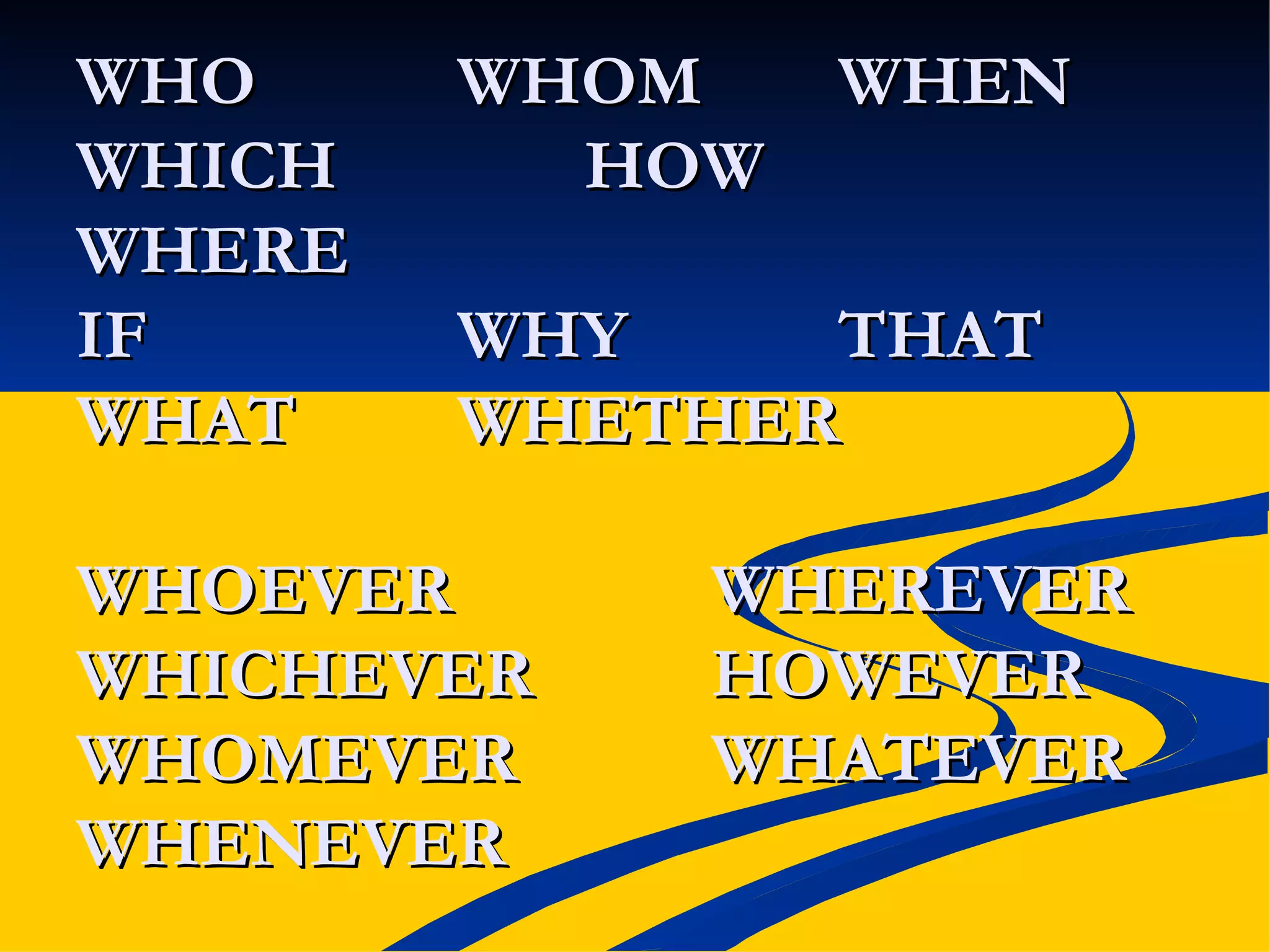
WHO WHOM WHEN WHICH HOW WHERE IF WHY THAT WHAT  WHETHER  WHOEVER WHEREVER WHICHEVER HOWEVER WHOMEVER WHATEVER WHENEVER
You can recognize a  noun clause  by one of the  relative pronouns  or  adverbs  that begin the clause
A  noun clause  consists of three components: A relative pronoun or adverb A subject A verb
Noun clauses  function like  nouns . They can be: subject subject complement object object of prepositions
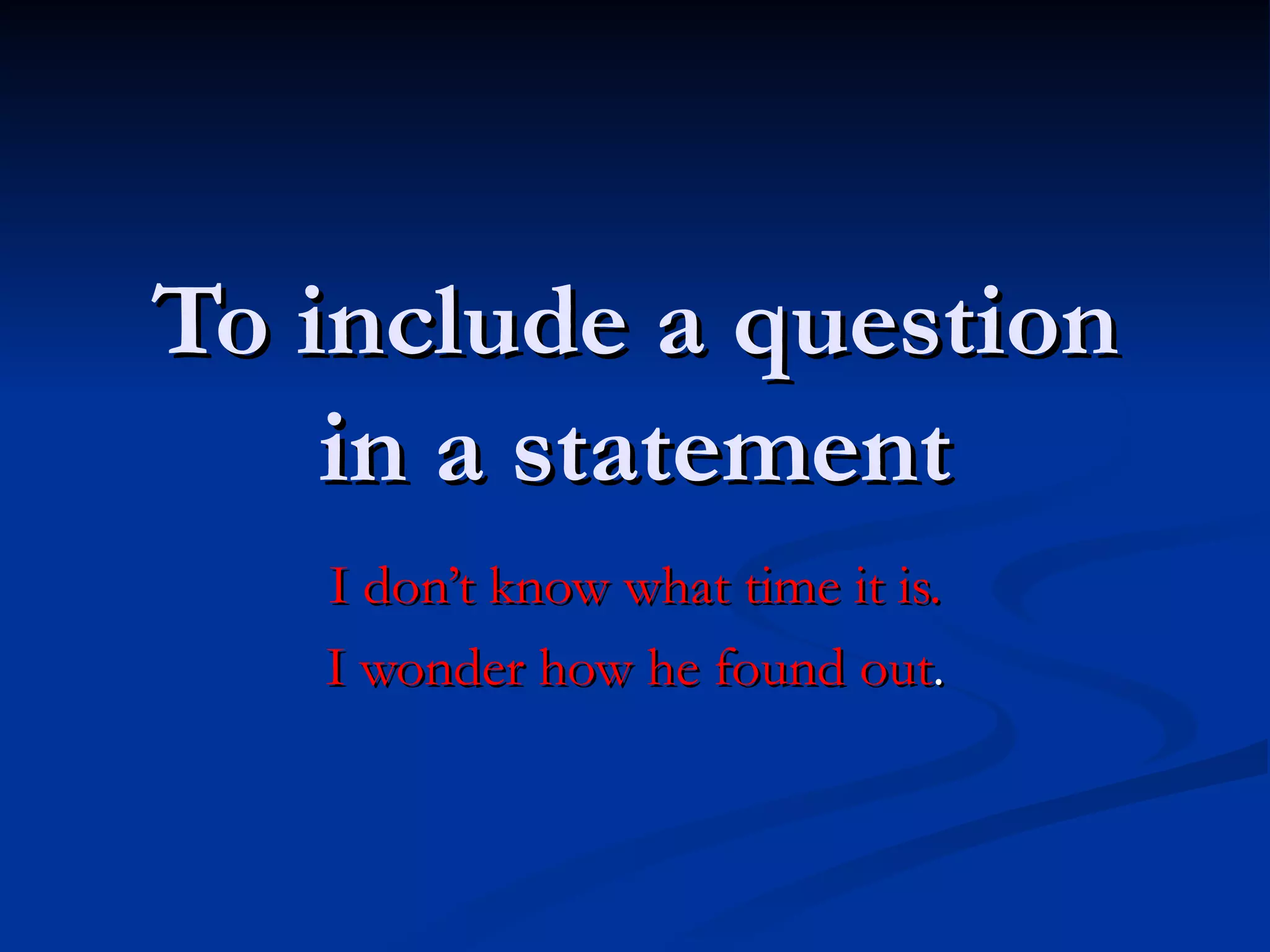
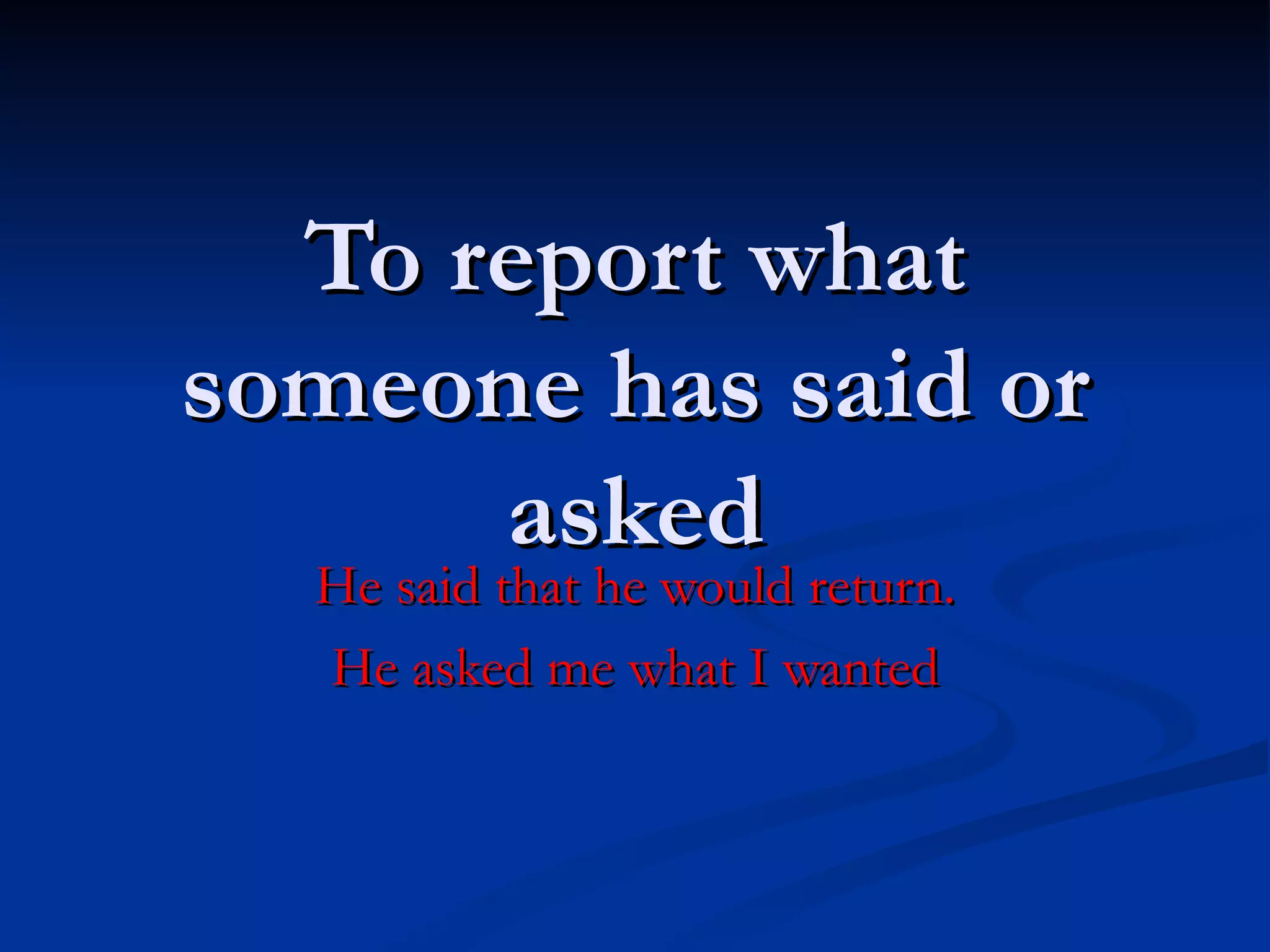
Uses of  Noun Clauses After some verbs and adjectives To include a question in a statement (embedded questions) To report what someone has said or asked
Noun clauses  can follow certain verbs and adjectives that express mental activities Agree notice afraid positive Believe realize angry sorry Decide remember aware surprised Doubt see certain sure Feel show clear worried Forget suppose convinced Guess think disappointed Hear understand glad Hope wonder happy Imagine say pleased Know tell sad
To include a question in a statement I don’t know what time it is. I wonder how he found out .
To report what someone has said or asked He said that he would return. He asked me what I wanted
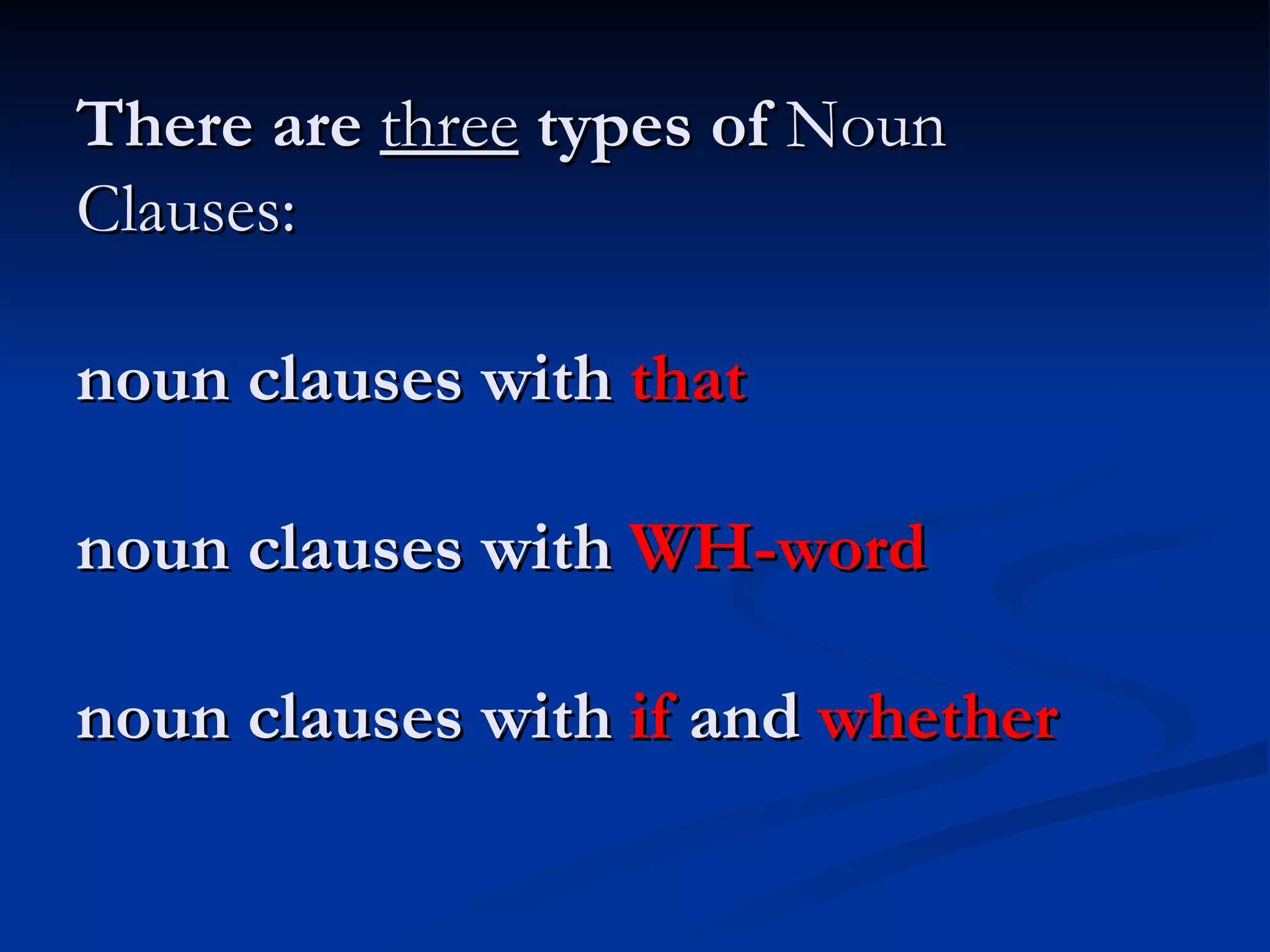
There are  three  types of  Noun  Clauses: noun clauses with  that noun clauses with  WH-word noun clauses with  if  and  whether
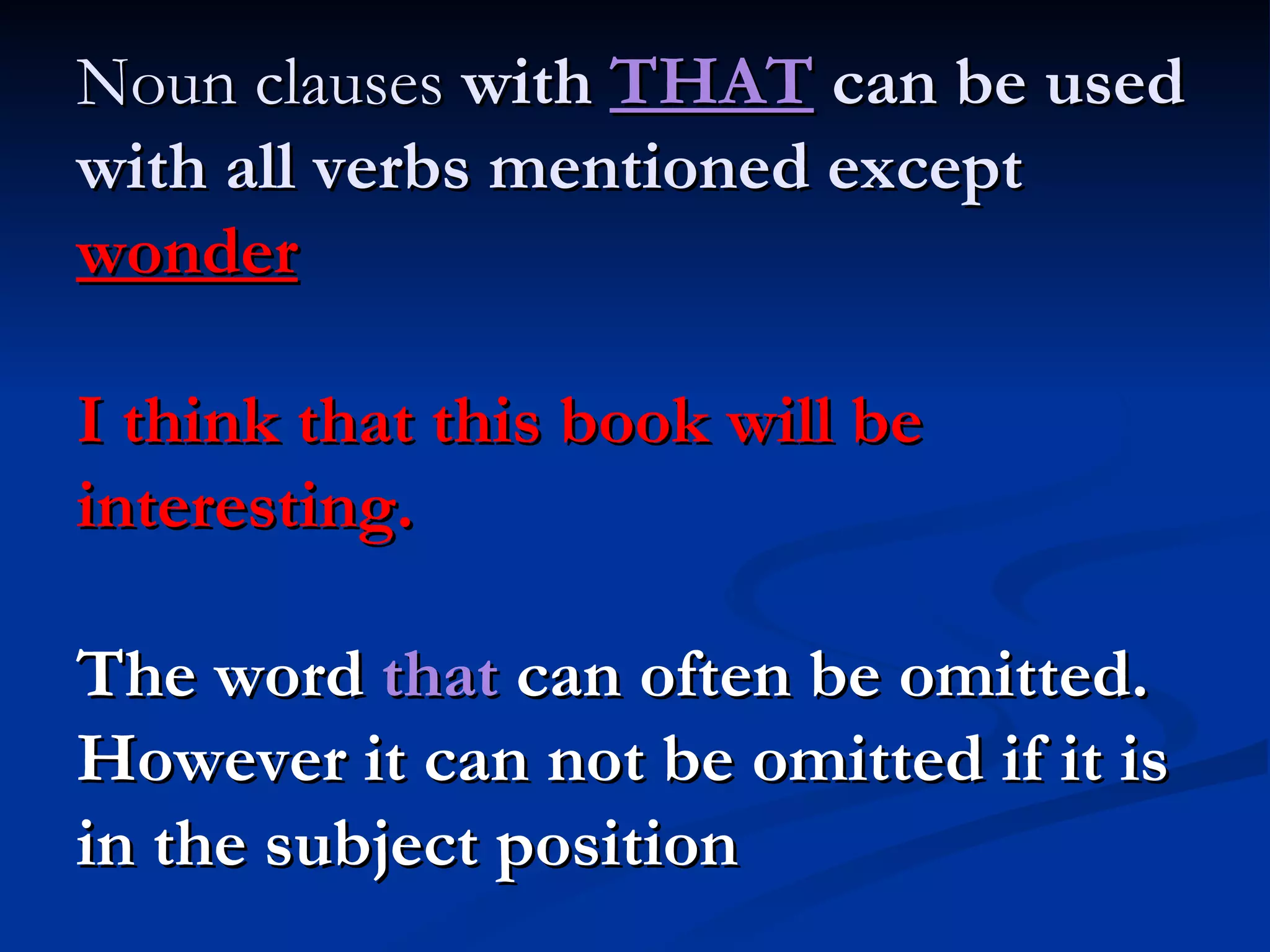
Noun clauses  with  THAT  can be used with all verbs mentioned except  wonder I think that this book will be interesting. The word  that  can often be omitted. However it can not be omitted if it is in the subject position
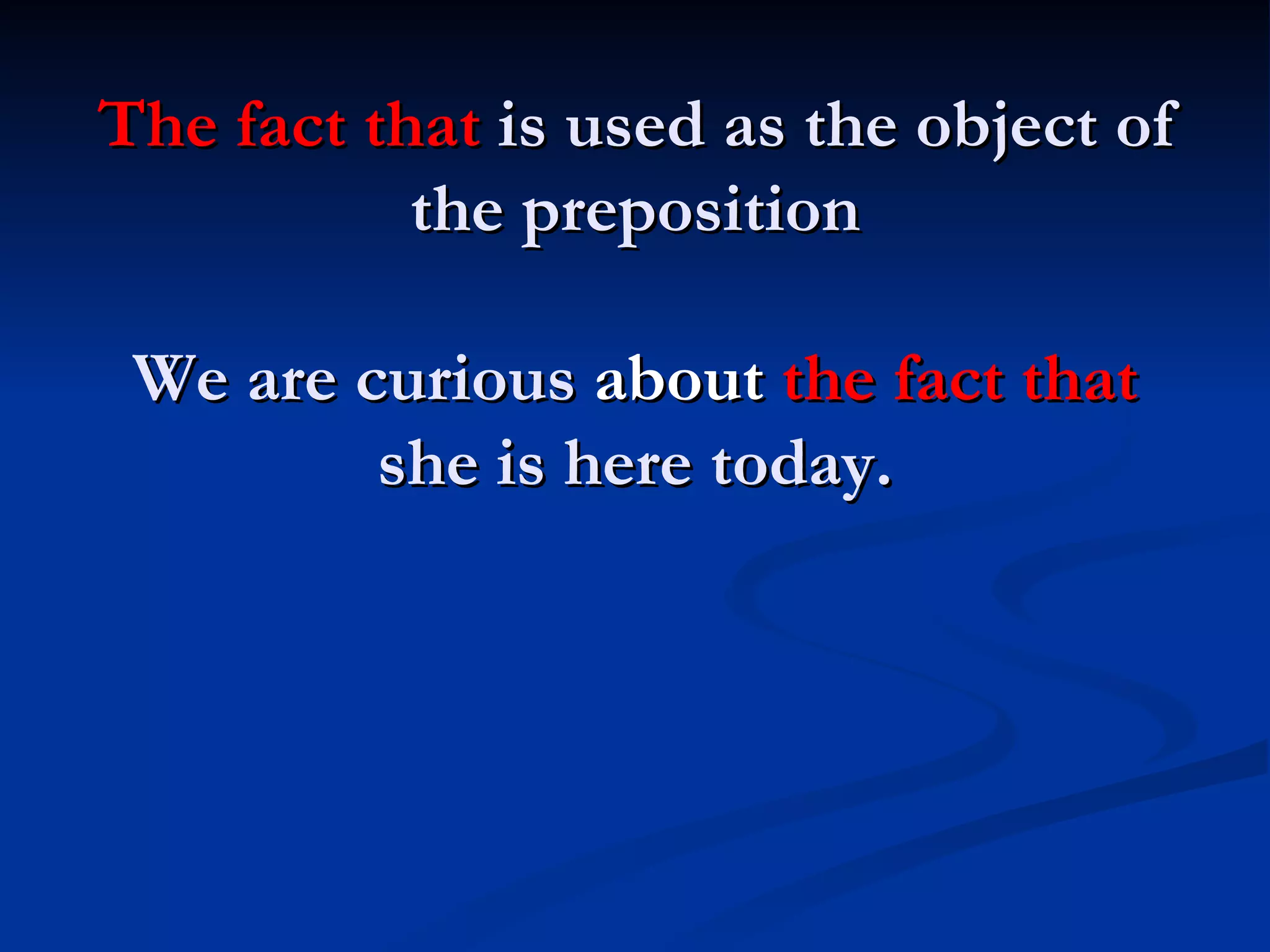
The fact that  is used as the object of the preposition We are curious  about  the fact that  she is here today.
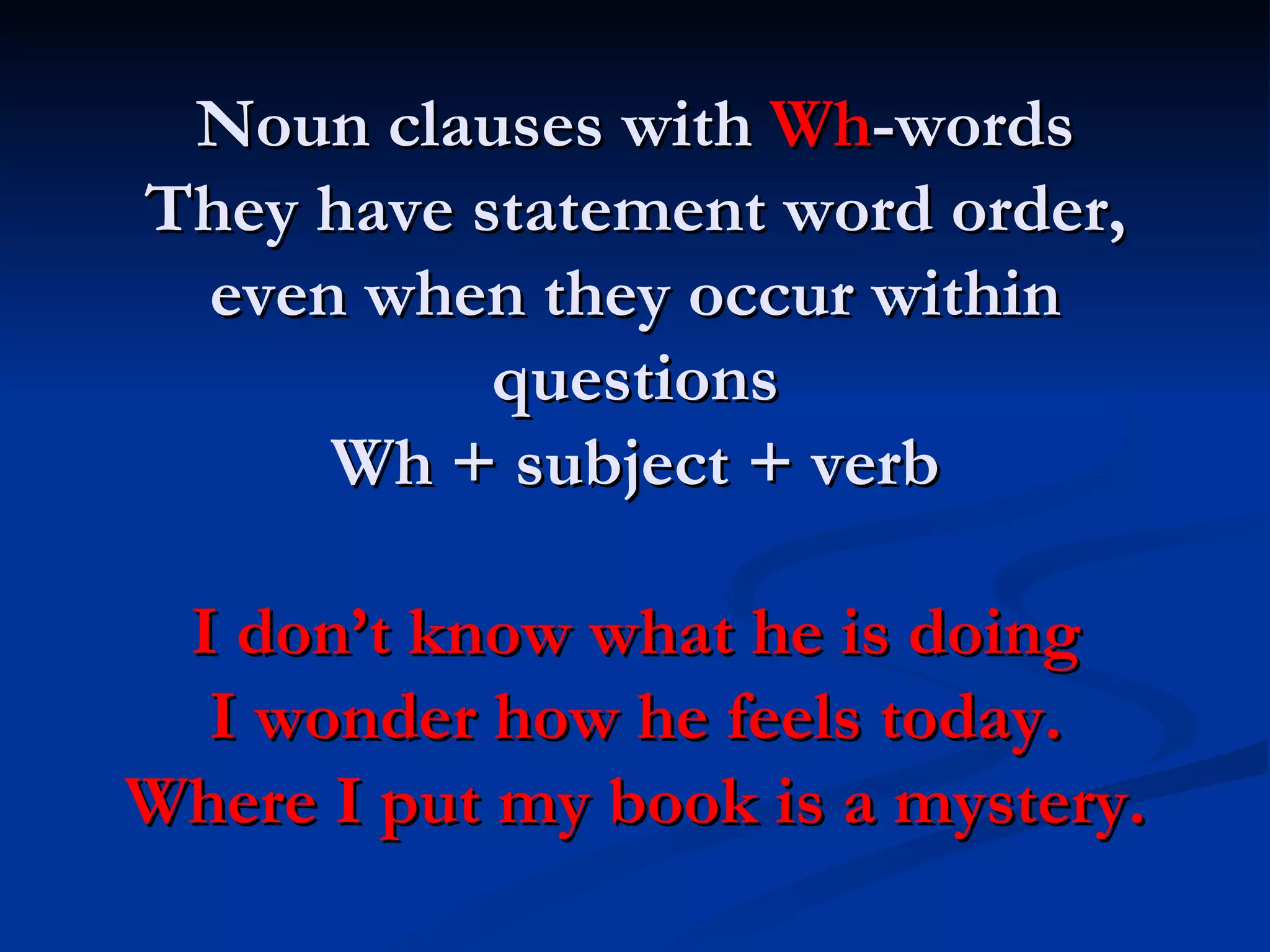
Noun clauses with  Wh -words They have statement word order, even when they occur within questions Wh + subject + verb I don’t know what he is doing I wonder how he feels today. Where I put my book is a mystery.
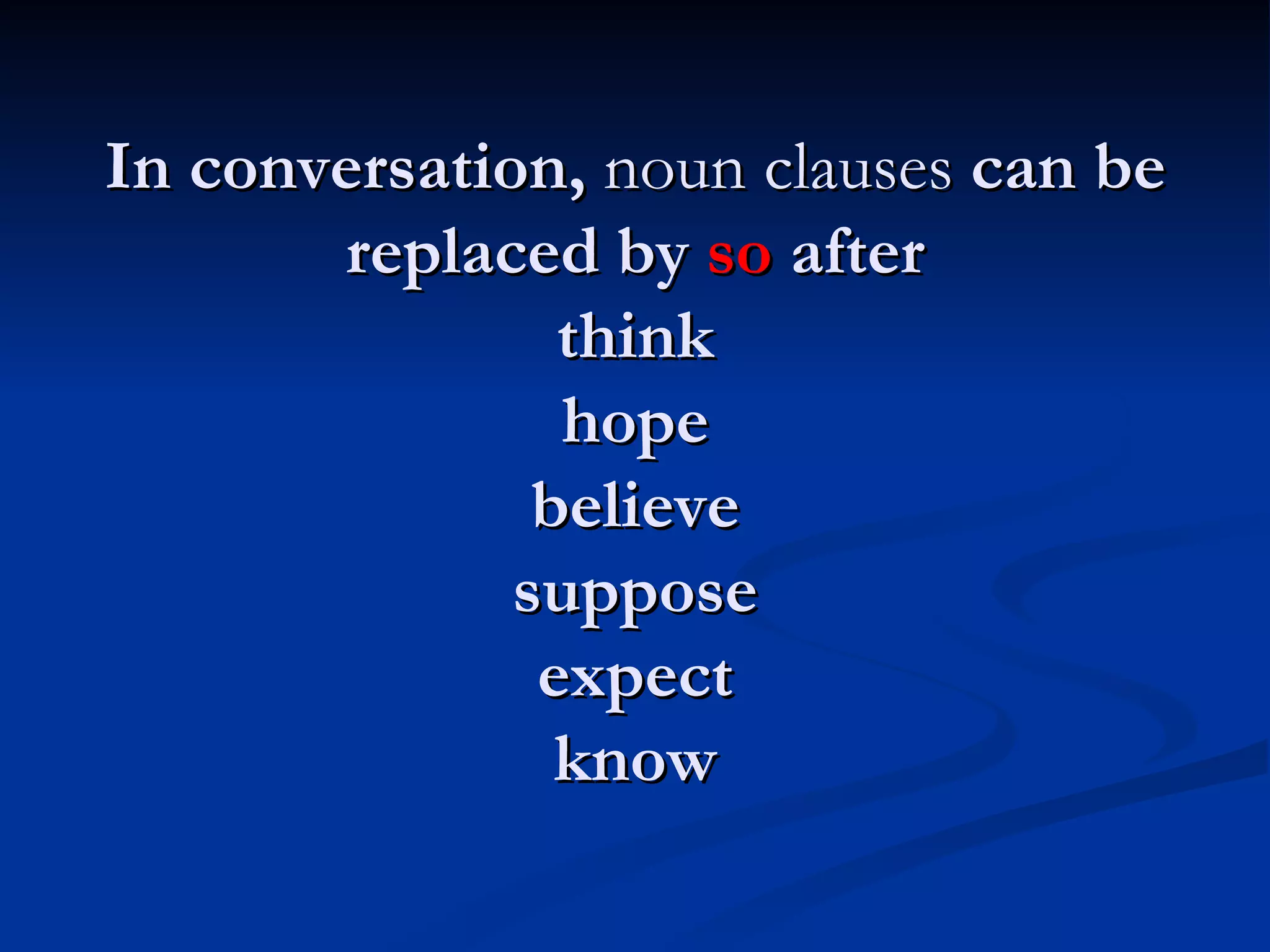
In conversation,  noun clauses  can be replaced by  so  after think hope believe suppose expect know
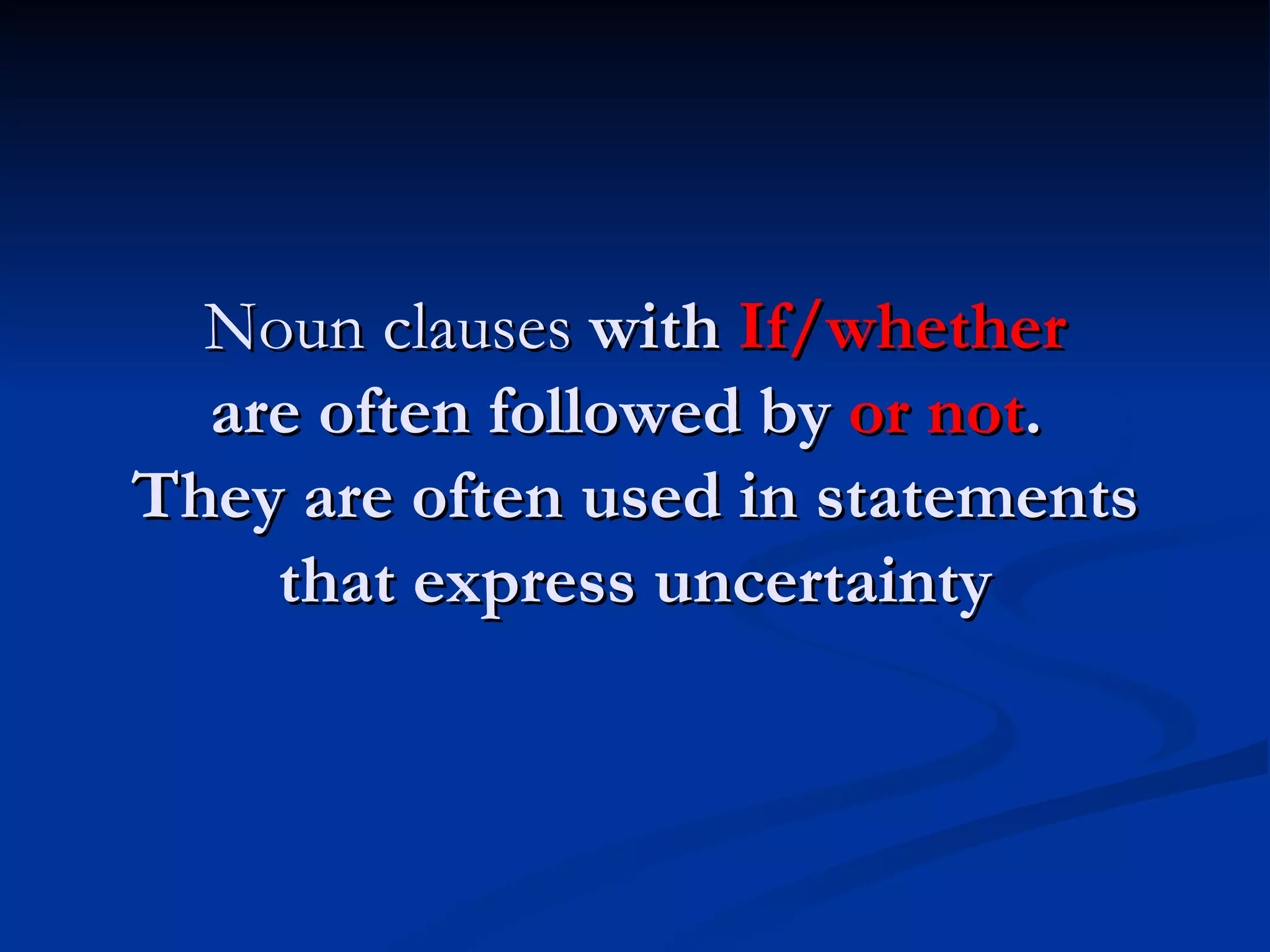
Noun clauses  with  If/whether are often followed by  or not .  They are often used in statements that express uncertainty
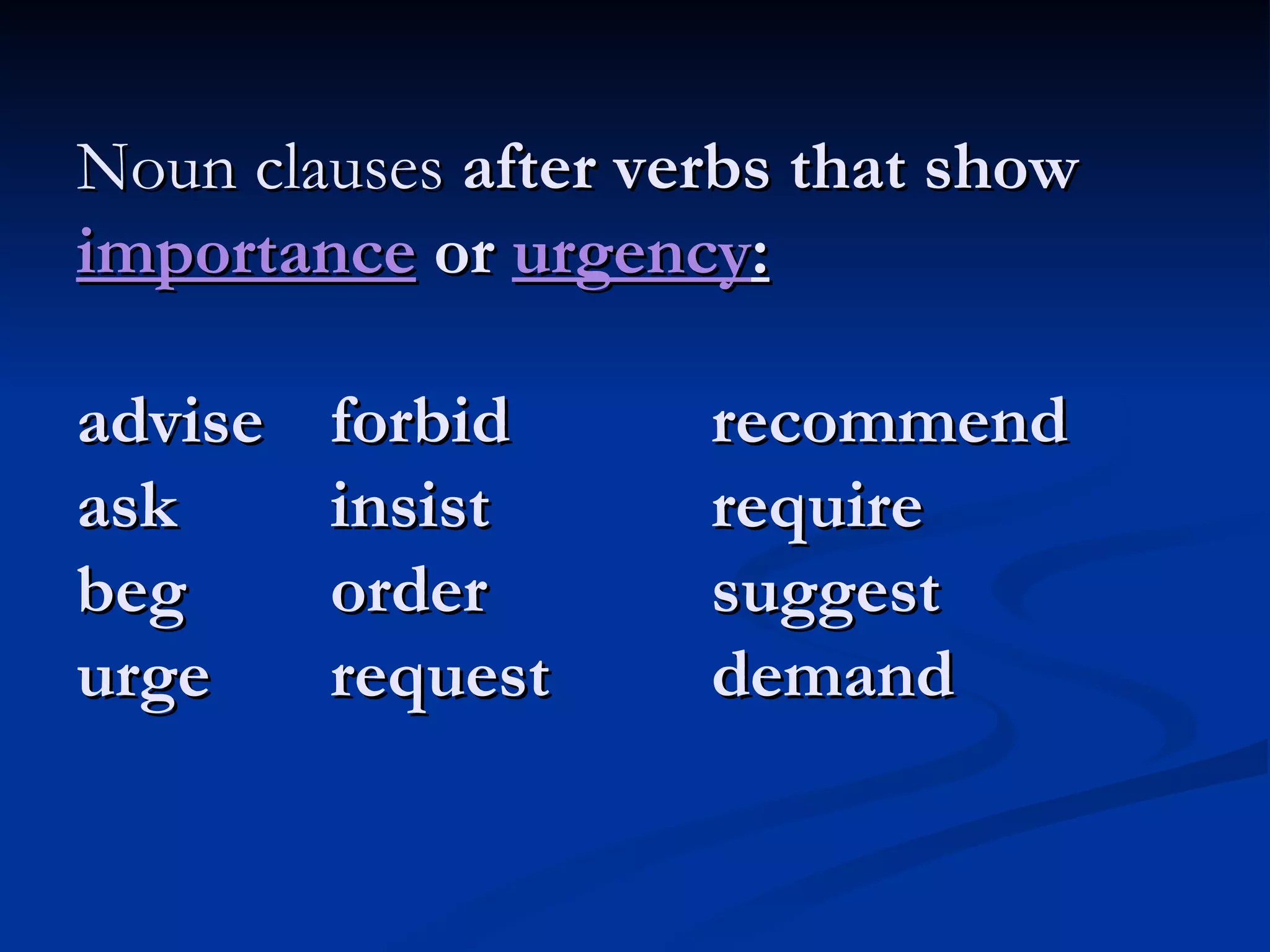
Noun clauses  after verbs that show  importance  or  urgency : advise forbid recommend ask insist require beg order suggest urge request demand
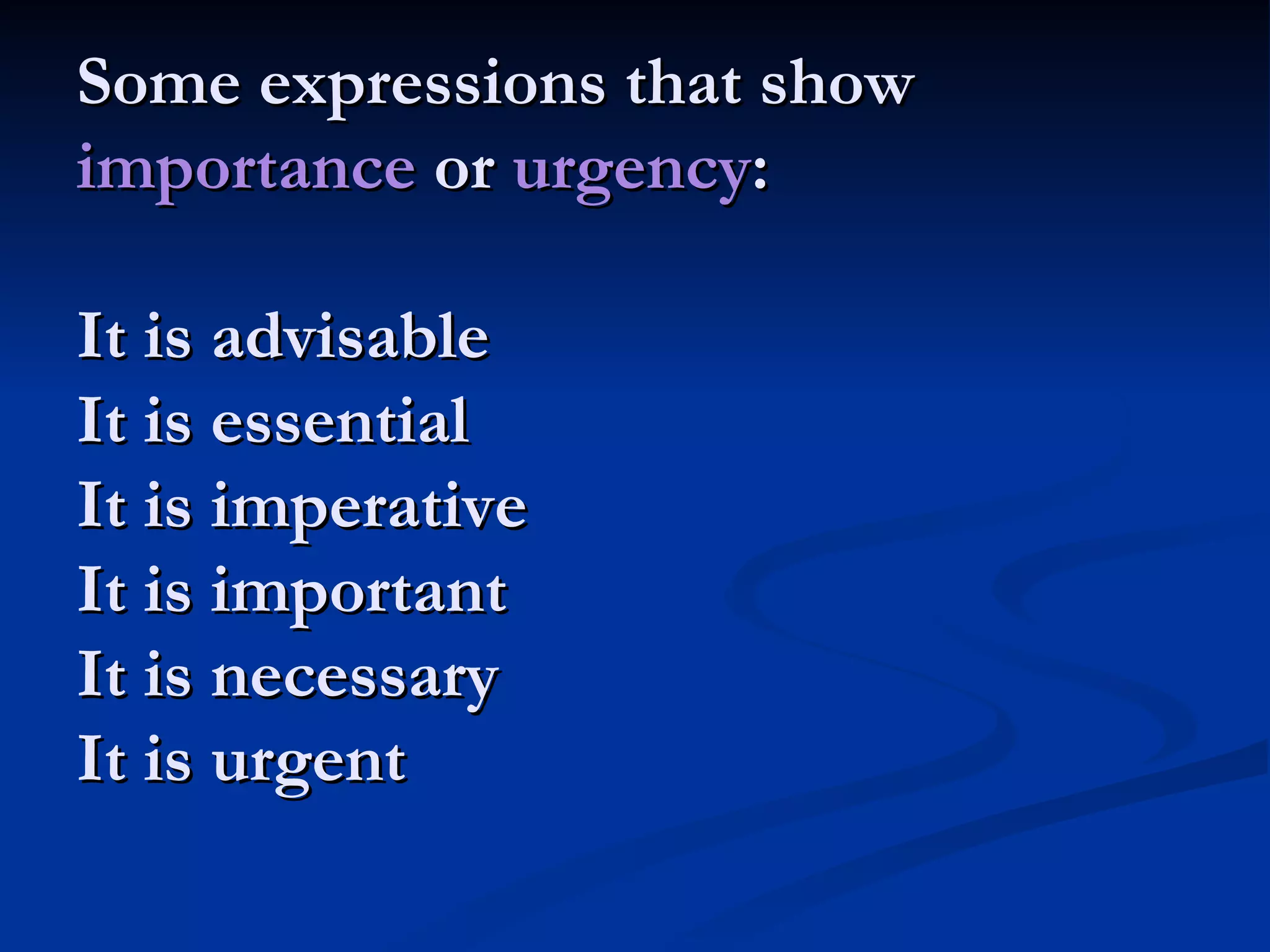
Some expressions that show  importance  or  urgency : It is advisable It is essential It is imperative It is important It is necessary It is urgent
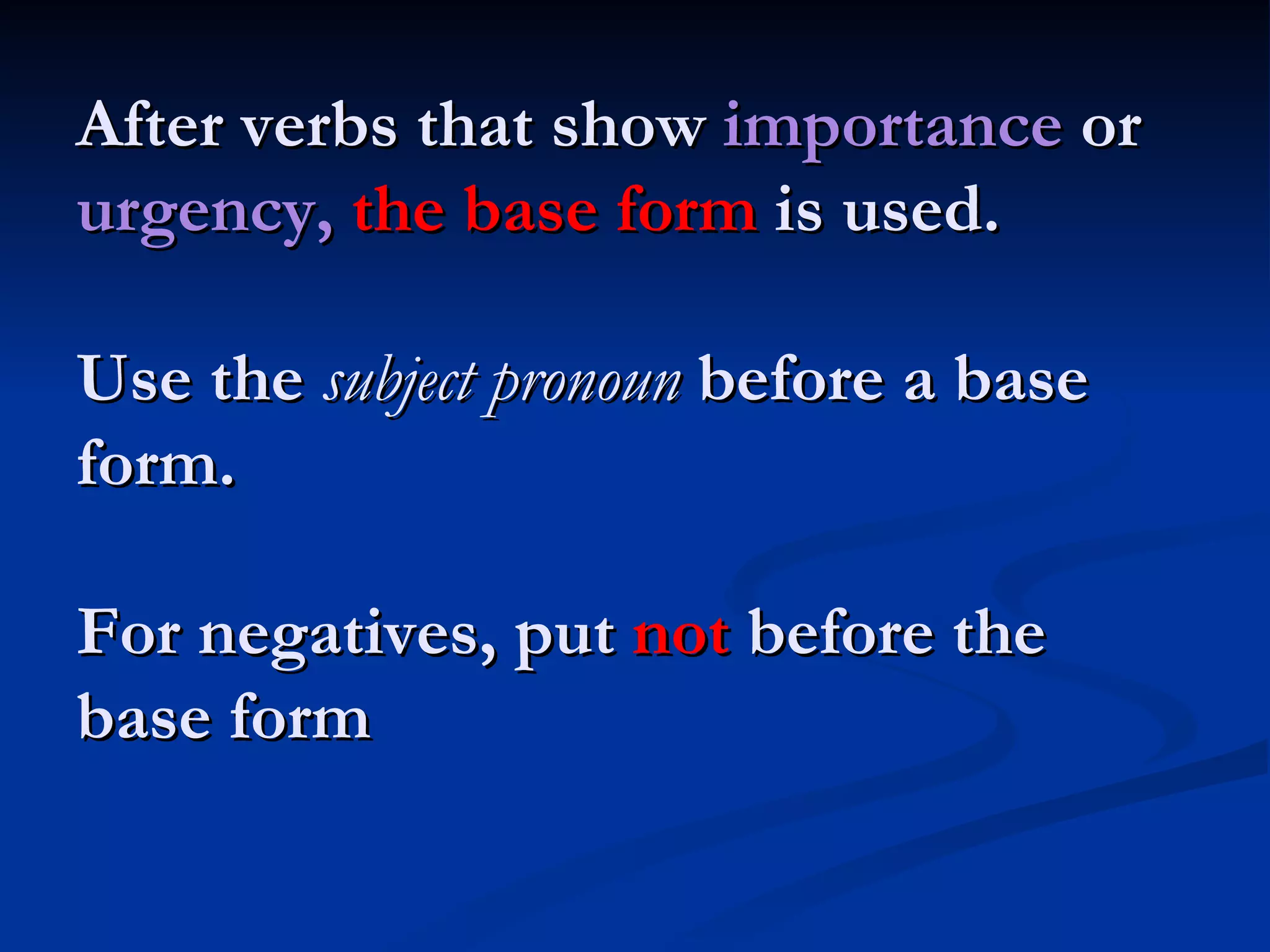
After verbs that show  importance  or  urgency,   the base form  is used. Use the  subject pronoun  before a base form. For negatives, put  not  before the base form
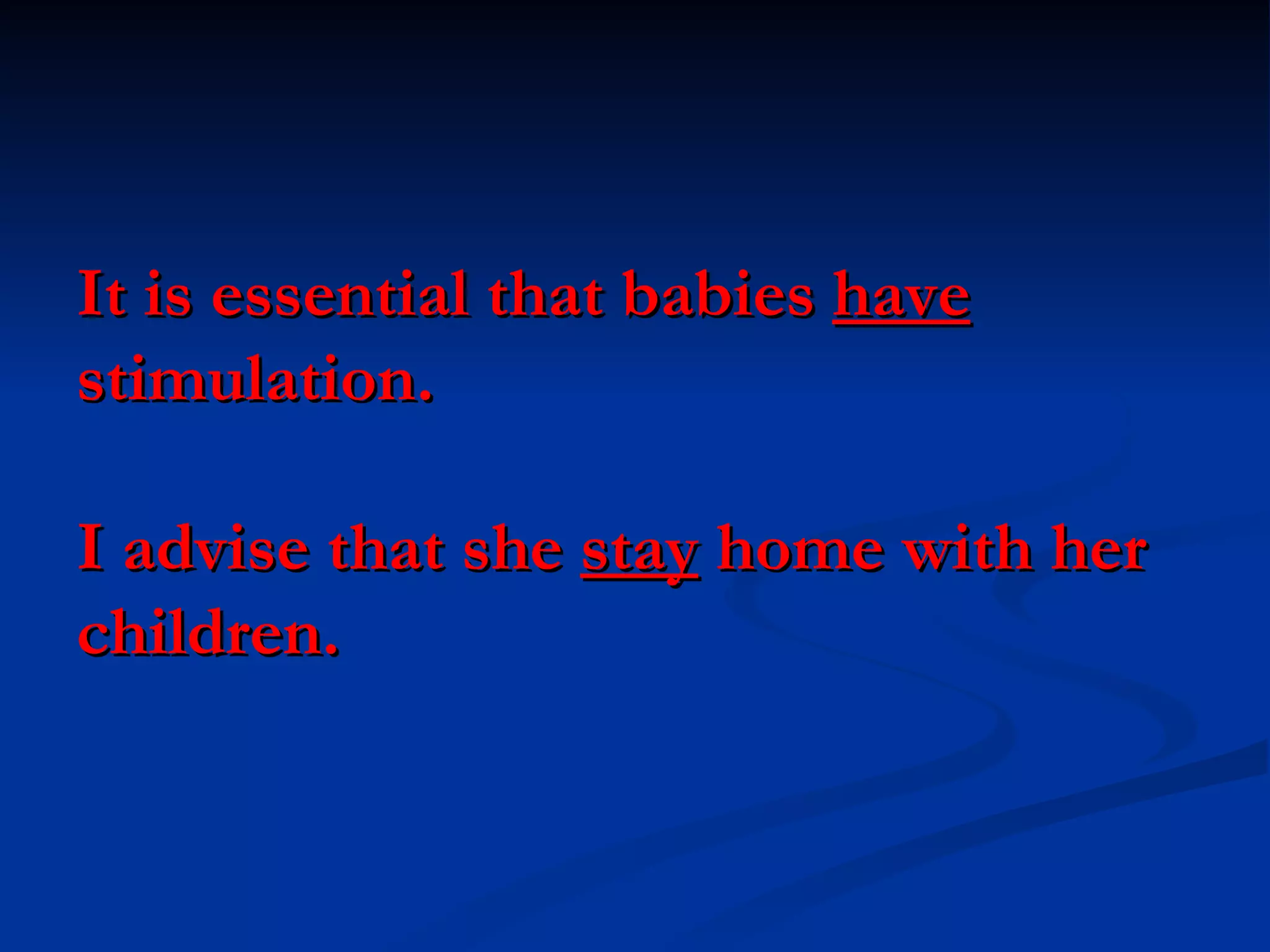
It is essential that babies  have  stimulation. I advise that she  stay  home with her children.
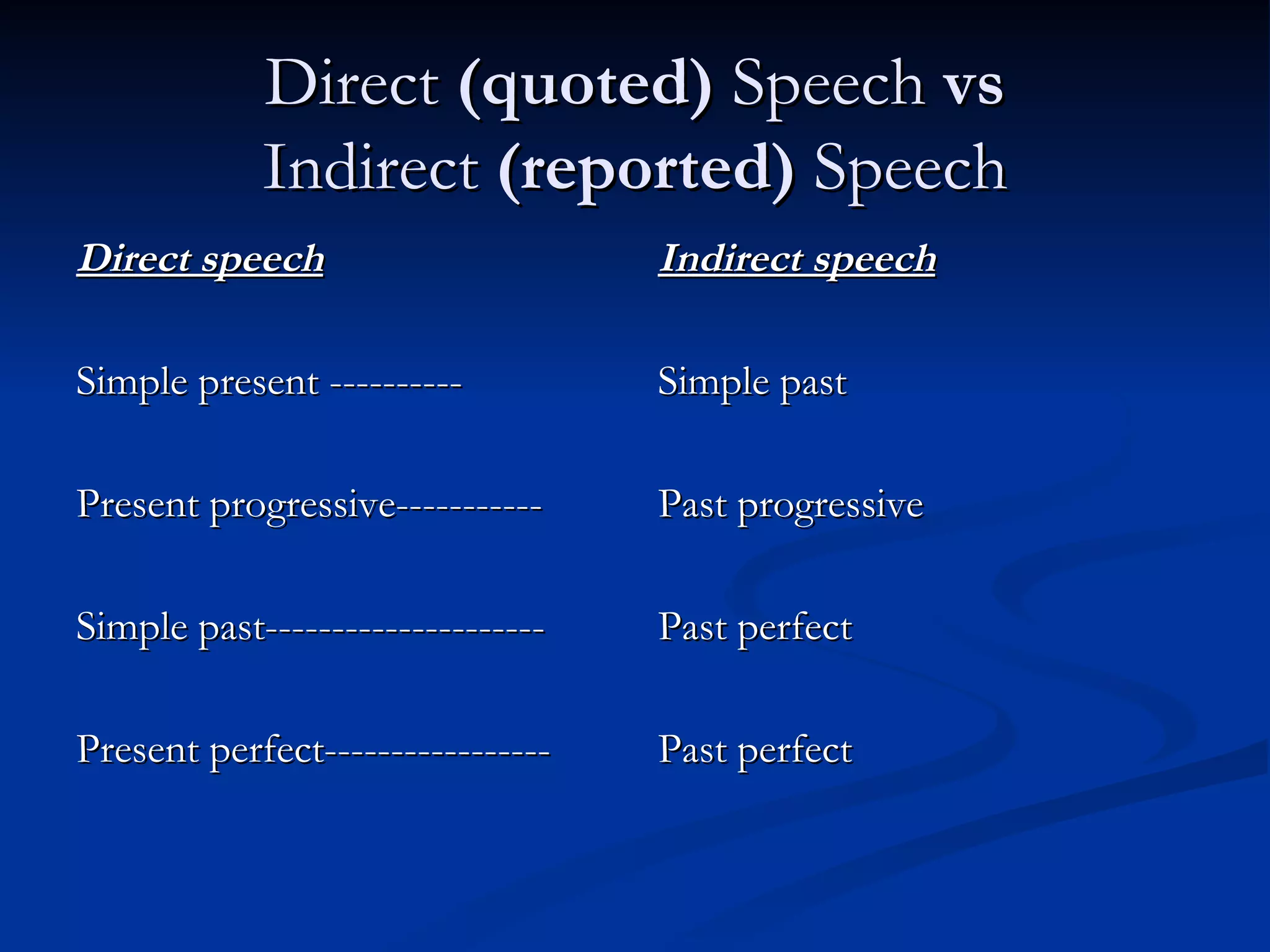
Direct  (quoted)  Speech  vs Indirect  (reported)  Speech Direct speech Simple present ---------- Present progressive----------- Simple past--------------------- Present perfect----------------- Indirect speech Simple past Past progressive Past perfect Past perfect
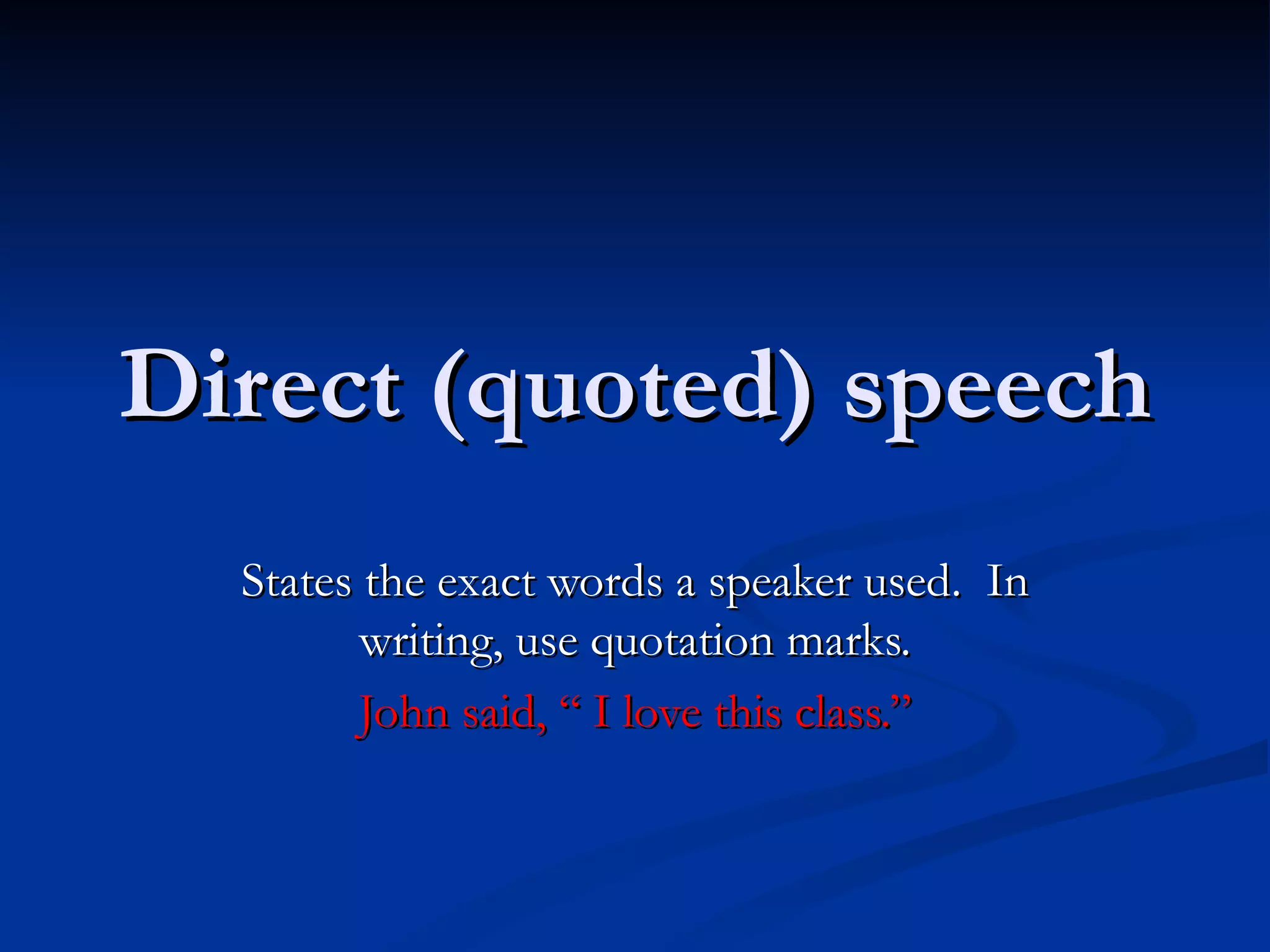
Direct (quoted) speech States the exact words a speaker used.  In writing, use quotation marks. John said, “ I love this class.”
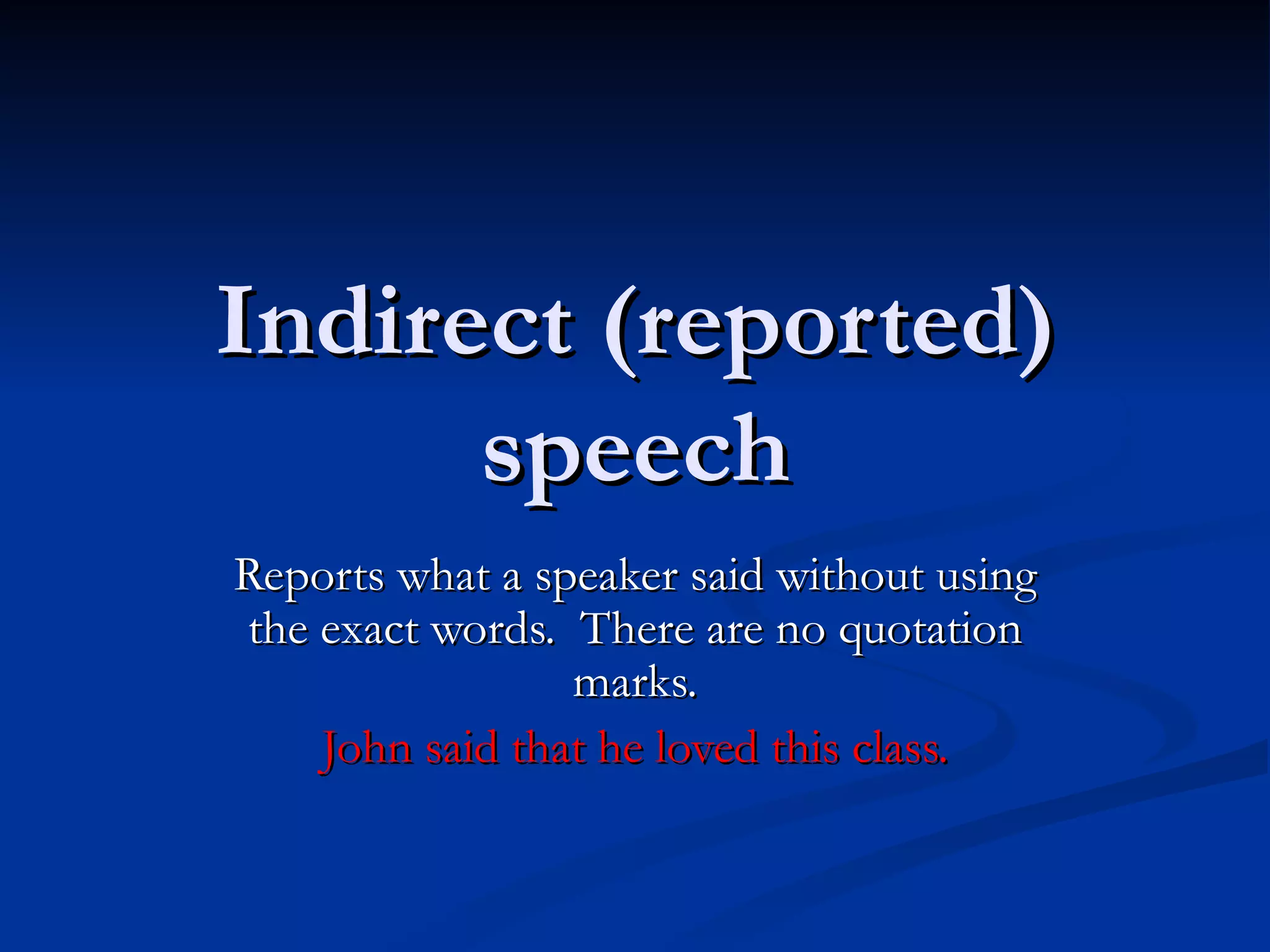
Indirect (reported) speech Reports what a speaker said without using the exact words.  There are no quotation marks. John said that he loved this class.
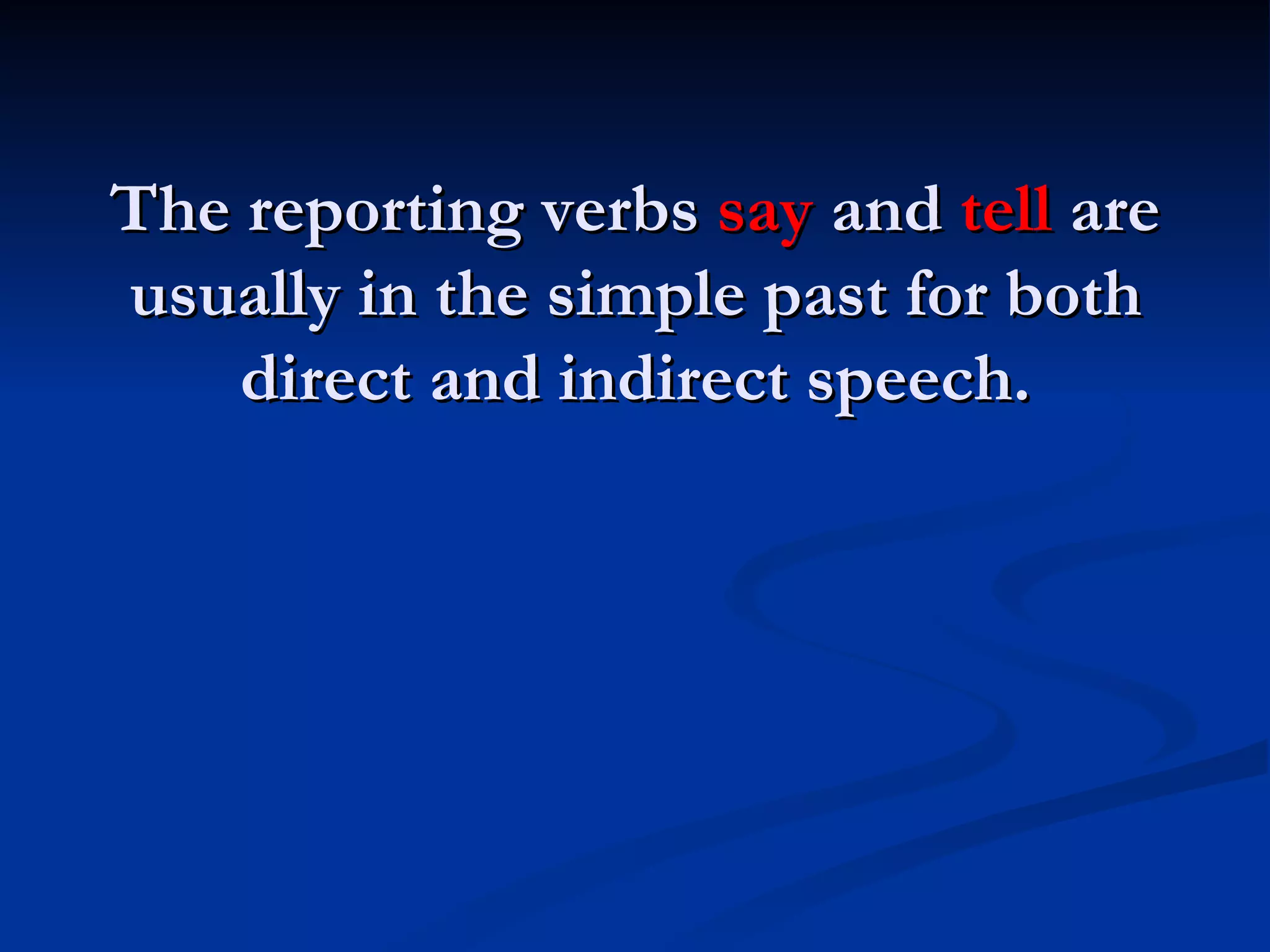
The reporting verbs  say  and  tell  are usually in the simple past for both direct and indirect speech.
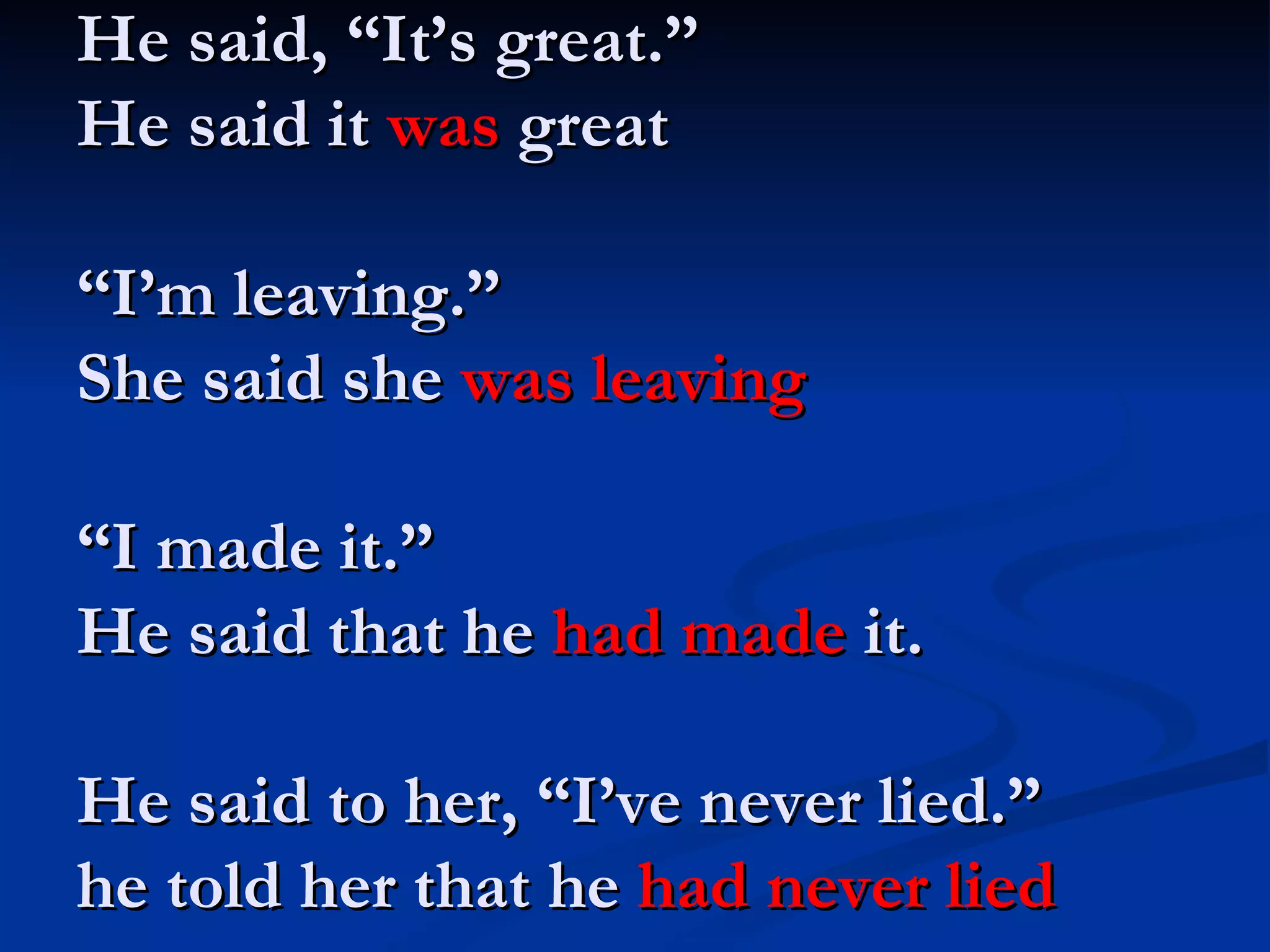
He said, “It’s great.” He said it  was  great “I’m leaving.” She said she  was leaving “I made it.” He said that he  had made  it. He said to her, “I’ve never lied.” he told her that he  had never lied
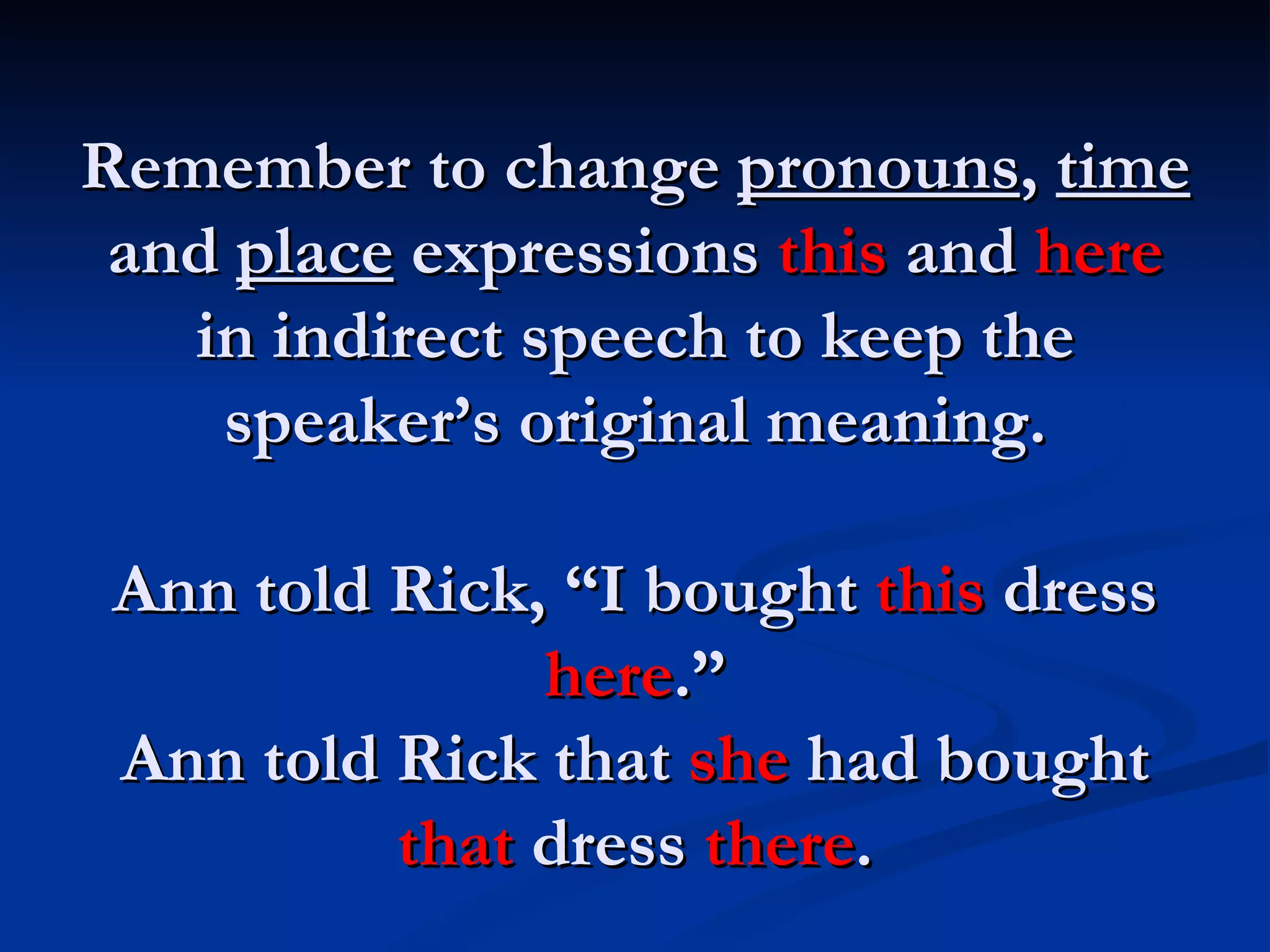
Remember to change  pronouns ,  time  and  place  expressions  this  and  here  in indirect speech to keep the speaker’s original meaning. Ann told Rick, “I bought  this  dress  here .” Ann told Rick that  she  had bought  that  dress  there .
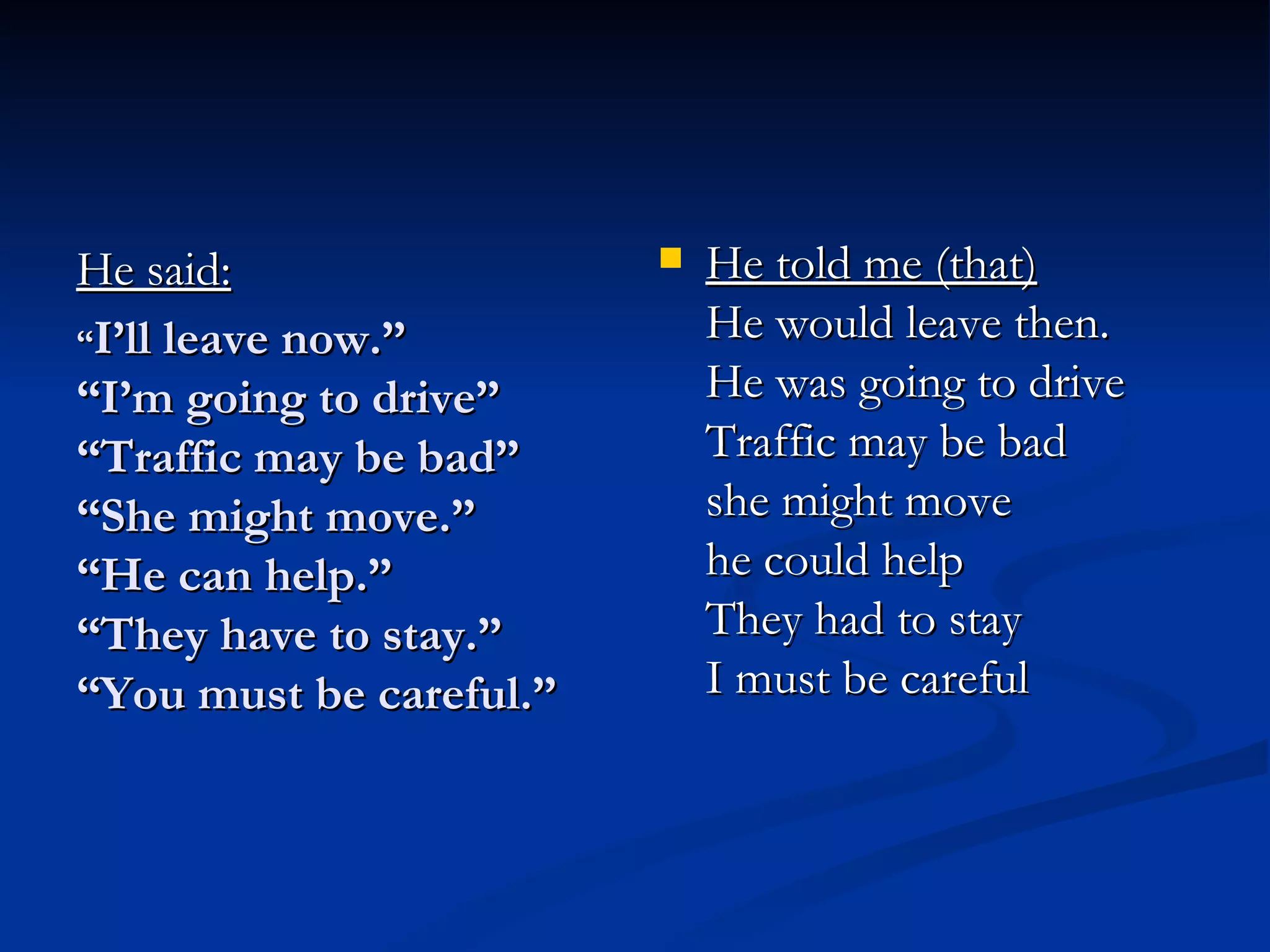
“ I’ll leave now.” “I’m going to drive” “Traffic may be bad” “She might move.” “He can help.” “They have to stay.” “You must be careful.” He said: He told me (that) He would leave then. He was going to drive Traffic may be bad she might move he could help They had to stay I must be careful
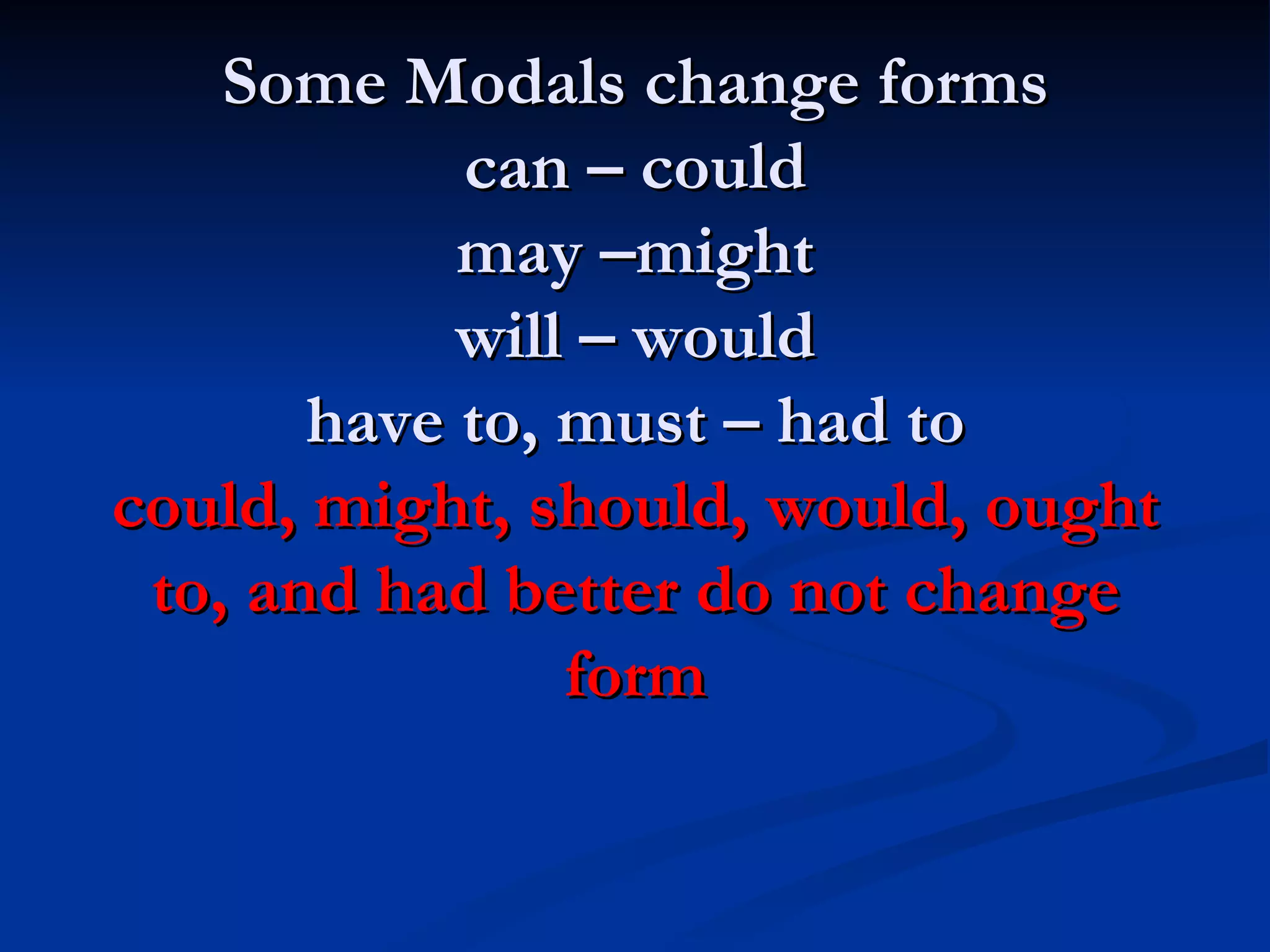
Some Modals change forms can – could may –might will – would have to, must – had to could, might, should, would, ought to, and had better do not change form
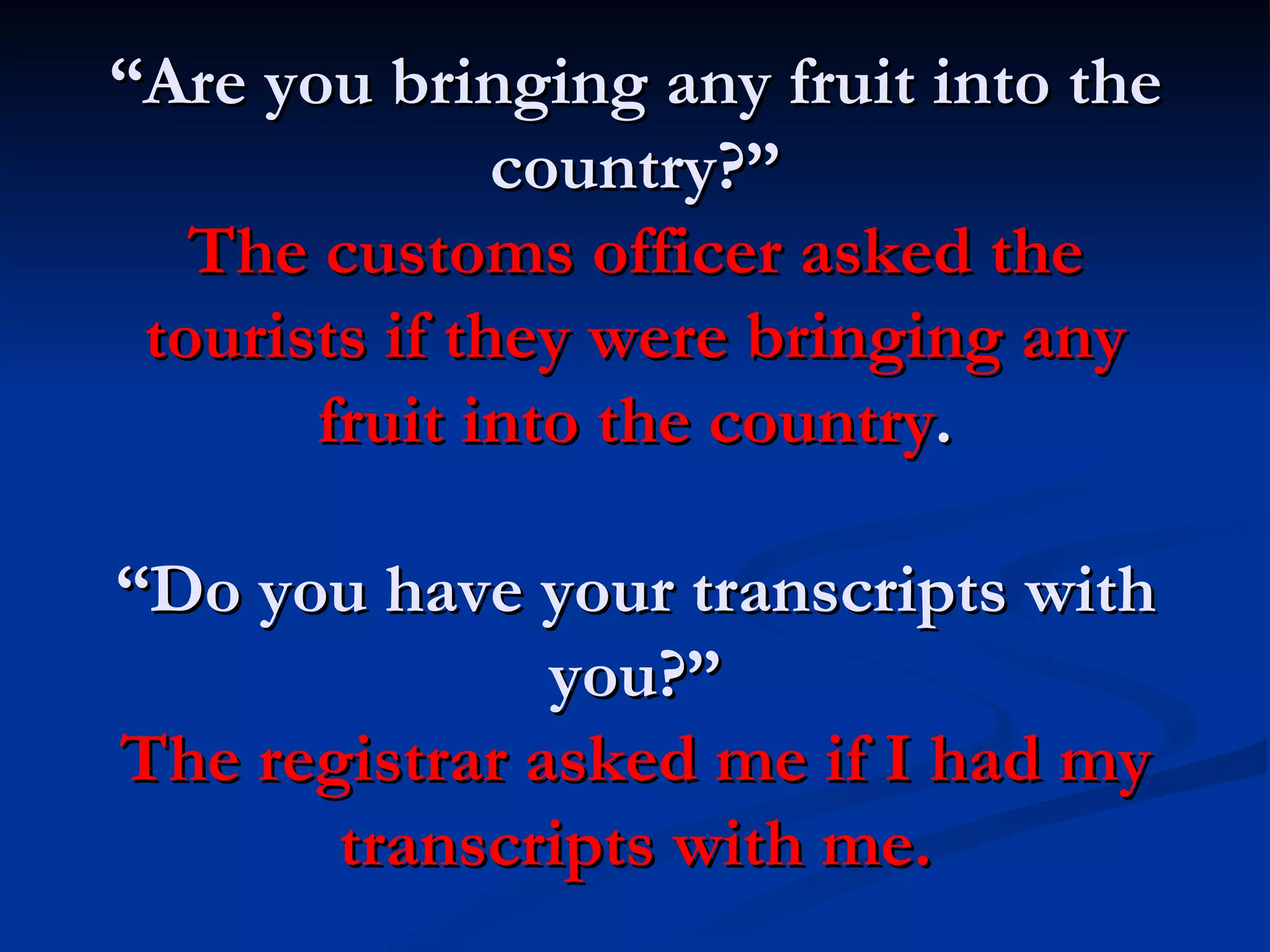
“ Are you bringing any fruit into the country?” The customs officer asked the tourists if   they were bringing any fruit into the country . “Do you have your transcripts with you?” The registrar asked me if I had my transcripts with me.
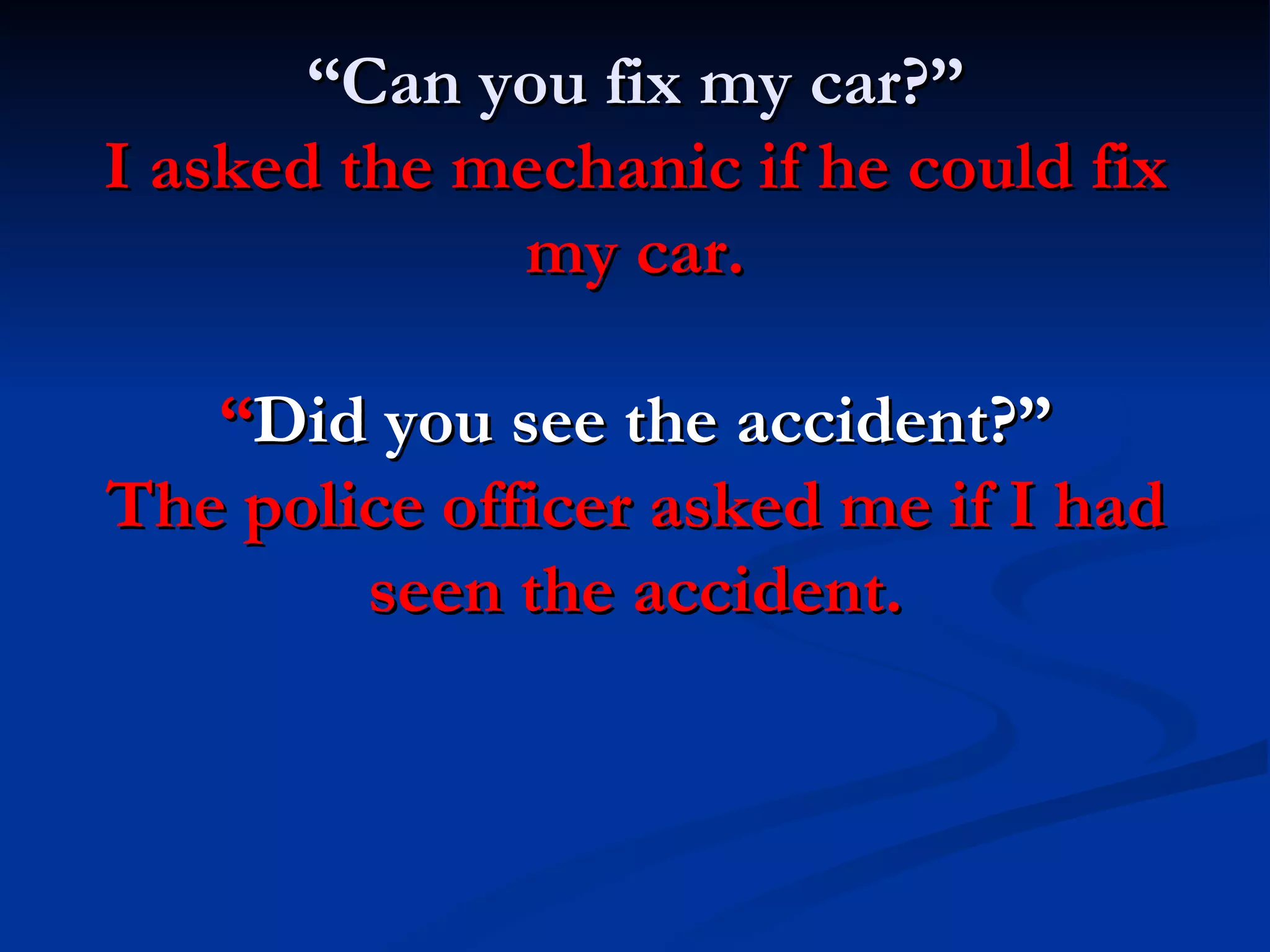
“ Can you fix my car?” I asked the mechanic if he could fix my car. “ Did you see the accident?” The police officer asked me if I had seen the accident.
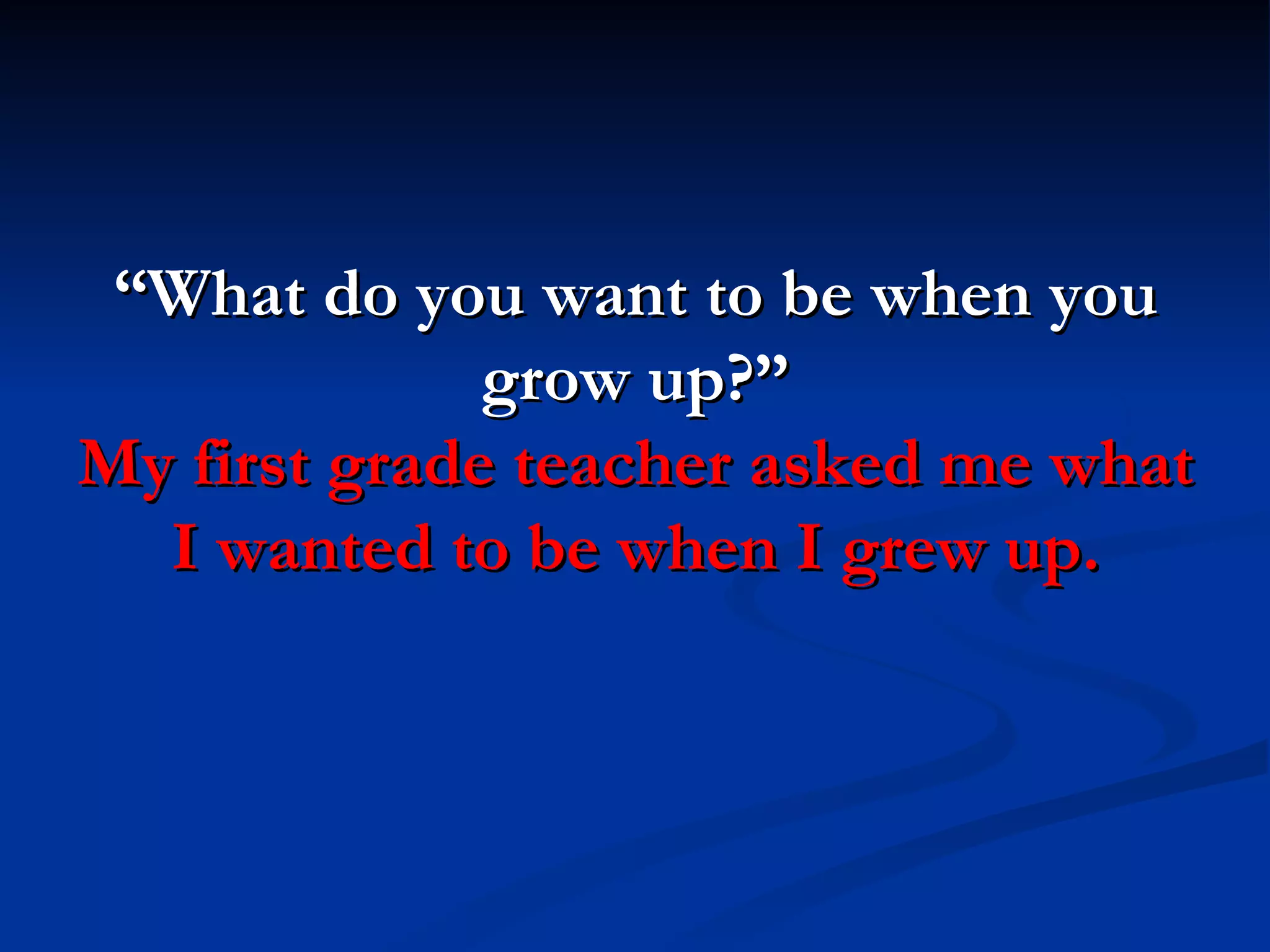
“ What do you want to be when you grow up?” My first grade teacher asked me what I wanted to be when I grew up.
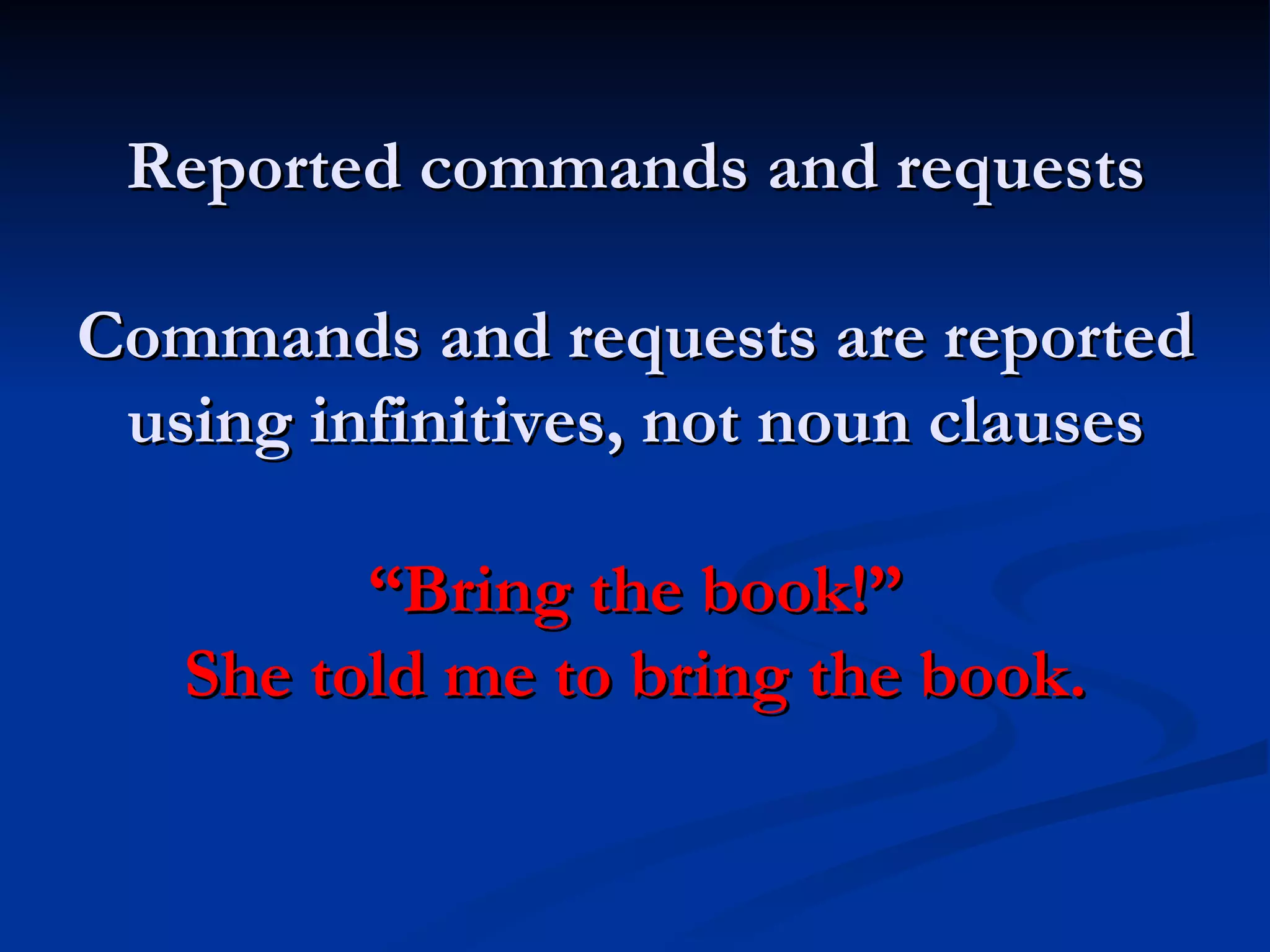
Reported commands and requests Commands and requests are reported using infinitives, not noun clauses “Bring the book!” She told me to bring the book.
The End!

Noun clauses

  • 1.
  • 2.
    A NOUN CLAUSEis a group of words with a subject and a verb
  • 3.
    WHO WHOM WHENWHICH HOW WHERE IF WHY THAT WHAT WHETHER WHOEVER WHEREVER WHICHEVER HOWEVER WHOMEVER WHATEVER WHENEVER
  • 4.
    You can recognizea noun clause by one of the relative pronouns or adverbs that begin the clause
  • 5.
    A nounclause consists of three components: A relative pronoun or adverb A subject A verb
  • 6.
    Noun clauses function like nouns . They can be: subject subject complement object object of prepositions
  • 7.
    Uses of Noun Clauses After some verbs and adjectives To include a question in a statement (embedded questions) To report what someone has said or asked
  • 8.
    Noun clauses can follow certain verbs and adjectives that express mental activities Agree notice afraid positive Believe realize angry sorry Decide remember aware surprised Doubt see certain sure Feel show clear worried Forget suppose convinced Guess think disappointed Hear understand glad Hope wonder happy Imagine say pleased Know tell sad
  • 9.
    To include aquestion in a statement I don’t know what time it is. I wonder how he found out .
  • 10.
    To report whatsomeone has said or asked He said that he would return. He asked me what I wanted
  • 11.
    There are three types of Noun Clauses: noun clauses with that noun clauses with WH-word noun clauses with if and whether
  • 12.
    Noun clauses with THAT can be used with all verbs mentioned except wonder I think that this book will be interesting. The word that can often be omitted. However it can not be omitted if it is in the subject position
  • 13.
    The fact that is used as the object of the preposition We are curious about the fact that she is here today.
  • 14.
    Noun clauses with Wh -words They have statement word order, even when they occur within questions Wh + subject + verb I don’t know what he is doing I wonder how he feels today. Where I put my book is a mystery.
  • 15.
    In conversation, noun clauses can be replaced by so after think hope believe suppose expect know
  • 16.
    Noun clauses with If/whether are often followed by or not . They are often used in statements that express uncertainty
  • 17.
    Noun clauses after verbs that show importance or urgency : advise forbid recommend ask insist require beg order suggest urge request demand
  • 18.
    Some expressions thatshow importance or urgency : It is advisable It is essential It is imperative It is important It is necessary It is urgent
  • 19.
    After verbs thatshow importance or urgency, the base form is used. Use the subject pronoun before a base form. For negatives, put not before the base form
  • 20.
    It is essentialthat babies have stimulation. I advise that she stay home with her children.
  • 21.
    Direct (quoted) Speech vs Indirect (reported) Speech Direct speech Simple present ---------- Present progressive----------- Simple past--------------------- Present perfect----------------- Indirect speech Simple past Past progressive Past perfect Past perfect
  • 22.
    Direct (quoted) speechStates the exact words a speaker used. In writing, use quotation marks. John said, “ I love this class.”
  • 23.
    Indirect (reported) speechReports what a speaker said without using the exact words. There are no quotation marks. John said that he loved this class.
  • 24.
    The reporting verbs say and tell are usually in the simple past for both direct and indirect speech.
  • 25.
    He said, “It’sgreat.” He said it was great “I’m leaving.” She said she was leaving “I made it.” He said that he had made it. He said to her, “I’ve never lied.” he told her that he had never lied
  • 26.
    Remember to change pronouns , time and place expressions this and here in indirect speech to keep the speaker’s original meaning. Ann told Rick, “I bought this dress here .” Ann told Rick that she had bought that dress there .
  • 27.
    “ I’ll leavenow.” “I’m going to drive” “Traffic may be bad” “She might move.” “He can help.” “They have to stay.” “You must be careful.” He said: He told me (that) He would leave then. He was going to drive Traffic may be bad she might move he could help They had to stay I must be careful
  • 28.
    Some Modals changeforms can – could may –might will – would have to, must – had to could, might, should, would, ought to, and had better do not change form
  • 29.
    “ Are youbringing any fruit into the country?” The customs officer asked the tourists if they were bringing any fruit into the country . “Do you have your transcripts with you?” The registrar asked me if I had my transcripts with me.
  • 30.
    “ Can youfix my car?” I asked the mechanic if he could fix my car. “ Did you see the accident?” The police officer asked me if I had seen the accident.
  • 31.
    “ What doyou want to be when you grow up?” My first grade teacher asked me what I wanted to be when I grew up.
  • 32.
    Reported commands andrequests Commands and requests are reported using infinitives, not noun clauses “Bring the book!” She told me to bring the book.
  • 33.