Sentence Structure


       By Gustavo Pérez
Sentence Structure

Skill focus: The production of
grammatically correct, structurally sound
and meaningful sentences.
What is a Clause?
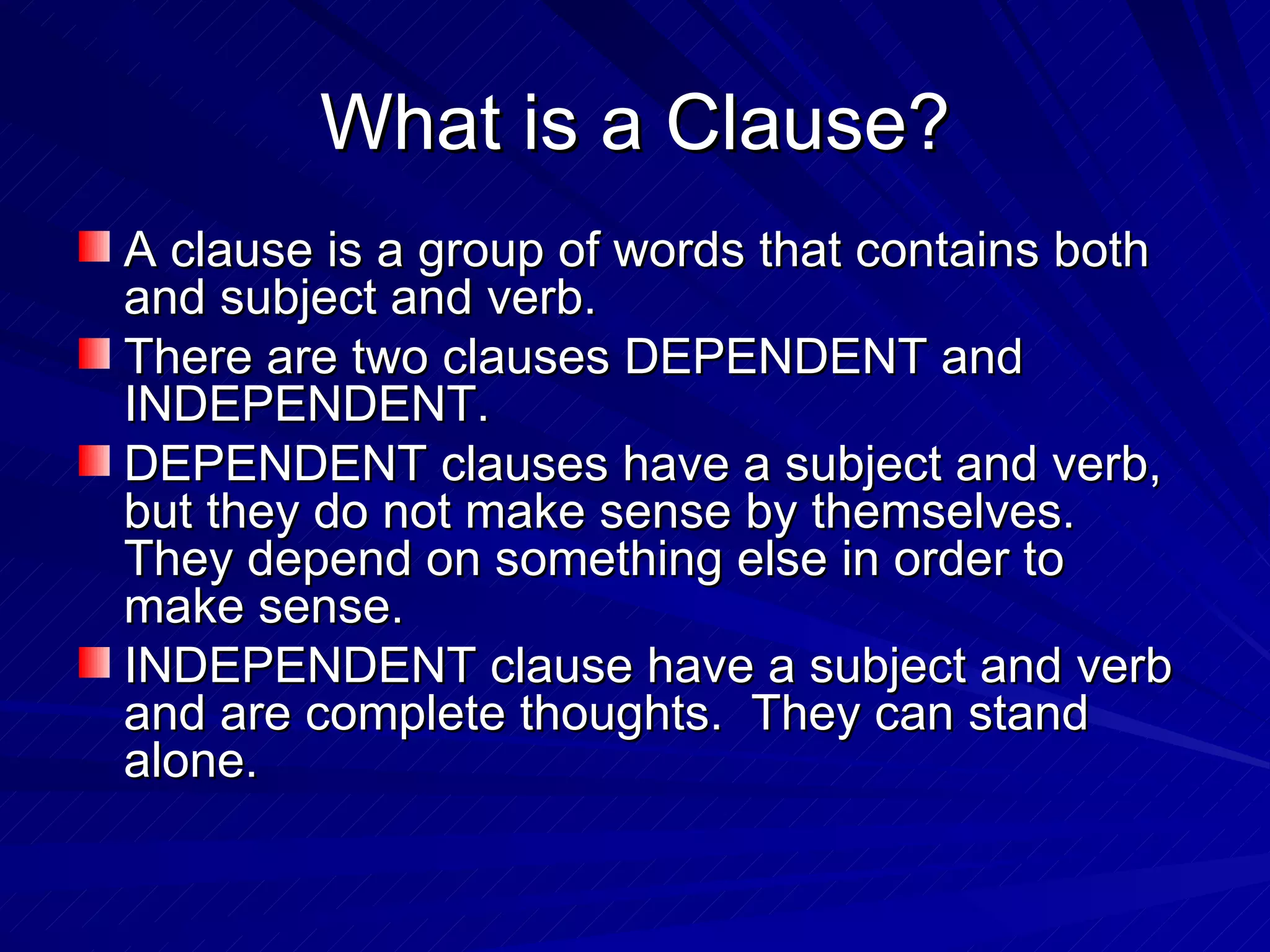
A clause is a group of words that contains both
and subject and verb.
There are two clauses DEPENDENT and
INDEPENDENT.
DEPENDENT clauses have a subject and verb,
but they do not make sense by themselves.
They depend on something else in order to
make sense.
INDEPENDENT clause have a subject and verb
and are complete thoughts. They can stand
alone.
Example Dependent Clause
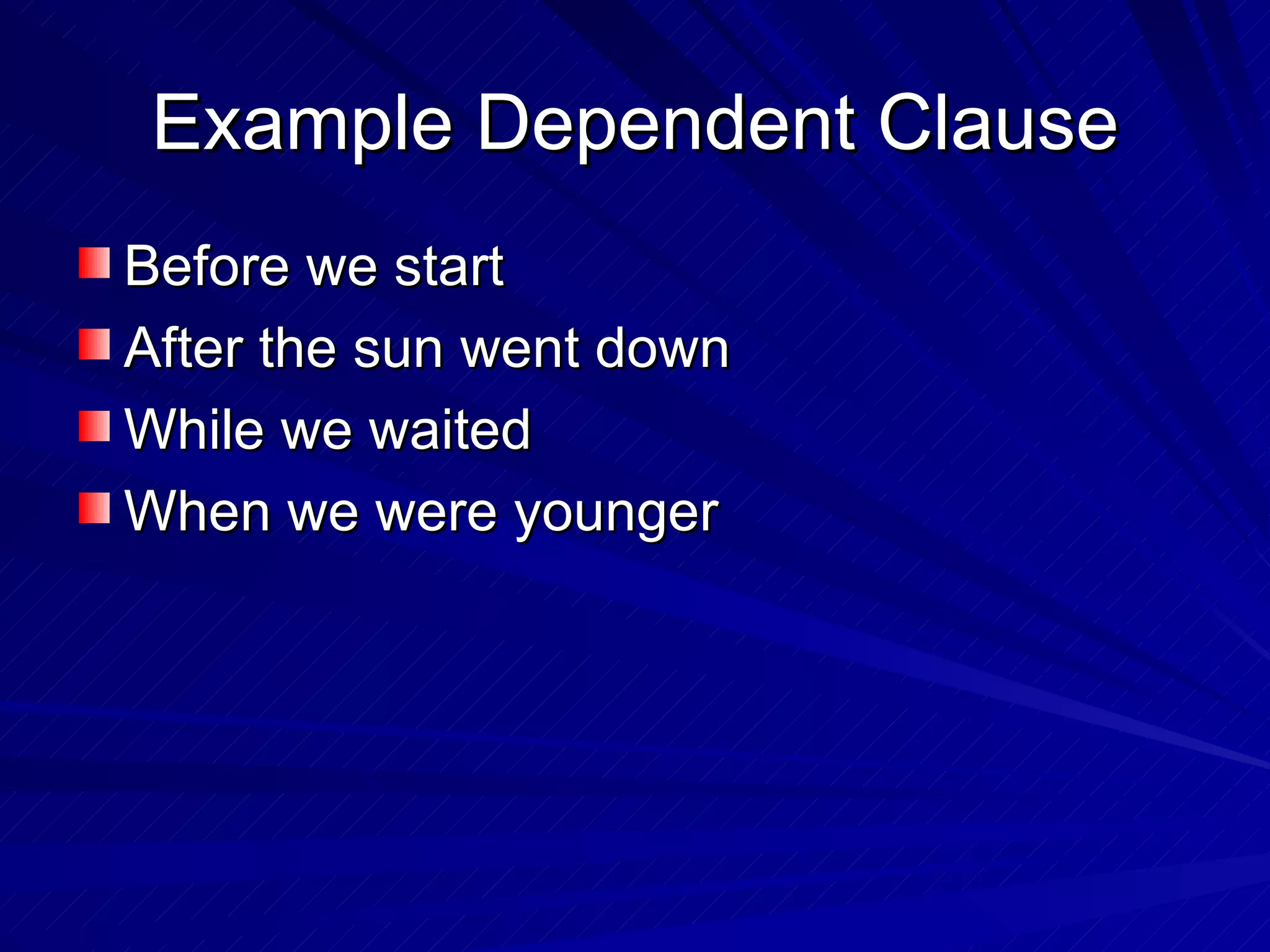
Before we start
After the sun went down
While we waited
When we were younger
Example Independent Clauses
We will say a prayer.
We made a bonfire on the beach.
We listened to our I-pods.
We played silly games.
Simple and Compound Sentences
Simple Sentence = ONE independent
clause and NO dependent clauses.
 – Ex. Brandy’s favorite assignment is writing.

Compound Sentence = Two or more
independent clauses and NO dependent
clauses.
 – Ex. Brandy likes to write; she loves the
   challenge.
Complex Sentences
Complex Sentence = ONE independent
clause and one or more dependent
clauses.
– Ex. When we went fishing, I had no luck.
– Ex. The president of student council, who is
  my best friend, is a true leader.
– Ex. I love the way she sings because she
  sounds like an angel.
Kinds of Dependent Clauses
 Adjective Clause = a dependent clause
 used as an adjective.
 It answers the questions: what kind, which
 one, how many, or how much.
 Adjective clauses usually start with words
 such as: who, whom, whose, that, or
 which.
Ex. Max is a student who likes to learn.
Kinds of Dependent Clauses
 Adverb Clause = a dependent clause used
 as an adverb.
 It answers the questions: where, when,
 why, how, to what extent, and under what
 conditions.
 Adverb clauses usually start with words
 such as: before, because, or when.
Ex. Because the weather was bad, school
 was cancelled.
Kinds of Dependent Clauses
 Noun Clause – a dependent clause uses
 as a noun.
 It can be used as a subject, P.N., D.O.,
 I.O., or O.P.
 Noun clauses can start with words such
 as: that, whomever, whichever, what, or
 who.
Ex. Whoever is making that noise must stop!
Compound-Complex Sentences
A compound-complex sentence = TWO or
more independents clause and one or
more dependent clauses.
 – Ex. While we were waiting, she challenged
   me to a game of tic-tac-toe, and I won!

Sentence structure 1

  • 1.
    Sentence Structure By Gustavo Pérez
  • 2.
    Sentence Structure Skill focus:The production of grammatically correct, structurally sound and meaningful sentences.
  • 3.
    What is aClause? A clause is a group of words that contains both and subject and verb. There are two clauses DEPENDENT and INDEPENDENT. DEPENDENT clauses have a subject and verb, but they do not make sense by themselves. They depend on something else in order to make sense. INDEPENDENT clause have a subject and verb and are complete thoughts. They can stand alone.
  • 4.
    Example Dependent Clause Beforewe start After the sun went down While we waited When we were younger
  • 5.
    Example Independent Clauses Wewill say a prayer. We made a bonfire on the beach. We listened to our I-pods. We played silly games.
  • 6.
    Simple and CompoundSentences Simple Sentence = ONE independent clause and NO dependent clauses. – Ex. Brandy’s favorite assignment is writing. Compound Sentence = Two or more independent clauses and NO dependent clauses. – Ex. Brandy likes to write; she loves the challenge.
  • 7.
    Complex Sentences Complex Sentence= ONE independent clause and one or more dependent clauses. – Ex. When we went fishing, I had no luck. – Ex. The president of student council, who is my best friend, is a true leader. – Ex. I love the way she sings because she sounds like an angel.
  • 8.
    Kinds of DependentClauses Adjective Clause = a dependent clause used as an adjective. It answers the questions: what kind, which one, how many, or how much. Adjective clauses usually start with words such as: who, whom, whose, that, or which. Ex. Max is a student who likes to learn.
  • 9.
    Kinds of DependentClauses Adverb Clause = a dependent clause used as an adverb. It answers the questions: where, when, why, how, to what extent, and under what conditions. Adverb clauses usually start with words such as: before, because, or when. Ex. Because the weather was bad, school was cancelled.
  • 10.
    Kinds of DependentClauses Noun Clause – a dependent clause uses as a noun. It can be used as a subject, P.N., D.O., I.O., or O.P. Noun clauses can start with words such as: that, whomever, whichever, what, or who. Ex. Whoever is making that noise must stop!
  • 11.
    Compound-Complex Sentences A compound-complexsentence = TWO or more independents clause and one or more dependent clauses. – Ex. While we were waiting, she challenged me to a game of tic-tac-toe, and I won!