building blocks of sentences Clauses Clauses
Simple definition A  clause  is a group of related words containing a subject and a verb. It is different from a phrase which does not include a subject and a verb.
Independent Clause. An  Independent Clause  can stand by itself and make sense. It could be its own sentence, but often it is combined with other independent clauses and dependent clauses to form a longer sentence.  They are sometimes called essential clauses or restrictive clauses.
Examples examples of independent clauses . . . .  Glaciers often leave behind holes in the ground . These holes are called kettles ,  and they look just like scooped-out pots. Glaciers also leave behind enormous deposits of glacial “garbage”  ;  these deposits are called  morains . Kettle holes result  when a large block of ice is left behind the glacier and then melts away, leaving a large depression . Lets take a closer look at this last sentence. .  .
explanation This sentence consists of a very brief  independent  clause  followed by a long, complex   dependent  clause . Kettle holes result  when a large block of ice is left behind the glacier and then melts away, leaving a large depression. The dependent clause begins with a subordinating conjunction. This causes the clause to be dependent upon the rest of the sentence for its meaning; it cannot stand alone.
Dependent clause A  dependent clause  cannot stand by itself. It depends on something else, for its meaning. Dependent clauses are sometimes called subordinate, nonessential, or nonrestrictive clauses.  A dependent clause standing by itself is a sentence fragment.
Independent clauses are connected by  1. a  comma  and  conjunction 2.   only a  semicolon  3. a  semicolon  and  conjunctive adverb   however, moreover, as a result, nevertheless, consequently ,  etc.) 4 .  separated by a period. and, but, or, nor, for, yet,  &  sometimes   so
Dependent clauses Dependent clauses  are identified  and classified according to their  role in a sentence.
Noun clauses Noun clauses  do anything a noun can do. They can be subjects,  The damage President George W. Bush has done to America’s international image  could fill entire libraries. JK Rowlings has written fabulous book about  a n orphaned  boy’s experiences in wizard school.. objects, objects of prepositions Our sales manager has finally revealed  what he  has in mind for his yearly sales target .
Adverb clauses ADVERB CLAUSES  tell us about the sentence’s main verb: when, why, under what condition.
Adverb clauses2 Adverb clauses After many customers complained about the after sales service ,  company managers took action to improve the situation .   The CEO insisted on attending the employee meeting   because it was important to demonstrate that he is willing to listen to employee concerns.   The dependent clauses begin with “dependent words,” words that subordinate what follows to the rest of the sentence. These words are also called subordinating conjunctions.
Adjective clauses An adjective clause often separates the  subject   separated from its  verb  by information represented by the dependent clause.
Adjective clauses ADJECTIVE  CLAUSES  modify nouns or pronouns in the rest of the sentence.. The Internet,  which started out as a means for military and academic types to share documents , has become a household necessity. Tim Berners-Lee,  who developed the World Wide Web , could never have foreseen the popularity of his invention. The graphical user interface (GUI)  that we all take for granted nowadays  is actually a late development in the World Wide Web.
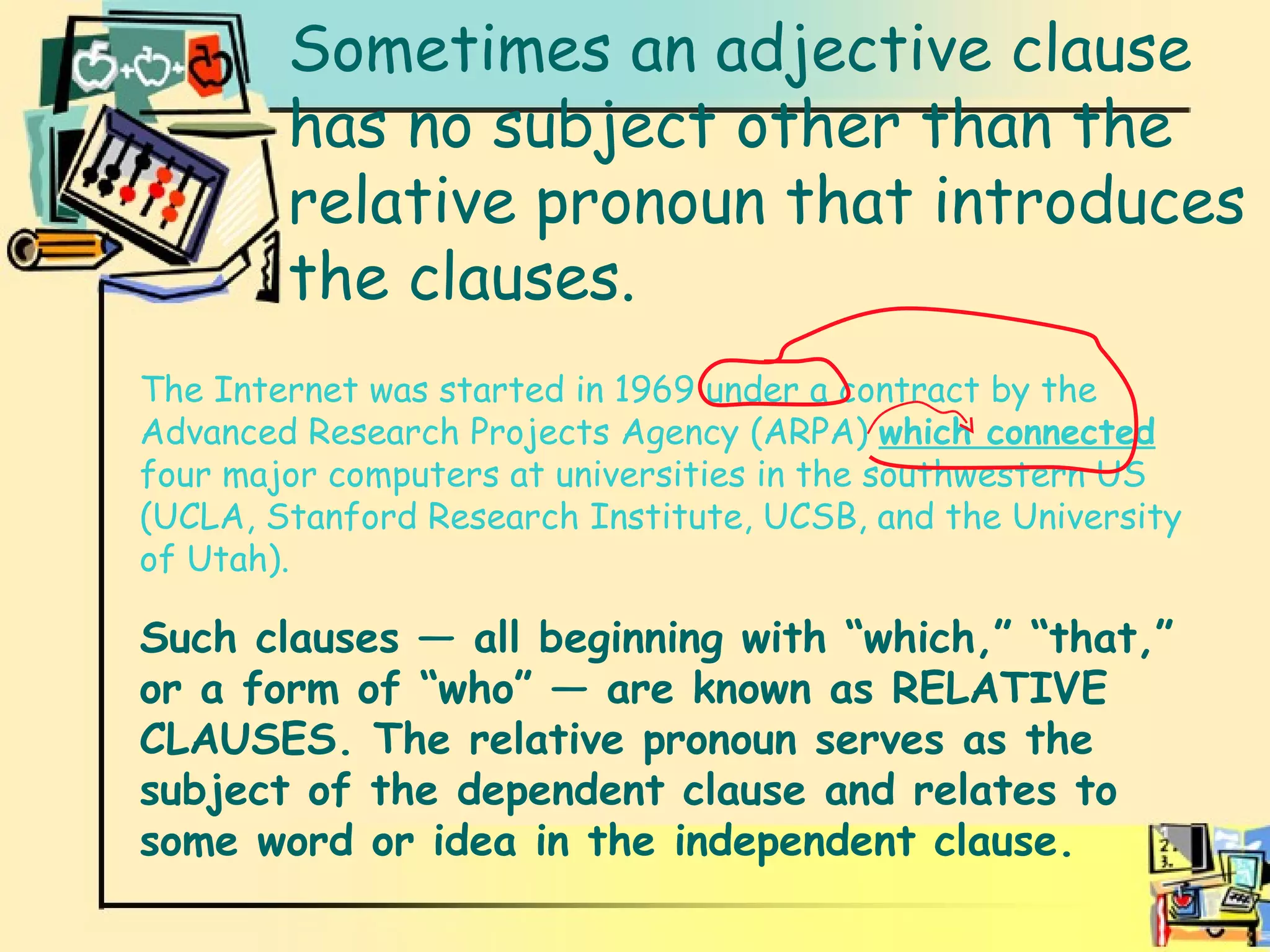
Adjective clauses Sometimes an adjective clause has no subject other than the relative pronoun that introduces the clauses. The Internet was started in 1969 under a contract by the Advanced Research Projects Agency (ARPA)  which connected  four major computers at universities in the southwestern US (UCLA, Stanford Research Institute, UCSB, and the University of Utah). Such clauses — all beginning with “which,” “that,” or a form of “who” — are known as RELATIVE CLAUSES. The relative pronoun serves as the subject of the dependent clause and relates to some word or idea in the independent clause.
conclusion   Understanding  CLAUSES  and  how they are connected within the overall structure of a sentence will help you avoid sentence fragments and run on sentences. You will also become more confident in your writing and punctuation.  Consult a good grammar book for more details.
 
BEST info This presentation is especially created for you by Nora   恩沛   2738 0770 0910 311 516 Located near 101 [email_address] CausingtheSongtoSing copyright March 2005

Grammar: Clauses

  • 1.
    building blocks ofsentences Clauses Clauses
  • 2.
    Simple definition A clause is a group of related words containing a subject and a verb. It is different from a phrase which does not include a subject and a verb.
  • 3.
    Independent Clause. An Independent Clause can stand by itself and make sense. It could be its own sentence, but often it is combined with other independent clauses and dependent clauses to form a longer sentence. They are sometimes called essential clauses or restrictive clauses.
  • 4.
    Examples examples ofindependent clauses . . . . Glaciers often leave behind holes in the ground . These holes are called kettles , and they look just like scooped-out pots. Glaciers also leave behind enormous deposits of glacial “garbage” ; these deposits are called morains . Kettle holes result when a large block of ice is left behind the glacier and then melts away, leaving a large depression . Lets take a closer look at this last sentence. . .
  • 5.
    explanation This sentenceconsists of a very brief independent clause followed by a long, complex dependent clause . Kettle holes result when a large block of ice is left behind the glacier and then melts away, leaving a large depression. The dependent clause begins with a subordinating conjunction. This causes the clause to be dependent upon the rest of the sentence for its meaning; it cannot stand alone.
  • 6.
    Dependent clause A dependent clause cannot stand by itself. It depends on something else, for its meaning. Dependent clauses are sometimes called subordinate, nonessential, or nonrestrictive clauses. A dependent clause standing by itself is a sentence fragment.
  • 7.
    Independent clauses areconnected by 1. a comma and conjunction 2. only a semicolon 3. a semicolon and conjunctive adverb however, moreover, as a result, nevertheless, consequently , etc.) 4 . separated by a period. and, but, or, nor, for, yet, & sometimes so
  • 8.
    Dependent clauses Dependentclauses are identified and classified according to their role in a sentence.
  • 9.
    Noun clauses Nounclauses do anything a noun can do. They can be subjects, The damage President George W. Bush has done to America’s international image could fill entire libraries. JK Rowlings has written fabulous book about a n orphaned boy’s experiences in wizard school.. objects, objects of prepositions Our sales manager has finally revealed what he has in mind for his yearly sales target .
  • 10.
    Adverb clauses ADVERBCLAUSES tell us about the sentence’s main verb: when, why, under what condition.
  • 11.
    Adverb clauses2 Adverbclauses After many customers complained about the after sales service , company managers took action to improve the situation . The CEO insisted on attending the employee meeting because it was important to demonstrate that he is willing to listen to employee concerns. The dependent clauses begin with “dependent words,” words that subordinate what follows to the rest of the sentence. These words are also called subordinating conjunctions.
  • 12.
    Adjective clauses Anadjective clause often separates the subject separated from its verb by information represented by the dependent clause.
  • 13.
    Adjective clauses ADJECTIVE CLAUSES modify nouns or pronouns in the rest of the sentence.. The Internet, which started out as a means for military and academic types to share documents , has become a household necessity. Tim Berners-Lee, who developed the World Wide Web , could never have foreseen the popularity of his invention. The graphical user interface (GUI) that we all take for granted nowadays is actually a late development in the World Wide Web.
  • 14.
    Adjective clauses Sometimesan adjective clause has no subject other than the relative pronoun that introduces the clauses. The Internet was started in 1969 under a contract by the Advanced Research Projects Agency (ARPA) which connected four major computers at universities in the southwestern US (UCLA, Stanford Research Institute, UCSB, and the University of Utah). Such clauses — all beginning with “which,” “that,” or a form of “who” — are known as RELATIVE CLAUSES. The relative pronoun serves as the subject of the dependent clause and relates to some word or idea in the independent clause.
  • 15.
    conclusion Understanding CLAUSES and how they are connected within the overall structure of a sentence will help you avoid sentence fragments and run on sentences. You will also become more confident in your writing and punctuation. Consult a good grammar book for more details.
  • 16.
  • 17.
    BEST info Thispresentation is especially created for you by Nora 恩沛 2738 0770 0910 311 516 Located near 101 [email_address] CausingtheSongtoSing copyright March 2005