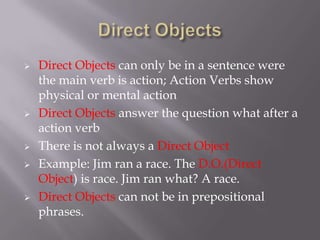
   Direct Objects can only be in a sentence were
    the main verb is action; Action Verbs show
    physical or mental action
   Direct Objects answer the question what after a
    action verb
   There is not always a Direct Object
   Example: Jim ran a race. The D.O.(Direct
    Object) is race. Jim ran what? A race.
   Direct Objects can not be in prepositional
    phrases.
Put two lines under the verb, decide if it is action if it is
not leave the sentence alone. Then find the D.O. in each
sentence, and put a box around it.
   1.   He walked the dog.
   2.   The dog played fetch with a tennis
        ball.
   3.   The dog ate the bone.
   4.   The dog is smelly.
   5.   They dog smelled a bunny.
Acton verbs are orange
                           and D.O.s are red
1.   1. He walked the dog.
2.   The dog played fetch with a tennis
     ball.
3.   The dog ate the bone.
4.   The dog is smelly. They is no D.O.
     because there is no action verbs. Is
     is a linking verb.
5.   They dog smelled a bunny.
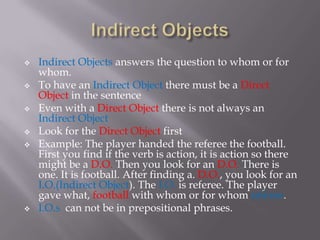
   Indirect Objects answers the question to whom or for
    whom.
   To have an Indirect Object there must be a Direct
    Object in the sentence
   Even with a Direct Object there is not always an
    Indirect Object
   Look for the Direct Object first
   Example: The player handed the referee the football.
    First you find if the verb is action, it is action so there
    might be a D.O. Then you look for an D.O. There is
    one. It is football. After finding a. D.O., you look for an
    I.O.(Indirect Object). The I.O. is referee. The player
    gave what, football with whom or for whom referee.
   I.O.s can not be in prepositional phrases.
1. They gave me a cake.
2. He threw Jessica the ball.
3. I baked Joe a cake.
4. We gave chinchillas a chance.
5. He gave me candy.
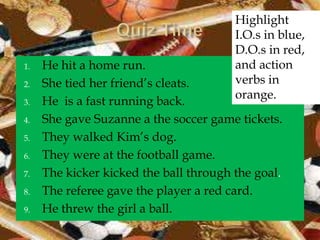
Highlight
                                        I.O.s in blue,
                                        D.O.s in red,
1.   He hit a home run.                 and action
2.   She tied her friend’s cleats.      verbs in
                                        orange.
3.   He is a fast running back.
4.   She gave Suzanne a the soccer game tickets.
5.   They walked Kim’s dog.
6.   They were at the football game.
7.   The kicker kicked the ball through the goal.
8.   The referee gave the player a red card.
9.   He threw the girl a ball.
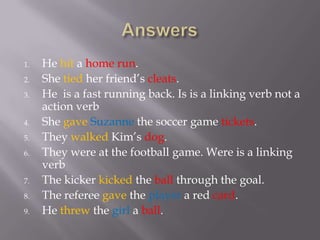
1.   He hit a home run.
2.   She tied her friend’s cleats.
3.   He is a fast running back. Is is a linking verb not a
     action verb
4.   She gave Suzanne the soccer game tickets.
5.   They walked Kim’s dog.
6.   They were at the football game. Were is a linking
     verb
7.   The kicker kicked the ball through the goal.
8.   The referee gave the player a red card.
9.   He threw the girl a ball.
   D.O.s can only come after a action verb
   For they to be a I.O. they must be a D.O.
   D.O.s answer the question what?
   I.O.s answer the question to whom or for
    whom
   D.O. and I.O.s can not be in prepositional
    phrases

Direct Objects and Indirect Objects

  • 2.
    Direct Objects can only be in a sentence were the main verb is action; Action Verbs show physical or mental action  Direct Objects answer the question what after a action verb  There is not always a Direct Object  Example: Jim ran a race. The D.O.(Direct Object) is race. Jim ran what? A race.  Direct Objects can not be in prepositional phrases.
  • 3.
    Put two linesunder the verb, decide if it is action if it is not leave the sentence alone. Then find the D.O. in each sentence, and put a box around it. 1. He walked the dog. 2. The dog played fetch with a tennis ball. 3. The dog ate the bone. 4. The dog is smelly. 5. They dog smelled a bunny.
  • 4.
    Acton verbs areorange and D.O.s are red 1. 1. He walked the dog. 2. The dog played fetch with a tennis ball. 3. The dog ate the bone. 4. The dog is smelly. They is no D.O. because there is no action verbs. Is is a linking verb. 5. They dog smelled a bunny.
  • 5.
    Indirect Objects answers the question to whom or for whom.  To have an Indirect Object there must be a Direct Object in the sentence  Even with a Direct Object there is not always an Indirect Object  Look for the Direct Object first  Example: The player handed the referee the football. First you find if the verb is action, it is action so there might be a D.O. Then you look for an D.O. There is one. It is football. After finding a. D.O., you look for an I.O.(Indirect Object). The I.O. is referee. The player gave what, football with whom or for whom referee.  I.O.s can not be in prepositional phrases.
  • 6.
    1. They gaveme a cake. 2. He threw Jessica the ball. 3. I baked Joe a cake. 4. We gave chinchillas a chance. 5. He gave me candy.
  • 7.
    Highlight I.O.s in blue, D.O.s in red, 1. He hit a home run. and action 2. She tied her friend’s cleats. verbs in orange. 3. He is a fast running back. 4. She gave Suzanne a the soccer game tickets. 5. They walked Kim’s dog. 6. They were at the football game. 7. The kicker kicked the ball through the goal. 8. The referee gave the player a red card. 9. He threw the girl a ball.
  • 8.
    1. He hit a home run. 2. She tied her friend’s cleats. 3. He is a fast running back. Is is a linking verb not a action verb 4. She gave Suzanne the soccer game tickets. 5. They walked Kim’s dog. 6. They were at the football game. Were is a linking verb 7. The kicker kicked the ball through the goal. 8. The referee gave the player a red card. 9. He threw the girl a ball.
  • 9.
    D.O.s can only come after a action verb  For they to be a I.O. they must be a D.O.  D.O.s answer the question what?  I.O.s answer the question to whom or for whom  D.O. and I.O.s can not be in prepositional phrases