Muhammad Arslan
Muhammad Arslan
To know the propose and importance of classroom
observation
To discuss how a systematic process of evaluating
performance can contribute to teacher’s professional
growth , teacher’s effectiveness and therefore, to more
effective student learning.
is a formative
(continuous) process of gathering data
around teacher learning targets to provide
feedback to the teacher regarding growth
and to inform future teacher learning.
Muhammad Arslan
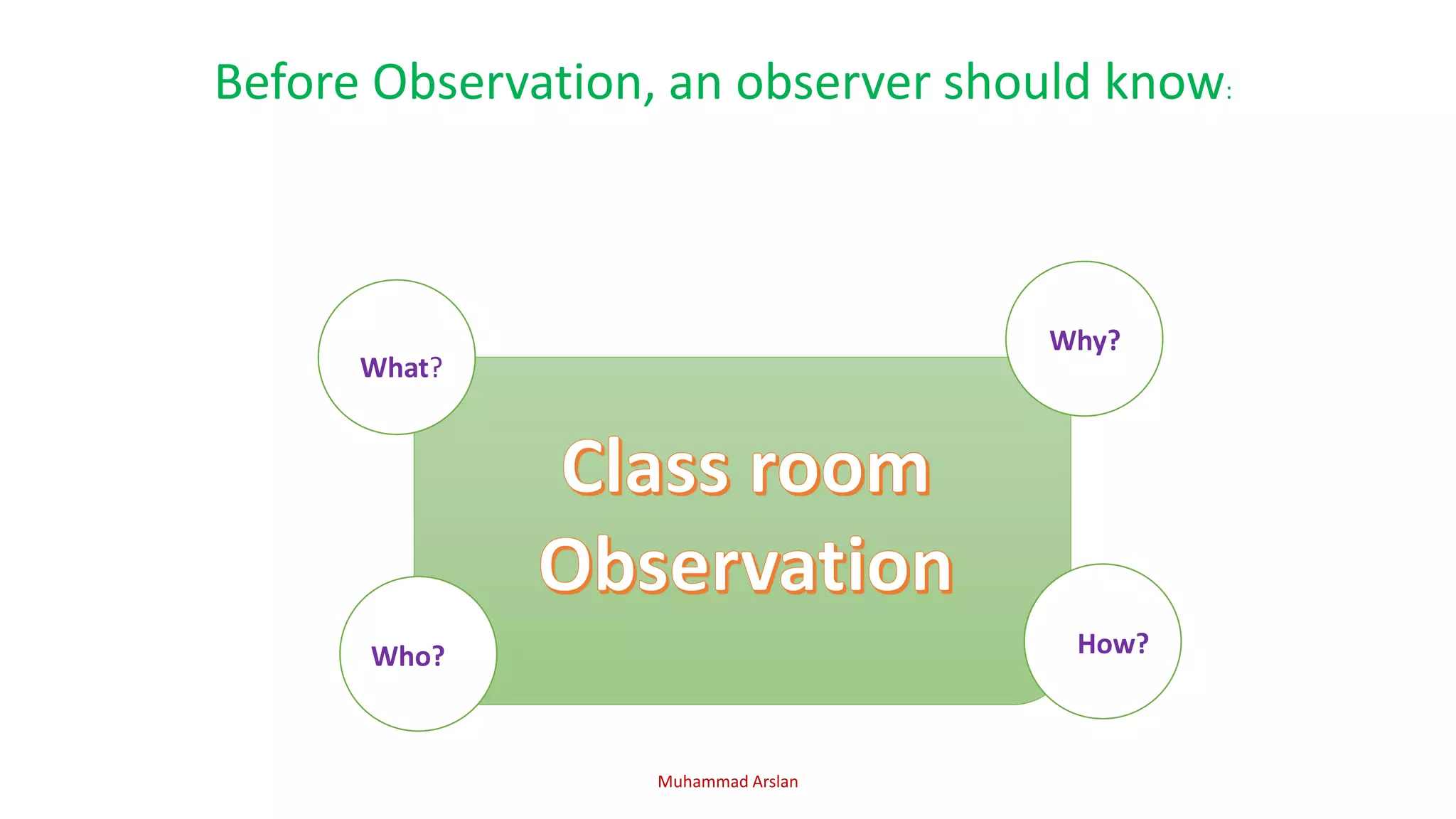
Before Observation, an observer should know:
What?
How?Who?
Why?
Muhammad Arslan
What: One or more observers spending time in the class to observe a
lesson partly or completely.
Why: Two major purposes
1.Evaluation: It may lead to making administrative decisions such
as, rating of appraisal, job conflict, warning etc.
2.Professional Development: This approach to lesson observation
is driven by a concern for continuous Quality improvement.
Muhammad Arslan
How: A teacher may be Observed
unannounced, or with a prior notice.
Single observation or series of observations.
Clinical supervision
Muhammad Arslan
Who: Observer may be the principal, vice principal, HOD , any
supervisor or any colleague.
It is a well-known classroom observation approach.
It has three basic steps:
1.Pre-Observation conference: Before observation teacher discuss the
lesson plan with observer.
2.Class Observation: Observer, Observe the class quietly, takes notes and
gathers important data.
3.Post-Lesson Conference: Feedback session, Sharing the observations
positively with teacher.
Muhammad Arslan
The effectiveness of an observation would depend on the
Content Knowledge
Feedback Skills
Experience &
Expertise
Interpersonal Skills
Pedagogy
Muhammad Arslan
If more than one observers in the school then all members of
team should know that:
What counts as effective teaching
The number of times a teacher has been observed
What kind of feedback has been given
Muhammad Arslan
Develop a climate of mutual trust with teacher
Treat the teacher with respect
Never insult the teacher
Be a silent observer , “like a fly on the wall”
Don’t intervene during observation
A) For the individual observer
Muhammad Arslan
Muhammad Arslan
What is the teacher doing?
What are the students doing?
What are students saying to the teacher ? To each other?
What is the task?
How much time spend on the task?
What is the depth of knowledge of the task?
Muhammad Arslan
B) For the Management:
Maintain a record of observations
The information can also be used for preparing the performance
appraisal.
Develop a culture of peer-observation
A blank copy of the lesson observation form should be given to
all teachers and discuss the points in the form.
Muhammad Arslan
Feedback is a way of the effect of our behavior has on others.
so it:
increases self-awareness
offers options
encourages development
Constructive feedback does not mean “only positive”
Muhammad Arslan
Muhammad Arslan
Feed back should be given in private and not in public.
Pay complete attention.
Share only few major weak points, if several noted.
Don’t sound authoritative.
First ask the teacher to reflect on his teaching.
Share running notes.
Start with positive
Be specific
Refers to behavior which can be changed
Offer alternatives
Be descriptive rather than evaluative
Own the feedback
Leave the recipients with a choice
Say “Thank You” with smile
Think what it says about you
Muhammad Arslan
Muhammad Arslan

Classroom observation

  • 1.
  • 3.
    Muhammad Arslan To knowthe propose and importance of classroom observation To discuss how a systematic process of evaluating performance can contribute to teacher’s professional growth , teacher’s effectiveness and therefore, to more effective student learning.
  • 4.
    is a formative (continuous)process of gathering data around teacher learning targets to provide feedback to the teacher regarding growth and to inform future teacher learning. Muhammad Arslan
  • 5.
    Before Observation, anobserver should know: What? How?Who? Why? Muhammad Arslan
  • 6.
    What: One ormore observers spending time in the class to observe a lesson partly or completely. Why: Two major purposes 1.Evaluation: It may lead to making administrative decisions such as, rating of appraisal, job conflict, warning etc. 2.Professional Development: This approach to lesson observation is driven by a concern for continuous Quality improvement. Muhammad Arslan
  • 7.
    How: A teachermay be Observed unannounced, or with a prior notice. Single observation or series of observations. Clinical supervision Muhammad Arslan Who: Observer may be the principal, vice principal, HOD , any supervisor or any colleague.
  • 8.
    It is awell-known classroom observation approach. It has three basic steps: 1.Pre-Observation conference: Before observation teacher discuss the lesson plan with observer. 2.Class Observation: Observer, Observe the class quietly, takes notes and gathers important data. 3.Post-Lesson Conference: Feedback session, Sharing the observations positively with teacher. Muhammad Arslan
  • 9.
    The effectiveness ofan observation would depend on the Content Knowledge Feedback Skills Experience & Expertise Interpersonal Skills Pedagogy Muhammad Arslan
  • 10.
    If more thanone observers in the school then all members of team should know that: What counts as effective teaching The number of times a teacher has been observed What kind of feedback has been given Muhammad Arslan
  • 11.
    Develop a climateof mutual trust with teacher Treat the teacher with respect Never insult the teacher Be a silent observer , “like a fly on the wall” Don’t intervene during observation A) For the individual observer Muhammad Arslan
  • 12.
    Muhammad Arslan What isthe teacher doing? What are the students doing? What are students saying to the teacher ? To each other? What is the task? How much time spend on the task? What is the depth of knowledge of the task?
  • 13.
  • 14.
    B) For theManagement: Maintain a record of observations The information can also be used for preparing the performance appraisal. Develop a culture of peer-observation A blank copy of the lesson observation form should be given to all teachers and discuss the points in the form. Muhammad Arslan
  • 15.
    Feedback is away of the effect of our behavior has on others. so it: increases self-awareness offers options encourages development Constructive feedback does not mean “only positive” Muhammad Arslan
  • 16.
    Muhammad Arslan Feed backshould be given in private and not in public. Pay complete attention. Share only few major weak points, if several noted. Don’t sound authoritative. First ask the teacher to reflect on his teaching. Share running notes.
  • 17.
    Start with positive Bespecific Refers to behavior which can be changed Offer alternatives Be descriptive rather than evaluative Own the feedback Leave the recipients with a choice Say “Thank You” with smile Think what it says about you Muhammad Arslan
  • 18.