
Progressivism
Presented By:
The term "progressive education”
means to describe ideas and
practices that aim to make schools
more effective agencies of a
democratic society.
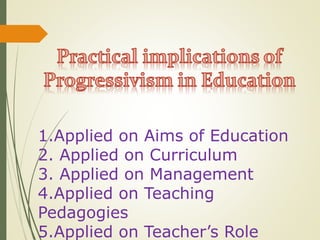
1.Applied on Aims of Education
2. Applied on Curriculum
3. Applied on Management
4.Applied on Teaching
Pedagogies
5.Applied on Teacher’s Role
To promote:
Democratic and social
living
Cultural values.
Subjects are
interdisciplinary,
integrative and interactive.
Curriculum is focused on
students’ interest, human
problems and affairs.
School reforms,
relevant and
contextualized
curriculum,
humanistic
education.
Student interests
and needs;
democracy;
morality; social
development.
Knowledge leads to
growth and
development of
lifelong learners who
actively learn by
Participate in
formulating the
purposes that are the
basis for the student-
centered curriculum.
Learning centers
Cooperative learning
Student-led and -
initiated discussion.
Act as a facilitator for
student learning.
Determine student interests
for developing curriculum.
Guiding the students to their
needs.
The Progressive education
movement was an integral part
of the early twentieth-century
reform impulse directed toward
the reconstruction of American
democracy through social,
as well as cultural, uplift.
The altered landscape of American
life, Progressive reformers believed,
provided the school with a new
opportunity–indeed, a new
responsibility–to play a leading role
in preparing American citizens for
active civic participation in a
democratic society.
Application of progressivism
Creates individuals with a
Developed PSYCHOMOTOR
& COGNITIVE personality.
INNOVATION
IS
PROGRESS

Progressivism