CLASSROOM RESEARCH


CLASSROOM OBSERVATION
      STEFAN RATHERT
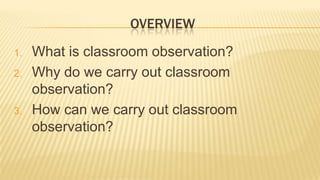
OVERVIEW
1.   What is classroom observation?
2.   Why do we carry out classroom
     observation?
3.   How can we carry out classroom
     observation?
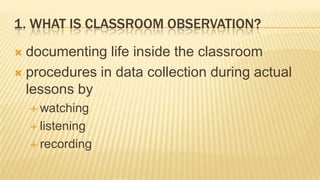
1. WHAT IS CLASSROOM OBSERVATION?
 documenting life inside the classroom
 procedures in data collection during actual
  lessons by
     watching

     listening

     recording
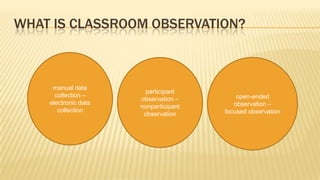
WHAT IS CLASSROOM OBSERVATION?


     manual data
                       participant
      collection –                         open-ended
                      observation –
    electronic data                       observation –
                      nonparticipant
       collection                      focused observation
                       observation
2. WHY DO WE CARRY OUT CLASSROOM OBSERVATION?

 SLA research does not only focus on results
 focus is on result and process

 classroom interaction is essential
3. HOW CAN WE CARRY OUT CLASSROOM OBSERVATION?

   basic approaches
     ethnographic     narratives
     transcriptions

     observation   systems to code data
   quality control
ETHNOGRAPHIC NARRATIVES
              not only record of
               utterances but also
               description of classroom
               dynamics/atmosphere
              time-consuming to
               produce
              requires high-quality
               recording equipment
               and/or note taking skills
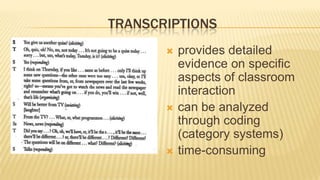
TRANSCRIPTIONS
          provides detailed
           evidence on specific
           aspects of classroom
           interaction
          can be analyzed
           through coding
           (category systems)
          time-consuming
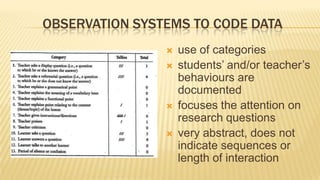
OBSERVATION SYSTEMS TO CODE DATA
                   use of categories
                   students’ and/or teacher’s
                    behaviours are
                    documented
                   focuses the attention on
                    research questions
                   very abstract, does not
                    indicate sequences or
                    length of interaction
OBSERVATION SYSTEMS TO CODE DATA: SELECTING AN OBSERVATION SCHEME


                  check of a behaviour every time or at
                   regular intervals?
                  high- or low-inference categories?
                  possible to assign an utterance to more
                   than one category?
                  designed for use in real time or with audio-
                   /videotape recordings?
                  designed for research or teacher
                   education?
                  focus of the instrument
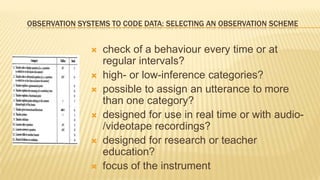
EXAMPLE OF AN OBSERVATION SYSTEM: COLT
   Communicative Orientation to Language Teaching
   influenced by communicative approaches in FL
    learning
   designed to meet the needs for research on
    relationship between teaching and learning
   designed to develop psycholinguistically valid
    categories for classroom observation
   has two parts: Classroom Activities and Classroom
    Language
EXAMPLE OF AN OBSERVATION SYSTEM: COLT PART A
EXAMPLE OF AN OBSERVATION SYSTEM: COLT PART B
EXAMPLE OF AN OBSERVATION SYSTEM: COLT

 obtained data reliable but:
 categories given are ideologically loaded

 categories mirror assumption that
  communicative teaching facilitates effective
  learning best
OBSERVATION SCHEMES: GENERAL CONSIDERATIONS
 no totally objective classroom observation
  scheme
 observation schemes show tallies (frequency)
  not the interaction itself, i.e. the language used
  in interaction
 particularly elaborate schemes require trained
  observers
 complementary to transcriptions/ethnographic
  narratives
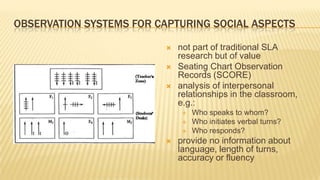
OBSERVATION SYSTEMS FOR CAPTURING SOCIAL ASPECTS

                            not part of traditional SLA
                             research but of value
                            Seating Chart Observation
                             Records (SCORE)
                            analysis of interpersonal
                             relationships in the classroom,
                             e.g.:
                                 Who speaks to whom?
                                 Who initiates verbal turns?
                                 Who responds?
                            provide no information about
                             language, length of turns,
                             accuracy or fluency
QUALITY CONTROL – THREATS TO OBSERVATION QUALITY


    validity                observer                 technical
                             effect                   issues


               adequate
               capture of              reliability
                events
QUALITY CONTROL – THINGS TO CONSIDER
   check location beforehand
   check technical equipment
   acclimate participants to observation, build up trust
   reach an agreement with other observers
   match the categories for the observation to the research
    questions
   do a pilot study
   provide methods triangulation (e.g. observation scheme +
    field notes + stimulated recall)
REFERENCES
   Fraenkel, J.R & Wallen, N.M. (2006) How to Design and Evaluate
    Research in Education. Boston: McGraw-Hill
   Hopkins, D. (2002) A Teacher’s Guide to Classroom Research.
    Berkshire: Open University Press
   McKay, S. L. (2006). Researching second language classrooms.
    Mahwah, NJ: Lawrence Erlbaum Associates
   Nunan D. & Bailey K. M. (2009) Exploring Second Language Classroom
    Research - A Comprehensive Guide. Boston: Heinle Cengage Learning
   Taggart, G.L. & Wilson A.P. (2005). Promoting Reflective Thinking in
    Teachers. 50 Action Strategies. Thousand Oaks, California: Corwin
    Press

Classroom observation

  • 1.
  • 2.
    OVERVIEW 1. What is classroom observation? 2. Why do we carry out classroom observation? 3. How can we carry out classroom observation?
  • 3.
    1. WHAT ISCLASSROOM OBSERVATION?  documenting life inside the classroom  procedures in data collection during actual lessons by  watching  listening  recording
  • 4.
    WHAT IS CLASSROOMOBSERVATION? manual data participant collection – open-ended observation – electronic data observation – nonparticipant collection focused observation observation
  • 5.
    2. WHY DOWE CARRY OUT CLASSROOM OBSERVATION?  SLA research does not only focus on results  focus is on result and process  classroom interaction is essential
  • 6.
    3. HOW CANWE CARRY OUT CLASSROOM OBSERVATION?  basic approaches  ethnographic narratives  transcriptions  observation systems to code data  quality control
  • 7.
    ETHNOGRAPHIC NARRATIVES  not only record of utterances but also description of classroom dynamics/atmosphere  time-consuming to produce  requires high-quality recording equipment and/or note taking skills
  • 8.
    TRANSCRIPTIONS  provides detailed evidence on specific aspects of classroom interaction  can be analyzed through coding (category systems)  time-consuming
  • 9.
    OBSERVATION SYSTEMS TOCODE DATA  use of categories  students’ and/or teacher’s behaviours are documented  focuses the attention on research questions  very abstract, does not indicate sequences or length of interaction
  • 10.
    OBSERVATION SYSTEMS TOCODE DATA: SELECTING AN OBSERVATION SCHEME  check of a behaviour every time or at regular intervals?  high- or low-inference categories?  possible to assign an utterance to more than one category?  designed for use in real time or with audio- /videotape recordings?  designed for research or teacher education?  focus of the instrument
  • 11.
    EXAMPLE OF ANOBSERVATION SYSTEM: COLT  Communicative Orientation to Language Teaching  influenced by communicative approaches in FL learning  designed to meet the needs for research on relationship between teaching and learning  designed to develop psycholinguistically valid categories for classroom observation  has two parts: Classroom Activities and Classroom Language
  • 12.
    EXAMPLE OF ANOBSERVATION SYSTEM: COLT PART A
  • 13.
    EXAMPLE OF ANOBSERVATION SYSTEM: COLT PART B
  • 14.
    EXAMPLE OF ANOBSERVATION SYSTEM: COLT  obtained data reliable but:  categories given are ideologically loaded  categories mirror assumption that communicative teaching facilitates effective learning best
  • 15.
    OBSERVATION SCHEMES: GENERALCONSIDERATIONS  no totally objective classroom observation scheme  observation schemes show tallies (frequency) not the interaction itself, i.e. the language used in interaction  particularly elaborate schemes require trained observers  complementary to transcriptions/ethnographic narratives
  • 16.
    OBSERVATION SYSTEMS FORCAPTURING SOCIAL ASPECTS  not part of traditional SLA research but of value  Seating Chart Observation Records (SCORE)  analysis of interpersonal relationships in the classroom, e.g.:  Who speaks to whom?  Who initiates verbal turns?  Who responds?  provide no information about language, length of turns, accuracy or fluency
  • 17.
    QUALITY CONTROL –THREATS TO OBSERVATION QUALITY validity observer technical effect issues adequate capture of reliability events
  • 18.
    QUALITY CONTROL –THINGS TO CONSIDER  check location beforehand  check technical equipment  acclimate participants to observation, build up trust  reach an agreement with other observers  match the categories for the observation to the research questions  do a pilot study  provide methods triangulation (e.g. observation scheme + field notes + stimulated recall)
  • 19.
    REFERENCES  Fraenkel, J.R & Wallen, N.M. (2006) How to Design and Evaluate Research in Education. Boston: McGraw-Hill  Hopkins, D. (2002) A Teacher’s Guide to Classroom Research. Berkshire: Open University Press  McKay, S. L. (2006). Researching second language classrooms. Mahwah, NJ: Lawrence Erlbaum Associates  Nunan D. & Bailey K. M. (2009) Exploring Second Language Classroom Research - A Comprehensive Guide. Boston: Heinle Cengage Learning  Taggart, G.L. & Wilson A.P. (2005). Promoting Reflective Thinking in Teachers. 50 Action Strategies. Thousand Oaks, California: Corwin Press