Under Supervision
Dr. Anjali Sharma
BY Education management Students:
AKANKHYA GOSWAMI
GUTIMALI GOSWAMI
RASHMI DAS
MAMI MANDAL
SANDEEPAAGASTHI
EDUCATIONAL LEADERSHIP
Leaders are people who do right things.
Manager are people who do things Right.
Peter Drucker
Leadership is an act of influencing others to
perform and engage them in achieving a
goal.
A leader steps up in the time of crisis and is
able to think and act creatively in different
situations.
Let’s start with what leadership is
not……
 Leadership has nothing to do with
seniority or one’s position in the hierarchy.
 Leadership has nothing to do with titles.
 Leadership has nothing to do with
personal attributes.
 Leadership is not Management.
 As we look in to next century, leaders
will be those who empower others.
Bill Gates
• Leadership is influence- nothing more,
nothing less.
John Maxwell
• Leadership is an extra push.
Koontz
Definitions_________________
EDUCATIONAL
LEADERSHIP
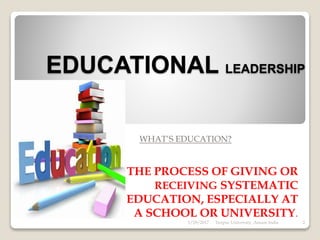
WHAT’S EDUCATION?
THE PROCESS OF GIVING
OR RECEIVING
SYSTEMATIC EDUCATION,
ESPECIALLY AT A SCHOOL
OR UNIVERSITY.
EDUCATIONAL
LEADERSHIP
THE ACTION OF LEADING A GROUP
INVOLE IN EDUCTIONAL PROCESS OR
EDUCATIONAL ORGANISATION, OR THE
ABILITY TO DO THIS.
EDUCATIONAL
LEADERSHIP
Is a term applied to school
administration that strive to create
positive change in educational policies
and processes.
.
EDUCATIONAL LEADERS
Educational leaders usually are
employed
As school principles or
administrators.
Additional, such as department chair
or academic dean.
Is a leadership quality existing in
any individual of an educational
institute?
who have the quality to influence
his/her fellow mates?
The Person has a clear
Educational vision and mission.
Worries…….
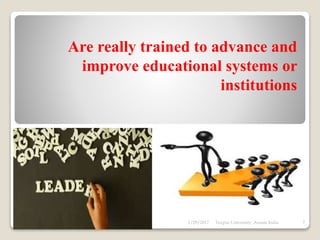
Are really trained to advance and
improve educational systems or
institutions
WHO IS A LEADER?
 A person who leads or commands or guides
a group or a organisation or a country to
achieve predefined objectives.
 A leader by its meaning is one who goes
first and leads by example, so that others
are motivated to follow him.
 A person must have a deep-rooted
commitment to the goal, will strive to
achieve it even if nobody follows him.
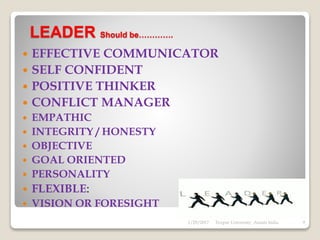
LEADER IS
 EFFECTIVE COMMUNICATOR: A leader
should be able to communicate his ideas,
objectives to others. If he fails in
effective communication, their leadership
will fail. Effective communication helps a
leader to reach out to his people.
 SELF CONFIDENT: Whatever he/she
says he should be confident about it. Self
confidence helps a leader to become
assertive. It also instills confidence in
others and draws out the trust and best
efforts of the team to complete the task
well.
Contd.
 POSITIVE THINKER: A leader should
have positive attitude. He should be
hopeful even if there is doubt. In adverse
situations he should be able to work hard
and get the results.
 CONFLICT MANAGER: Leaders should
have the ability to resolve conflicts among
team members. He should be able to
handle any kind of conflicts efficiently
without losing team-spirit.
Contd.
 EMPATHIC: Empathy is based on
stepping into others’ shoes show that
he can understand their problems and
be able to solve it.
 INTEGRITY / HONESTY: A leader should
be honest and moral. He should have
the ability to keep his promises. It
helps him to gain trust and confidence
of others. Honesty also allows for better
assessment and growth.
 OBJECTIVE: A leader should be
impartial. He should give equal respect
to everyone without being biased or
subjective.
Contd.
 GOAL ORIENTED: He should work towards
the accomplishment of goals without
deviating from his target. A goal oriented
leader can break down his objectives into
manageable steps and make progress
towards it.
 PERSONALITY: Leaders should have such
a personality that the moment he or she
arrives, the whole environment changes.
Personality is not only about outer
appearance. It also includes intelligence,
creativity, strictness, ability to think
differently, impressiveness etc.
Contd.
 FLEXIBLE: An effective leader will adapt
to new surroundings and situations, doing
his/her best to adjust. Not every problem
demands the same solution. By being
flexible to new ideas and open-minded
enough to consider them, a leader
increases the likelihood to find the best
possible solution.
 VISION OR FORESIGHT: He should have
the ability to foresee what will happen in
the future. Foresight means identifying
relevant opportunities that are emerging
and strategizing how to make the most of
them.
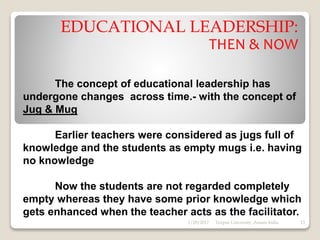
The concept of educational leadership has
undergone changes across the time- with
the concept of Jug & Mug
Earlier teachers were considered as jugs
full of knowledge and the students as
empty mugs i.e. having no knowledge
This concept has changed in the recent
years. now the students are not regarded
completely empty. They have some prior
knowledge which gets enhanced when the
teacher acts as the facilitator.
CONCEPT OF EDUCATIONAL LEADERSHIP:
THEN & NOW
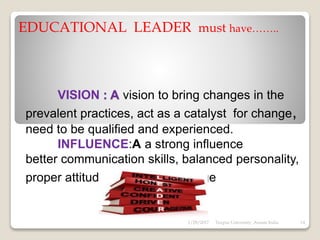
1. VISION-must have a vision to bring
changes in the prevalent practices, act as a
catalyst for change, need to be qualified and
experienced.
2. INFLUENCE-must have a strong
influence- better communication skills,
balanced personality, proper attitude towards
knowledge
CHARACTERISTICS OF EDUCATIONAL
LEADERSHIP
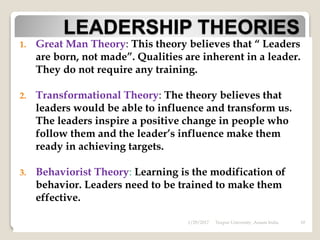
LEADERSHIP THEORIES
Great Man Theory
 This theory believes that Leaders are in
born, not made. Qualities are inherent in a
leader. They do not require any training.
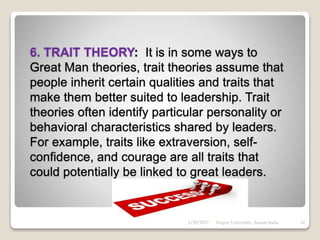
• TRAIT THEORY: It is in some
ways to Great Man theories, trait
theories assume that people
inherit certain qualities and traits
that make them better suited to
leadership. Trait theories often
identify particular personality or
behavioral characteristics shared
by leaders.
Situational Theory
 Leadership is the product of situational
demand: situational factors determine
who will emerge as a leader rather than a
person’s heritage. The emergence of a
great leader is the result of time, place
and circumstances.
Personal Situational Theory
 Personal Situational theory represents
the combination of great man, trait and
situational theories.
 Leadership includes intellectual, affective
and action traits as well as the specific
conditions under which the individual
operates.
Humanistic Theory
 This theory believes that the human being
are by nature motivational things and
organization are by nature structured and
controlled.
 Leadership is to modify organizational
constraints to provide freedom for
individual in order to realized their full
potential and contribute to the
organization.
Path Goal Theory
 Leaders enforce change in the followers
by showing path, also clarify the goal to
the followers and encourage them to
perform well.
Participative Leadership theory
 Participative theory deals with power
sharing and empowerment of the
followers.
Transformational Theory
 This is a process where leaders and
followers raise one another to higher level
of morality and motivation.
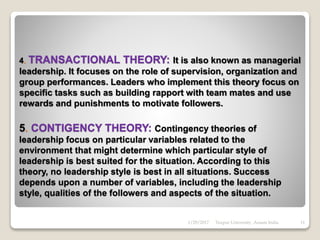
TRANSACTIONAL THEORY
 It is also known as managerial
leadership. It focuses on the role of
supervision, organization and group
performances. Leaders who
implement this theory focus on
specific tasks such as building
rapport with team mates and use
rewards and punishments to motivate
followers
Contingency theories of leadership focus
on particular variables related to the
environment that might determine which
particular style of leadership is best suited
for the situation. According to this theory,
no leadership style is best in all situations.
Success depends upon a number of
variables, including the leadership style,
qualities of the followers and aspects of the
situation.
CONTIGENCY LEADERSHIP THEORY
Transformational Theory
The theory believes that leaders
would be able to influence and
transform others. The leaders inspire
a positive change in people who
follow them and the leader’s
influence make them ready in
achieving targets.
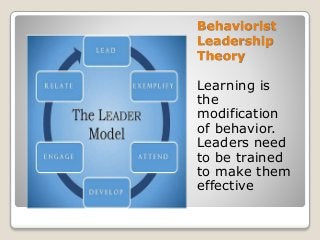
Behaviorist
Leadership
Theory
Learning is
the
modification
of behavior.
Leaders need
to be trained
to make them
effective
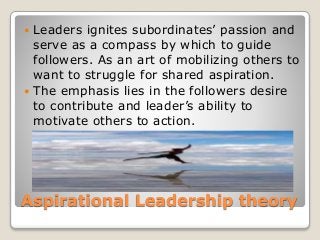
Aspirational Leadership theory
 Leaders ignites subordinates’ passion and
serve as a compass by which to guide
followers. As an art of mobilizing others to
want to struggle for shared aspiration.
 The emphasis lies in the followers desire
to contribute and leader’s ability to
motivate others to action.
Servant Leadership Theory
 This implies that leaders primarily leads
by serving others- customers, employees
and community.
 This includes listening , empathy, healing,
awareness, foresight, commitment to
others growth and development and
community building.
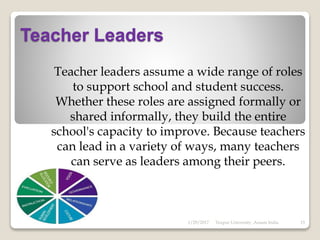
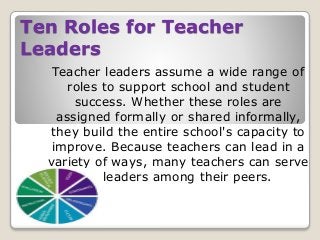
Ten Roles for Teacher
Leaders
Teacher leaders assume a wide range of
roles to support school and student
success. Whether these roles are
assigned formally or shared informally,
they build the entire school's capacity to
improve. Because teachers can lead in a
variety of ways, many teachers can serve
as leaders among their peers.
1. RESOURCE PROVIDER
 Teachers help their colleagues by sharing
instructional resources. These might include
Web sites, instructional materials, readings, or
other resources to use with students. They
might also share such professional resources as
articles, books, lesson or unit plans, and
assessment tools.
 Tinisha becomes a resource provider when she
offers to help Carissa, a new staff member in
her second career, set up her classroom.
Tinisha gives Carissa extra copies of a number
line for her students to use, signs to post on
the wall that explain to students how to get
help when the teacher is busy, and the grade-
level language arts pacing guide.
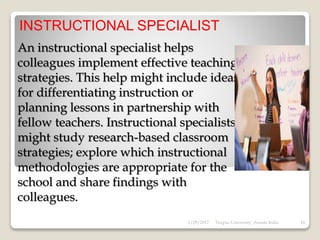
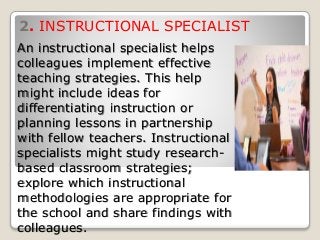
2. INSTRUCTIONAL SPECIALIST
An instructional specialist helps
colleagues implement effective
teaching strategies. This help
might include ideas for
differentiating instruction or
planning lessons in partnership
with fellow teachers. Instructional
specialists might study research-
based classroom strategies;
explore which instructional
methodologies are appropriate for
the school and share findings with
colleagues.
3.CURRICULUM SPECIALIST
understanding content standards, how
various components of the curriculum link
together, and how to use the curriculum in
planning instruction and assessment is
essential to ensuring consistent curriculum
implementation throughout a school.
curriculum specialists lead teachers to
agree on standards, follow the adopted
curriculum, use common pacing charts,
and develop shared assessments.
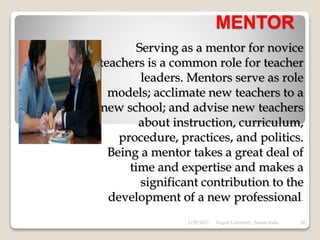
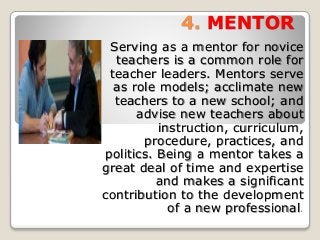
4. MENTOR
Serving as a mentor for novice
teachers is a common role for
teacher leaders. Mentors serve
as role models; acclimate new
teachers to a new school; and
advise new teachers about
instruction, curriculum,
procedure, practices, and
politics. Being a mentor takes a
great deal of time and expertise
and makes a significant
contribution to the development
of a new professional.
5. LEARNING FACILITATOR
Facilitating professional learning
opportunities among staff members is
another role for teacher leaders. When
teachers learn with and from one
another, they can focus on what most
directly improves student learning.
Their professional learning becomes
more relevant, focused on teachers'
classroom work, and aligned to fill gaps
in student learning. Such communities
of learning can break the norms of
isolation present in many schools.
6. CLASSROOM SUPPORTER
Classroom supporters work inside
classrooms to help teachers implement
new ideas, often by demonstrating a
lesson, co-teaching, or observing and
giving feedback. BLASÉ& BLASE found that
consultation with peers
enhanced teachers' self-efficacy (teachers'
belief in their own abilities and capacity to
successfully solve teaching and learning
problems) as they reflected on practice
and grew together, and it also encouraged
a bias for action (improvement through
collaboration) on the part of teachers.
7. SCHOOL LEADER
Being a school leader means serving on
a committee, such as a school
improvement team; acting as a grade-
level or department chair; supporting
school initiatives; or representing the
school on community or district task
forces or committees. A school leader
shares the vision of the school, aligns his
or her professional goals with those of
the school and district, and shares
responsibility for the success of the
school as a whole.
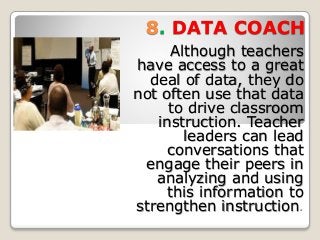
8. DATA COACH
Although teachers
have access to a great
deal of data, they do
not often use that data
to drive classroom
instruction. Teacher
leaders can lead
conversations that
engage their peers in
analyzing and using
this information to
strengthen instruction.
9. CATALYST FOR CHANGE
Teacher leaders can also be
catalysts for change, visionaries
who are “never content with the
status quo but rather always looking
for a better way” (Larner). Teachers
who take on the catalyst role feel
secure in their own work and have a
strong commitment to continual
improvement. They pose questions
to generate analysis of student
learning.
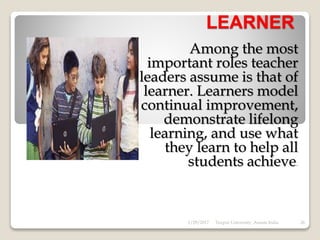
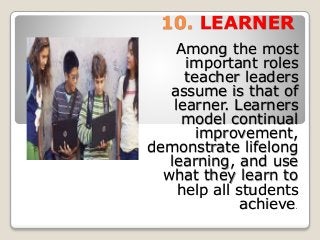
10. LEARNER
Among the most
important roles
teacher leaders
assume is that of
learner. Learners
model continual
improvement,
demonstrate lifelong
learning, and use
what they learn to
help all students
achieve.
THANK YOU

Educational leadership

  • 1.
    Under Supervision Dr. AnjaliSharma BY Education management Students: AKANKHYA GOSWAMI GUTIMALI GOSWAMI RASHMI DAS MAMI MANDAL SANDEEPAAGASTHI EDUCATIONAL LEADERSHIP
  • 2.
    Leaders are peoplewho do right things. Manager are people who do things Right. Peter Drucker Leadership is an act of influencing others to perform and engage them in achieving a goal. A leader steps up in the time of crisis and is able to think and act creatively in different situations.
  • 3.
    Let’s start withwhat leadership is not……  Leadership has nothing to do with seniority or one’s position in the hierarchy.  Leadership has nothing to do with titles.  Leadership has nothing to do with personal attributes.  Leadership is not Management.
  • 4.
     As welook in to next century, leaders will be those who empower others. Bill Gates • Leadership is influence- nothing more, nothing less. John Maxwell • Leadership is an extra push. Koontz Definitions_________________
  • 5.
    EDUCATIONAL LEADERSHIP WHAT’S EDUCATION? THE PROCESSOF GIVING OR RECEIVING SYSTEMATIC EDUCATION, ESPECIALLY AT A SCHOOL OR UNIVERSITY.
  • 6.
    EDUCATIONAL LEADERSHIP THE ACTION OFLEADING A GROUP INVOLE IN EDUCTIONAL PROCESS OR EDUCATIONAL ORGANISATION, OR THE ABILITY TO DO THIS.
  • 7.
    EDUCATIONAL LEADERSHIP Is a termapplied to school administration that strive to create positive change in educational policies and processes. .
  • 8.
    EDUCATIONAL LEADERS Educational leadersusually are employed As school principles or administrators. Additional, such as department chair or academic dean.
  • 9.
    Is a leadershipquality existing in any individual of an educational institute? who have the quality to influence his/her fellow mates? The Person has a clear Educational vision and mission. Worries…….
  • 10.
    Are really trainedto advance and improve educational systems or institutions
  • 11.
    WHO IS ALEADER?  A person who leads or commands or guides a group or a organisation or a country to achieve predefined objectives.  A leader by its meaning is one who goes first and leads by example, so that others are motivated to follow him.  A person must have a deep-rooted commitment to the goal, will strive to achieve it even if nobody follows him.
  • 12.
    LEADER IS  EFFECTIVECOMMUNICATOR: A leader should be able to communicate his ideas, objectives to others. If he fails in effective communication, their leadership will fail. Effective communication helps a leader to reach out to his people.  SELF CONFIDENT: Whatever he/she says he should be confident about it. Self confidence helps a leader to become assertive. It also instills confidence in others and draws out the trust and best efforts of the team to complete the task well.
  • 13.
    Contd.  POSITIVE THINKER:A leader should have positive attitude. He should be hopeful even if there is doubt. In adverse situations he should be able to work hard and get the results.  CONFLICT MANAGER: Leaders should have the ability to resolve conflicts among team members. He should be able to handle any kind of conflicts efficiently without losing team-spirit.
  • 14.
    Contd.  EMPATHIC: Empathyis based on stepping into others’ shoes show that he can understand their problems and be able to solve it.  INTEGRITY / HONESTY: A leader should be honest and moral. He should have the ability to keep his promises. It helps him to gain trust and confidence of others. Honesty also allows for better assessment and growth.  OBJECTIVE: A leader should be impartial. He should give equal respect to everyone without being biased or subjective.
  • 15.
    Contd.  GOAL ORIENTED:He should work towards the accomplishment of goals without deviating from his target. A goal oriented leader can break down his objectives into manageable steps and make progress towards it.  PERSONALITY: Leaders should have such a personality that the moment he or she arrives, the whole environment changes. Personality is not only about outer appearance. It also includes intelligence, creativity, strictness, ability to think differently, impressiveness etc.
  • 16.
    Contd.  FLEXIBLE: Aneffective leader will adapt to new surroundings and situations, doing his/her best to adjust. Not every problem demands the same solution. By being flexible to new ideas and open-minded enough to consider them, a leader increases the likelihood to find the best possible solution.  VISION OR FORESIGHT: He should have the ability to foresee what will happen in the future. Foresight means identifying relevant opportunities that are emerging and strategizing how to make the most of them.
  • 17.
    The concept ofeducational leadership has undergone changes across the time- with the concept of Jug & Mug Earlier teachers were considered as jugs full of knowledge and the students as empty mugs i.e. having no knowledge This concept has changed in the recent years. now the students are not regarded completely empty. They have some prior knowledge which gets enhanced when the teacher acts as the facilitator. CONCEPT OF EDUCATIONAL LEADERSHIP: THEN & NOW
  • 18.
    1. VISION-must havea vision to bring changes in the prevalent practices, act as a catalyst for change, need to be qualified and experienced. 2. INFLUENCE-must have a strong influence- better communication skills, balanced personality, proper attitude towards knowledge CHARACTERISTICS OF EDUCATIONAL LEADERSHIP
  • 19.
  • 20.
    Great Man Theory This theory believes that Leaders are in born, not made. Qualities are inherent in a leader. They do not require any training.
  • 21.
    • TRAIT THEORY:It is in some ways to Great Man theories, trait theories assume that people inherit certain qualities and traits that make them better suited to leadership. Trait theories often identify particular personality or behavioral characteristics shared by leaders.
  • 22.
    Situational Theory  Leadershipis the product of situational demand: situational factors determine who will emerge as a leader rather than a person’s heritage. The emergence of a great leader is the result of time, place and circumstances.
  • 23.
    Personal Situational Theory Personal Situational theory represents the combination of great man, trait and situational theories.  Leadership includes intellectual, affective and action traits as well as the specific conditions under which the individual operates.
  • 24.
    Humanistic Theory  Thistheory believes that the human being are by nature motivational things and organization are by nature structured and controlled.  Leadership is to modify organizational constraints to provide freedom for individual in order to realized their full potential and contribute to the organization.
  • 25.
    Path Goal Theory Leaders enforce change in the followers by showing path, also clarify the goal to the followers and encourage them to perform well.
  • 26.
    Participative Leadership theory Participative theory deals with power sharing and empowerment of the followers.
  • 27.
    Transformational Theory  Thisis a process where leaders and followers raise one another to higher level of morality and motivation.
  • 28.
    TRANSACTIONAL THEORY  Itis also known as managerial leadership. It focuses on the role of supervision, organization and group performances. Leaders who implement this theory focus on specific tasks such as building rapport with team mates and use rewards and punishments to motivate followers
  • 29.
    Contingency theories ofleadership focus on particular variables related to the environment that might determine which particular style of leadership is best suited for the situation. According to this theory, no leadership style is best in all situations. Success depends upon a number of variables, including the leadership style, qualities of the followers and aspects of the situation. CONTIGENCY LEADERSHIP THEORY
  • 30.
    Transformational Theory The theorybelieves that leaders would be able to influence and transform others. The leaders inspire a positive change in people who follow them and the leader’s influence make them ready in achieving targets.
  • 31.
  • 32.
    Aspirational Leadership theory Leaders ignites subordinates’ passion and serve as a compass by which to guide followers. As an art of mobilizing others to want to struggle for shared aspiration.  The emphasis lies in the followers desire to contribute and leader’s ability to motivate others to action.
  • 33.
    Servant Leadership Theory This implies that leaders primarily leads by serving others- customers, employees and community.  This includes listening , empathy, healing, awareness, foresight, commitment to others growth and development and community building.
  • 34.
    Ten Roles forTeacher Leaders Teacher leaders assume a wide range of roles to support school and student success. Whether these roles are assigned formally or shared informally, they build the entire school's capacity to improve. Because teachers can lead in a variety of ways, many teachers can serve as leaders among their peers.
  • 35.
    1. RESOURCE PROVIDER Teachers help their colleagues by sharing instructional resources. These might include Web sites, instructional materials, readings, or other resources to use with students. They might also share such professional resources as articles, books, lesson or unit plans, and assessment tools.  Tinisha becomes a resource provider when she offers to help Carissa, a new staff member in her second career, set up her classroom. Tinisha gives Carissa extra copies of a number line for her students to use, signs to post on the wall that explain to students how to get help when the teacher is busy, and the grade- level language arts pacing guide.
  • 36.
    2. INSTRUCTIONAL SPECIALIST Aninstructional specialist helps colleagues implement effective teaching strategies. This help might include ideas for differentiating instruction or planning lessons in partnership with fellow teachers. Instructional specialists might study research- based classroom strategies; explore which instructional methodologies are appropriate for the school and share findings with colleagues.
  • 37.
    3.CURRICULUM SPECIALIST understanding contentstandards, how various components of the curriculum link together, and how to use the curriculum in planning instruction and assessment is essential to ensuring consistent curriculum implementation throughout a school. curriculum specialists lead teachers to agree on standards, follow the adopted curriculum, use common pacing charts, and develop shared assessments.
  • 38.
    4. MENTOR Serving asa mentor for novice teachers is a common role for teacher leaders. Mentors serve as role models; acclimate new teachers to a new school; and advise new teachers about instruction, curriculum, procedure, practices, and politics. Being a mentor takes a great deal of time and expertise and makes a significant contribution to the development of a new professional.
  • 39.
    5. LEARNING FACILITATOR Facilitatingprofessional learning opportunities among staff members is another role for teacher leaders. When teachers learn with and from one another, they can focus on what most directly improves student learning. Their professional learning becomes more relevant, focused on teachers' classroom work, and aligned to fill gaps in student learning. Such communities of learning can break the norms of isolation present in many schools.
  • 40.
    6. CLASSROOM SUPPORTER Classroomsupporters work inside classrooms to help teachers implement new ideas, often by demonstrating a lesson, co-teaching, or observing and giving feedback. BLASÉ& BLASE found that consultation with peers enhanced teachers' self-efficacy (teachers' belief in their own abilities and capacity to successfully solve teaching and learning problems) as they reflected on practice and grew together, and it also encouraged a bias for action (improvement through collaboration) on the part of teachers.
  • 41.
    7. SCHOOL LEADER Beinga school leader means serving on a committee, such as a school improvement team; acting as a grade- level or department chair; supporting school initiatives; or representing the school on community or district task forces or committees. A school leader shares the vision of the school, aligns his or her professional goals with those of the school and district, and shares responsibility for the success of the school as a whole.
  • 42.
    8. DATA COACH Althoughteachers have access to a great deal of data, they do not often use that data to drive classroom instruction. Teacher leaders can lead conversations that engage their peers in analyzing and using this information to strengthen instruction.
  • 43.
    9. CATALYST FORCHANGE Teacher leaders can also be catalysts for change, visionaries who are “never content with the status quo but rather always looking for a better way” (Larner). Teachers who take on the catalyst role feel secure in their own work and have a strong commitment to continual improvement. They pose questions to generate analysis of student learning.
  • 44.
    10. LEARNER Among themost important roles teacher leaders assume is that of learner. Learners model continual improvement, demonstrate lifelong learning, and use what they learn to help all students achieve.
  • 45.