Session 1 Teacher Connect
Teacher CONNECT Session 1- Minds On! Design a name tag from cardstock. Please include the following: Your name in the middle Teaching assignment in the top left corner School name in top right corner Best advice about teaching you’ve received across the bottom of your name tag What you hope to get from Teacher CONNECT on the back of your name tag
Housekeeping Daily Schedule Phone Use Water Cooler Breaks/Lunch Washroom location
Sociograms Group your self according to… Your favourite season How you drink your coffee Your pets Your shoes Your family Your style of learning What you do after work hours Your sleeping habits

Teacher CONNECT C  – Creating O  – Opportunities and N  – New N  – Networks for E  – Experiencing C  – Collaboration and T  - Teaching
Question Board
How will this program help me? Provide support and  professional development through your first year of teaching Board and school orientation Mentoring from an experienced teacher
What is My Role? Being open to new ideas and to the exchange of information Reflecting on practice and being willing to take risks and learn from others Being aware of and identifying your own professional needs Working respectfully with your mentor and colleagues
Today…. Building our Community Getting to Know our Learners Assessment and Learning Building Classroom Communities Developing the Learner Profile Links to Learning Strategies/Tools/Inspiration
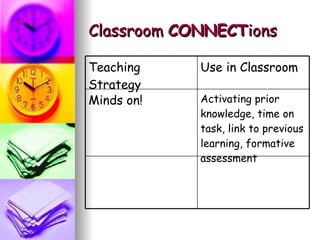
Classroom  CONNECT ions Activating prior knowledge, time on task, link to previous learning, formative assessment Minds on! Use in Classroom Teaching Strategy
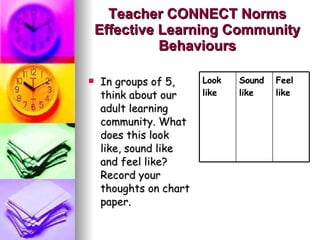
Teacher CONNECT Norms Effective Learning Community Behaviours In groups of 5, think about our adult learning community. What does this look like, sound like and feel like? Record your thoughts on chart paper. Feel like Sound like Look like
Group Norms
Learning Community Behaviours How would you develop an effective learning community in your classroom? What are some of the considerations you need to think about as you develop learning community norms with your class?
 
Core Beliefs   Graffiti Graffiti graffiti graffiti Graffiti
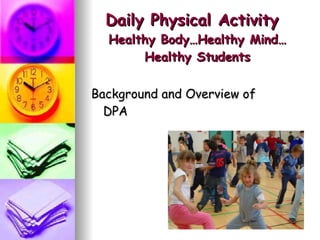
Daily Physical Activity   Healthy Body…Healthy Mind…Healthy Students Background and Overview of DPA
Benefits of Daily Physical Activity “ . . . studies generally support the suggestion from cross-sectional data that  academic performance is maintained or even enhanced  by an increase in a student’s level of habitual physical activity,  despite a reduction in curricular or free time for the study of academic material .” Roy J. Shephard,“Curricular Physical Activity and Academic Performance”,  Pediatric Exercise Science 9  (1997), p. 119.
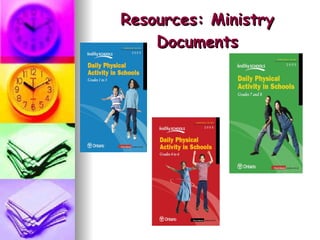
Resources: Ministry Documents
Resource:  DPA Cards Located in First Class under Daily Physical Activity Divided into divisions Divided into venues within divisions This year: print copies to all teachers
DPA: Primary Active Walk and Talk
Break
Assessment vs. Evaluation Purpose: to improve student learning Identify strengths and  learning needs Monitor progress Provide feedback Inform instruction Provide data for evaluation  Purpose: to assign a value to student achievement   Recording performance for tracking of achievement Identifying student placement on a continuum of learning Making decisions
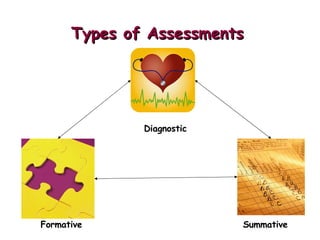
Types of Assessments Diagnostic Formative Summative
Approaches to Assessment
Assessment for Learning: Where are you? Starting Points for Assessment and Evaluation A Diagnostic Assessment using CPS
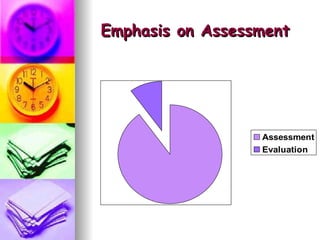
Emphasis on Assessment
Is there evidence that improving assessment  for  learning improves student achievement?
… an unequivocal YES …
Assessment for Learning: Feedback
Numerical score; Right/wrong; Anecdotal feedback; No grade necessary for formative tasks Assessment for Learning: Feedback
Students who are given comments only – rather than marks or marks and comments – make more gains in achievement and feel more positive about the experience (Butler, 1998).
Quality Feedback to Improve Learning Specific (based on criteria) Timely (on-going) Descriptive, focused Multiple opportunities for practice and quality feedback
General (“need more practice”) Identify what is done well,  what needs improvement,  and how to get there Specific, Focused Assessment for Learning: Feedback
Task: You have been hired to write a speech defending a position on a significant, current social issue.
Some of your paragraphs should be more logically organized. For example, in paragraph 2… You have a very good understanding of the facts surrounding your issue. Identify what is done well Identify what needs improvement
Review the components of a paragraph (e.g. topic sentence, supporting ideas, concluding sentence) and use them consistently throughout the speech. Tell them how…
It informs teachers about their instructional approach and next steps. Six of my students struggled with effective paragraphs. They need a mini-lesson on paragraph structure…
“ Research indicates that oral feedback is more effective than written feedback, particularly for low-achieving, at-risk students.”  (James, McCormick, & William,(n.d.).  Leading Math   Success , p 50 )
Little or no  follow-up Opportunities for students to respond to comments Assessment for Learning: Feedback
Effective feedback: is anecdotal is specific and focused includes opportunities for improvement and follow-up Assessment for Learning: Feedback
Feedback Activity Identify what is done well State in non-evaluative terms what needs improvement State in concrete terms how to improve.
Feedback Placemat Choose a writing sample (P/J/I) Review the learning activity. Examine the student response and the teacher notes.  Divide the chart paper into as many sections as there are people. Individually, record feedback suggestions on the placemat. Include the 3 part feedback: What was done well, what needs improvement and how to improve it. Share  Choose a quality feedback statement and write in the centre of your page.
LUNCH
Thinking Map On the chart paper provided, represent an ideal classroom using words, pictures, charts, symbols, etc….
Key Idea The teacher is responsible for organizing a well-managed classroom where students are engaged in learning…
Characteristics of a Well-Managed Classroom Students are deeply involved with their work, especially with academic, teacher-led instruction. Students know what is expected of them and are generally successful. There is relatively little wasted time, confusion or disruption. The climate of the classroom is work-oriented but relaxed and pleasant.
Building Classroom Community The classroom environment should: Foster mutual respect Promote independence Have established routines, procedures, and celebrations to foster a community of learners Have student-generated materials posted Promote shared decision-making and problem-solving
Physical Environment Floor space Work area Student area Storage Teacher Area Wall space
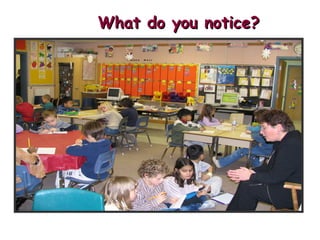
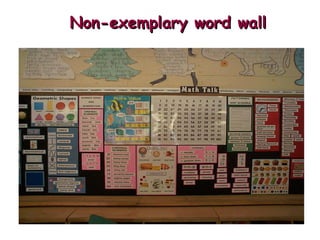
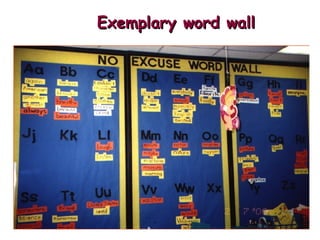
What do you notice?
What’s on the Walls? Word walls (accessible to students) Anchor charts, exemplars Student work Graphic organizers Strategies Inspirational pieces
Non-exemplary word wall
Exemplary word wall
Break
Home-School Connection Think-Pair-Share How will you establish and maintain communication with parents?  What form will this take?  How often will you communicate with parents?
Initial Contact with Parents Introduce yourself Say something positive about the child Discuss the classroom standards Ask about any special needs of the child Briefly describe the highlights of the curriculum Emphasize that you and the parent are partners in their child’s learning
What’s My Number?
Adapt for  Learning  Preferences Read the Learning Preferences  Matrix. Highlight the squares that best describe you as a learner. When everyone in your group has finished highlighting, take turns sharing your learning preference.  Any surprises?
Guiding Questions What did you learn about yourself by completing this survey?  What could you learn about your students by having them complete a similar survey? How would these survey results impact your instructional strategies? Your assessment strategies? How does a teacher’s own learning preference impact on instructional choices for process and product?
“ In differentiated classrooms, teachers begin [teaching] where students are, not at the front of a curriculum guide.” Teachers in differentiated classrooms are students of their students. Tomlinson , The Differentiated Classroom, 2000
Differentiated Instruction  Means  Recognizing Differences There are no two students who learn at the  same pace. There are no two students who solve problems  in exactly the same way. There are no two students who have the  same interests.   There are no two students who have learned  the same skills.
Knowing the Whole Child –  Other Kinds of Data… Family Data Student Self-Assessment Preferred Learning Styles Data Multiple Intelligences Socio-Affective data
Diagnostic Assessments DRA CASI DIBELS/Marie Clay Alpha Jeunes
Student Profile Reading Record Data Writing Samples Interest Inventory Learning Preferences Profile Classroom Observations
Learning Styles Try one out Multiple Intelligences Learning modalities Sternberg  Discuss Guiding Questions Jigsaw
Guiding Questions   What did you learn about yourself by completing this survey?  What could you learn about your students by having them complete a similar survey? How would these survey results impact your instructional strategies? Your assessment strategies? How does a teacher’s own learning preference impact on instructional choices for process and product?
Planning with Profile Information What would the most powerful teaching points be for this student?  What does the the child need to learn next? (Context) How will this child learn this content best? (e.g., group size, instructional strategy, text choices) How will the child demonstrate learning? (e.g., reading record, reading response)
Resources and Supports Teacher CONNECT link on board website Binder – ISF, Classroom CONNECTions Books – Jones, Wong Mentors – formal, informal LNSTs, Teacher Consultants First Class Conference – CONNECT 2008 Thumbnail Sketches  Wiki
Links to Learning Using our Teacher CONNECT wiki to access resources, share ideas, etc….. http://gecdsbconnect.wikispaces.com
Question Board
For next time…. Choose at least one student profile tool and use it with your class Bring a sample of a home school connection – newsletter, calendar, webpage, agenda, phone call record sheet, etc to the October session Read a section of your choice from Jones OR Wong and be prepared to share your reflections Check out our Wiki!
Ten Top Things They Didn’t Teach in Teacher’s College

Teacher Connect Slide Share Version

  • 1.
  • 2.
    Teacher CONNECT Session1- Minds On! Design a name tag from cardstock. Please include the following: Your name in the middle Teaching assignment in the top left corner School name in top right corner Best advice about teaching you’ve received across the bottom of your name tag What you hope to get from Teacher CONNECT on the back of your name tag
  • 3.
    Housekeeping Daily SchedulePhone Use Water Cooler Breaks/Lunch Washroom location
  • 4.
    Sociograms Group yourself according to… Your favourite season How you drink your coffee Your pets Your shoes Your family Your style of learning What you do after work hours Your sleeping habits
  • 5.
    Teacher CONNECT C – Creating O – Opportunities and N – New N – Networks for E – Experiencing C – Collaboration and T - Teaching
  • 6.
  • 7.
    How will thisprogram help me? Provide support and professional development through your first year of teaching Board and school orientation Mentoring from an experienced teacher
  • 8.
    What is MyRole? Being open to new ideas and to the exchange of information Reflecting on practice and being willing to take risks and learn from others Being aware of and identifying your own professional needs Working respectfully with your mentor and colleagues
  • 9.
    Today…. Building ourCommunity Getting to Know our Learners Assessment and Learning Building Classroom Communities Developing the Learner Profile Links to Learning Strategies/Tools/Inspiration
  • 10.
    Classroom CONNECTions Activating prior knowledge, time on task, link to previous learning, formative assessment Minds on! Use in Classroom Teaching Strategy
  • 11.
    Teacher CONNECT NormsEffective Learning Community Behaviours In groups of 5, think about our adult learning community. What does this look like, sound like and feel like? Record your thoughts on chart paper. Feel like Sound like Look like
  • 12.
  • 13.
    Learning Community BehavioursHow would you develop an effective learning community in your classroom? What are some of the considerations you need to think about as you develop learning community norms with your class?
  • 14.
  • 15.
    Core Beliefs Graffiti Graffiti graffiti graffiti Graffiti
  • 16.
    Daily Physical Activity Healthy Body…Healthy Mind…Healthy Students Background and Overview of DPA
  • 17.
    Benefits of DailyPhysical Activity “ . . . studies generally support the suggestion from cross-sectional data that academic performance is maintained or even enhanced by an increase in a student’s level of habitual physical activity, despite a reduction in curricular or free time for the study of academic material .” Roy J. Shephard,“Curricular Physical Activity and Academic Performance”, Pediatric Exercise Science 9 (1997), p. 119.
  • 18.
  • 19.
    Resource: DPACards Located in First Class under Daily Physical Activity Divided into divisions Divided into venues within divisions This year: print copies to all teachers
  • 20.
    DPA: Primary ActiveWalk and Talk
  • 21.
  • 22.
    Assessment vs. EvaluationPurpose: to improve student learning Identify strengths and learning needs Monitor progress Provide feedback Inform instruction Provide data for evaluation Purpose: to assign a value to student achievement Recording performance for tracking of achievement Identifying student placement on a continuum of learning Making decisions
  • 23.
    Types of AssessmentsDiagnostic Formative Summative
  • 24.
  • 25.
    Assessment for Learning:Where are you? Starting Points for Assessment and Evaluation A Diagnostic Assessment using CPS
  • 26.
  • 27.
    Is there evidencethat improving assessment for learning improves student achievement?
  • 28.
  • 29.
  • 30.
    Numerical score; Right/wrong;Anecdotal feedback; No grade necessary for formative tasks Assessment for Learning: Feedback
  • 31.
    Students who aregiven comments only – rather than marks or marks and comments – make more gains in achievement and feel more positive about the experience (Butler, 1998).
  • 32.
    Quality Feedback toImprove Learning Specific (based on criteria) Timely (on-going) Descriptive, focused Multiple opportunities for practice and quality feedback
  • 33.
    General (“need morepractice”) Identify what is done well, what needs improvement, and how to get there Specific, Focused Assessment for Learning: Feedback
  • 34.
    Task: You havebeen hired to write a speech defending a position on a significant, current social issue.
  • 35.
    Some of yourparagraphs should be more logically organized. For example, in paragraph 2… You have a very good understanding of the facts surrounding your issue. Identify what is done well Identify what needs improvement
  • 36.
    Review the componentsof a paragraph (e.g. topic sentence, supporting ideas, concluding sentence) and use them consistently throughout the speech. Tell them how…
  • 37.
    It informs teachersabout their instructional approach and next steps. Six of my students struggled with effective paragraphs. They need a mini-lesson on paragraph structure…
  • 38.
    “ Research indicatesthat oral feedback is more effective than written feedback, particularly for low-achieving, at-risk students.” (James, McCormick, & William,(n.d.). Leading Math Success , p 50 )
  • 39.
    Little or no follow-up Opportunities for students to respond to comments Assessment for Learning: Feedback
  • 40.
    Effective feedback: isanecdotal is specific and focused includes opportunities for improvement and follow-up Assessment for Learning: Feedback
  • 41.
    Feedback Activity Identifywhat is done well State in non-evaluative terms what needs improvement State in concrete terms how to improve.
  • 42.
    Feedback Placemat Choosea writing sample (P/J/I) Review the learning activity. Examine the student response and the teacher notes. Divide the chart paper into as many sections as there are people. Individually, record feedback suggestions on the placemat. Include the 3 part feedback: What was done well, what needs improvement and how to improve it. Share Choose a quality feedback statement and write in the centre of your page.
  • 43.
  • 44.
    Thinking Map Onthe chart paper provided, represent an ideal classroom using words, pictures, charts, symbols, etc….
  • 45.
    Key Idea Theteacher is responsible for organizing a well-managed classroom where students are engaged in learning…
  • 46.
    Characteristics of aWell-Managed Classroom Students are deeply involved with their work, especially with academic, teacher-led instruction. Students know what is expected of them and are generally successful. There is relatively little wasted time, confusion or disruption. The climate of the classroom is work-oriented but relaxed and pleasant.
  • 47.
    Building Classroom CommunityThe classroom environment should: Foster mutual respect Promote independence Have established routines, procedures, and celebrations to foster a community of learners Have student-generated materials posted Promote shared decision-making and problem-solving
  • 48.
    Physical Environment Floorspace Work area Student area Storage Teacher Area Wall space
  • 49.
    What do younotice?
  • 50.
    What’s on theWalls? Word walls (accessible to students) Anchor charts, exemplars Student work Graphic organizers Strategies Inspirational pieces
  • 51.
  • 52.
  • 53.
  • 54.
    Home-School Connection Think-Pair-ShareHow will you establish and maintain communication with parents? What form will this take? How often will you communicate with parents?
  • 55.
    Initial Contact withParents Introduce yourself Say something positive about the child Discuss the classroom standards Ask about any special needs of the child Briefly describe the highlights of the curriculum Emphasize that you and the parent are partners in their child’s learning
  • 56.
  • 57.
    Adapt for Learning Preferences Read the Learning Preferences Matrix. Highlight the squares that best describe you as a learner. When everyone in your group has finished highlighting, take turns sharing your learning preference. Any surprises?
  • 58.
    Guiding Questions Whatdid you learn about yourself by completing this survey? What could you learn about your students by having them complete a similar survey? How would these survey results impact your instructional strategies? Your assessment strategies? How does a teacher’s own learning preference impact on instructional choices for process and product?
  • 59.
    “ In differentiatedclassrooms, teachers begin [teaching] where students are, not at the front of a curriculum guide.” Teachers in differentiated classrooms are students of their students. Tomlinson , The Differentiated Classroom, 2000
  • 60.
    Differentiated Instruction Means Recognizing Differences There are no two students who learn at the same pace. There are no two students who solve problems in exactly the same way. There are no two students who have the same interests. There are no two students who have learned the same skills.
  • 61.
    Knowing the WholeChild – Other Kinds of Data… Family Data Student Self-Assessment Preferred Learning Styles Data Multiple Intelligences Socio-Affective data
  • 62.
    Diagnostic Assessments DRACASI DIBELS/Marie Clay Alpha Jeunes
  • 63.
    Student Profile ReadingRecord Data Writing Samples Interest Inventory Learning Preferences Profile Classroom Observations
  • 64.
    Learning Styles Tryone out Multiple Intelligences Learning modalities Sternberg Discuss Guiding Questions Jigsaw
  • 65.
    Guiding Questions What did you learn about yourself by completing this survey? What could you learn about your students by having them complete a similar survey? How would these survey results impact your instructional strategies? Your assessment strategies? How does a teacher’s own learning preference impact on instructional choices for process and product?
  • 66.
    Planning with ProfileInformation What would the most powerful teaching points be for this student? What does the the child need to learn next? (Context) How will this child learn this content best? (e.g., group size, instructional strategy, text choices) How will the child demonstrate learning? (e.g., reading record, reading response)
  • 67.
    Resources and SupportsTeacher CONNECT link on board website Binder – ISF, Classroom CONNECTions Books – Jones, Wong Mentors – formal, informal LNSTs, Teacher Consultants First Class Conference – CONNECT 2008 Thumbnail Sketches Wiki
  • 68.
    Links to LearningUsing our Teacher CONNECT wiki to access resources, share ideas, etc….. http://gecdsbconnect.wikispaces.com
  • 69.
  • 70.
    For next time….Choose at least one student profile tool and use it with your class Bring a sample of a home school connection – newsletter, calendar, webpage, agenda, phone call record sheet, etc to the October session Read a section of your choice from Jones OR Wong and be prepared to share your reflections Check out our Wiki!
  • 71.
    Ten Top ThingsThey Didn’t Teach in Teacher’s College