arslan.jm13@gmail.com
Exam
Preparation Skills
Muhammad Arslan
arslan.jm13@gmail.com
WELCOME PARTICIPANTS
arslan.jm13@gmail.com
Program Objectives
• Understand and control Exam Stress
• Exam-Long Term Planning
• Ten (10) Key Steps to Examination Success
• Motivate for Exam Success (General Strategies)
arslan.jm13@gmail.com
EXAMINATION…..??
 An examination is a test to measure that how good
somebody is in performing and doing something.
 In education an examination (exam for short) is a
test to measure the knowledge and ability of a
student.
arslan.jm13@gmail.com
TYPES OF EXAMINATION
1. Multiple choice exams
2. Short and long answer exams
3. Essay exams
4. Open-book and take-home exams
5. Problem or case-based exams
6. Oral exams
7. An on-screen test is a test which uses the computer.
arslan.jm13@gmail.com
Why Exams?
• Ability to Recall and Apply Theory
• Knowledge of the Content Area
• Critical Thinking and Problem Solving Skills
• Communication Skills
• Ability to Work Alone and Under Pressure
• Authenticity of Our Work
arslan.jm13@gmail.com
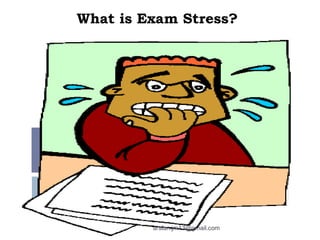
What is Exam Stress?
arslan.jm13@gmail.com
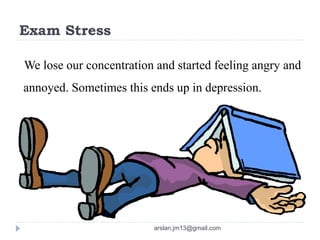
Exam Stress
We lose our concentration and started feeling angry and
annoyed. Sometimes this ends up in depression.
arslan.jm13@gmail.com
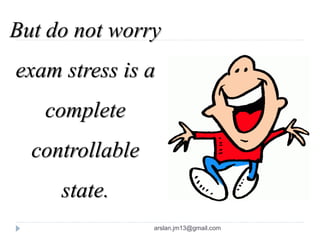
But do not worry
exam stress is a
complete
controllable
state.
arslan.jm13@gmail.com
Symptoms of Exam Stress
• Feeling difficulty in getting out sleep or waking up
• Started forgetting things that we have read or learn
• Losing interest in activities
• Unexpected and unexplainable dull pain
• Feeling constantly tired and increased heart rate
• Migraines or headaches, Feeling dizzy most of the time
• Anxiety and irritated feeling
arslan.jm13@gmail.com
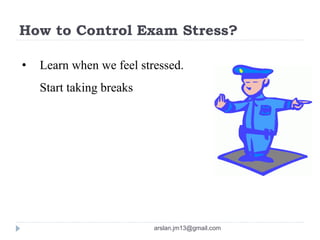
How to Control Exam Stress?
• Learn when we feel stressed.
Start taking breaks
arslan.jm13@gmail.com
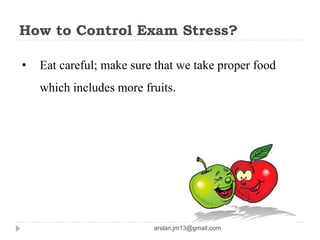
How to Control Exam Stress?
• Eat careful; make sure that we take proper food
which includes more fruits.
arslan.jm13@gmail.com
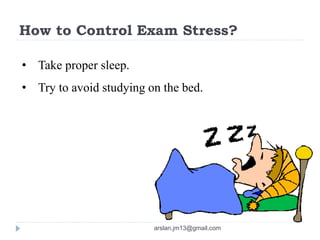
How to Control Exam Stress?
• Take proper sleep.
• Try to avoid studying on the bed.
arslan.jm13@gmail.com
How to Control Exam Stress?
• Exercise is the one best way to control our stress.
arslan.jm13@gmail.com
How to Control Exam Stress?
• Always remember
exams are not the only thing in the life.
• There is a life after the exams.
arslan.jm13@gmail.com
Before the Exam: Long-Term
Planning
arslan.jm13@gmail.com
Useful Strategies for Long Term Planning
 Identify your learning style
 Auditory Learner
 Visual Learner
 Kinesthetic Learner
arslan.jm13@gmail.com
Useful Strategies for Long Term
Planning
 Identifying the most important issues in each theme
from the course outline, lecture and tutorial notes
and past exam papers
 Developing a list of likely questions on each topic
 Developing question analysis skills
 Talking through the questions and topics with other
students
arslan.jm13@gmail.com
Before the Exam: Final Weeks
 Its time to fine tune of our
understanding about the topics
and concepts.
 Develop an overview.
arslan.jm13@gmail.com
Nearer to the Exam We Will Need to:
 Allocate more time to revision
 Write practice answers keeping to the time in mind that will
be allowed in the exam
 Re-arrange work or family commitments that might affect our
exam performance
arslan.jm13@gmail.com
On the Day of the Exam
 Read the instructions carefully
 Note how many questions we must answer, any
compulsory questions or sections and the allocation
of marks
 Allocate time for each question
 If we are allowed to write, a little amount down
ideas or plans for questions
arslan.jm13@gmail.com
During Writing Time
o Analyze questions carefully to understand what to do
o Start with questions that we know best, this will
boost confidence
o Monitor progress so that we do not go over time on
any section of the paper
o Make sure that the number that we put on our answer
matches the number on the question
o Leave time at the end to check our writings
arslan.jm13@gmail.com
After the Exam
 Review our performance and take note of anything
we want to change next time
 If our performance was disappointing, make time to
discuss our exam paper with the course coordinator
to find out what we did to lose marks
arslan.jm13@gmail.com
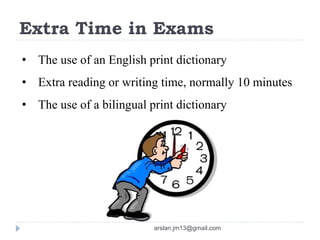
Extra Time in Exams
• The use of an English print dictionary
• Extra reading or writing time, normally 10 minutes
• The use of a bilingual print dictionary
arslan.jm13@gmail.com
Session 3
Ten Key Steps to Examination Success
arslan.jm13@gmail.com
10 Key Steps
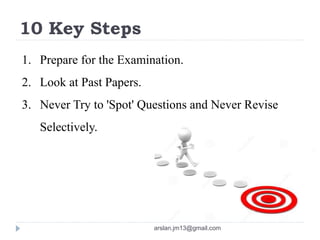
1. Prepare for the Examination.
2. Look at Past Papers.
3. Never Try to 'Spot' Questions and Never Revise
Selectively.
arslan.jm13@gmail.com
10 Key Steps
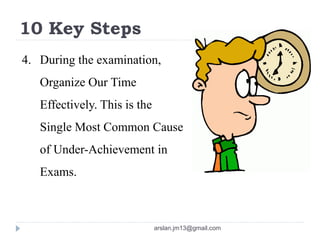
4. During the examination,
Organize Our Time
Effectively. This is the
Single Most Common Cause
of Under-Achievement in
Exams.
arslan.jm13@gmail.com
10 Key Steps
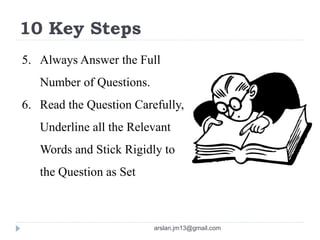
5. Always Answer the Full
Number of Questions.
6. Read the Question Carefully,
Underline all the Relevant
Words and Stick Rigidly to
the Question as Set
arslan.jm13@gmail.com
10 Key Steps
7. For every question, stop writing after the first few
minutes and re-read the question, then stop again to
recheck before our time is up.
8. Make Rough Notes at the Start of a Question, so as
to Organize Our Thoughts.
arslan.jm13@gmail.com
10 Key Steps
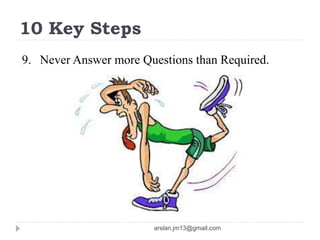
9. Never Answer more Questions than Required.
arslan.jm13@gmail.com
10 Key Steps
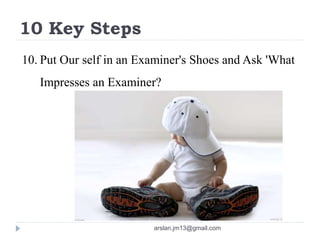
10. Put Our self in an Examiner's Shoes and Ask 'What
Impresses an Examiner?
arslan.jm13@gmail.com
Achieve Exam Success with
Exam Time
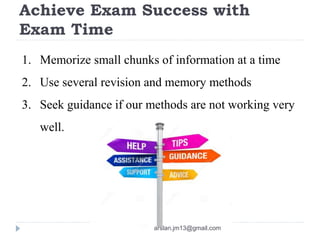
1. Memorize small chunks of information at a time
2. Use several revision and memory methods
3. Seek guidance if our methods are not working very
well.
arslan.jm13@gmail.com
Achieve Exam Success with
Exam Time
4. Test our self as we go along.
5. Involve friends or family to help
6. Identify the specific points we need help with and
then get the help we need.
arslan.jm13@gmail.com
Achieve Exam Success with
Exam Time
7. Use a copy of the syllabus as a checklist for what we
know and what we still need to work on
8. Make it fun & enjoy it with a good imagination this
works
arslan.jm13@gmail.com
General Strategies for
Students’ Motivation
to Success
arslan.jm13@gmail.com
Motivation Theory
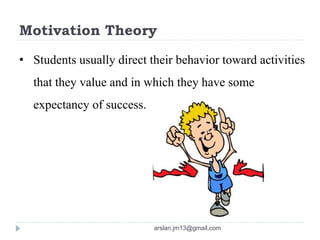
• Students usually direct their behavior toward activities
that they value and in which they have some
expectancy of success.
arslan.jm13@gmail.com
Capitalize on Students' Existing
Needs
• Use students’ interest and natural curiosity appeal aid
in motivation. Students will be motivated to learn
when the course is structured in a way that students
learn best when incentives for learning in a classroom
satisfy their own motives for enrolling in the course.
arslan.jm13@gmail.com
Make Students Active
Participants in Learning
• Students learn by doing, making, writing, designing,
creating and solving. Passivity reduces students'
motivation and curiosity. Encourage students to
suggest approaches to a problem or to guess the
results of an experiment.
arslan.jm13@gmail.com
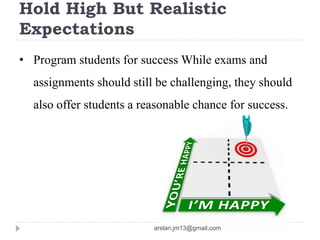
Hold High But Realistic
Expectations
• Program students for success While exams and
assignments should still be challenging, they should
also offer students a reasonable chance for success.
arslan.jm13@gmail.com
Achievable Goals for
Themselves.
• Failure to attain unrealistic goals can disappoint and
frustrate students. Encourage students to focus on
their continued improvement rather than just on their
grade on any one test or assignment.
arslan.jm13@gmail.com
Tell Students What They Need
to Do to Succeed in Course.
• Do not let our students struggle to figure out what is
expected of them. Reassure students that they can do
well in course and tell them exactly what they must do
to succeed.
arslan.jm13@gmail.com
Strengthen Students' Self-
Motivation.
• Avoid messages that reinforce our power as an
instructor or that emphasizes extrinsic rewards.
Instead of saying "I require," "you must," or "you
should," stress "I think you will find," or "I will be
interested in your reaction."
arslan.jm13@gmail.com
Avoid Creating Intense
Competition among Students.
• Students are more attentive, display better
comprehension, produce more work and are more
favorable to the teaching method when they work
cooperatively in groups rather than compete as
individuals.
arslan.jm13@gmail.com
Be Enthusiastic about Subject
• An instructor's enthusiasm is an essential factor in
student motivation. If we become bored or indifferent,
students will too. Typically, an instructor's enthusiasm
comes from confidence, excitement about the content
and genuine pleasure in teaching.
arslan.jm13@gmail.com

Exam preparation skills

  • 1.
  • 2.
  • 3.
  • 4.
    Program Objectives • Understandand control Exam Stress • Exam-Long Term Planning • Ten (10) Key Steps to Examination Success • Motivate for Exam Success (General Strategies) arslan.jm13@gmail.com
  • 5.
    EXAMINATION…..??  An examinationis a test to measure that how good somebody is in performing and doing something.  In education an examination (exam for short) is a test to measure the knowledge and ability of a student. arslan.jm13@gmail.com
  • 6.
    TYPES OF EXAMINATION 1.Multiple choice exams 2. Short and long answer exams 3. Essay exams 4. Open-book and take-home exams 5. Problem or case-based exams 6. Oral exams 7. An on-screen test is a test which uses the computer. arslan.jm13@gmail.com
  • 7.
    Why Exams? • Abilityto Recall and Apply Theory • Knowledge of the Content Area • Critical Thinking and Problem Solving Skills • Communication Skills • Ability to Work Alone and Under Pressure • Authenticity of Our Work arslan.jm13@gmail.com

  • 8.
    What is ExamStress? arslan.jm13@gmail.com
  • 9.
    Exam Stress We loseour concentration and started feeling angry and annoyed. Sometimes this ends up in depression. arslan.jm13@gmail.com
  • 10.
    But do notworry exam stress is a complete controllable state. arslan.jm13@gmail.com
  • 11.
  • 12.
    Symptoms of ExamStress • Feeling difficulty in getting out sleep or waking up • Started forgetting things that we have read or learn • Losing interest in activities • Unexpected and unexplainable dull pain • Feeling constantly tired and increased heart rate • Migraines or headaches, Feeling dizzy most of the time • Anxiety and irritated feeling arslan.jm13@gmail.com
  • 13.
    How to ControlExam Stress? • Learn when we feel stressed. Start taking breaks arslan.jm13@gmail.com
  • 14.
    How to ControlExam Stress? • Eat careful; make sure that we take proper food which includes more fruits. arslan.jm13@gmail.com
  • 15.
    How to ControlExam Stress? • Take proper sleep. • Try to avoid studying on the bed. arslan.jm13@gmail.com
  • 16.
    How to ControlExam Stress? • Exercise is the one best way to control our stress. arslan.jm13@gmail.com
  • 17.
    How to ControlExam Stress? • Always remember exams are not the only thing in the life. • There is a life after the exams. arslan.jm13@gmail.com
  • 18.
    Before the Exam:Long-Term Planning arslan.jm13@gmail.com
  • 19.
    Useful Strategies forLong Term Planning  Identify your learning style  Auditory Learner  Visual Learner  Kinesthetic Learner arslan.jm13@gmail.com
  • 20.
    Useful Strategies forLong Term Planning  Identifying the most important issues in each theme from the course outline, lecture and tutorial notes and past exam papers  Developing a list of likely questions on each topic  Developing question analysis skills  Talking through the questions and topics with other students arslan.jm13@gmail.com
  • 21.
    Before the Exam:Final Weeks  Its time to fine tune of our understanding about the topics and concepts.  Develop an overview. arslan.jm13@gmail.com
  • 22.
    Nearer to theExam We Will Need to:  Allocate more time to revision  Write practice answers keeping to the time in mind that will be allowed in the exam  Re-arrange work or family commitments that might affect our exam performance arslan.jm13@gmail.com
  • 23.
    On the Dayof the Exam  Read the instructions carefully  Note how many questions we must answer, any compulsory questions or sections and the allocation of marks  Allocate time for each question  If we are allowed to write, a little amount down ideas or plans for questions arslan.jm13@gmail.com
  • 24.
    During Writing Time oAnalyze questions carefully to understand what to do o Start with questions that we know best, this will boost confidence o Monitor progress so that we do not go over time on any section of the paper o Make sure that the number that we put on our answer matches the number on the question o Leave time at the end to check our writings arslan.jm13@gmail.com
  • 25.
    After the Exam Review our performance and take note of anything we want to change next time  If our performance was disappointing, make time to discuss our exam paper with the course coordinator to find out what we did to lose marks arslan.jm13@gmail.com
  • 26.
    Extra Time inExams • The use of an English print dictionary • Extra reading or writing time, normally 10 minutes • The use of a bilingual print dictionary arslan.jm13@gmail.com
  • 27.
  • 28.
    Session 3 Ten KeySteps to Examination Success arslan.jm13@gmail.com
  • 29.
    10 Key Steps 1.Prepare for the Examination. 2. Look at Past Papers. 3. Never Try to 'Spot' Questions and Never Revise Selectively. arslan.jm13@gmail.com
  • 30.
    10 Key Steps 4.During the examination, Organize Our Time Effectively. This is the Single Most Common Cause of Under-Achievement in Exams. arslan.jm13@gmail.com
  • 31.
    10 Key Steps 5.Always Answer the Full Number of Questions. 6. Read the Question Carefully, Underline all the Relevant Words and Stick Rigidly to the Question as Set arslan.jm13@gmail.com
  • 32.
    10 Key Steps 7.For every question, stop writing after the first few minutes and re-read the question, then stop again to recheck before our time is up. 8. Make Rough Notes at the Start of a Question, so as to Organize Our Thoughts. arslan.jm13@gmail.com
  • 33.
    10 Key Steps 9.Never Answer more Questions than Required. arslan.jm13@gmail.com
  • 34.
    10 Key Steps 10.Put Our self in an Examiner's Shoes and Ask 'What Impresses an Examiner? arslan.jm13@gmail.com
  • 35.
  • 36.
    Achieve Exam Successwith Exam Time 1. Memorize small chunks of information at a time 2. Use several revision and memory methods 3. Seek guidance if our methods are not working very well. arslan.jm13@gmail.com
  • 37.
    Achieve Exam Successwith Exam Time 4. Test our self as we go along. 5. Involve friends or family to help 6. Identify the specific points we need help with and then get the help we need. arslan.jm13@gmail.com
  • 38.
    Achieve Exam Successwith Exam Time 7. Use a copy of the syllabus as a checklist for what we know and what we still need to work on 8. Make it fun & enjoy it with a good imagination this works arslan.jm13@gmail.com
  • 39.
  • 40.
    General Strategies for Students’Motivation to Success arslan.jm13@gmail.com
  • 41.
    Motivation Theory • Studentsusually direct their behavior toward activities that they value and in which they have some expectancy of success. arslan.jm13@gmail.com
  • 42.
    Capitalize on Students'Existing Needs • Use students’ interest and natural curiosity appeal aid in motivation. Students will be motivated to learn when the course is structured in a way that students learn best when incentives for learning in a classroom satisfy their own motives for enrolling in the course. arslan.jm13@gmail.com
  • 43.
    Make Students Active Participantsin Learning • Students learn by doing, making, writing, designing, creating and solving. Passivity reduces students' motivation and curiosity. Encourage students to suggest approaches to a problem or to guess the results of an experiment. arslan.jm13@gmail.com
  • 44.
    Hold High ButRealistic Expectations • Program students for success While exams and assignments should still be challenging, they should also offer students a reasonable chance for success. arslan.jm13@gmail.com
  • 45.
  • 46.
    Achievable Goals for Themselves. •Failure to attain unrealistic goals can disappoint and frustrate students. Encourage students to focus on their continued improvement rather than just on their grade on any one test or assignment. arslan.jm13@gmail.com
  • 47.
    Tell Students WhatThey Need to Do to Succeed in Course. • Do not let our students struggle to figure out what is expected of them. Reassure students that they can do well in course and tell them exactly what they must do to succeed. arslan.jm13@gmail.com
  • 48.
    Strengthen Students' Self- Motivation. •Avoid messages that reinforce our power as an instructor or that emphasizes extrinsic rewards. Instead of saying "I require," "you must," or "you should," stress "I think you will find," or "I will be interested in your reaction." arslan.jm13@gmail.com
  • 49.
    Avoid Creating Intense Competitionamong Students. • Students are more attentive, display better comprehension, produce more work and are more favorable to the teaching method when they work cooperatively in groups rather than compete as individuals. arslan.jm13@gmail.com
  • 50.
    Be Enthusiastic aboutSubject • An instructor's enthusiasm is an essential factor in student motivation. If we become bored or indifferent, students will too. Typically, an instructor's enthusiasm comes from confidence, excitement about the content and genuine pleasure in teaching. arslan.jm13@gmail.com
  • 51.
  • 52.